Home / Amphibians / Axolotls and mole salamanders / Eastern tiger salamander
Federal restrictions apply In-depth sheetEastern tiger salamander
Ambystoma tigrinum
Amphibians › Axolotls and mole salamanders (Caudata) › Ambystomatidae (Axolotls and mole salamanders)
Tiger salamanders are large burrowing salamanders that can live 10–25 years in captivity and need cool, deep, moist substrate.
Warnings
Care guide
Care
- Deep, moist substrate to burrow in and cool temperatures; they hide underground to stay cool and moist.
Sources 84
Show the group care guide for mole salamanders
Mole salamanders
Applies to most species in this group. Habitat: Burrows near ponds. Individual species can differ, so compare with the species numbers above and the linked sources.
Housing & setup
- Metamorphosed terrestrial mole salamanders need moist burrowing space; neotenic Ambystoma mexicanum and A. dumerilii need species-specific fully aquatic housing.
- Ambystoma mexicanum needs a separate, fully aquatic axolotl guide; do not apply terrestrial substrate or air-humidity targets.
Climate & lighting
Starting point only: Axolotls require measured water temperature, while metamorphosed mole salamanders require terrestrial microclimates. Check the species-specific values for this animal where shown.
| Warm side / daytime | 62–68°F |
| Cool side | 55–62°F |
| Humidity | 70–90% |
Diet
- Worms, insects and pinkies for large tiger salamanders.
Health watch
- Overheating and impaction from swallowing substrate.
Understanding the animal
In the wild
In the wild
Researched for this exact species, not its family. Good care copies these conditions.123
| Where it lives | Eastern and central North American forests, grasslands and coastal pine barrens with burrowable uplands beside breeding ponds. New York populations use sandy pine-oak landscapes and fish-free seasonal or permanent ponds. |
| Ground it lives on | Loose sandy loam or loamy sand with underground burrows and surface litter. |
| Water it lives in | Freshwater, still fish-free ponds for breeding and aquatic larvae; chemistry and temperature ranges were not established. |
| Climate | Adults need access to suitable humidity and burrow underground to reach appropriate humidity levels. During dry periods, large numbers have been found beneath suitable cover or underground. The provided source text gives no specific temperatures in F. |
| Active | Nocturnal when above ground; spends most of the year underground. |
| Social life | Generally solitary outside breeding gatherings. |
| Wild diet | Worms, insects, slugs and snails; larvae eat small crustaceans and insect larvae, then larger aquatic prey including other larvae. |
| Behavior to plan for | Adults dig deeply to escape surface temperature extremes. Adults are terrestrial after metamorphosis, while larvae require water. |
What this means for care
- Give metamorphosed adults deep, moist, burrowable substrate.
- Use separate terrestrial-adult and aquatic-larval setups.
- Keep larval systems free of predatory fish.
Native climate (measured)
Native climate (measured)
| Warm-season highs | about 83°F (up to 90°F in the hottest sampled areas) |
| Cool-season lows | about 4°F (down to 0°F in the coldest sampled areas) |
| Average temperature | 43–59°F across sampled records |
| Relative humidity | 71–73% on average (driest month about 60%) |
| Rainfall | about 826 mm a year |
| Winters | Cool to cold winters (lows around 4°F) in much of its native range. Seasonal slowdown may be relevant, but species-specific biology determines whether brumation or hibernation occurs. |
Measured at 27 wild occurrence records sampled against WorldClim 2.1 climate data (1970–2000 averages). Air conditions in the range are ecological context, not enclosure settings: microhabitats such as burrows, leaf litter or basking rocks can be cooler, warmer or more humid.
Profile
Profile
Researched for this exact species. Sources are listed under In the wild above.
History
Ambystoma tigrinum is a widely distributed North American mole salamander with fully metamorphosed adults adapted to terrestrial life while still depending on nearby ponds or small waters for breeding.
Keeper tips
- Provide soil that permits burrowing.
- Maintain access to humid retreats or covered areas.
- Do not rely on a dry terrestrial surface alone, because adults seek appropriate humidity underground.
- Provide secure cover comparable to the refuges used during dry periods.
Behaviors reported
- Burrowing underground to reach suitable humidity.
- Using burrows made by other animals.
- Sheltering beneath cover or underground during dry periods.
- Large numbers may be found together under suitable cover during dry conditions.
Unique adaptations
- Skin consistency and thickness suited to terrestrial existence.
- A thick-bodied terrestrial form.
- Ability to use underground burrows to maintain appropriate humidity.
Remarkable facts
- The source describes it as the largest land-dwelling salamander in North America.
- Adults are about 17 to 33 cm long.
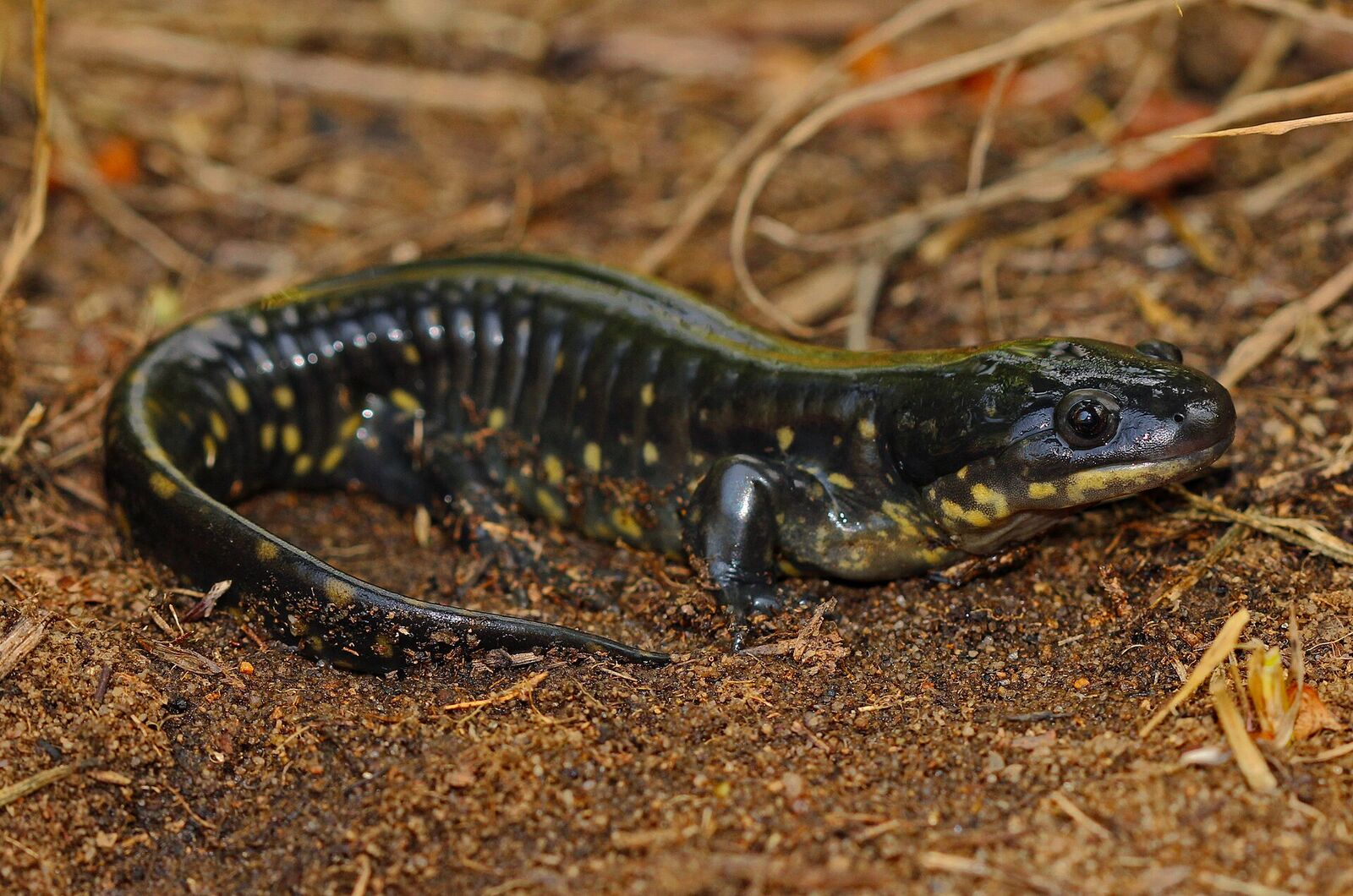
- Adults are generally black with yellow blotches or spots, although tan or olive-green markings can occur.
- Spot and background patterns vary enough that geographic origin may sometimes be suggested by coloration.
- Tiger salamanders are less dependent on forest habitat than most other Ambystoma species.
From the sources
From the sources
Quoted from the matching sections of reputable sources for this exact species. Specialist databases are used first; Wikipedia (community-edited, CC BY-SA 4.0) only fills gaps. Other sources are short credited quotes.
| Overview | The tiger salamander (Ambystoma tigrinum), or eastern tiger salamander, is a species of mole salamander and one of the largest terrestrial salamanders in North America. — Wikipedia (community-edited) |
| Where it lives | Fully metamorphosed adults lead a terrestrial existance and, depending upon where in the country they are found, some may inhabit forests, grasslands, or marshy areas (Petranka 1998). — Animal Diversity Web |
| Wild diet | The tiger salamander's food source consists of worms, snails, insects, and slugs in the wild; while captive specimens rely on smaller salamanders, frogs, newborn mice, and baby snakes. — Animal Diversity Web |
| Behavior | Adult Tiger Salamanders live underground for most of the year and usually dig their own burrows, unlike other species that use burrows of other animals. — Animal Diversity Web |
| Reproduction | Ambystoma tigrinum migrates to the breeding ponds in late winter or early spring, usually after a warm rain that thaws out the ground's surface. — Animal Diversity Web |
| Lifespan | Aquatic adult tiger salamanders live up to 25 years in captivity. — Animal Diversity Web |
| Appearance and size | The adult tiger salamander is a thick-bodied creature generally with yellow blotches or spots against a black background. — Animal Diversity Web |
| Biology | Their diet consists largely of small insects, snails, slugs, frogs, aquatic microcrustaceans, and worms, although it is not rare for an adult to turn cannibalistic and consume its own kind. Cannibalism in these salamanders can almost always be traced back to a large volume of competing predators and lack of prey in the area. — Wikipedia (community-edited) |
| History and naming | Tiger salamanders are popular as pets, and suitable for beginner amphibian enthusiasts due to their manageable care requirements and generally docile nature. — Wikipedia (community-edited) |
| Conservation | Populations in the southeastern U.S. have been affected by deforestation and loss of wetland habitats and appear to be declining in many areas. — Animal Diversity Web |
Data and studies
The numbers
The numbers
Each bar is what one source reports. Where several sources weigh in, the dashed gold band marks their average.
Lifespan in care
Maximum recorded lifespan
Longest recorded lifespan reported by each database; typical lifespans are usually shorter. The AnAge record comes from an animal in human care.
Typical adult weight
Average adult body mass in each database (FishBase gives the maximum recorded weight).
Incubation
Female maturity
Veterinary & husbandry research
Veterinary & husbandry research
- The Immune System and the Antiviral Responses in Chinese Giant Salamander, Andrias davidianus Jiang N et al., Frontiers in immunology 2021
- Evaluation of thermal regimes for transported ambassador ectotherms: One size does not fit all Tetzlaff SJ et al., Zoo biology 2016
- Monoamines and their metabolites in the amphibian (Ambystoma tigrinum) brain: quantitative changes during metamorphosis and captivity Norris DO et al., Comparative biochemistry and physiology. Comparative physiology 1992
- Scoliosis in a tiger salamander (Ambystoma tigrinum) associated with encysted digenetic trematodes of the genus Clinostomum Perpiñán D et al., Journal of wildlife diseases 2010
Peer-reviewed papers that mention this species alongside captivity, zoos, veterinary care or aquaculture. Some cover several species or mention it only in passing, so check the abstract. See all 10 on PubMed → 170
Sources for this sheet
- Animal Diversity Web (University of Michigan): Ambystoma tigrinum Zoo, university or veterinaryUniversity-hosted species account, mostly wild biology.
- AnAge: The Animal Ageing and Longevity Database (Human Ageing Genomic Resources) Peer-reviewed researchCurated, referenced longevity and life-history records for thousands of species; maximum lifespans are often from zoo animals.
- 50 CFR Part 16: Injurious wildlife (Lacey Act) Zoo, university or veterinaryCurrent federal regulation, read from eCFR.
- U.S. Association of Reptile Keepers v. Zinke (D.C. Cir. 2017) Zoo, university or veterinaryAppeals ruling that the Lacey Act's shipping ban does not cover moves between the continental states.
- Merck Veterinary Manual: Environment and husbandry for amphibians Zoo, university or veterinaryThe Merck Veterinary Manual: a standard veterinary reference written and reviewed by veterinary specialists.
- Merck Veterinary Manual: Overview of amphibians Zoo, university or veterinaryThe Merck Veterinary Manual: a standard veterinary reference written and reviewed by veterinary specialists.
- Ambystoma Genetic Stock Center (University of Kentucky): Guide to axolotl husbandry Zoo, university or veterinaryThe lab that has bred research axolotls for decades.
- Bland et al. (2021): EAZA Best Practice Guidelines for the Lake Pátzcuaro Salamander Zoo, university or veterinaryAdded in the 2026 source-checked care-guide review.
- AmphibiaWeb (University of California, Berkeley) Peer-reviewed researchUniversity-hosted database of amphibian biology and conservation.
- GBIF Backbone Taxonomy (Global Biodiversity Information Facility) Peer-reviewed researchInternational scientific taxonomy used here for classification.
- Wikipedia (species article) Community referenceFree encyclopedia; useful overviews with their own citations. Intro text is quoted under CC BY-SA 4.0.
- PubMed (U.S. National Library of Medicine) Peer-reviewed researchIndex of peer-reviewed veterinary, zoo and husbandry research.
- iNaturalist (captive observations) Community referenceCommunity observation platform run by the California Academy of Sciences and National Geographic; observations marked captive show animals living in homes, zoos and aquariums.