Home / Amphibians / Axolotls and mole salamanders / Axolotl
Federal restrictions apply In-depth sheetAxolotl
Ambystoma mexicanum
Amphibians › Axolotls and mole salamanders (Caudata) › Ambystomatidae (Axolotls and mole salamanders)
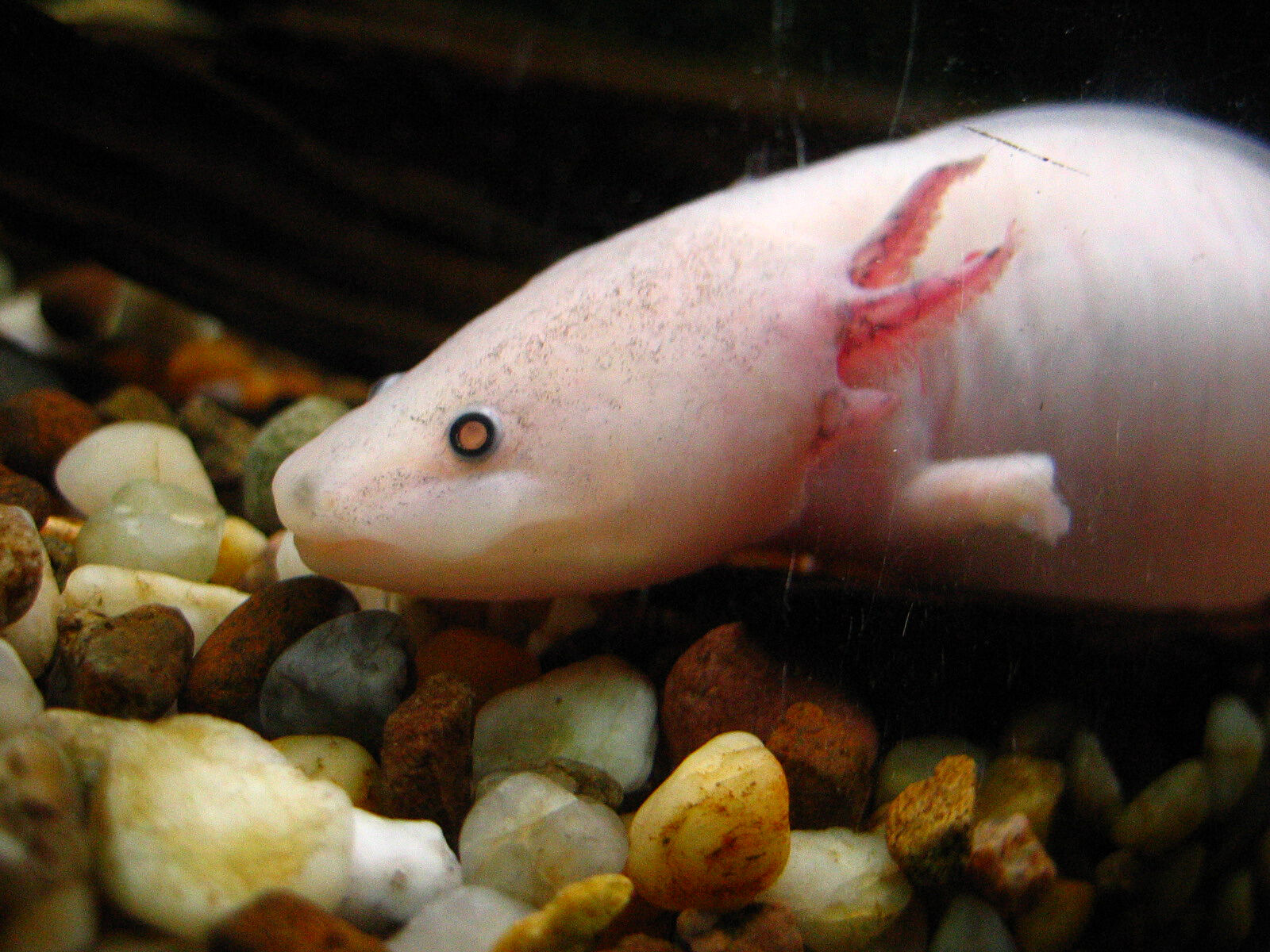
Axolotls are fully aquatic salamanders that keep their feathery gills for life. They're critically endangered in the wild, but thriving in labs and home aquariums. Cool, clean water is the key to keeping them healthy.
Care at a glance
Species-specific values
Values researched for this exact species. Where they differ from the group guide below, follow these. Air, surface and water temperatures are listed separately, and each source is kept as published rather than averaged.
| Water temperature | 60–65 °F Stock-centre recommendation; old intensive laboratory tank sizes are not imported as pet enclosure minima | 26 |
| Water temperature upper limit | 72 °F Stock-centre recommendation; old intensive laboratory tank sizes are not imported as pet enclosure minima | 26 |
| Water pH | 6.5–8 pH Stock-centre recommendation; old intensive laboratory tank sizes are not imported as pet enclosure minima | 26 |
| Water temperature | 64–68 °F Separate laboratory-housing range; keep alongside stock-centre recommendation | 217 |
| Enclosure type | Fully aquatic, cycled water with gentle flow; avoid ingestible gravel. | 26 |
| Water hardness note | Avoid extremely soft or distilled water; dechlorinate and remove chloramine. | 26 |
| Diet | Complete sinking pellets for juveniles/adults; newly hatched larvae need appropriately small live food. | 26 |
Warnings
Care guide
Tank setup
- Plan at least a 20-gallon long aquarium for one adult and add about 10 gallons for each additional axolotl; more water stays cooler and cleaner.
- Bare bottom, fine sand, or smooth stones too large to fit in the mouth. Avoid gravel: axolotls swallow it while feeding and it can cause impaction.
- About 14 hours of light a day is what the University of Kentucky colony uses, but they prefer dim, shaded areas.
Sources 26
Water quality
- Hard, chemical-free water. Never distilled or very soft water, which harms their skin.
- Remove chlorine and chloramine with a dechlorinator, and keep ammonia at zero.
- Frequent water changes: lab colonies change water daily for young and at least every other day for adults.
Sources 26
Diet
- Juveniles and adults: pellets 3–4 times a week, plus earthworms, bloodworms, daphnia and similar foods.
- Young larvae: live brine shrimp daily.
Sources 26
Temperature science
- A 2023 study rearing 174 axolotls found growth and reproduction suffered at 27°C (81°F), and noted 16–18°C (61–64°F) as the lab ideal.
Sources 27
Show the group care guide for axolotls
Axolotls
Applies to most species in this group. Habitat: Fully aquatic Mexican salamander; adult housing remains aquatic. [rvc-axolotl-2024]. Individual species can differ, so compare with the species numbers above and the linked sources.
Housing & setup
- Choose aquarium floor space for an adult potentially reaching 35 cm; mature the biological filter before stocking and provide shaded retreats.
- Use conditioned, mineral-containing freshwater; avoid distilled water. UKY reports pH 6.5–8.0.
- Maintain zero ammonia, nitrite and chlorine, with biological filtration and partial water replacement.
- Avoid swallowable gravel; bare-bottom housing is an option. Keep water flow gentle: strong circulation is stressful.
Climate & lighting
| Water | 60–65°F |
Diet
- Feed earthworms and suitable axolotl pellets; UKY feeds older animals three to four times weekly. Newly feeding larvae need appropriately sized live prey.
Social life
- Small larvae can be aggressive and cannibalistic; prevent overcrowding and separate vulnerable individuals.
Handling
- Minimize handling: skin is vulnerable to trauma and contaminants.
Health watch
- Poor appetite, deteriorating gills, sores or swelling warrant prompt veterinary assessment.
Understanding the animal
In the wild
In the wild
Researched for this exact species, not its family. Good care copies these conditions.12345
| Where it lives | Native to the high-elevation Chalco–Xochimilco lake system in Mexico's Valley of Mexico. Its remaining natural habitat is the shallow Xochimilco wetland and canal system, with aquatic vegetation and lake-bottom refuges. |
| Water it lives in | Freshwater, predominantly standing or slowly moving. Xochimilco field sites have mineralized, alkaline and turbid water; a UNAM study identifies favorable habitat conditions of 61–68°F and pH 7.4–8.2, rather than a complete annual temperature range. |
| Climate | Highland temperate aquatic habitat; favorable water temperatures reported as 61–68°F. Air humidity is not an applicable exposure measure for this fully aquatic salamander. |
| Active | Cathemeral; activity can occur during daylight or darkness. |
| Social life | Generally solitary; conspecific predation occurs. |
| Wild diet | Aquatic arthropods, molluscs, small fish and other axolotls. |
| Behavior to plan for | Normally retains external gills and an aquatic adult form throughout life. It captures animal prey and may consume smaller conspecifics. |
What this means for care
- Provide cool freshwater and aquatic cover throughout life.
- Use gentle circulation consistent with a lake-and-canal habitat.
- Avoid housing it with animals small enough to swallow.
Native climate (measured)
Native climate (measured)
| Warm-season highs | about 80°F (up to 83°F in the hottest sampled areas) |
| Cool-season lows | about 39°F (down to 38°F in the coldest sampled areas) |
| Average temperature | 60–61°F across sampled records |
| Relative humidity | 58–58% on average (driest month about 44%) |
| Rainfall | about 790 mm a year, with strong wet and dry seasons |
| Winters | Cool to cold winters (lows around 39°F) in much of its native range. Seasonal slowdown may be relevant, but species-specific biology determines whether brumation or hibernation occurs. |
Measured at 27 wild occurrence records sampled against WorldClim 2.1 climate data (1970–2000 averages). Air conditions in the range are ecological context, not enclosure settings: microhabitats such as burrows, leaf litter or basking rocks can be cooler, warmer or more humid.
Profile
Profile
Researched for this exact species. Sources are listed under In the wild above.
History
Axolotls historically occurred in the lake and wetland system of the Valley of Mexico, particularly Lakes Xochimilco and Chalco. Desiccation and destruction of these habitats, together with introduced predatory fishes such as tilapia and carp, drove the wild population close to extinction, while a large captive population became established for research, zoo display and the pet trade.
Keeper tips
- Provide a fully aquatic enclosure; they do not require a terrestrial section.
- Keep water temperature well controlled.
- Keep water flow well controlled.
- Plan filtration and maintenance around the relatively large amount of waste they produce.
- Healthy animals are often obtained from private breeders and other hobbyists.
Behaviors reported
- They retain their aquatic larval form even after becoming sexually mature.
- They normally remain aquatic for their entire lives instead of completing the usual salamander transition to a terrestrial adult.
- Captive individuals can be bold and tame.
Unique adaptations
- Feathery external gills are retained into adulthood and support their permanently aquatic lifestyle.
- A finned tail is retained for swimming.
- They are neotenic or paedomorphic, retaining larval characteristics in the reproductively mature adult form.
- They have an unusual capacity to regenerate structures including limbs, gills, and parts of the eyes and brain.
Remarkable facts
- Axolotls are a species of mole salamander.
- They average about 20 to 23 cm in length, while some individuals can exceed 30 cm.
- They can reach sexual maturity at about 8 inches in length; under good captive care this may occur in as little as six months but generally takes about a year.
- They have been known to live more than 20 years, although individuals older than 10 years are described as unusual.
- The species is assessed as critically endangered in the wild and is listed under CITES Appendix II.
- A large captive population exists, and axolotls are extensively used as scientific model organisms.
Stories
- Axolotls became important research animals because of their ability to regenerate body parts, including limbs, gills and portions of the eyes and brain.
- The name 'axolotl' comes from Nahuatl and is associated with Xolotl, an Aztec god connected with, among other things, the dead and the resurrected.
From the sources
From the sources
Quoted from the matching sections of reputable sources for this exact species. Specialist databases are used first; Wikipedia (community-edited, CC BY-SA 4.0) only fills gaps. Other sources are short credited quotes.
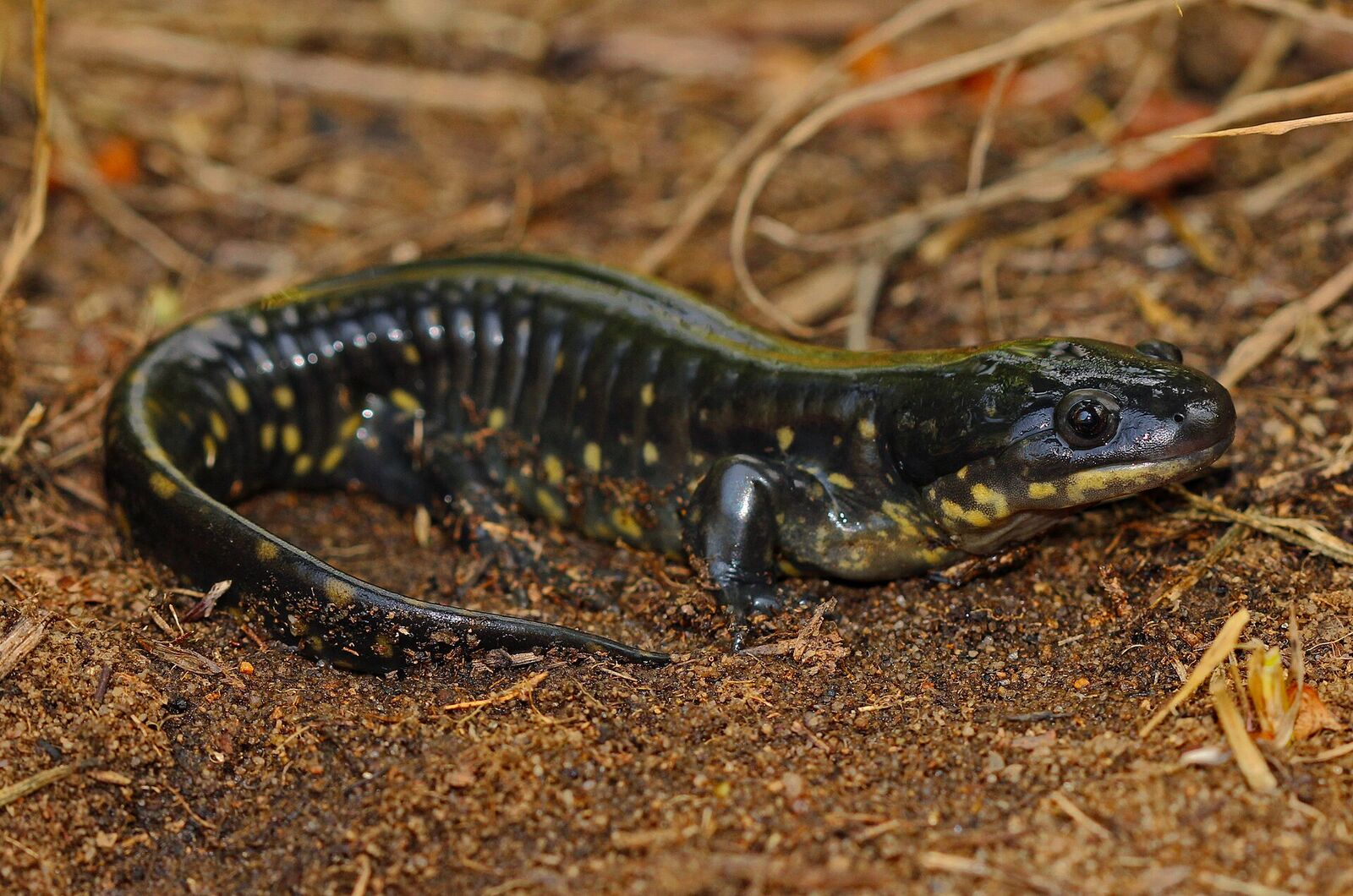
| Overview | The axolotl (; from; Ambystoma mexicanum) is a species of mole salamander. It is neotenic, reaching sexual maturity without undergoing metamorphosis, and the adults remain fully aquatic with obvious external gills. Axolotls may be difficult to distinguish from the larval stage of other neotenic adult mole salamanders, in particular the tiger salamander, or other species such as mudpuppies. Axolotls originally inhabited a system of interconnected wetlands and lakes in the highlands of Mexico. — Wikipedia (community-edited) |
| Where it lives | The native habitats of A. mexicanum are large, relatively permanent (until recently), high-altitude lakes located near Mexico City. — Animal Diversity Web |
| Social life and communication | Axolotls communicate mainly via visual cues and chemical cues during mating. — Animal Diversity Web |
| Wild diet | Generally the top predator in their natural environment, axolotls will eat anything that they can catch, including molluscs, fishes, and arthropods, as well as conspecifics. — Animal Diversity Web |
| Behavior | Axolotls are solitary and may be active at any time of the day. — Animal Diversity Web |
| Reproduction | The courtship behavior of A. mexicanum follows the general Ambystoma pattern; it first involes each animal nudging the other's cloacal region, eventually leading to a "waltz," with both animals moving in a circle. — Animal Diversity Web |
| Lifespan | Expected laboratory longevity is 5 to 6 years; however, some animals have been known to live as long as 10 to 15 years. — Animal Diversity Web |
| Appearance and size | Axolotls are paedomorphic or neotenic aquatic salamanders, meaning they retain certain larval characteristics in the adult, reproductive state. — Animal Diversity Web |
| Conservation | The natural habitat of A. mexicanum is nearly gone. — Animal Diversity Web |
Data and studies
Researched care notes
Researched care notes
Findings checked against veterinary, zoo, welfare, keeper and peer-reviewed sources. Air, basking-surface and water temperatures are kept separate, and where sources disagree both are shown. “Study” notes report what a paper measured, not a universal rule.
Axolotl (species)
- The colony protocol states an ideal water range of 16–18°C. Research-colony context.1
- The university guide’s individually maintained containers require intensive servicing; they do not establish household aquarium-space minima. Scope limitation.2
Axolotl
- University of Kentucky advises against extremely soft or distilled water; its axolotl protocol uses mineral-containing water.2
- The university protocol gives pH 6.5–8 and notes that increasing pH increases ammonia toxicity; pH tolerance does not make poor water quality acceptable.2
- Avoid pea-sized gravel that axolotls can ingest; the colony guide explicitly documents this substrate-ingestion problem.2
- Larval axolotls can injure or cannibalize one another; manage stocking and separation by developmental stage rather than copying adult group arrangements.2
- Nutritionally fortified soft sinking pellets and suitable earthworms are feeding options; the research colony transitions growing larvae from live Artemia to fortified pellets.2
The numbers
The numbers
Each bar is what one source reports. Where several sources weigh in, the dashed gold band marks their average.
Water temperature
Never above about 72°F; above 75°F (24°C) stresses them.
pH
Maximum recorded lifespan
Longest recorded lifespan reported by each database; typical lifespans are usually shorter. The AnAge record comes from an animal in human care.
Incubation
Female maturity
Care articles for this species
Care articles for this species
- Axolotl Care Sheet (Reptiles Magazine)
- Axolotl Breeding (Reptiles Magazine)
Veterinary & husbandry research
Veterinary & husbandry research
- Thyroxine-induced metamorphosis in the axolotl (Ambystoma mexicanum) Coots PS et al., Methods in molecular biology (Clifton, N.J.) 2015
- Chytridiomycosis in an aquarium collection of frogs: diagnosis, treatment, and control Forzán MJ et al., Journal of zoo and wildlife medicine: official publication of the American Association of Zoo Veterinarians 2008
- Chytridiomycosis survey in wild and captive mexican amphibians Frías-Alvarez P et al., EcoHealth 2008
- Experimentally induced metamorphosis in highly regenerative axolotl (ambystoma mexicanum) under constant diet restructures microbiota Demircan T et al., Scientific reports 2018
Peer-reviewed papers that mention this species alongside captivity, zoos, veterinary care or aquaculture. Some cover several species or mention it only in passing, so check the abstract. See all 19 on PubMed → 170
Sources for this sheet
- Ambystoma Genetic Stock Center (University of Kentucky): Guide to axolotl husbandry Zoo, university or veterinaryThe lab that has bred research axolotls for decades.
- Figiel Jr. (2023). Effects of water temperature on gonads growth in axolotl salamanders. Animals 13(5). Peer-reviewed researchPeer-reviewed study rearing 174 axolotls at four temperatures.
- Clint's Reptiles (YouTube): Axolotl, The Best Pet Amphibian? Expert educator & keeperClint Laidlaw, PhD in Biology Education and MS in Evolutionary Ecology; owner of Clint's Reptile Room and a longtime keeper. Rates each species on handleability, care, hardiness, availability and upfront cost.
- AnAge: The Animal Ageing and Longevity Database (Human Ageing Genomic Resources) Peer-reviewed researchCurated, referenced longevity and life-history records for thousands of species; maximum lifespans are often from zoo animals.
- 50 CFR Part 16: Injurious wildlife (Lacey Act) Zoo, university or veterinaryCurrent federal regulation, read from eCFR.
- U.S. Association of Reptile Keepers v. Zinke (D.C. Cir. 2017) Zoo, university or veterinaryAppeals ruling that the Lacey Act's shipping ban does not cover moves between the continental states.
- Species+ (UNEP-WCMC and the CITES Secretariat) Zoo, university or veterinaryThe official database of species listed under CITES.
- USFWS International Affairs: CITES Zoo, university or veterinaryFederal agency that issues CITES permits.
- Royal Veterinary College: Axolotl care sheet, reviewed December 2024 Zoo, university or veterinaryAdded in the 2026 source-checked care-guide review.
- Merck Veterinary Manual: Management of Laboratory Animals (aquatic vertebrates) Zoo, university or veterinaryAdded in the 2026 source-checked care-guide review.
- CITES Animals Committee AC21 Doc. 11.2: Periodic review of Ambystoma mexicanum, Annex 2 Zoo, university or veterinaryAdded in the 2026 source-checked care-guide review.
- Clint's Reptiles (YouTube): Axolotl, The Best Pet Amphibian? Expert educator & keeperClint Laidlaw, PhD in Biology Education and MS in Evolutionary Ecology; owner of Clint's Reptile Room and a longtime keeper. His "Best Pet?" series reviews each species' care in depth.
- AmphibiaWeb (University of California, Berkeley) Peer-reviewed researchUniversity-hosted database of amphibian biology and conservation.
- GBIF Backbone Taxonomy (Global Biodiversity Information Facility) Peer-reviewed researchInternational scientific taxonomy used here for classification.
- Wikipedia (species article) Community referenceFree encyclopedia; useful overviews with their own citations. Intro text is quoted under CC BY-SA 4.0.
- PubMed (U.S. National Library of Medicine) Peer-reviewed researchIndex of peer-reviewed veterinary, zoo and husbandry research.
- iNaturalist (captive observations) Community referenceCommunity observation platform run by the California Academy of Sciences and National Geographic; observations marked captive show animals living in homes, zoos and aquariums.
- Reptiles Magazine (care articles) Experienced keeper or breederEstablished reptile and amphibian hobby magazine; care articles are written by breeders, keepers and veterinarians.