Home / Mammals / Rodents / Patagonian mara
No federal permit to keep In-depth sheetPatagonian mara
Dolichotis patagonum
Mammals › Rodents (Rodentia) › Caviidae (Guinea pigs, maras, capybaras)
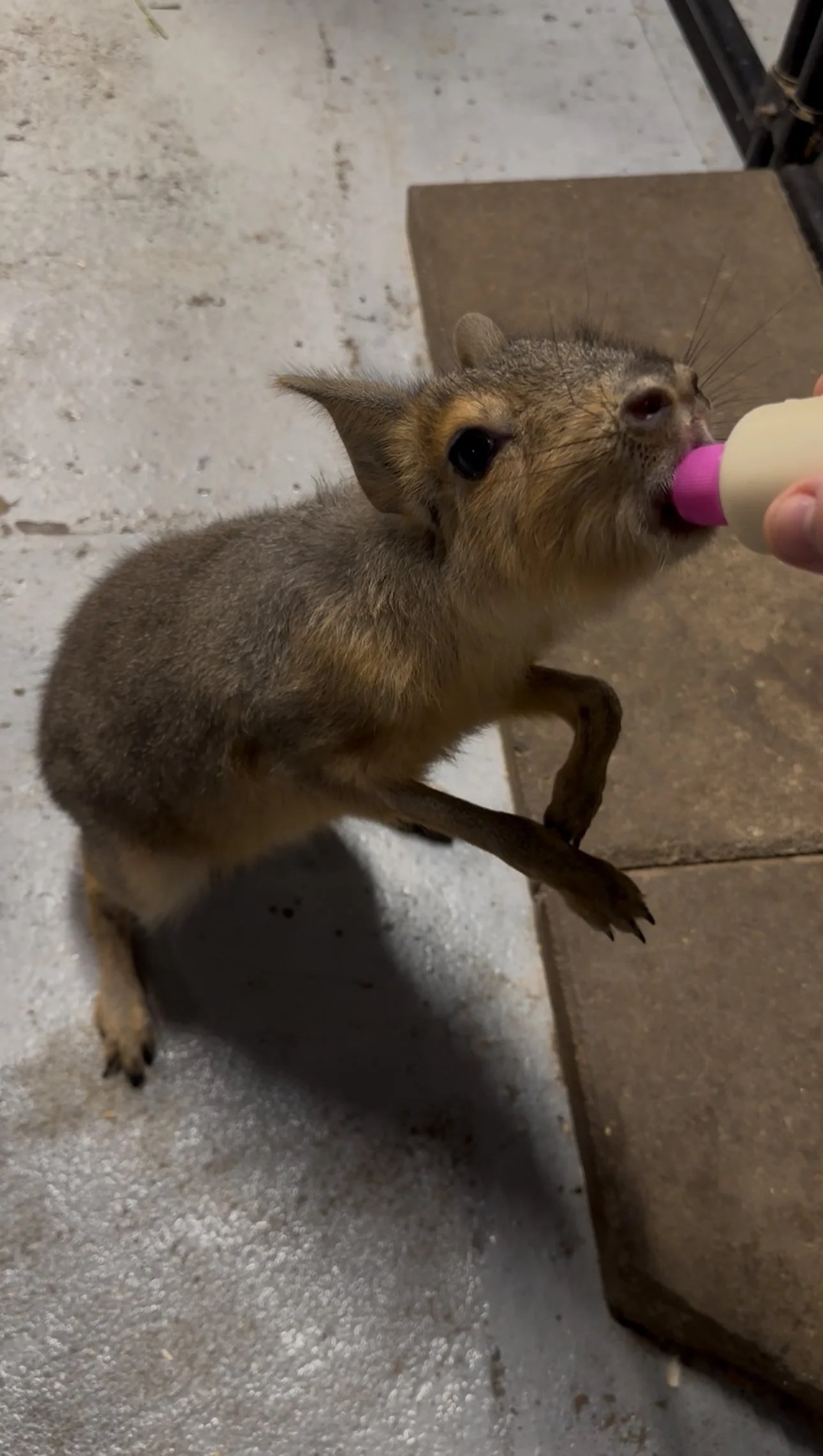
Maras are large, long-legged, grazing rodents from Argentina. Pairs usually bond for life, and families raise pups in shared crèche dens. They're calm with people when raised gently and can even learn to walk on a leash.
Care guide
Housing
- Room to run matters: maras can sprint at about 45 km/h (28 mph) and range widely in the wild. A large, grassy outdoor paddock is ideal.
- Provide shelters or den boxes; families share dens when raising pups.
Diet
- Strict herbivores: grasses make up about 70% of the wild diet, plus cacti and other plants.
- Zoos feed grass or hay, leafy greens and commercial herbivore pellets. Fresh water daily.
Behavior & enrichment
- Keep them in bonded pairs or small family groups.
- Scatter hay and greens around the enclosure to encourage natural grazing.
Health & vet care
- Like other rodents, they practice coprophagy (eating some droppings); that's normal digestion.
- Breeding is easy in captivity, so plan ahead for pups.
Sources 5
Show the group care guide for maras
Maras
Applies to most species in this group. Habitat: Patagonian grassland. Individual species can differ, so compare with the species numbers above and the linked sources.
Housing & setup
- Large grassy paddocks with shelter; they run fast and far.
Sources 5
Diet
- Grass, hay, greens and herbivore pellets.
Sources 5
Social life
- Bonded pairs or groups.
Sources 5
Health watch
- Injury from bolting into fences when startled.
Sources 5
Understanding the animal
In the wild
In the wild
Researched for this exact species, not its family. Good care copies these conditions.1
| Where it lives | Arid central and southern Argentina, in open grasslands, sandy plains and shrub steppe. Young occupy underground dens, sometimes shared by many breeding pairs. |
| Ground it lives on | sandy or earthy plains with short grass and sparse thorny shrubs |
| Climate | The habitat account reports summer averages around 68°F and winter temperatures usually above 32°F, with unpredictable rainfall and wet–dry changes; relative-humidity ranges are unavailable. |
| Active | Diurnal. |
| Social life | Long-lasting male–female pairs; communal nursery dens during breeding, with males defending mates. |
| Wild diet | Grasses, including Pappophorum, Poa and Panicum depending on locality; also herbs, shrubs and moisture-rich cacti. Re-ingests special feces. |
| Behavior to plan for | Fast runner that bounds when evading predators and relies on open sight lines. Pairs take turns visiting communal dens to nurse their own young. |
What this means for care
- Provide a large open exercise area with visible escape routes.
- Manage bonded pairs rather than assuming interchangeable caviid groups.
- Provide fibrous grazing foods and secure nursery shelters.
Native climate (measured)
Native climate (measured)
| Warm-season highs | about 108°F (up to 108°F in the hottest sampled areas) |
| Cool-season lows | about 54°F (down to 54°F in the coldest sampled areas) |
| Average temperature | 82–82°F across sampled records |
| Relative humidity | 49–50% on average (driest month about 39%) |
| Rainfall | about 124 mm a year, with strong wet and dry seasons |
Measured at 31 wild occurrence records sampled against WorldClim 2.1 climate data (1970–2000 averages). Air conditions in the range are ecological context, not enclosure settings: microhabitats such as burrows, leaf litter or basking rocks can be cooler, warmer or more humid.
Profile
Profile
Researched for this exact species. Sources are listed under In the wild above.
Behaviors reported
- Builds dens in open habitats.
- Uses visual surveillance to monitor for predators.
- Shows a preference for open habitat where predator detection is more effective.
- Large settlements have been observed on and around sheep ranches, probably because of similar habitat preferences.
Unique adaptations
- Long, rabbit-like ears.
- A short, nearly hairless tail held close to the body.
Remarkable facts
- It is the second-largest member of the family Caviidae.
- One study reported average weights of 7.73 kg for males and 8.44 kg for females, although most accounts report males as larger.
- Body length ranges from about 610 to 810 mm, averaging about 700 mm.
- Its common body coloration is short, grizzled gray fur with a conspicuous white rump patch.
- Its genus name Dolichotis refers to its long ears.
From the sources
From the sources
Quoted from the matching sections of reputable sources for this exact species. Specialist databases are used first; Wikipedia (community-edited, CC BY-SA 4.0) only fills gaps. Other sources are short credited quotes.
| Overview | The Patagonian mara (Dolichotis patagonum) is a rodent in the mara genus Dolichotis. It is also known as the Patagonian cavy or Patagonian hare. This herbivorous, somewhat rabbit-like animal is found in open and semi-open habitats in Argentina, including large parts of Patagonia. It is monogamous, but often breeds in warrens shared by several pairs. — Wikipedia (community-edited) |
| Where it lives | Patagonian maras live only in the arid central and southern regions of Argentina. — Animal Diversity Web |
| Social life and communication | Their social organizations have a unique combination of monogamy and communal breeding. Being monogamous, pairs of maras stay together for life, with replacement of partners only occurring after one's death. The male has almost the sole responsibility in maintaining the pair by following the female wherever she goes. — Wikipedia (community-edited) |
| Reproduction | Dolichotis patagonum is strongly monogamous, and male-female pairs usually bond for life. — Animal Diversity Web |
| Appearance and size | Dolichotis patagonum is the second largest member of the family Caviidae. — Animal Diversity Web |
Data and studies
The numbers
The numbers
Each bar is what one source reports. Where several sources weigh in, the dashed gold band marks their average.
Maximum recorded lifespan
Longest recorded lifespan reported by each database; typical lifespans are usually shorter. The AnAge record comes from an animal in human care.
Typical adult weight
Average adult body mass in each database (FishBase gives the maximum recorded weight).
Veterinary & husbandry research
Veterinary & husbandry research
- MRSA carrying mecC in captive mara Espinosa-Gongora C et al., The Journal of antimicrobial chemotherapy 2015
- Pathological findings in a captive colony of maras (Dolichotis patagonum) Rosas-Rosas AG et al., The Veterinary record 2006
- Digestive anatomy, physiology, resting metabolism and methane production of captive maras (Dolichotis patagonum) Clauss M et al., Comparative biochemistry and physiology. Part A, Molecular & integrative physiology 2019
Peer-reviewed papers that mention this species alongside captivity, zoos, veterinary care or aquaculture. Some cover several species or mention it only in passing, so check the abstract. See all 20 on PubMed → 170
Sources for this sheet
- Animal Diversity Web: Dolichotis patagonum Zoo, university or veterinaryUniversity-hosted species account.
- Exmoor Zoo: Patagonian mara Zoo, university or veterinaryZoo that keeps a breeding group of maras.
- AnAge: The Animal Ageing and Longevity Database (Human Ageing Genomic Resources) Peer-reviewed researchCurated, referenced longevity and life-history records for thousands of species; maximum lifespans are often from zoo animals.
- Myhrvold et al. (2015). An amniote life-history database. Ecology 96: 3109 Peer-reviewed researchPeer-reviewed compilation of life-history data for over 21,000 birds, mammals and reptiles.
- 9 CFR 2.1: Animal Welfare Act licensing (USDA) Zoo, university or veterinaryWho needs a USDA license to breed, sell or exhibit animals.
- GBIF Backbone Taxonomy (Global Biodiversity Information Facility) Peer-reviewed researchInternational scientific taxonomy used here for classification.
- Wikipedia (species article) Community referenceFree encyclopedia; useful overviews with their own citations. Intro text is quoted under CC BY-SA 4.0.
- PubMed (U.S. National Library of Medicine) Peer-reviewed researchIndex of peer-reviewed veterinary, zoo and husbandry research.
- iNaturalist (captive observations) Community referenceCommunity observation platform run by the California Academy of Sciences and National Geographic; observations marked captive show animals living in homes, zoos and aquariums.