Home / Mammals / Rodents / Guinea pig
No federal permit to keep In-depth sheetGuinea pig
Cavia porcellus
Mammals › Rodents (Rodentia) › Caviidae (Guinea pigs, maras, capybaras)
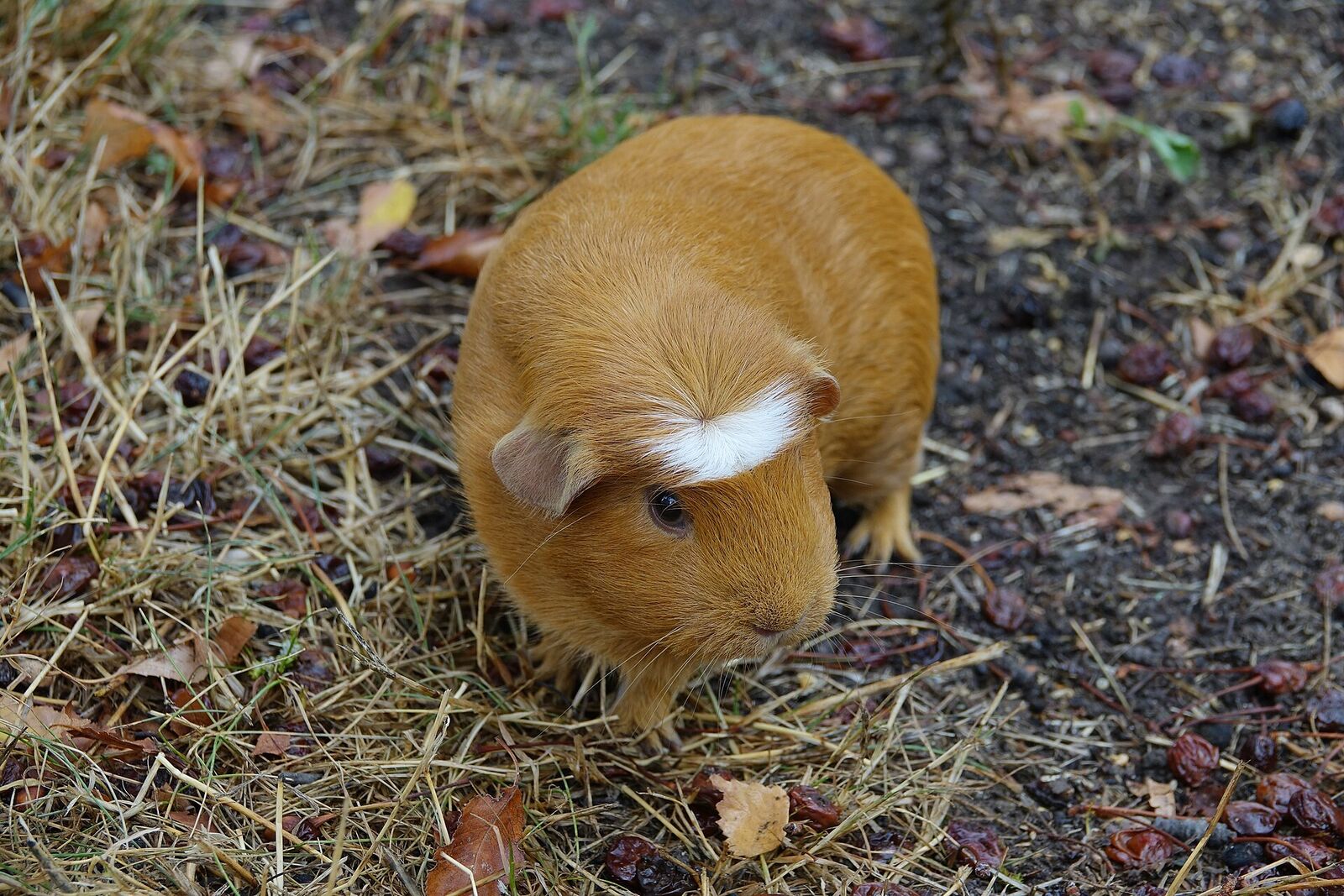
Guinea pigs are social, vocal rodents that live on hay and fresh greens. They need company of their own kind and can't make their own vitamin C.
Care at a glance
Species-specific values
Values researched for this exact species. Where they differ from the group guide below, follow these. Air, surface and water temperatures are listed separately, and each source is kept as published rather than averaged.
| Lifespan typical captive | 4–8 years Pet-rodent table; not maximum longevity | 291 |
| Adult body mass male | 800–1600 g | 291 |
| Adult body mass female | 700–1300 g | 291 |
| Minimum main enclosure base | length: 5 ft; width: 2 ft For two, plus an exercise area. | 299 |
| Social | Keep with at least one compatible guinea pig; rabbits are unsuitable companions. | 300 |
| Typical captive lifespan | 4–8 years Some live longer; this is not a maximum. | 300 |
Care guide
Housing
- RSPCA minimum floor space for a pair: about 47×24 in (120×60 cm); more is better.
- Avoid wire floors; use deep hay, paper bedding or fleece.
Sources 42
Diet & health
- Unlimited hay, fresh greens and a guinea-pig pellet. They need dietary vitamin C every day.
- Keep pairs or groups; they're social.
Sources 42
Show the group care guide for guinea pigs and cavies
Guinea pigs and cavies
Applies to most species in this group. Habitat: South American grasslands. Individual species can differ, so compare with the species numbers above and the linked sources.
Housing & setup
- For two domestic guinea pigs, Blue Cross recommends a main enclosure of at least 5 × 2 ft, plus an exercise area, hides and safe flooring.
Diet
- Unlimited grass hay, guinea pig pellets and fresh vegetables. They need vitamin C every day.
Social life
- Keep in pairs or groups.
Health watch
- Scurvy without vitamin C, dental overgrowth, bladder stones and respiratory infections.
Understanding the animal
In the wild
In the wild
Researched for this exact species, not its family. Good care copies these conditions.12
| Where it lives | A domesticated guinea pig with no established native wild population; a natural habitat for this exact taxon cannot be assigned from wild Cavia relatives. |
| Climate | Humidity and seasonal patterns are not stated. |
| Social life | Social animals. Studies of guinea pigs kept by humans indicate that social housing is important for healthy stress levels and well-being. |
| Behavior to plan for | Guinea pigs are skittish in response to noise or danger and use a freeze-or-flight strategy. Their continuously growing teeth lead them to chew regularly, with tooth length maintained through grinding during feeding. |
What this means for care
- Use evidence for domestic guinea pigs to set care conditions.
- Do not copy temperatures or social arrangements from Cavia aperea or Cavia tschudii as exact-species wild facts.
Native climate (measured)
Native climate (measured)
| Warm-season highs | about 68°F (up to 68°F in the hottest sampled areas) |
| Cool-season lows | about 44°F (down to 44°F in the coldest sampled areas) |
| Average temperature | 56–56°F across sampled records |
| Relative humidity | 81–81% on average (driest month about 79%) |
| Rainfall | about 1208 mm a year, spread fairly evenly |
Measured at 76 wild occurrence records sampled against WorldClim 2.1 climate data (1970–2000 averages). Air conditions in the range are ecological context, not enclosure settings: microhabitats such as burrows, leaf litter or basking rocks can be cooler, warmer or more humid.
Profile
Profile
Researched for this exact species. Sources are listed under In the wild above.
History
Guinea pigs were domesticated in the Andean region of South America, with Animal Diversity Web placing the beginning of domestication around 5,000 B.C. European traders introduced them to Europe and later North America in the 16th century, and they subsequently became widespread pets and laboratory animals.
Keeper tips
- Keep guinea pigs socially rather than in isolation when appropriate.
- Provide hides and other structures for environmental enrichment.
- Maintain constant access to hay.
- Provide adequate space to support healthy stress levels and well-being.
- Separate males and females when breeding is not intended.
Behaviors reported
- Uses freeze or flight responses when startled by noise or danger.
- Chews regularly because its teeth grow continuously.
- Responds readily to handling and feeding and is described as docile.
Unique adaptations
- Continuously growing teeth are maintained through grinding during feeding.
- The presumed wild ancestors had short brown hair that likely provided camouflage from predators.
Remarkable facts
- Domestic guinea pigs generally weigh about 700 to 1,200 g.
- They are about 8–10 in long.
- They are tailless rodents.
- They have 20 teeth.
- Selective breeding has produced numerous coat-color, texture, and length phenotypes.
- They have been kept as food animals, pets, laboratory subjects, and for ceremonial purposes.
From the sources
From the sources
Quoted from the matching sections of reputable sources for this exact species. Specialist databases are used first; Wikipedia (community-edited, CC BY-SA 4.0) only fills gaps. Other sources are short credited quotes.
| Overview | The guinea pig (Cavia porcellus), also known as the domestic guinea pig, cavy or domestic cavy, is a species of rodent. It belongs to the genus Cavia, family Caviidae, and its closest wild relatives include the montane guinea pig. Domestic guinea pigs typically weigh between 700 and 1,200 g (1.5 and 2.6 lb) and measure between 20 and 25 cm (8 and 10 in) in length; most breeds have fur, and they have long front teeth that grow continuously, leading the animals to chew regularly to wear them down. — Wikipedia (community-edited) |
| Where it lives | Guinea pigs no longer exist in their wild, native, grassland habitat. — Animal Diversity Web |
| Social life and communication | Guinea pigs communicate through a variety of noises, including chutts, squeaks, whines, whistles, purrs, and chirps. — Animal Diversity Web |
| Wild diet | Guinea pigs are strict herbivores and depend on humans for food. — Animal Diversity Web |
| Behavior | Guinea pigs are gregarious and prefer close contact with other conspecifics. — Animal Diversity Web |
| Reproduction | Guinea pigs no longer exist in the wild, therefore, mating systems in natural environments are unknown. — Animal Diversity Web |
| Lifespan | Guinea pigs can live up to 14 years in captivity, but have an average lifespan of 8 years. — Animal Diversity Web |
| Appearance and size | Guinea pigs are tailless rodents that weigh between 700 g and 1100 g, with males being larger than females. — Animal Diversity Web |
| History and naming | Cavia porcellus is not found naturally in the wild; it is likely descended from closely related species of cavies, such as C. aperea, C. fulgida, and C. tschudii. These closely related species are still commonly found in various regions of South America. — Wikipedia (community-edited) |
Data and studies
Researched care notes
Researched care notes
Findings checked against veterinary, zoo, welfare, keeper and peer-reviewed sources. Air, basking-surface and water temperatures are kept separate, and where sources disagree both are shown. “Study” notes report what a paper measured, not a universal rule.
Guinea Pig (species)
- Adult feeding should centre on grass hay, guinea-pig pellets, and appropriate fresh produce.1
- Guinea pigs require dietary vitamin C.1
- The professional reference gives 10–25 mg vitamin C/kg body weight/day for healthy adults. This refers to total nutritional intake, not an automatic additional supplement dose. Growing, pregnant, lactating, or ill animals require a separate plan.1
- RSPCA independently recommends continuously available hay/grass, fresh guinea-pig pellets, and suitable vegetables.2
- Pellet storage and freshness affect vitamin C. Use fresh daily portions rather than indefinitely topping up a bowl.2
The numbers
The numbers
Each bar is what one source reports. Where several sources weigh in, the dashed gold band marks their average.
Room temperature
Avoid temperatures above about 79°F (26°C).
Humidity
Maximum recorded lifespan
Longest recorded lifespan reported by each database; typical lifespans are usually shorter. The AnAge record comes from an animal in human care.
Typical adult weight
Average adult body mass in each database (FishBase gives the maximum recorded weight).
Litter size
Average per litter or clutch.
Veterinary & husbandry research
Veterinary & husbandry research
- Modeling asthma: Pitfalls, promises, and the road ahead Rosenberg HF et al., Journal of leukocyte biology 2018
- Design-based stereological study of the guinea-pig (Cavia porcellus) cerebellum De Silva M et al., Journal of anatomy 2021
- Validation of an immunocytochemical assay for immunophenotyping of lymphoma in guinea pigs (Cavia porcellus) Evans SJM et al., Veterinary clinical pathology 2018
- Blood profiles in unanesthetized and anesthetized guinea pigs (Cavia porcellus) Williams WR et al., Lab animal 2016
Peer-reviewed papers that mention this species alongside captivity, zoos, veterinary care or aquaculture. Some cover several species or mention it only in passing, so check the abstract. See all 89 on PubMed → 170
Sources for this sheet
- Royal Veterinary College Exotics Service: Guinea pig care Zoo, university or veterinaryVet-school exotics hospital factsheet, reviewed 2021–2024.
- AnAge: The Animal Ageing and Longevity Database (Human Ageing Genomic Resources) Peer-reviewed researchCurated, referenced longevity and life-history records for thousands of species; maximum lifespans are often from zoo animals.
- Myhrvold et al. (2015). An amniote life-history database. Ecology 96: 3109 Peer-reviewed researchPeer-reviewed compilation of life-history data for over 21,000 birds, mammals and reptiles.
- 9 CFR 2.1: Animal Welfare Act licensing (USDA) Zoo, university or veterinaryWho needs a USDA license to breed, sell or exhibit animals.
- Merck Veterinary Manual: Housing and nutrition of guinea pigs Zoo, university or veterinaryThe Merck Veterinary Manual: a standard veterinary reference written and reviewed by veterinary specialists.
- Blue Cross — How to introduce guinea pigs Expert educator & keeperAdded in the 2026 source-checked care-guide review.
- Blue Cross — Guinea pig care Expert educator & keeperAdded in the 2026 source-checked care-guide review.
- GBIF Backbone Taxonomy (Global Biodiversity Information Facility) Peer-reviewed researchInternational scientific taxonomy used here for classification.
- Wikipedia (species article) Community referenceFree encyclopedia; useful overviews with their own citations. Intro text is quoted under CC BY-SA 4.0.
- PubMed (U.S. National Library of Medicine) Peer-reviewed researchIndex of peer-reviewed veterinary, zoo and husbandry research.
- iNaturalist (captive observations) Community referenceCommunity observation platform run by the California Academy of Sciences and National Geographic; observations marked captive show animals living in homes, zoos and aquariums.