Home / Mammals / Rodents / Capybara
No federal permit to keep In-depth sheetCapybara
Hydrochoerus hydrochaeris
Mammals › Rodents (Rodentia) › Caviidae (Guinea pigs, maras, capybaras)
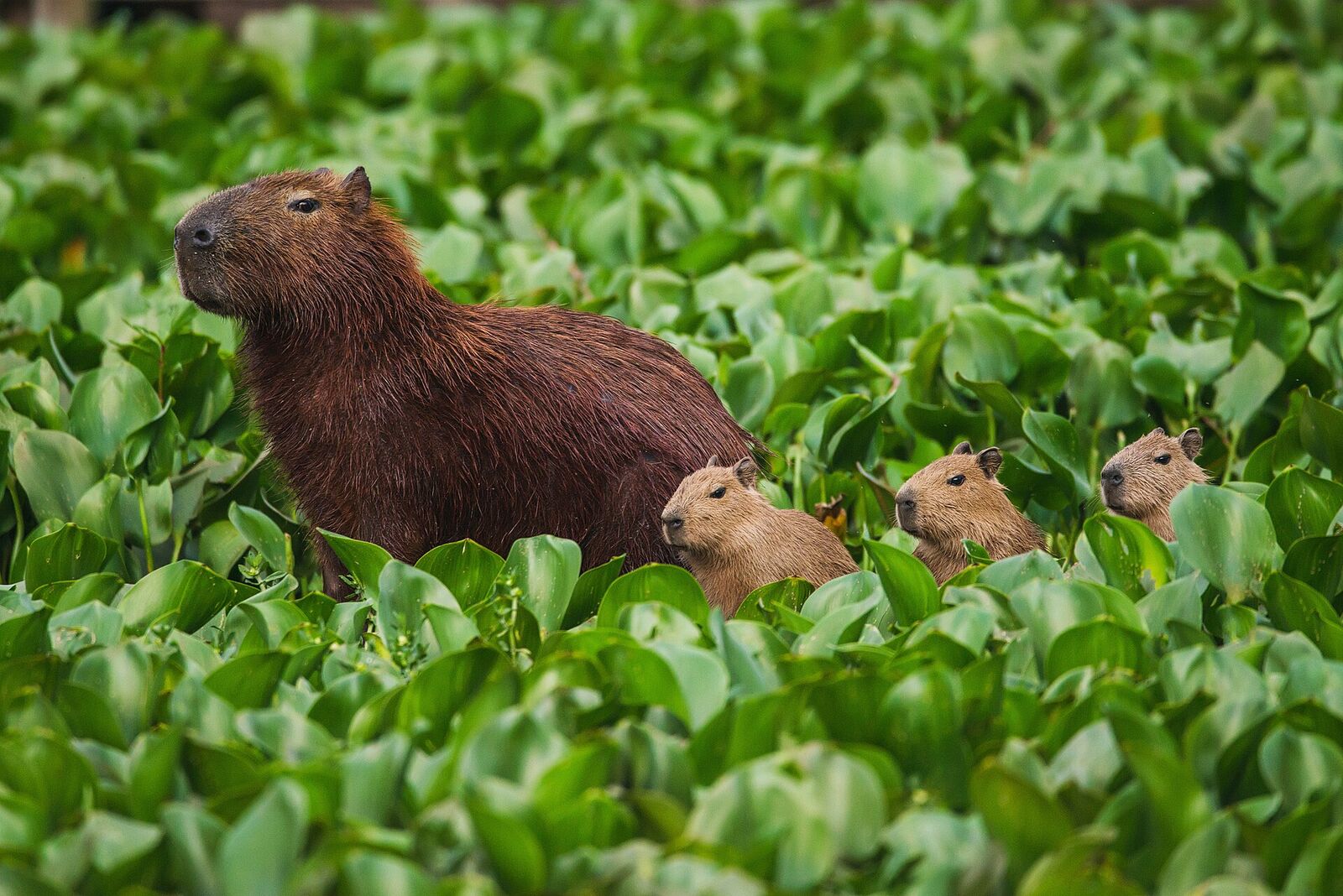
Capybaras are huge, social, semi-aquatic grazers. They need water deep enough to swim in and the company of other capybaras.
Care guide
Housing
- Reliable water access is essential; they swim to cool off and spend hot days in water.
Sources 71
Diet
- Strict herbivores: grasses and aquatic plants; like other rodents they practice coprophagy.
Sources 71
Show the group care guide for capybaras
Capybaras
Applies to most species in this group. Habitat: Wetlands and riverbanks. Individual species can differ, so compare with the species numbers above and the linked sources.
Housing & setup
- A large, securely fenced grassy area with a pool deep enough to swim in, plus heated shelter in winter.
Diet
- Grass and hay as a staple, guinea pig or herbivore pellets, and vitamin C-rich vegetables.
Social life
- Highly social; keep at least two.
Health watch
- Skin problems without water access; dental issues; lonely capybaras do poorly.
Understanding the animal
In the wild
In the wild
Researched for this exact species, not its family. Good care copies these conditions.12
| Where it lives | South American flooded grasslands, marsh margins and lowland forests with grazing and accessible water throughout the year. Uses water for refuge and relief from heat. |
| Ground it lives on | grassy banks and floodplain soil beside water |
| Water it lives in | Freshwater wetlands, ponds and river margins, including still and flowing habitats. Species-wide wild pH, hardness, clarity and water-temperature ranges were not established. |
| Climate | Occurs in both temperate and tropical regions of South America. |
| Active | Primarily crepuscular; may become nocturnal where disturbed. |
| Social life | Stable territorial mixed-sex groups, commonly around ten adults; males maintain dominance hierarchies. |
| Wild diet | Mainly grasses and aquatic plants, with occasional bark and fruit; re-ingests fecal material. |
| Behavior to plan for | Strong swimmer that escapes predators by submerging. Often rests in water during the hottest hours. |
What this means for care
- Provide a substantial freshwater swimming area with easy bank access.
- Provide dry grazing/resting space and shade as well as water.
- Maintain compatible groups with separation options.
- Base feeding on fibrous forage rather than fruit.
Native climate (measured)
Native climate (measured)
| Warm-season highs | about 85°F (up to 90°F in the hottest sampled areas) |
| Cool-season lows | about 51°F (down to 43°F in the coldest sampled areas) |
| Average temperature | 63–77°F across sampled records |
| Relative humidity | 71–80% on average (driest month about 69%) |
| Rainfall | about 1314 mm a year |
Measured at 104 wild occurrence records sampled against WorldClim 2.1 climate data (1970–2000 averages). Air conditions in the range are ecological context, not enclosure settings: microhabitats such as burrows, leaf litter or basking rocks can be cooler, warmer or more humid.
Profile
Profile
Researched for this exact species. Sources are listed under In the wild above.
Keeper tips
- Provide opportunities that reflect the species' natural use of both land and water rather than treating it as exclusively terrestrial.
- Account for their large adult size: the source reports 35 to 66 kg, lengths of 106 to 134 cm, and heights up to about 0.6 m at the shoulder.
- Consider social-group dynamics because dominant males naturally compete for reproductive access.
- Use habitat features that allow grazing as well as access to water, reflecting the species' favored wild habitats.
Behaviors reported
- Lives in social groups.
- Dominant males attempt to monopolize mating activity.
- Females have been observed mating with both dominant and subordinate males.
- Uses habitats closely associated with readily accessible water.
Unique adaptations
- Partially webbed feet support semiaquatic life.
- Eyes are positioned on top of the head.
- Ears are positioned on top of the head.
- Nostrils are positioned on top of the head.
Remarkable facts
- Capybaras are the largest rodents.
- Adults weigh about 35 to 66 kg, or 77.09 to 145.37 lb.
- Body length ranges from about 106 to 134 cm.
- They can stand up to about 0.6 m at the shoulder.
- Females are slightly larger than males.
- The body is barrel-shaped, sturdy, and tailless.
From the sources
From the sources
Quoted from the matching sections of reputable sources for this exact species. Specialist databases are used first; Wikipedia (community-edited, CC BY-SA 4.0) only fills gaps. Other sources are short credited quotes.
| Overview | The capybara or greater capybara (Hydrochoerus hydrochaeris) is the largest living rodent, native to all countries in South America except Chile. It is a semiaquatic herbivore that inhabits savannas and dense forests, living near and in bodies of freshwater and feeding mainly on grasses and aquatic plants. Together with the lesser capybara, it constitutes the genus Hydrochoerus. Its other close relatives include guinea pigs and rock cavies, and it is more distantly related to the agouti, the chinchilla, and the nutria. — Wikipedia (community-edited) |
| Where it lives | Capybaras are found only in areas where water is easily accessible: flooded grasslands are a favored habitat, as are marsh edges and lowland forests where grazing is good and there is water year-round. — Animal Diversity Web |
| Social life and communication | Vocalization appears to be very important in capybara groups, but the purpose of many of the sounds made is unknown. — Animal Diversity Web |
| Wild diet | Capybaras are grazers, feeding mainly on grasses and aquatic plants. — Animal Diversity Web |
| Behavior | Capybaras live in groups of around 10 adults of both sexes, although groups can range in size from 3 to 30 and larger aggregations often form around water resources during the dry season. — Animal Diversity Web |
| Reproduction | Capybaras are polygynous to promiscuous. — Animal Diversity Web |
| Lifespan | Capybaras live about 6 years on average (and as many as 10 years) in the wild and up to 12 years in captivity. — Animal Diversity Web |
| Appearance and size | Capybaras are the largest of rodents, weighing from 35 to 66 kg and standing up to 0.6 meters at the shoulder, with a length of about 1.2 meters. — Animal Diversity Web |
| History and naming | Its common name is derived from Tupi ka'apiûara, a complex agglutination of kaá (leaf) + píi (slender) + ú (eat) + ara (a suffix for agent nouns), meaning "one who eats slender leaves", or "grass-eater". The genus name, hydrochoerus, comes from Greek ὕδωρ (hýdor "water") and χοῖρος (choíros "pig, hog") and the species name, hydrochaeris, comes from Greek ὕδωρ (hýdor "water") and χαίρω (chairo "feel happy, enjoy"). — Wikipedia (community-edited) |
Data and studies
Researched care notes
Researched care notes
Findings checked against veterinary, zoo, welfare, keeper and peer-reviewed sources. Air, basking-surface and water temperatures are kept separate, and where sources disagree both are shown. “Study” notes report what a paper measured, not a universal rule.
Capybara (species)
- Provide social space, visual barriers, sheltered resting places, and usable water access.1
- The manual calls for indoor and outdoor pools. Its pool-size figures describe surveyed exhibits rather than experimentally validated minima.1
- A high-fibre forage-based ration supports fermentation; large amounts of cultivated fruit are discouraged.1
- Dietary vitamin C is required; fruit should not be the sole strategy for supplying it.1
- Body-condition monitoring is useful, but the illustrated scoring method partly adapts a pig system. Method limitation.1
The numbers
The numbers
Each bar is what one source reports. Where several sources weigh in, the dashed gold band marks their average.
Lifespan in care
Maximum recorded lifespan
Longest recorded lifespan reported by each database; typical lifespans are usually shorter. The AnAge record comes from an animal in human care.
Typical adult weight
Average adult body mass in each database (FishBase gives the maximum recorded weight).
Gestation
Female maturity
Veterinary & husbandry research
Veterinary & husbandry research
- Nutrition of Six Selected Neo-Tropical Mammals in Trinidad and Tobago with the Potential for Domestication Lall KR et al., Veterinary sciences 2018
- Outbreak of Yersinia pseudotuberculosis in capybaras (Hydrochoerus hydrochaeris) kept in captivity Cano-Terriza D et al., Comparative immunology, microbiology and infectious diseases 2022
- Digestive physiology of captive capybara (Hydrochoerus hydrochaeris) Kiani A et al., Zoo biology 2019
- Parasite infestations and infections of non-traditional pets and wild mammals: diagnosis and treatment Ramos RV et al., Revista brasileira de parasitologia veterinaria = Brazilian journal of veterinary parasitology: Orgao Oficial do Colegio Brasileiro de Parasitologia Veterinaria 2024
Peer-reviewed papers that mention this species alongside captivity, zoos, veterinary care or aquaculture. Some cover several species or mention it only in passing, so check the abstract. See all 22 on PubMed → 170
Sources for this sheet
- Animal Diversity Web (University of Michigan): Hydrochoerus hydrochaeris Zoo, university or veterinaryUniversity-hosted species account, mostly wild biology.
- AnAge: The Animal Ageing and Longevity Database (Human Ageing Genomic Resources) Peer-reviewed researchCurated, referenced longevity and life-history records for thousands of species; maximum lifespans are often from zoo animals.
- 9 CFR 2.1: Animal Welfare Act licensing (USDA) Zoo, university or veterinaryWho needs a USDA license to breed, sell or exhibit animals.
- Merck Veterinary Manual: Management of zoo animals Zoo, university or veterinaryThe Merck Veterinary Manual: a standard veterinary reference written and reviewed by veterinary specialists.
- Merck Veterinary Manual: Nutrition: exotic and zoo animals Zoo, university or veterinaryThe Merck Veterinary Manual: a standard veterinary reference written and reviewed by veterinary specialists.
- GBIF Backbone Taxonomy (Global Biodiversity Information Facility) Peer-reviewed researchInternational scientific taxonomy used here for classification.
- Wikipedia (species article) Community referenceFree encyclopedia; useful overviews with their own citations. Intro text is quoted under CC BY-SA 4.0.
- PubMed (U.S. National Library of Medicine) Peer-reviewed researchIndex of peer-reviewed veterinary, zoo and husbandry research.
- iNaturalist (captive observations) Community referenceCommunity observation platform run by the California Academy of Sciences and National Geographic; observations marked captive show animals living in homes, zoos and aquariums.