Home / Reptiles / Lizards / Crocodile monitor
Some federal rules applyCrocodile monitor
Varanus salvadorii
Reptiles › Lizards (Lacertilia) › Varanidae (Monitor lizards)
The crocodile monitor (Varanus salvadorii), also known as the Papuan monitor or Salvadori's monitor, is a species of monitor lizard endemic to New Guinea.

Care guide
Large monitors
Applies to most species in this group. Habitat: Savanna, rainforest and riverbanks. Individual species can differ, so compare with the species numbers above and the linked sources.
Housing & setup
- Room-sized enclosures with a large pool for semi-aquatic species; heavy-duty construction.
- Basking surfaces well over 120 °F with a broad gradient.
Climate & lighting
| Basking spot | 120–140°F |
| Warm side / daytime | 85–95°F |
| Cool side | 75–80°F |
| Humidity | 50–80% |
- UVB: Required.
Diet
- Whole prey (rodents, poultry, fish) and insects; avoid fatty meats and dog food.
Health watch
- Obesity, gout and injuries; strong bites, sharp claws and tail whips.
Understanding the animal
About this animal
About this animal
It is the largest monitor lizard in New Guinea and is one of the longest lizards, verified at up to 255 cm (100 in). Its tail is exceptionally long, with some specimens having been claimed to exceed the length of the Komodo dragon, however less massive.
Quoted from the Wikipedia article “Varanus salvadorii” (CC BY-SA 4.0) 174
In the wild
In the wild
Researched for this exact species, not its family. Good care copies these conditions.12345
| Where it lives | New Guinea primary rainforest, riverine and alluvial forest, with montane records to about 4,900 feet. Uses canopy branches and large trees with high hollow retreats. |
| Ground it lives on | predominantly arboreal; branches and tree hollows |
| Climate | Warm, humid monsoonal climate with little seasonal temperature change but cooler conditions at elevation; daytime temperatures below 6,560 feet generally exceed 72°F. A species-wide humidity range is unavailable. |
| Active | Diurnal. |
| Wild diet | Reported prey include birds and their eggs, small mammals and insects; birds are frequently observed prey, but quantitative wild diet studies are lacking. |
| Behavior to plan for | Runs and leaps between canopy branches and uses its tail for balance. Hooked teeth can cause severe bite injuries. |
What this means for care
- Provide very large vertical space with connected, weight-bearing branches.
- Include elevated hollow-like retreats.
- Offer varied smaller whole prey and canopy feeding opportunities.
- Use protected contact and secure containment.
Native climate (measured)
Native climate (measured)
| Warm-season highs | about 86°F (up to 89°F in the hottest sampled areas) |
| Cool-season lows | about 72°F (down to 68°F in the coldest sampled areas) |
| Average temperature | 77–80°F across sampled records |
| Relative humidity | 82–85% on average (driest month about 82%) |
| Rainfall | about 2933 mm a year, spread fairly evenly |
Measured at 12 wild occurrence records sampled against WorldClim 2.1 climate data (1970–2000 averages). Air conditions in the range are ecological context, not enclosure settings: microhabitats such as burrows, leaf litter or basking rocks can be cooler, warmer or more humid.
Profile
Profile
Researched for this exact species. Sources are listed under In the wild above.
Keeper tips
- Provide extensive vertical climbing space.
- Use exceptionally secure enclosure construction.
- Maintain warm daytime conditions consistent with the reported 84-88°F rainforest range.
- Design perches and branches to accommodate a very long, heavy-bodied monitor.
- Treat feeding and maintenance with caution because the teeth are large and recurved.
Behaviors reported
- Diurnal.
- Highly arboreal.
- Uses both trees and the ground depending on access to sunlight and prey.
- Described as one of the more agile monitor species.
Unique adaptations
- Very long prehensile tail suited to arboreal movement.
- Large backward-curving teeth suited to seizing fast-moving prey.
- Monitor-lizard respiratory anatomy permits easier breathing while running than in many other lizards.
- Dark green coloration with yellowish spotting provides rainforest-patterned coloration.
Remarkable facts
- It is endemic to New Guinea.
- It is the largest monitor lizard native to New Guinea.
- Animal Diversity Web reports lengths up to about 2.5 m.
- Its tail is typically about twice the snout-to-vent length.
- Reptiles Magazine notes that field expeditions specifically targeting the species have sometimes failed to see even one animal.
- Reptiles Magazine states that comparatively little is known about its wild natural history because of the dense rainforest it occupies.
Stories
- Expeditions organized specifically to find crocodile monitors have reportedly returned without observing a single individual.
From the sources
From the sources
Quoted from the matching sections of reputable sources for this exact species. Specialist databases are used first; Wikipedia (community-edited, CC BY-SA 4.0) only fills gaps. Other sources are short credited quotes.
| Overview | The crocodile monitor (Varanus salvadorii), also known as the Papuan monitor or Salvadori's monitor, is a species of monitor lizard endemic to New Guinea. It is the largest monitor lizard in New Guinea and is one of the longest lizards, verified at up to 255 cm. Its tail is exceptionally long, with some specimens having been claimed to exceed the length of the Komodo dragon, however less massive. The crocodile monitor is an arboreal lizard with a dark green body marked with bands of yellowish spots. — Wikipedia (community-edited) |
| Where it lives | Papuan monitors primarily reside in coastal lowland environments, mainly tropical rainforests and mangrove swamplands. — Animal Diversity Web |
| Social life and communication | In general, varanids are known have well-developed auditory and visual systems. — Animal Diversity Web |
| Wild diet | Papuan monitors are carnivorous, feeding on small animals. — Animal Diversity Web |
| Behavior | Papuan monitors bask in the sun throughout the day. — Animal Diversity Web |
| Reproduction | Male Papuan monitors are aggressive, fighting (as all vanarids do) in a ritualized fashion that involves head weaving, bipedal clinching and wrestling in order to attract females; the larger a male is, the more likely he is to succeed. — Animal Diversity Web |
| Lifespan | Lifespan of Papuan monitors in the wild is unknown. — Animal Diversity Web |
| Appearance and size | Papuan monitors are the largest known species of monitor lizard found on New Guinea, growing up to 2.5 m, with an average weight of 20 kg. — Animal Diversity Web |
| Biology | A characteristic feature of the crocodile monitor is its blunt, bulbous snout, which makes it look different from every other monitor on New Guinea, and suggested the common name "tree crocodile". The body of the lizard is dark green with rings of yellow spots. The tail is banded yellow and black and is extremely long. — Wikipedia (community-edited) |
| History and naming | Named after Conte Adelardo Tommaso Paleotti Salvadori (1835-1923), an eminent physician, author, educator, and ornithologist. He was Vice Director of the Museum of Zoology at Universita degli Studi di Torino (1879-1923). — The Reptile Database |
Data and studies
Researched care notes
Researched care notes
Findings checked against veterinary, zoo, welfare, keeper and peer-reviewed sources. Air, basking-surface and water temperatures are kept separate, and where sources disagree both are shown. “Study” notes report what a paper measured, not a universal rule.
Crocodile Monitor (species)
- The guideline describes a cool end around 26°C and basking access above 36°C, with escape from heat. Methods and measurement location matter. A threshold is not an unlimited upper temperature. Confidence: LOW.1
- The manual illustrates differing globe and infrared thermometer readings. These instruments measure different thermal quantities. Reported observation.1
- Varied, appropriately sized whole prey is preferred to treating plain muscle meat as a balanced ration.1
- Provide usable arboreal movement and choices among thermal and light microhabitats.1
The numbers
The numbers
Each bar is what one source reports. Where several sources weigh in, the dashed gold band marks their average.
Maximum recorded lifespan
Longest recorded lifespan reported by each database; typical lifespans are usually shorter.
Incubation
Basking spot
Species-specific values from keeper care sheets. Basking figures are often surface readings taken with an infrared thermometer, which run hotter than air.
Care articles for this species
Care articles for this species
- Crocodile Monitor Care Sheet (Reptiles Magazine)
Veterinary & husbandry research
Veterinary & husbandry research
- Morphological and histochemical characterization of eyelids and orbital glands in the crocodile monitor (Varanus salvadorii) Klećkowska-Nawrot J et al., Scientific reports 2026
Peer-reviewed papers that mention this species alongside captivity, zoos, veterinary care or aquaculture. Some cover several species or mention it only in passing, so check the abstract. 170
Sources for this sheet
- Myhrvold et al. (2015). An amniote life-history database. Ecology 96: 3109 Peer-reviewed researchPeer-reviewed compilation of life-history data for over 21,000 birds, mammals and reptiles.
- Reptiles Magazine (care articles) Experienced keeper or breederEstablished reptile and amphibian hobby magazine; care articles are written by breeders, keepers and veterinarians.
- Species+ (UNEP-WCMC and the CITES Secretariat) Zoo, university or veterinaryThe official database of species listed under CITES.
- USFWS International Affairs: CITES Zoo, university or veterinaryFederal agency that issues CITES permits.
- Merck Veterinary Manual: Management and husbandry of reptiles Zoo, university or veterinaryThe Merck Veterinary Manual: a standard veterinary reference written and reviewed by veterinary specialists.
- Merck Veterinary Manual: Nutritional, metabolic and endocrine diseases of reptiles Zoo, university or veterinaryThe Merck Veterinary Manual: a standard veterinary reference written and reviewed by veterinary specialists.
- Clint's Reptiles (YouTube): Crocodile Monitor, The Best Pet Lizard? Expert educator & keeperClint Laidlaw, PhD in Biology Education and MS in Evolutionary Ecology; owner of Clint's Reptile Room and a longtime keeper. His "Best Pet?" series reviews each species' care in depth.
- The Reptile Database Peer-reviewed researchScientist-curated catalog of every reptile species, with taxonomy and literature.
- GBIF Backbone Taxonomy (Global Biodiversity Information Facility) Peer-reviewed researchInternational scientific taxonomy used here for classification.
- Wikipedia (species article) Community referenceFree encyclopedia; useful overviews with their own citations. Intro text is quoted under CC BY-SA 4.0.
- PubMed (U.S. National Library of Medicine) Peer-reviewed researchIndex of peer-reviewed veterinary, zoo and husbandry research.
- iNaturalist (captive observations) Community referenceCommunity observation platform run by the California Academy of Sciences and National Geographic; observations marked captive show animals living in homes, zoos and aquariums.
More monitor lizards
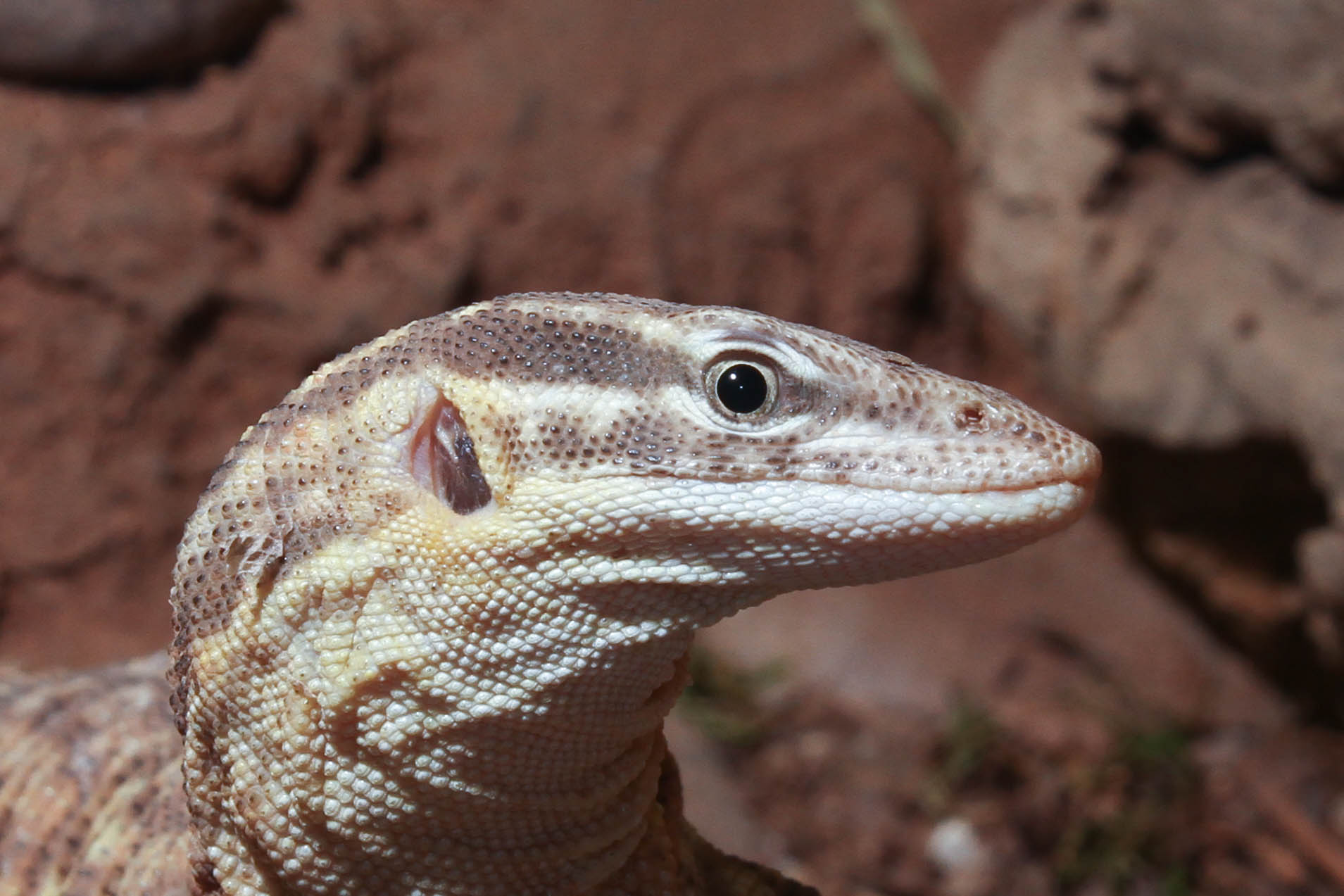 In-depth
Ackie (spiny-tailed) monitor
Varanus acanthurus
A pint-sized monitor with a huge personality.
Pet trade
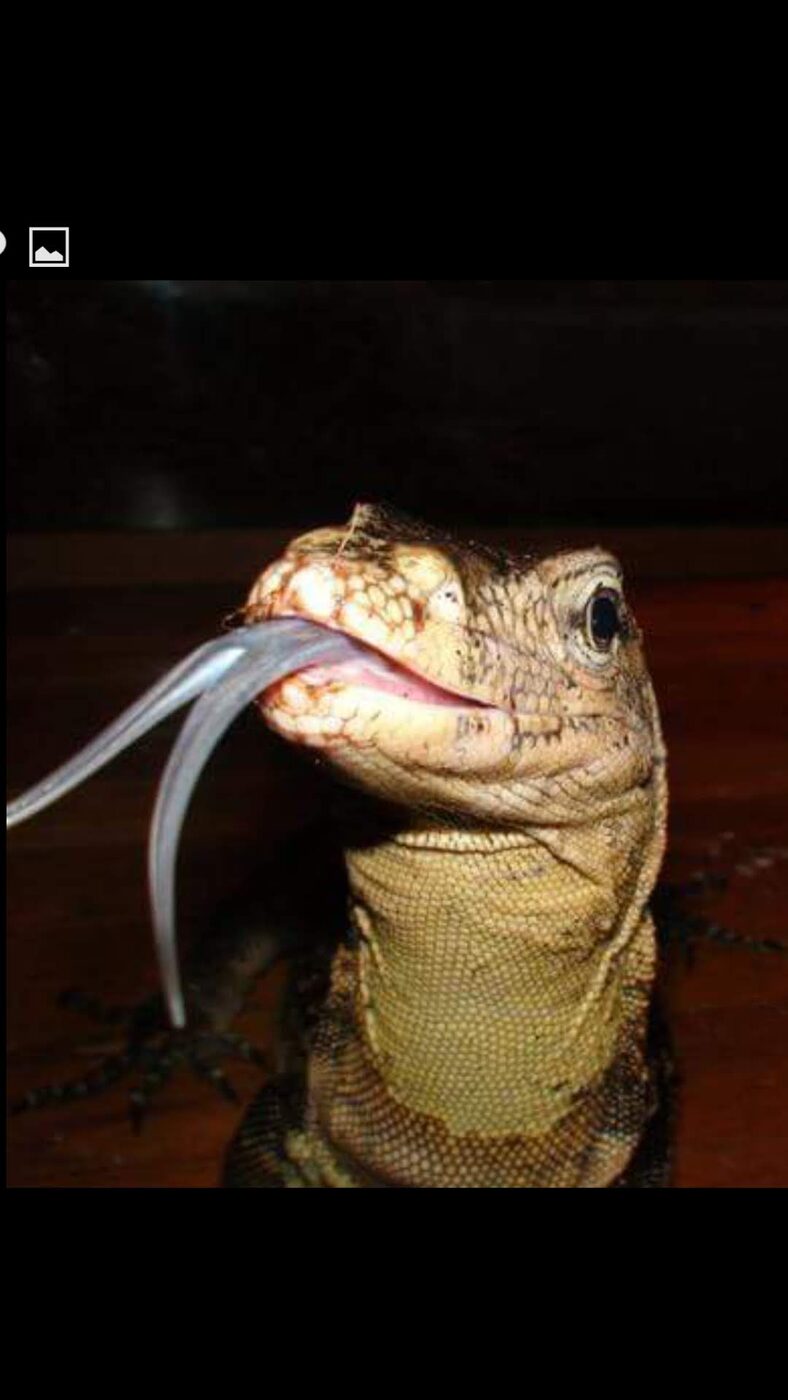 In-depth
Asian water monitor
Varanus salvator
An intelligent, swimming giant: the "gentle giant" of monitors.
Pet trade
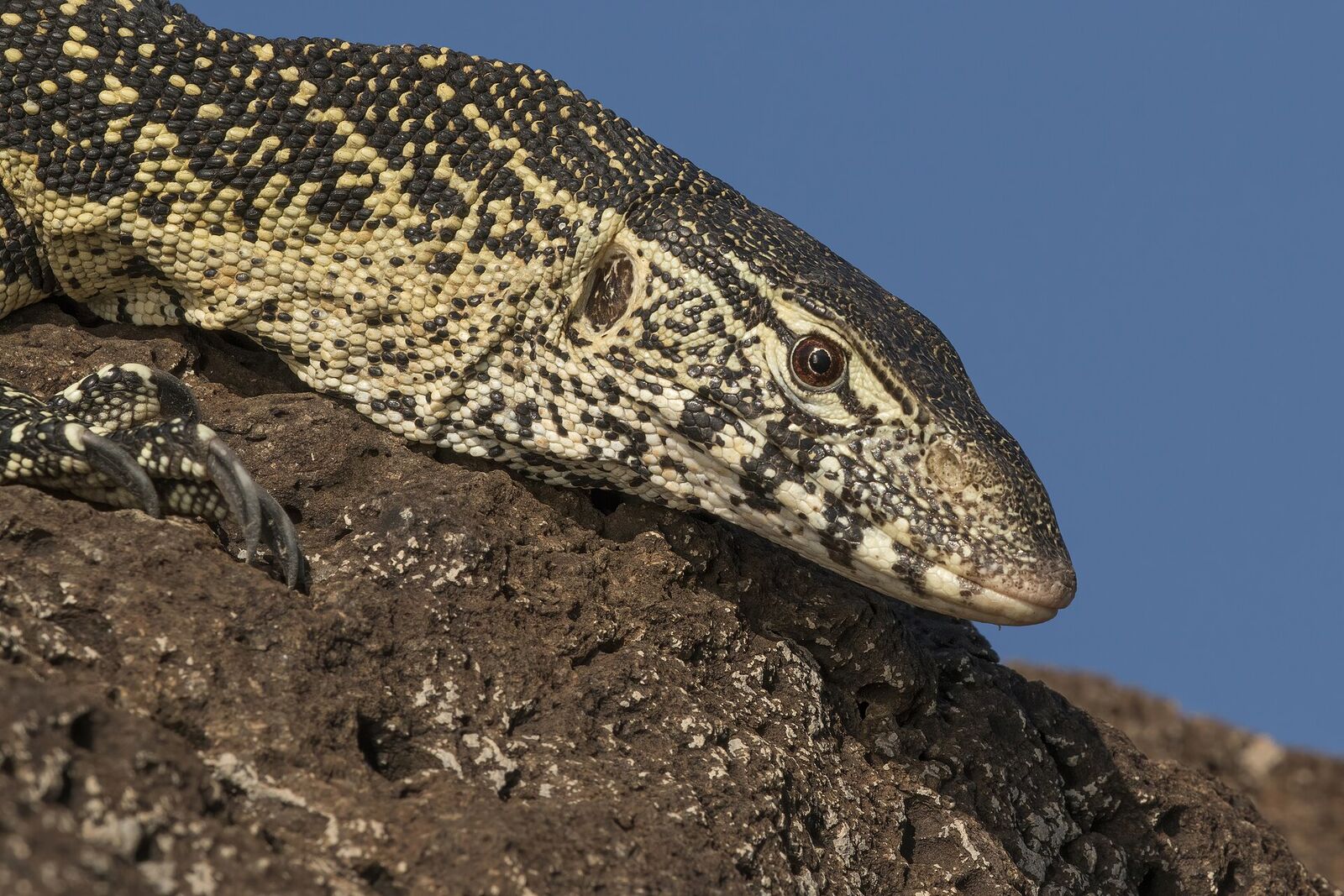 In-depth
Nile monitor
Varanus niloticus
Africa's longest lizard, fast, bold and powerful.
Pet trade