Home / Reptiles / Turtles and tortoises / Russian tortoise
Some federal rules apply In-depth sheetRussian tortoise
Testudo horsfieldii
Reptiles › Turtles and tortoises (Testudines) › Testudinidae (Tortoises)
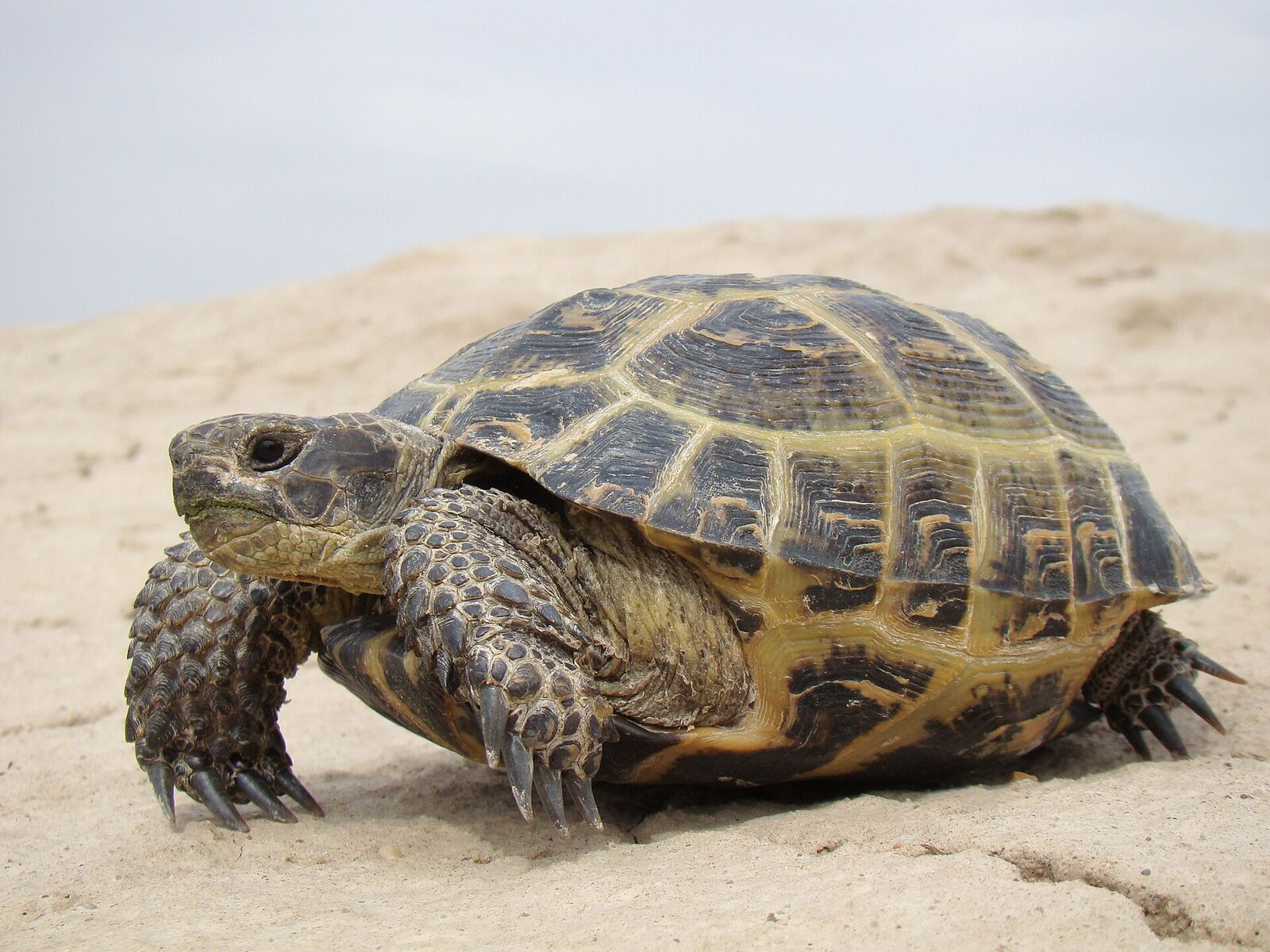
Russian (Horsfield's) tortoises are small, hardy tortoises that live 40+ years. Clint's Reptiles scores them 4.4/5.
Care at a glance
Species-specific values
Values researched for this exact species. Where they differ from the group guide below, follow these. Air, surface and water temperatures are listed separately, and each source is kept as published rather than averaged.
| Minimum enclosure dimensions | length: 7 ft; width: 3.5 ft; height: 2 ft One adult; RF current recommendation, not an older 4 x 2 ft adult minimum. | 223 |
| Basking surface temperature | 95 °F Probe on basking surface. | 223 |
| Cool zone temperature | 75–85 °F Source labels cool-zone temperature without explicitly identifying measurement type. | 223 |
| Night temperature | 70–75 °F RF indoor regime; not brumation temperatures. | 223 |
| Juvenile relative humidity | 40–75 % Day/night variation; humid hide available at every age. | 223 |
| Adult length | 5–10 in Overall shell/body-length estimate in source. | 223 |
| Lifespan | possible at least: 50 years Care-sheet estimate, not a survival guarantee. | 223 |
| Diet | Varied fibrous leafy forage, grasses and safe weeds; sugary fruit is not a staple. | 223 |
| Social needs | Single housing is acceptable; do not house multiple males together. | 223 |
Care guide
Diet
- Mostly weeds (over 70% of the diet) with vegetables and salad if weeds aren't available.
Sources 47
Lighting
- Strong UVB (10–12%) for about 12 hours a day.
Sources 47
Show the group care guide for mediterranean, desert and small tortoises
Mediterranean, desert and small tortoises
Applies to most species in this group. Habitat: Dry scrub and desert. Individual species can differ, so compare with the species numbers above and the linked sources.
Housing & setup
- Tortoise tables indoors or secure outdoor pens; deep substrate for burrowers like Russian tortoises.
- Winter management must follow the identified species and veterinary advice. Egyptian tortoise guidelines prescribe seasonal air changes while retaining a warm basking surface; do not extrapolate temperate Testudo hibernation to every tortoise here.
Climate & lighting
Starting point only: Juvenile Russian and seasonally maintained Egyptian tortoises are not described by a constant dry regime. Check the species-specific values for this animal where shown.
| Basking spot | 95–100°F |
| Warm side / daytime | 80–85°F |
| Cool side | 68–75°F |
| Humidity | 30–50% |
- UVB: Required (strong).
Diet
- High-fiber weeds and greens; avoid fruit.
Health watch
- Respiratory infections in damp cold; overgrown beaks without abrasive food.
Understanding the animal
In the wild
In the wild
Researched for this exact species, not its family. Good care copies these conditions.12345678
| Where it lives | Central Asian dry steppe, rocky desert and hillsides. It often concentrates near springs, brooks or oases where seasonal vegetation is available, and shelters in burrows or beneath rocks. |
| Ground it lives on | Sandy or loamy soil among rocks and sparse plants, suitable for digging long burrows. |
| Climate | Strong continental seasonality with winter cold and hot dry summers. A field study recorded emergence with substrate as low as 53°F and surfaces exceeding 104°F from mid-May; these are field exposures, not captive targets. Numeric wild humidity was not established. |
| Active | Diurnal, concentrated in spring; winter brumation and summer aestivation occur according to locality. |
| Social life | Burrows may be shared and are not necessarily defended; animals do not form coordinated feeding groups. |
| Wild diet | Herbaceous leaves, flowers and other vegetation; an Uzbekistan field study found strong selection for non-grass plants and avoidance of grasses. |
| Behavior to plan for | Excavates long burrows and retreats underground during heat and overnight. Its annual surface-active season can be only about three months. |
What this means for care
- Provide deep diggable substrate and barriers extending below ground.
- Offer broadleaf weeds and leaves rather than a grass-only grazing diet.
- Provide thermally sheltered retreats.
- Treat seasonal dormancy as locality-dependent and plan it with species-specific guidance.
- Naturalis, Turtles of the World: Testudo horsfieldii
- Thermal Biology and Dayly Activity of Central Asian Tortoise
- Lagarde et al.: Foraging behaviour and diet of an ectothermic herbivore: Testudo horsfieldi
- Care and Breeding of the Afghan or Steppe tortoise, Testudo horsfieldii
- Wikipedia: Central Asian tortoise
- The Reptile Database: Testudo horsfieldii
- Russian Tortoise Care Sheet | ReptiFiles
- Russian Tortoise Care Sheet - Reptiles Magazine
Profile
Profile
Researched for this exact species. Sources are listed under In the wild above.
History
The species was placed for several decades in the proposed genus Agrionemys, although that treatment was never unanimous. In 2021 it was again classified in Testudo, with Agrionemys treated as a subgenus. The familiar name 'Russian tortoise' reflects its historical export through the Soviet Union rather than a specifically Russian origin.
Keeper tips
- Provide the opportunity to burrow.
- Plan for several decades of care.
- Consider the animal's origin when acquiring one because Reptiles Magazine states that many adults and subadults in the trade are imported wild-caught animals.
- Do not assume that a small adult body size means minimal long-term care requirements.
Behaviors reported
- Burrows when given the opportunity.
- Described as more active than some other tortoises.
- Described as feisty and eager to eat.
Unique adaptations
- Four toes on each forefoot.
- Enlarged scales on the tail and thighs.
- A clawlike spur at the end of the tail.
- Burrowing is associated with a high tolerance for temperature extremes.
Remarkable facts
- ReptiFiles gives an adult length of about 5-10 inches, while Reptiles Magazine gives a maximum around 8-10 inches.
- Females are generally larger than males.
- Other names include Afghan tortoise, Horsfield's tortoise, Central Asian tortoise, four-clawed tortoise, four-toed tortoise and steppe tortoise.
- The common pet-trade name 'Russian tortoise' became established after animals were heavily exported from Soviet Central Asia.
- The species is considered threatened, with human activity in its native habitat contributing to its status.
- The Reptile Database reports viable hybrids with Testudo graeca ibera and hybrids with Testudo hermanni boettgeri.
Stories
- Two Testudo horsfieldii traveled aboard the Soviet Zond 5 mission in September 1968 and became the first Earth inhabitants to travel around the Moon.
From the sources
From the sources
Quoted from the matching sections of reputable sources for this exact species. Specialist databases are used first; Wikipedia (community-edited, CC BY-SA 4.0) only fills gaps. Other sources are short credited quotes.
| Overview | The Central Asian tortoise (Testudo horsfieldii), also commonly known as the Afghan tortoise, the steppe tortoise, the Russian tortoise (mainly in the pet trade), Horsfield's tortoise, the four-clawed tortoise, the four-toed tortoise, the Russian steppe tortoise, the Soviet tortoise, is a threatened species of tortoise in the family Testudinidae. The species is endemic to Central Asia from the Caspian Sea south through Iran, Pakistan and Afghanistan, and east across Kazakhstan to Xinjiang, China. Human activities in its native habitat contribute to its threatened status. — Wikipedia (community-edited) |
| Where it lives | Range: S Kazakhstan, Kyrgyzstan, Tajikistan, Turkmenistan, Uzbekistan, N/E Iran, Afghanistan, N Pakistan, N/W Baluchistan, NW China (Xinjiang); elevations up to 2400 m (in Afghanistan fide WERNING & WOLF 2007). — The Reptile Database |
| Reproduction | Testudo horsfieldii and Testudo graeca ibera have been reported to produce viable hybrids (KABISCH 2001). T. horsfieldii produced also hybrids with T. hermanni boettgeri (STEINLE 1977, FRITZ 1995). — The Reptile Database |
| Appearance and size | The Russian tortoise is a small tortoise species, with a size range of 13–25 cm. Females grow slightly larger (15–25 cm) to accommodate eggs. Russian tortoises are sexually dimorphic. — Wikipedia (community-edited) |
| History and naming | Named after Dr. Thomas Horsfield (1773-1859), American naturalist and physician. He worked in Java (1796) and for the East India Company and later became a friend of Sir Thomas Raffles. — The Reptile Database |
Data and studies
Researched care notes
Researched care notes
Findings checked against veterinary, zoo, welfare, keeper and peer-reviewed sources. Air, basking-surface and water temperatures are kept separate, and where sources disagree both are shown. “Study” notes report what a paper measured, not a universal rule.
Russian Tortoise
- Plan a substantial walking pen; ReptiFiles recommends about 2.1 × 1.1 m for one adult, but this husbandry recommendation is not an experimentally validated welfare threshold.1
- Outdoor pens need well-drained ground, shade, sunlight, predator protection and barriers against both climbing and digging escapes.1
- Surface: ReptiFiles recommends a basking surface around 95°F (35°C), checked at the actual basking substrate.1
- Provide a humid retreat rather than assuming a dry-region tortoise should experience uniformly dry substrate and air.1
- Base the diet on varied fibrous leafy plants, weeds and appropriate grasses; a fruit-heavy or animal-protein-heavy ration is inappropriate.1
- Individual housing is acceptable; do not assume tortoises need a companion, and monitor any shared housing for aggression and breeding pressure.1
- Provide continuously available clean drinking water in a shallow, easily entered dish; remove fouling promptly.1
- Uvb: ReptiFiles recommends basking UVI around 3–4, accounting for the lamp fixture, mesh and the tortoise's position.1
The numbers
The numbers
Each bar is what one source reports. Where several sources weigh in, the dashed gold band marks their average.
Basking (Testudo group guidance)
RVC's guidance for Mediterranean Testudo tortoises as a group; cool end 68–77°F.
Typical adult weight
Average adult body mass in each database (FishBase gives the maximum recorded weight).
Incubation
Night temperature
Species-specific values from keeper care sheets. Basking figures are often surface readings taken with an infrared thermometer, which run hotter than air.
Humidity
Species-specific values from keeper care sheets. Basking figures are often surface readings taken with an infrared thermometer, which run hotter than air.
Care articles for this species
Care articles for this species
- Russian Tortoise Care Sheet (ReptiFiles)
- Russian Tortoise Care Sheet (Reptiles Magazine)
- Russian Tortoise Care Tips (Reptiles Magazine)
- Russian Tortoise Breeding (Reptiles Magazine)
- Build The Best Breeding Enclosure For Your Russian Tortoises (Reptiles Magazine)
Veterinary & husbandry research
Veterinary & husbandry research
- Herpesviruses in Captive Chelonians in Europe Between 2016 and 2020 Leineweber C et al., Frontiers in veterinary science 2021
- Detection of Mycoplasma spp., herpesviruses, topiviruses, and ferlaviruses in samples from chelonians in Europe Kolesnik E et al., Journal of veterinary diagnostic investigation: official publication of the American Association of Veterinary Laboratory Diagnosticians, Inc 2017
- Urothelial carcinoma in a Russian tortoise (Testudohorsfieldii) Hetterich J et al., Journal of comparative pathology 2023
- Demography, commonly recorded disorders and mortality in chelonia under UK primary veterinary care: A VetCompass study Hornby JM et al., PloS one 2025
Peer-reviewed papers that mention this species alongside captivity, zoos, veterinary care or aquaculture. Some cover several species or mention it only in passing, so check the abstract. See all 8 on PubMed → 170
Sources for this sheet
- Royal Veterinary College Exotics Service: Mediterranean tortoise care Zoo, university or veterinaryVet-school exotics hospital factsheet, reviewed 2021–2024.
- Clint's Reptiles (YouTube): Russian Tortoise, The Best Pet Turtle? Expert educator & keeperClint Laidlaw, PhD in Biology Education and MS in Evolutionary Ecology; owner of Clint's Reptile Room and a longtime keeper. Rates each species on handleability, care, hardiness, availability and upfront cost.
- Myhrvold et al. (2015). An amniote life-history database. Ecology 96: 3109 Peer-reviewed researchPeer-reviewed compilation of life-history data for over 21,000 birds, mammals and reptiles.
- ReptiFiles (care guides) Experienced keeper or breederWell-researched reptile care guides that cite herpetological literature and experienced keepers.
- Species+ (UNEP-WCMC and the CITES Secretariat) Zoo, university or veterinaryThe official database of species listed under CITES.
- USFWS International Affairs: CITES Zoo, university or veterinaryFederal agency that issues CITES permits.
- 21 CFR 1240.62: Turtles under 4 inches (FDA) Zoo, university or veterinaryFederal ban on selling small turtles.
- Merck Veterinary Manual: Management and husbandry of reptiles Zoo, university or veterinaryThe Merck Veterinary Manual: a standard veterinary reference written and reviewed by veterinary specialists.
- Merck Veterinary Manual: Nutritional, metabolic and endocrine diseases of reptiles Zoo, university or veterinaryThe Merck Veterinary Manual: a standard veterinary reference written and reviewed by veterinary specialists.
- ReptiFiles: Russian tortoise care sheet Zoo, university or veterinaryAdded in the 2026 source-checked care-guide review.
- EAZA: Egyptian tortoise Best Practice Guidelines (2019) Zoo, university or veterinaryAdded in the 2026 source-checked care-guide review.
- Merck Veterinary Manual: Important Husbandry Requirements for Selected Reptiles Zoo, university or veterinaryAdded in the 2026 source-checked care-guide review.
- Clint's Reptiles (YouTube): Russian Tortoise, The Best Pet Turtle? Expert educator & keeperClint Laidlaw, PhD in Biology Education and MS in Evolutionary Ecology; owner of Clint's Reptile Room and a longtime keeper. His "Best Pet?" series reviews each species' care in depth.
- The Reptile Database Peer-reviewed researchScientist-curated catalog of every reptile species, with taxonomy and literature.
- GBIF Backbone Taxonomy (Global Biodiversity Information Facility) Peer-reviewed researchInternational scientific taxonomy used here for classification.
- Wikipedia (species article) Community referenceFree encyclopedia; useful overviews with their own citations. Intro text is quoted under CC BY-SA 4.0.
- PubMed (U.S. National Library of Medicine) Peer-reviewed researchIndex of peer-reviewed veterinary, zoo and husbandry research.
- iNaturalist (captive observations) Community referenceCommunity observation platform run by the California Academy of Sciences and National Geographic; observations marked captive show animals living in homes, zoos and aquariums.
- Reptiles Magazine (care articles) Experienced keeper or breederEstablished reptile and amphibian hobby magazine; care articles are written by breeders, keepers and veterinarians.
More tortoises
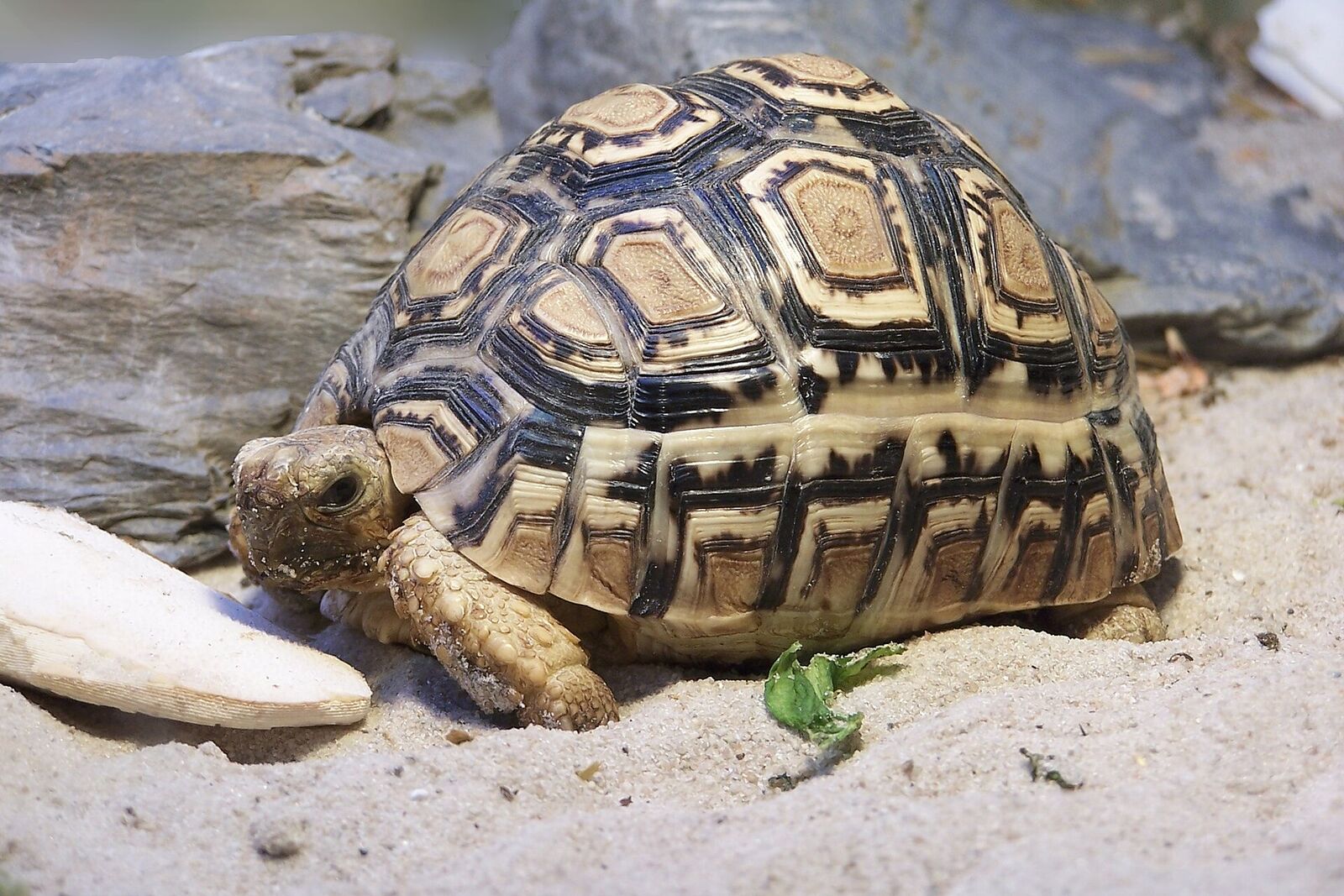 In-depth
Leopard tortoise
Stigmochelys pardalis
A spotted savanna grazer.
Pet trade
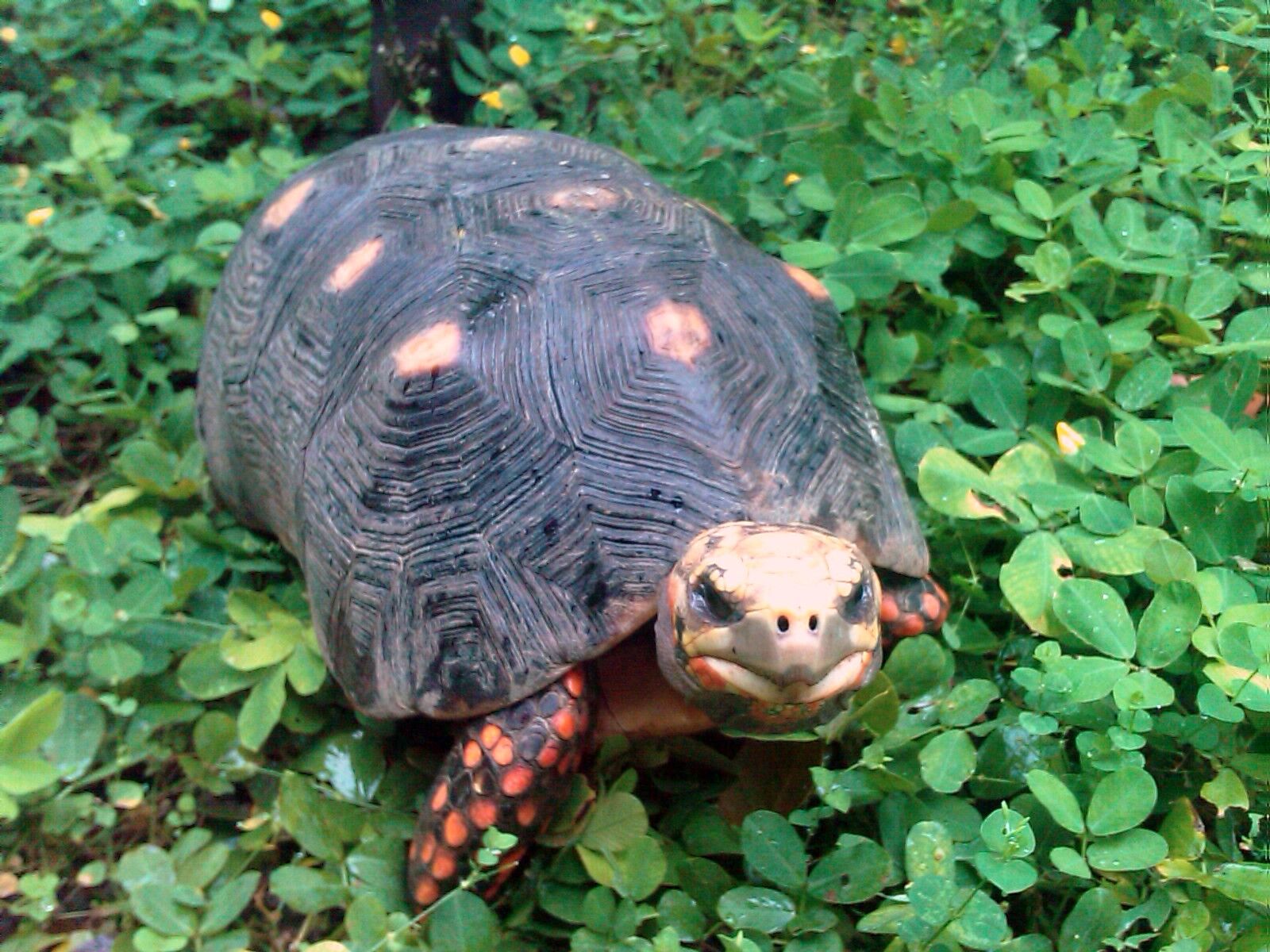 In-depth
Red-footed tortoise
Chelonoidis carbonarius
A humid-forest tortoise that eats fruit.
Pet trade
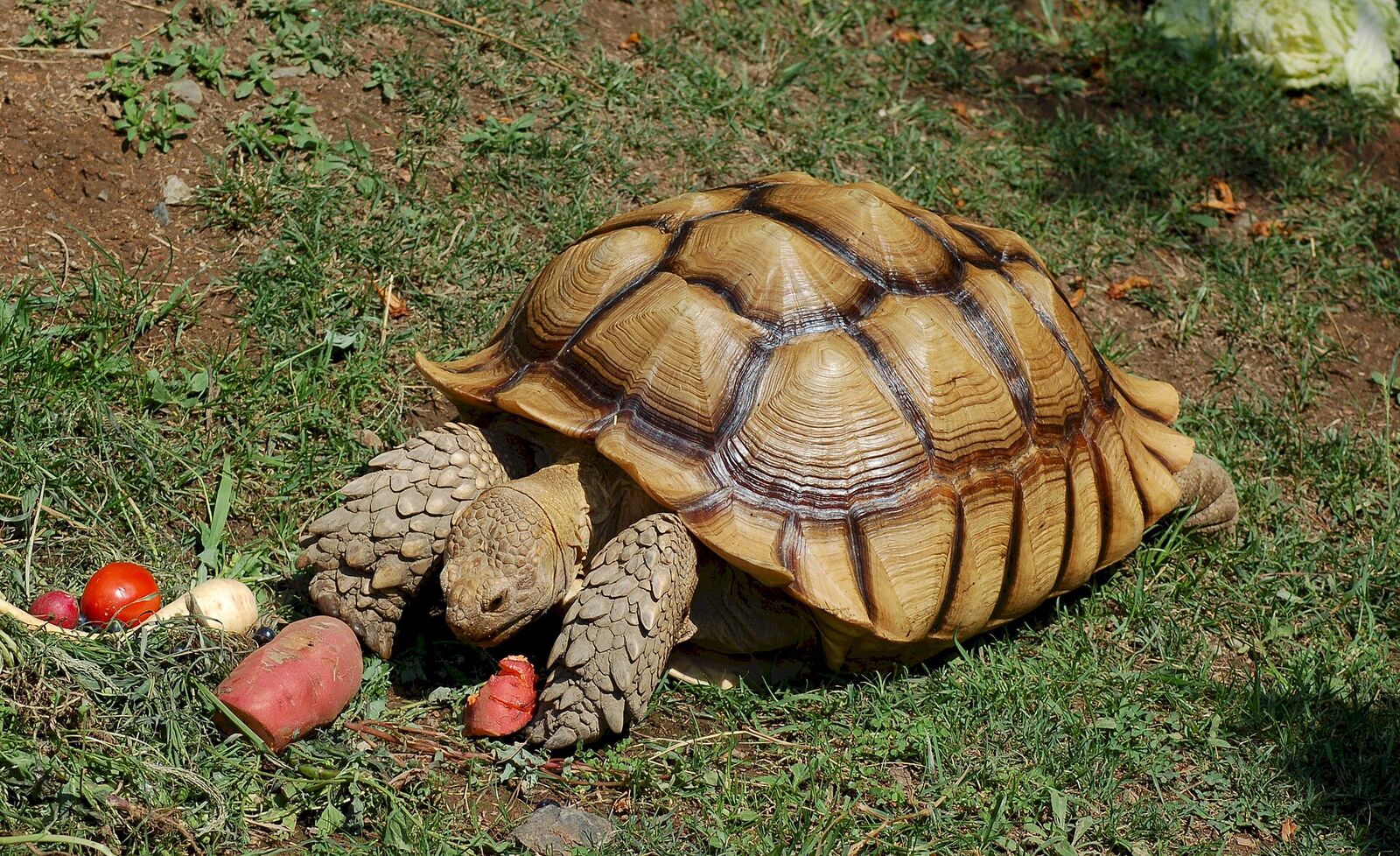 In-depth
Sulcata (African spurred) tortoise
Centrochelys sulcata
The giant backyard tortoise, best adopted.
Pet trade

Egyptian tortoise
Testudo kleinmanni
Pet trade