Home / Fishes / Silversides and rainbowfish / Pacific blue-eye
No federal permit to keepPacific blue-eye
Pseudomugil signifer
Fishes › Silversides and rainbowfish (Atheriniformes) › Pseudomugilidae (Blue-eye rainbowfish)
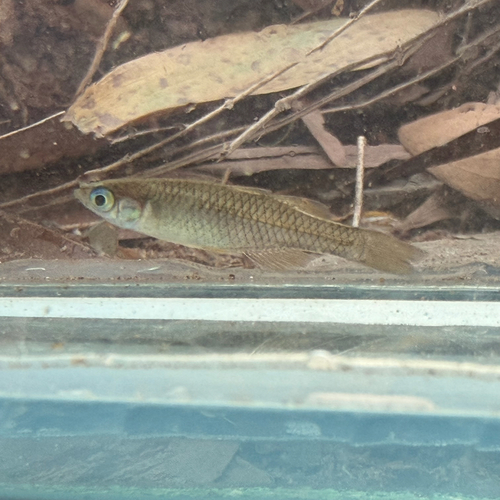
The Pacific blue-eye (Pseudomugil signifer) is a species of fish in the subfamily Pseudomugilinae native to eastern Australia.

Care at a glance
Species-specific aquarium care
- Tank: At least 24 in long and 12 in front to back for one adult (adults commonly reach about 1.4 in / 3.5 cm; the largest recorded was 2.8 in).
- Water: Freshwater (tolerates brackish).
- Temperature: 73–82°F (range recorded for this species).
- pH: 6.5–7.5.
- Hardness: 12–15 dGH.
- Layout: Uses both the bottom and open water: give open swimming space plus cover near the substrate.
- Diet: FishBase classes it as a carnivore.
- Availability: Rarely or never seen in the aquarium trade; expect to source it from specialists or not at all.
Calculated from this species' own FishBase record: tank size from its typical adult length and swimming zone, water values from its recorded ranges. The group guide below fills in general care.
Care guide
Species care notes
- Tank: a base of at least 24 × 12 in (roughly 14 US gallons); space needed is rated “modest tank”.
- Water: a fairly wide range, from slightly acidic to slightly alkaline, 68–79 °F, pH 6.5–7.5, 5–15 dGH.
- Behaviour: a shoaling fish best kept in a group of six or more; suited to a community tank.
- Difficulty: Moderate (Seriously Fish rating).
Short excerpts from the species profile:
- Setup: “Best kept in a densely-planted tank and an excellent choice for the carefully-aquascaped set-up.”
- Diet: “Feeds chiefly on floating or suspended zooplankton, phytoplankton, and invertebrates in nature, and in the aquarium must be offered items of a suitable size.”
- Tankmates: “Most forms are peaceful and suitable for well-chosen community aquaria alongside fishes of comparable size, disposition, and requirements with many cyprinids, gobiids, eleotrids, and smaller melanotaeniids suitable.”
- Breeding: “This species is an egg-scatterer exhibiting no parental care and will often consume its own eggs and fry given the opportunity, although in a well-decorated aquarium some may survive.”
From the Seriously Fish profile for this species, which has the full habitat, maintenance, diet, behaviour and breeding write-up 167
Blue-eye rainbowfish
Applies to most species in this group. Habitat: Blue-eyes occupy Australasian streams and vegetated freshwater margins, with some Pacific blue-eye populations also using brackish mangrove creeks. Individual species can differ, so compare with the species numbers above and the linked sources.
Housing & setup
- Spotted blue-eyes: tank base at least 18 × 12 inches; forktail blue-eyes: at least 24 × 12 inches.
- Plant densely, including floating vegetation and roots that shade the upper water.
- Provide a biologically mature aquarium with well-oxygenated water and some flow.
- For breeding provide fine aquatic moss or spawning mops; adults can eat eggs and fry.
Climate & lighting
| Water | 75.2–82.4°F |
Diet
- Live Daphnia or Moina sized to the fish
- Artemia nauplii
- Microworms
- Small or crushed floating dried foods
Social life
- Keep spotted blue-eyes in shoals of at least 8–10 with similarly small, peaceful companions; avoid competitors that monopolize food.
Health watch
- Ammonia toxicity in immature systems
- Hypoxia
- Inbred forktail stocks can produce deformed fry and reduced fertility
Understanding the animal
About this animal
About this animal
Described by Austrian naturalist Rudolf Kner in 1866, it comprises two subspecies that have been regarded as separate species in the past and may be once again with further study. It is a common fish of rivers and estuaries along the eastern seaboard from Cape York in North Queensland to southern New South Wales, the Burdekin Gap in central-north Queensland dividing the ranges of the two subspecies.
Quoted from the Wikipedia article “Pacific blue-eye” (CC BY-SA 4.0) 174
In the wild
In the wild
From this species’ own FishBase record (habitat, bottom type, water and breeding data), not its family. Good care copies these conditions.1
| Where it lives | Lives in freshwater and brackish water, in rivers and streams, estuaries, mangroves, seagrass beds. Uses both the bottom and open water. Occurs in clear, cool, fast-flowing streams and also brackish mangrove estuaries. Inhabits tidal mangrove creeks or fringing coastal mangrove and around offshore islands. Also common in clear, forest streams. Water temperature varies between 15° and 28°C, with the lower end of the scale applicable during winter over the southernmost part of the range. The pH fluctuates from 5.5-7.8 according to habitat conditions. At least 15 geographical varieties have been recognized, but detailed morphological studies reveal there is only one species. |
| Water it lives in | Freshwater / brackish water, 73–82 °F (23–28 °C), pH 6.5–7.5, hardness 12–15 dH. |
| Climate | Tropical climate. |
| Behavior to plan for | Breeding: open water/substratum egg scatterers. |
What this means for care
- Keep water within its wild range, 73–82 °F.
- It tolerates or needs brackish water; check salinity needs before setup.
Native climate (measured)
Native climate (measured)
| Warm-season highs | about 86°F (up to 91°F in the hottest sampled areas) |
| Cool-season lows | about 49°F (down to 42°F in the coldest sampled areas) |
| Average temperature | 62–76°F across sampled records |
| Relative humidity | 69–74% on average (driest month about 66%) |
| Rainfall | about 1209 mm a year |
Measured at 169 wild occurrence records sampled against WorldClim 2.1 climate data (1970–2000 averages). Air conditions in the range are ecological context, not enclosure settings: microhabitats such as burrows, leaf litter or basking rocks can be cooler, warmer or more humid.
From the sources
From the sources
Quoted from the matching sections of reputable sources for this exact species. Specialist databases are used first; Wikipedia (community-edited, CC BY-SA 4.0) only fills gaps. Other sources are short credited quotes.
| Overview | The Pacific blue-eye (Pseudomugil signifer) is a species of fish in the subfamily Pseudomugilinae native to eastern Australia. Described by Austrian naturalist Rudolf Kner in 1866, it comprises two subspecies that have been regarded as separate species in the past and may be once again with further study. It is a common fish of rivers and estuaries along the eastern seaboard from Cape York in North Queensland to southern New South Wales, the Burdekin Gap in central-north Queensland dividing the ranges of the two subspecies. — Wikipedia (community-edited) |
| Where it lives | Home ranges Population dynamics Growth parameters Max. ages / sizes Length-weight rel. Length-frequencies Mass conversion Recruitment Abundance Life cycle Reproduction Maturity Maturity/Gills rel. — FishBase |
| Behavior | The Pacific blue-eye is found in loose schools of tens to thousands of fish. They are generally found in the middle to upper water column within 1 metre (3 ft) of the riverbank and often close to underwater cover. The Pacific blue-eye is euryhaline—it can survive in a wide range of water salinities from fresh-water to marine environments. — Wikipedia (community-edited) |
| Reproduction | Female Pacific blue-eyes are sexually mature at six months of age or when they have reached 2.3 cm in standard length. Males are mature at 2.8 cm standard length. A study published in 2003 showed that males will preferentially choose larger females—who are more fecund as a rule—unless more energy is required to do so, such as swimming further against a current. — Wikipedia (community-edited) |
| Appearance and size | The Pacific blue-eye generally reaches a total length of around 3–3.5 long; males can reach 8.8 cm and females 6.3 cm. The size of Pacific blue-eyes found north of the Burdekin Gap increases directly with distance from the gap, males and females being the same size. — Wikipedia (community-edited) |
| Biology | Occurs in clear, cool, fast-flowing streams and also brackish mangrove estuaries. Inhabits tidal mangrove creeks or fringing coastal mangrove and around offshore islands. Also common in clear, forest streams. — FishBase |
| History and naming | Austrian naturalist Rudolf Kner described the species in 1866, from a specimen collected in Sydney in 1858 during the course of the Novara Expedition and taken to Vienna by the SMS Novara. German–British zoologist Albert Günther described Atherina signata from collections in Cape York in 1867. — Wikipedia (community-edited) |
Data and studies
The numbers
The numbers
Each bar is what one source reports. Where several sources weigh in, the dashed gold band marks their average.
Adult length
Common length to maximum recorded length. Measured as standard length (snout to the base of the tail, not counting the tail fin). Fish in home aquariums often stay smaller than wild records.
Water temperature
Range the species tolerates in nature; aim for the middle.
Minimum tank footprint
Seriously Fish recommends a tank base of at least 24 × 12 in (about 14 US gallons).
Sources for this sheet
- FishBase (Froese & Pauly, eds.), version 24.07 Peer-reviewed researchThe global scientific database on fishes, maintained by a consortium of research institutions; every value is referenced.
- Seriously Fish species profiles Experienced keeper or breederLong-running aquarium reference written and peer-checked by experienced fishkeepers and ichthyologists; each profile covers habitat, tank size, water, diet, behaviour and breeding.
- Seriously Fish: Pseudomugil gertrudae Experienced keeper or breederAdded in the 2026 source-checked care-guide review.
- Seriously Fish: Pseudomugil furcatus Experienced keeper or breederAdded in the 2026 source-checked care-guide review.
- FishBase: Pseudomugil signifer Peer-reviewed researchAdded in the 2026 source-checked care-guide review.
- Merck Veterinary Manual: Common Environmental Hazards for Fish Zoo, university or veterinaryAdded in the 2026 source-checked care-guide review.
- Wikipedia (species article) Community referenceFree encyclopedia; useful overviews with their own citations. Intro text is quoted under CC BY-SA 4.0.
- iNaturalist (captive observations) Community referenceCommunity observation platform run by the California Academy of Sciences and National Geographic; observations marked captive show animals living in homes, zoos and aquariums.