Home / Fishes / Silversides and rainbowfish / Neon blue-eye
No federal permit to keepNeon blue-eye
Pseudomugil cyanodorsalis
Fishes › Silversides and rainbowfish (Atheriniformes) › Pseudomugilidae (Blue-eye rainbowfish)
The neon blue-eye (Pseudomugil cyanodorsalis) or blueback blue-eye, is a species of fish in the subfamily Pseudomugilinae.

Care at a glance
Species-specific aquarium care
- Tank: At least 24 in long and 12 in front to back for one adult (adults commonly reach about 1.4 in / 3.5 cm).
- Water: Marine.
- Temperature: 72–88°F (range recorded for this species).
- Layout: An open-water coastal swimmer: needs long, open swimming space.
Calculated from this species' own FishBase record: tank size from its typical adult length and swimming zone, water values from its recorded ranges. The group guide below fills in general care.
Care guide
Species care notes
- Tank: a base of at least 18 × 12 in (roughly 11 US gallons); space needed is rated “modest tank”.
- Water: a fairly wide range, from slightly acidic to slightly alkaline, 70–88 °F, pH 7–8.5, 10–25 dGH.
- Behaviour: temperament peaceful; a shoaling fish best kept in a group of six or more; not a community fish.
- Difficulty: Moderate (Seriously Fish rating).
Short excerpts from the species profile:
- Setup: “Opinions vary as to whether this species requires salt or not, though the general consensus is that it's more vigorous, fecund, and long-lived when maintained in brackish conditions.”
- Diet: “Feeds chiefly on floating or suspended zooplankton, phytoplankton, and invertebrates in nature, and in the aquarium must be offered items of a suitable size.”
- Tankmates: “Peaceful but unsuitable for the general community aquarium since it's easily outcompeted and quite timid.”
- Breeding: “This species is an egg-scatterer exhibiting no parental care and will consume its own eggs and fry given the opportunity.”
From the Seriously Fish profile for this species, which has the full habitat, maintenance, diet, behaviour and breeding write-up 167
Blue-eye rainbowfish
Applies to most species in this group. Habitat: Blue-eyes occupy Australasian streams and vegetated freshwater margins, with some Pacific blue-eye populations also using brackish mangrove creeks. Individual species can differ, so compare with the species numbers above and the linked sources.
Housing & setup
- Spotted blue-eyes: tank base at least 18 × 12 inches; forktail blue-eyes: at least 24 × 12 inches.
- Plant densely, including floating vegetation and roots that shade the upper water.
- Provide a biologically mature aquarium with well-oxygenated water and some flow.
- For breeding provide fine aquatic moss or spawning mops; adults can eat eggs and fry.
Climate & lighting
| Water | 75.2–82.4°F |
Diet
- Live Daphnia or Moina sized to the fish
- Artemia nauplii
- Microworms
- Small or crushed floating dried foods
Social life
- Keep spotted blue-eyes in shoals of at least 8–10 with similarly small, peaceful companions; avoid competitors that monopolize food.
Health watch
- Ammonia toxicity in immature systems
- Hypoxia
- Inbred forktail stocks can produce deformed fry and reduced fertility
Understanding the animal
About this animal
About this animal
It is found in northern Australia, in the Gulf Country, the Kimberley and around Darwin. First described in 1983, they have become established in the aquarium trade worldwide.
Quoted from the Wikipedia article “Neon blue-eye” (CC BY-SA 4.0) 174
In the wild
In the wild
From this species’ own FishBase record (habitat, bottom type, water and breeding data), not its family. Good care copies these conditions.1
| Where it lives | Lives in brackish water and the sea. Swims in open water near the coast. Inhabits mangrove swamps and highly saline creeks flowing into estuaries, usually swimming over muddy bottom. Often congregate in large numbers. May be found in hypersaline waters (28-40 ppt) and in relatively high temperatures (22-31°C). Breeding has been achieved in aquaria; the eggs take about two weeks to hatch and young fish reach adulthood in only three months. |
| Water it lives in | Brackish water / marine, 72–88 °F (22–31 °C). |
| Climate | Tropical climate. |
What this means for care
- Keep water within its wild range, 72–88 °F.
- It tolerates or needs brackish water; check salinity needs before setup.
From the sources
From the sources
Quoted from the matching sections of reputable sources for this exact species. Specialist databases are used first; Wikipedia (community-edited, CC BY-SA 4.0) only fills gaps. Other sources are short credited quotes.
| Overview | The neon blue-eye (Pseudomugil cyanodorsalis) or blueback blue-eye, is a species of fish in the subfamily Pseudomugilinae. It is found in northern Australia, in the Gulf Country, the Kimberley and around Darwin. First described in 1983, they have become established in the aquarium trade worldwide. — Wikipedia (community-edited) |
| Where it lives | Home ranges Population dynamics Growth parameters Max. ages / sizes Length-weight rel. Length-frequencies Mass conversion Recruitment Abundance Life cycle Reproduction Maturity Maturity/Gills rel. — FishBase |
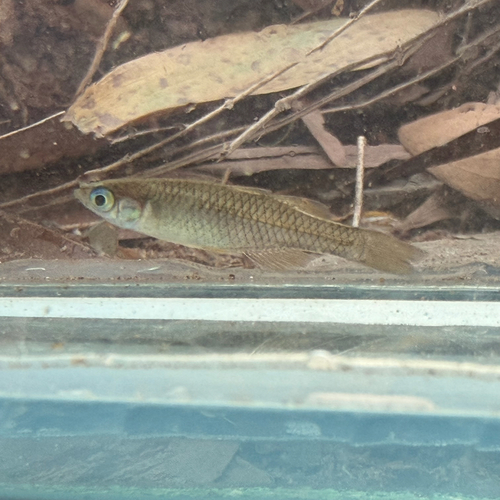
| Appearance and size | The Neon blue-eye is a small fish, attaining a total length of 3.5 cm. It is a sexually dimorphic species in which the males are colourful being a metallic blue on their backs, dotted with small black spots, a narrow black stripe along the centre of their flanks separates the blue back from the translucent to yellowish white lower half of their body. — Wikipedia (community-edited) |
| Biology | Inhabits mangrove swamps and highly saline creeks flowing into estuaries, usually swimming over muddy bottom. Often congregate in large numbers. May be found in hypersaline waters (28-40 ppt) and in relatively high temperatures (22-31°C). — FishBase |
| History and naming | The neon blue-eye was first discovered by Helen K. Larson in 1981 near Darwin before Neil Sarti found it in Crab Creek near Broome a year later. In 1983 the species was formally described by Gerald R Allen and Neil Sarti in 1983 with Crab Creek given as the type locality. — Wikipedia (community-edited) |
Data and studies
The numbers
The numbers
Each bar is what one source reports. Where several sources weigh in, the dashed gold band marks their average.
Adult length
Maximum recorded length. Measured as total length. Fish in home aquariums often stay smaller than wild records.
Water temperature
Range the species tolerates in nature; aim for the middle.
pH
Water hardness
Minimum tank footprint
Seriously Fish recommends a tank base of at least 18 × 12 in (about 11 US gallons).
Sources for this sheet
- FishBase (Froese & Pauly, eds.), version 24.07 Peer-reviewed researchThe global scientific database on fishes, maintained by a consortium of research institutions; every value is referenced.
- Seriously Fish species profiles Experienced keeper or breederLong-running aquarium reference written and peer-checked by experienced fishkeepers and ichthyologists; each profile covers habitat, tank size, water, diet, behaviour and breeding.
- Seriously Fish: Pseudomugil gertrudae Experienced keeper or breederAdded in the 2026 source-checked care-guide review.
- Seriously Fish: Pseudomugil furcatus Experienced keeper or breederAdded in the 2026 source-checked care-guide review.
- FishBase: Pseudomugil signifer Peer-reviewed researchAdded in the 2026 source-checked care-guide review.
- Merck Veterinary Manual: Common Environmental Hazards for Fish Zoo, university or veterinaryAdded in the 2026 source-checked care-guide review.
- Wikipedia (species article) Community referenceFree encyclopedia; useful overviews with their own citations. Intro text is quoted under CC BY-SA 4.0.