Home / Invertebrates / Spiders / Mexican redknee tarantula
Some federal rules apply In-depth sheetMexican redknee tarantula
Brachypelma hamorii
Invertebrates › Spiders (Araneae) › Theraphosidae (Tarantulas)
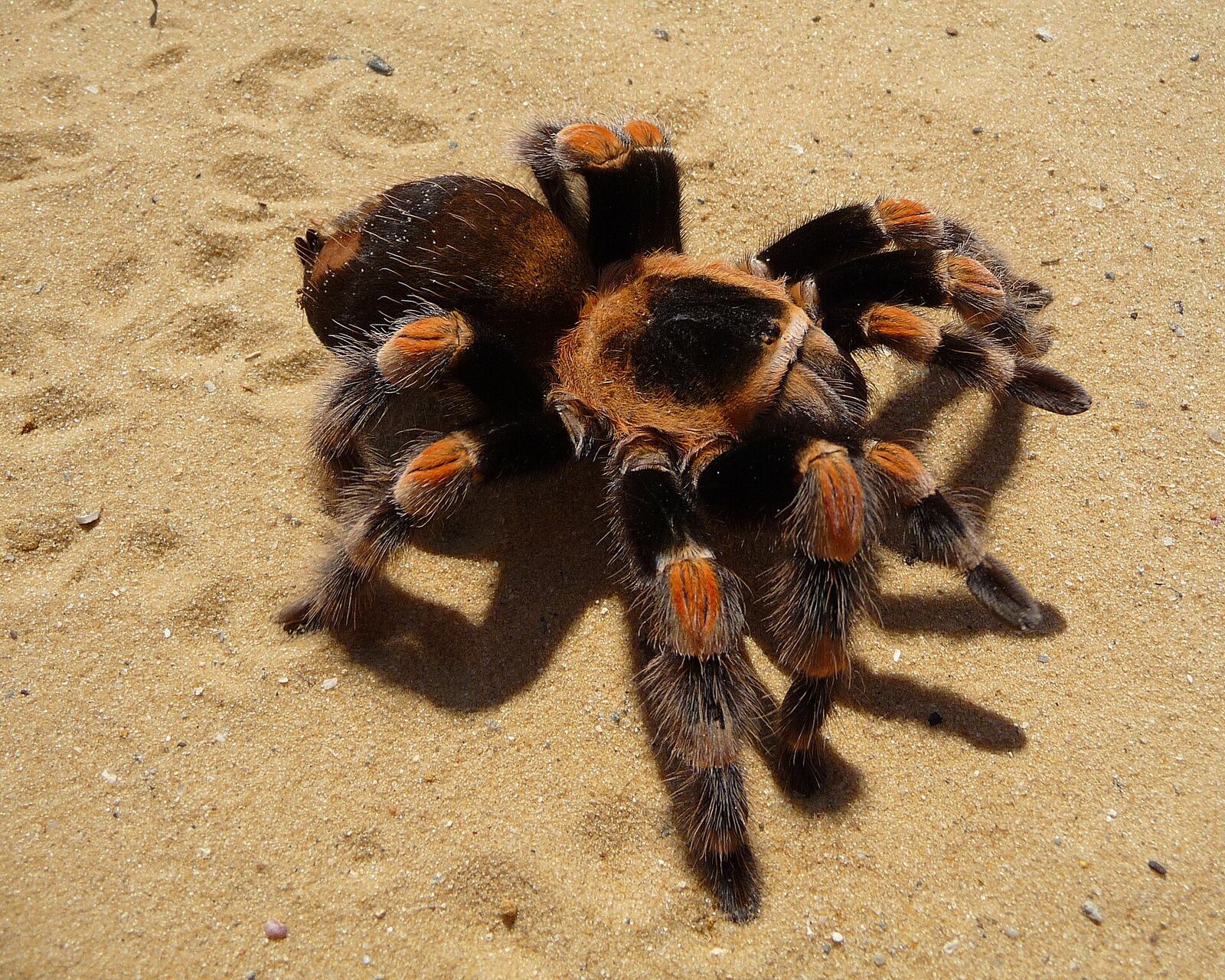
Mexican redknee tarantulas are docile, slow-growing ground dwellers. Females live 25–30 years; males rarely pass 10.
Care guide
Care
- Dry, burrow-friendly enclosure with plenty of substrate.
- They flick irritating hairs when stressed; keep hands away from your eyes.
Show the group care guide for tarantulas
Tarantulas
Applies to most species in this group. Habitat: Grassland, desert and rainforest. Individual species can differ, so compare with the species numbers above and the linked sources.
Housing & setup
- Separate dry terrestrial adults from moisture-dependent species. For dry terrestrials, keep most substrate dry with a filled water dish and a locally damp corner; moisture-dependent species need deep substrate with damp lower layers, never a flooded burrow.
- Arboreal species need vertical retreats and cross-ventilation. Do not make Avicularia housing stagnant to reach a high humidity percentage; water access and airflow matter.
Climate & lighting
Starting point only: Remove universal temperature/humidity targets. RVC uses 60–65% RH for most species and 75% for some; Moran prioritizes water, ventilation and substrate moisture. These approaches disagree and species overrides should retain the distinction. Check the species-specific values for this animal where shown.
| Warm side / daytime | 72–82°F |
| Humidity | 60–75% |
Diet
- Crickets, roaches and other insects; adults may eat weekly or less and fast before molting.
Handling
- Handling is optional and risky for the spider; most keepers avoid it.
Health watch
- Never feed during a molt. Many New World species flick irritating hairs; Old World species have stronger venom and are fast and defensive.
Understanding the animal
In the wild
In the wild
Researched for this exact species, not its family. Good care copies these conditions.12
| Where it lives | Seasonal subtropical dry forest along Mexico's Pacific foothills in Colima, Jalisco and Michoacán. It occupies burrows and cavities beneath rocks, roots or fallen wood among thorn scrub and grass. |
| Ground it lives on | Burrowable soil beneath rocks, roots and fallen logs in dry forest. |
| Climate | Seasonal dry-forest conditions with distinct rainy and dry seasons; burrows provide buffered refuges. Numeric wild temperature and relative-humidity ranges were not established. |
| Active | Nocturnal; waits near its refuge entrance from dusk. Mature males wander during the late rainy and early dry seasons. |
| Social life | Individual burrow occupancy; males seek females during mating season. Territorial boundaries are not established in the sources. |
| Wild diet | Ground-dwelling insects, other arachnids and myriapods; small vertebrates may also be taken. |
| Behavior to plan for | Excavates or modifies refuges and ambushes prey at the entrance. Defense includes urticating hairs and a venomous bite. |
What this means for care
- Provide deep substrate capable of supporting a burrow and an anchored starter refuge.
- Provide a moisture gradient instead of treating dry forest as uniformly desiccated soil.
- Prioritize floor area and limit fall height.
- Minimize handling to reduce hair exposure and defensive responses.
From the sources
From the sources
Quoted from the matching sections of reputable sources for this exact species. Specialist databases are used first; Wikipedia (community-edited, CC BY-SA 4.0) only fills gaps. Other sources are short credited quotes.
| Overview | Brachypelma hamorii is a vulnerable species of tarantula found in Mexico. It has been confused with B. smithi; both have been called Mexican redknee tarantulas. Many earlier sources referring to B. smithi either do not distinguish between the two species or relate to B. hamorii. B. hamorii is a terrestrial tarantula native to the western faces of the Sierra Madre Occidental and Sierra Madre del Sur mountain ranges in the Mexican states of Colima, Jalisco, and Michoacán. — Wikipedia (community-edited) |
| Where it lives | B. hamorii and the very similar B. smithi are found along the Pacific Coast of Mexico on opposite sides of the Balsas River basin as it opens onto the Pacific. B. hamorii is found to the north, in the states of Colima, Jalisco, and Michoacán. The natural habitat of the species is in hilly deciduous tropical forests. — Wikipedia (community-edited) |
| Behavior | Like most New World tarantulas, B. hamorii specimens kick urticating hairs from their abdomens and back legs if disturbed, rather than bite. — Wikipedia (community-edited) |
| Lifespan | B. hamorii grows very slowly and matures relatively late. The females of this species can live up to 30 years, but the males tend to live for only 5 years or so. — Wikipedia (community-edited) |
| Appearance and size | Brachypelma hamorii is a large spider. A sample of seven females had a total body length (excluding chelicerae and spinnerets) in the range 52–54 mm. A sample of 11 males was slightly smaller, with a total body length in the range 46–52 mm. — Wikipedia (community-edited) |
| History and naming | Brachypelma hamorii was initially misidentified as the very similar B. smithi, a species originally described in 1897. In 1968, the holotype of B. smithi was found to be an immature male, and in 1994, A. M. Smith redescribed B. smithi using two adult specimens. — Wikipedia (community-edited) |
| Conservation | In 1985, B. smithi (then not distinguished from B. hamorii) was placed on CITES Appendix II. Wild-caught specimens shipped for the Chinese market were decreasing in size. The smaller sizes were suspected to be a consequence of a declining population due to excessive export. — Wikipedia (community-edited) |
Data and studies
Researched care notes
Researched care notes
Findings checked against veterinary, zoo, welfare, keeper and peer-reviewed sources. Air, basking-surface and water temperatures are kept separate, and where sources disagree both are shown. “Study” notes report what a paper measured, not a universal rule.
Mexican Redknee Tarantula
- Identification: Brachypelma hamorii and B. smithi are distinct accepted species; the common name 'Mexican redknee' should not automatically assign every trade animal to B. smithi.1
- Tom's older B. smithi care article explicitly corrects its subject to B. hamorii; retain that correction when attributing the author's husbandry observations.2
- The keeper describes a relatively dry adult B. hamorii setup with a water dish; this single-animal account does not establish a universal substrate-moisture rule for spiderlings.2
- Redknee tarantulas can release irritating abdominal hairs when disturbed; a reputation for calmness does not eliminate this defensive response.2
- Suitable feeder insects are practical prey; adjust feeding to body condition rather than treating one keeper's weekly cricket count as a fixed dose.2,3
Terrestrial Tarantulas (beginner housing module)
Researched for this whole family or group; check species differences before applying.
- Use a secure terrestrial enclosure with refuge, appropriate substrate, and available water. Arboreal and deep-burrowing species require separate designs.4
- The keeper essay recommends managing substrate moisture, drinking water, and ventilation rather than chasing a generic RH number. Keeper experience; confidence LOW.5
Terrestrial Tarantulas
Researched for this whole family or group; check species differences before applying.
- A spider lying on its back may be molting; do not turn it upright or disturb the molt.4,3
- Remove loose living prey when a tarantula stops feeding before a molt, because prey insects can injure or kill the vulnerable spider.4
- Resume feeding only after the new exoskeleton has hardened; the BTS notes that newly molted adults can need more than a week.4
- Minimize fall risk and routine handling; the BTS recommends no handling because even a short fall can seriously injure a tarantula.4
- Arrange rocks and other heavy furnishings so they cannot fall onto the spider or create hazardous falls.3
- Natural History Museum Bern — World Spider Catalog: Brachypelma
- Tom's Big Spiders — Brachypelma hamorii (Mexican Redknee): A Tarantula Icon, corrected species note
- University of Illinois College of Veterinary Medicine — Care and Keeping of Tarantulas
- British Tarantula Society, basic keeping guide
- Tom’s Big Spiders, humidity, temperature, and tarantulas; keeper-experience source
The numbers
The numbers
Each bar is what one source reports. Where several sources weigh in, the dashed gold band marks their average.
Temperature
Humidity
Female lifespan
Sources for this sheet
- Animal Diversity Web (University of Michigan): Brachypelma smithi Zoo, university or veterinaryUniversity-hosted species account, mostly wild biology.
- Royal Veterinary College Exotics Service: Tarantula care Zoo, university or veterinaryVet-school exotics hospital factsheet, reviewed 2021–2024.
- Clint's Reptiles (YouTube): Mexican Redknee Tarantula, The Best Pet Spider? Expert educator & keeperClint Laidlaw, PhD in Biology Education and MS in Evolutionary Ecology; owner of Clint's Reptile Room and a longtime keeper. Rates each species on handleability, care, hardiness, availability and upfront cost.
- Species+ (UNEP-WCMC and the CITES Secretariat) Zoo, university or veterinaryThe official database of species listed under CITES.
- USFWS International Affairs: CITES Zoo, university or veterinaryFederal agency that issues CITES permits.
- Amateur Entomologists' Society: Tarantula care sheet Experienced keeper or breederAmateur Entomologists' Society (UK charity, since 1935): practical invertebrate care sheets written by experienced keepers.
- University of Kentucky: Exotic Bugs—Care and Feeding Zoo, university or veterinaryAdded in the 2026 source-checked care-guide review.
- Tom Moran: Keeping Moisture Dependent Tarantula Species Experienced keeper or breederAdded in the 2026 source-checked care-guide review.
- Tom Moran: Humidity, Temperature, and Tarantulas Experienced keeper or breederAdded in the 2026 source-checked care-guide review.
- Royal Veterinary College: Tarantula care and advice (December 2022) Zoo, university or veterinaryAdded in the 2026 source-checked care-guide review.
- Clint's Reptiles (YouTube): Mexican Redknee Tarantula, The Best Pet Spider? How To Breed Tarantulas W/out Anybody Getting Eaten Expert educator & keeperClint Laidlaw, PhD in Biology Education and MS in Evolutionary Ecology; owner of Clint's Reptile Room and a longtime keeper. His "Best Pet?" series reviews each species' care in depth.
- GBIF Backbone Taxonomy (Global Biodiversity Information Facility) Peer-reviewed researchInternational scientific taxonomy used here for classification.
- Wikipedia (species article) Community referenceFree encyclopedia; useful overviews with their own citations. Intro text is quoted under CC BY-SA 4.0.
- iNaturalist (captive observations) Community referenceCommunity observation platform run by the California Academy of Sciences and National Geographic; observations marked captive show animals living in homes, zoos and aquariums.

