Home / Mammals / Rodents / Golden (Syrian) hamster
No federal permit to keep In-depth sheetGolden (Syrian) hamster
Mesocricetus auratus
Mammals › Rodents (Rodentia) › Cricetidae (Hamsters, voles, American mice)
Hamsters are small nocturnal rodents that mostly live alone. A study of almost 4,000 vet records found pet hamsters live about 21 months on average.
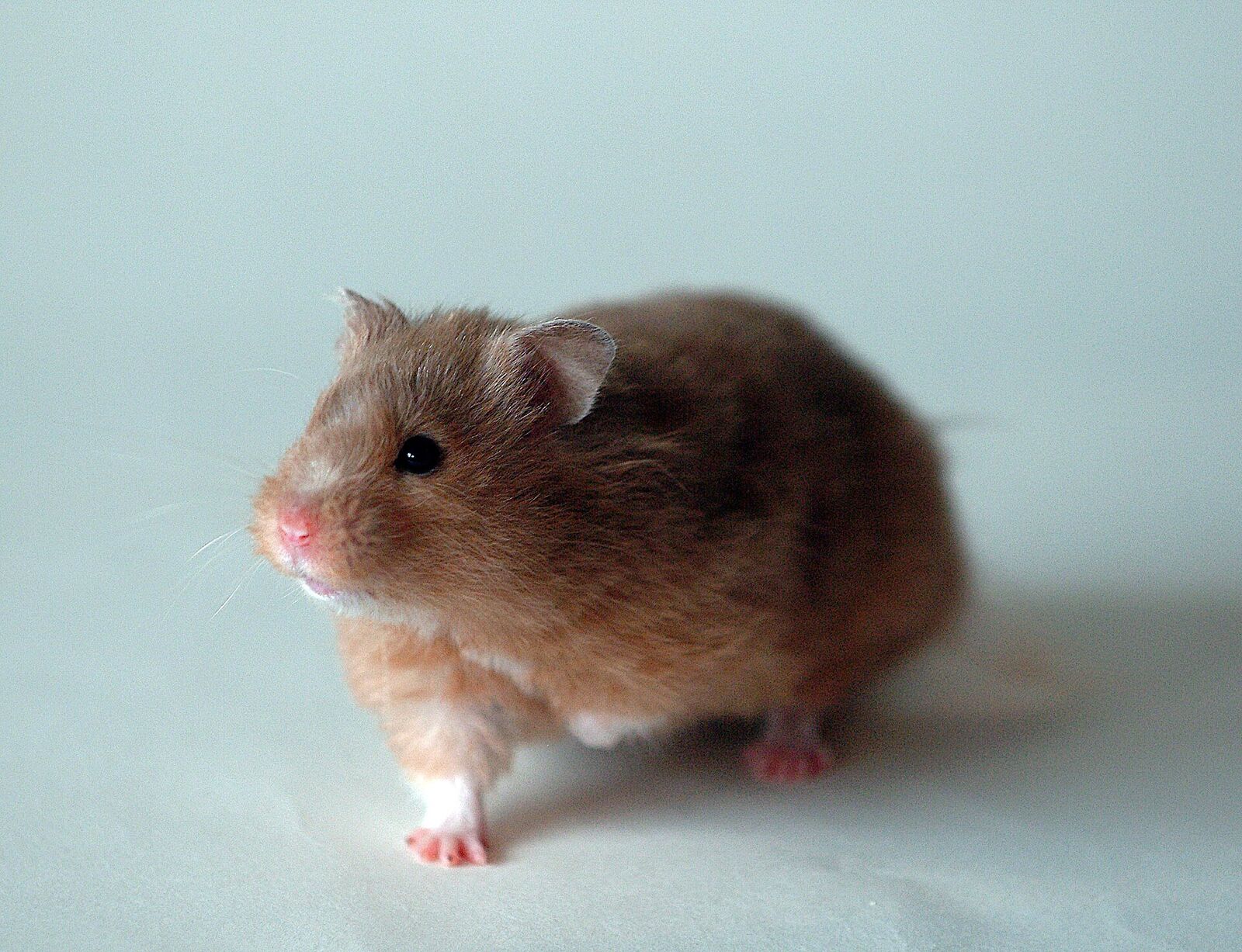
Care at a glance
Species-specific values
Values researched for this exact species. Where they differ from the group guide below, follow these. Air, surface and water temperatures are listed separately, and each source is kept as published rather than averaged.
| Lifespan typical captive | 1–2 years Pet-rodent table; not maximum longevity | 291 |
| Adult body mass male | 85–140 g | 291 |
| Adult body mass female | 95–120 g | 291 |
| Enclosure minimum | length: 100 cm; width: 50 cm; height: 50 cm Blue Cross pet-hamster recommendation | 292 |
| Substrate depth minimum | 20 cm | 292 |
| Social | Individual housing recommended. | 292 |
Care guide
Housing
- A large enclosure with deep bedding for burrowing, kept out of direct sun; tanks overheat easily.
Sources 43
Health
- The 2022 study of almost 4,000 hamsters identified their most common health problems, a useful read for owners.
Sources 59
Show the group care guide for hamsters, voles and new world mice
Hamsters, voles and New World mice
Applies to most species in this group. Habitat: Steppe, grassland and fields. Individual species can differ, so compare with the species numbers above and the linked sources.
Housing & setup
- For common pet hamsters, Blue Cross recommends 100×50×50 cm or larger, with at least 20 cm of burrowing bedding and a solid wheel.
Diet
- Hamster pellets or mix plus vegetables; occasional protein.
Social life
- House common pet hamsters individually; other voles and New World mice need their own species guidance.
Health watch
- For pet hamsters, Blue Cross recommends individual housing, including dwarf hamsters; companionship is not worth a fighting risk.
- Wet tail (diarrhea) in young hamsters is an emergency.
Understanding the animal
In the wild
In the wild
Researched for this exact species, not its family. Good care copies these conditions.123
| Where it lives | Northern Syria’s Aleppo plateau and adjacent southern Turkey; wild burrows occur in steppe-derived agricultural land, including legume fields and near irrigation wells. |
| Ground it lives on | diggable agricultural soil with underground nesting and food-storage chambers |
| Climate | The habitat account reports summer midday air temperatures of 95–100°F, summer nights 43–59°F and winter around 50°F with rain; burrows buffer exposure. Wild relative-humidity ranges are unavailable. |
| Active | Field-observed females were diurnal, chiefly early morning and late afternoon; captive animals are usually nocturnal. Winter torpor is reported, but wild timing is poorly resolved. |
| Social life | Solitary and strongly territorial except during mating. |
| Wild diet | Seeds, nuts and insects, including ants, flies and cockroaches. |
| Behavior to plan for | Caches food underground and aggressively excludes other adults. Natural surface activity differs from the familiar laboratory rhythm. |
What this means for care
- House adults individually.
- Provide deep burrow-supporting bedding, a dark nest and food-search opportunities.
- Respect captive activity rhythms; wild daytime observations do not justify waking pets.
- Do not reproduce regional air extremes as enclosure targets.
Native climate (measured)
Native climate (measured)
| Warm-season highs | about 84°F (up to 95°F in the hottest sampled areas) |
| Cool-season lows | about 30°F (down to 14°F in the coldest sampled areas) |
| Average temperature | 45–70°F across sampled records |
| Relative humidity | 65–75% on average (driest month about 63%) |
| Rainfall | about 775 mm a year, spread fairly evenly |
| Winters | Cool to cold winters (lows around 30°F) in much of its native range. Seasonal slowdown may be relevant, but species-specific biology determines whether brumation or hibernation occurs. |
Measured at 50 wild occurrence records sampled against WorldClim 2.1 climate data (1970–2000 averages). Air conditions in the range are ecological context, not enclosure settings: microhabitats such as burrows, leaf litter or basking rocks can be cooler, warmer or more humid.
Profile
Profile
Researched for this exact species. Sources are listed under In the wild above.
History
The species' wild range has contracted as its native region has been altered by agriculture and deliberate human elimination. In contrast, captive breeding is well established, and golden hamsters are now widespread worldwide as pets and research animals.
Keeper tips
- Avoid undersized cages.
- Provide sufficient substrate depth.
- Do not expose the hamster unnecessarily to nearby dogs or cats.
- Avoid excessive handling and excessive noise.
- Maintain good cage hygiene and cleanliness and minimize stress because these factors are associated with wet-tail risk.
Behaviors reported
- Golden hamsters carry food in expandable cheek pouches that extend from the cheeks toward the shoulders.
- They are larder hoarders and transport food to their burrows.
- Sexually mature females enter estrus every four days.
Unique adaptations
- Expandable cheek pouches allow food to be transported to underground stores.
- Burrow use and larder hoarding are characteristic parts of the species' wild lifestyle.
- Animal Diversity Web describes the species as heterothermic.
Remarkable facts
- Wild populations are restricted mainly to northern Syria and nearby eastern Turkey.
- Wild golden hamsters are considered endangered in the supplied Wikipedia source because of habitat loss from agriculture and deliberate killing by humans.
- Adults can reach about 7.1 inches in length.
- Females are generally larger than males.
- The supplied Wikipedia source gives a typical lifespan of about 1.5-2 years.
- Golden hamsters and other Mesocricetus species have a gestation of about 16 days, described as the shortest known among placental mammals.
Stories
- In the local Arabic dialect from the region where the species was found, its name roughly translates to "mister saddlebags," referring to the large storage capacity of its cheek pouches.
From the sources
From the sources
Quoted from the matching sections of reputable sources for this exact species. Specialist databases are used first; Wikipedia (community-edited, CC BY-SA 4.0) only fills gaps. Other sources are short credited quotes.
| Overview | The golden hamster or Syrian hamster (Mesocricetus auratus) is a rodent belonging to the hamster subfamily, Cricetinae. Their natural geographical range is in an arid region of northern Syria and southern Turkey. Their numbers have been declining in the wild due to a loss of habitat from agriculture and deliberate elimination by humans. Thus, wild golden hamsters are now considered endangered by the International Union for Conservation of Nature. — Wikipedia (community-edited) |
| Where it lives | Historically, golden hamsters probably inhabited open steppe habitat, which once characterized the Aleppinian plateau and adjacent areas. — Animal Diversity Web |
| Social life and communication | Golden hamsters communicate mainly by scent marking, but they also employ a variety of auditory signals. — Animal Diversity Web |
| Wild diet | Golden hamsters are omnivorous, feeding on seeds, nuts, and insects, including ants ( Formicidae ), flies ( Diptera ), cockroaches ( Blattaria ), and wasps ( Hymenoptera ). — Animal Diversity Web |
| Behavior | A solitary species, Syrian hamsters are very territorial and intolerant of each other; attacks against each other are commonplace. Exceptions do occur, usually when a female and male meet when the female is in heat, but even so, the female may attack the male after mating. In captivity, babies are separated from their mother and by sex after four weeks, as they sexually mature at four to five weeks old. — Wikipedia (community-edited) |
| Reproduction | Females indicate their receptiveness to males primarily through olfactory cues in vaginal secretions. — Animal Diversity Web |
| Lifespan | Golden hamsters have relatively short life spans, 1.5 to 2 years on average. — Animal Diversity Web |
| Appearance and size | Golden hamsters are medium-sized hamsters, with adult mass ranging from 100 to 125 g. — Animal Diversity Web |
| History and naming | Golden hamsters originate from Syria and were first described by scientists in the second edition of The Natural History of Aleppo, a book written and edited by two Scottish physicians living in Syria. The Syrian hamster was then recognized as a distinct species in 1839 by British zoologist George Robert Waterhouse, who named it Cricetus auratus or the "golden hamster". — Wikipedia (community-edited) |
Data and studies
Researched care notes
Researched care notes
Findings checked against veterinary, zoo, welfare, keeper and peer-reviewed sources. Air, basking-surface and water temperatures are kept separate, and where sources disagree both are shown. “Study” notes report what a paper measured, not a universal rule.
Syrian Hamster
- Syrian hamsters should be housed individually; a second hamster is not an appropriate companion.1
- Study: among 60 individually housed female golden hamsters, smaller cages produced more stereotypic wire-gnawing across tested floor areas of 1,800–10,000 cm².2
- Study limit: stereotypic gnawing occurred even in the largest tested cages; the results favor more space without establishing a universal stress-free minimum.2
Syrian And Dwarf Hamsters (Shared housing additions)
- Provide a solid-floor enclosure with deep digging bedding and a dark nest box, rather than a wire-mesh floor.3
- Avoid cotton wool and other nesting materials that separate into fine strands, because they can entangle limbs or obstruct the gut.3
- Keep a predictable daily light-dark cycle and place the enclosure away from direct sunlight, damp and draughts.3
- During cage cleaning, retain some clean used nesting material to preserve familiar scent, and avoid disturbing a sleeping hamster.3
Syrian And Dwarf Hamsters (Shared feeding additions)
- Use a nutritionally balanced hamster-formulated ration with appropriate variety; an arbitrary seed selection is not equivalent to a formulated complete diet.4
- Scatter or hide part of the normal ration to encourage foraging, while checking stored food for spoilage.4
- Check drinking-water delivery daily for leaks or blockage, including whether a young, elderly or ill hamster can operate its bottle.4
The numbers
The numbers
Each bar is what one source reports. Where several sources weigh in, the dashed gold band marks their average.
Lifespan
21 months was the average in the UK vet-records study.
Room temperature
Maximum recorded lifespan
Longest recorded lifespan reported by each database; typical lifespans are usually shorter. The AnAge record comes from an animal in human care.
Typical adult weight
Average adult body mass in each database (FishBase gives the maximum recorded weight).
Veterinary & husbandry research
Veterinary & husbandry research
- Hamster polyomavirus infection in a pet Syrian hamster (Mesocricetus auratus) Simmons JH et al., Veterinary pathology 2001
- Effects of bedding material and running wheel surface on paw wounds in male and female Syrian hamsters Beaulieu A et al., Laboratory animals 2009
- Social stress and reproductive success in the female Syrian hamster: endocrine and behavioral correlates Chelini MO et al., Physiology & behavior 2011
- Results of phenol red thread test in clinically normal Syrian hamsters (Mesocricetus auratus) Rajaei SM et al., Veterinary ophthalmology 2013
Peer-reviewed papers that mention this species alongside captivity, zoos, veterinary care or aquaculture. Some cover several species or mention it only in passing, so check the abstract. See all 40 on PubMed → 170
Sources for this sheet
- Royal Veterinary College Exotics Service: Hamster care Zoo, university or veterinaryVet-school exotics hospital factsheet, reviewed 2021–2024.
- O'Neill et al. (2022). Demography, disorders and mortality of pet hamsters under primary veterinary care in the UK. Journal of Small Animal Practice. Peer-reviewed researchPeer-reviewed study of almost 4,000 pet hamster health records.
- AnAge: The Animal Ageing and Longevity Database (Human Ageing Genomic Resources) Peer-reviewed researchCurated, referenced longevity and life-history records for thousands of species; maximum lifespans are often from zoo animals.
- Myhrvold et al. (2015). An amniote life-history database. Ecology 96: 3109 Peer-reviewed researchPeer-reviewed compilation of life-history data for over 21,000 birds, mammals and reptiles.
- 9 CFR 2.1: Animal Welfare Act licensing (USDA) Zoo, university or veterinaryWho needs a USDA license to breed, sell or exhibit animals.
- Merck Veterinary Manual: Hamsters Zoo, university or veterinaryThe Merck Veterinary Manual: a standard veterinary reference written and reviewed by veterinary specialists.
- Blue Cross: Choosing the Right Small Pet Experienced keeper or breederAdded in the 2026 source-checked care-guide review.
- GBIF Backbone Taxonomy (Global Biodiversity Information Facility) Peer-reviewed researchInternational scientific taxonomy used here for classification.
- Wikipedia (species article) Community referenceFree encyclopedia; useful overviews with their own citations. Intro text is quoted under CC BY-SA 4.0.
- PubMed (U.S. National Library of Medicine) Peer-reviewed researchIndex of peer-reviewed veterinary, zoo and husbandry research.
- iNaturalist (captive observations) Community referenceCommunity observation platform run by the California Academy of Sciences and National Geographic; observations marked captive show animals living in homes, zoos and aquariums.


