Home / Reptiles / Snakes / Green anaconda
Federal restrictions apply In-depth sheetGreen anaconda
Eunectes murinus
Reptiles › Snakes (Serpentes) › Boidae (Boas)
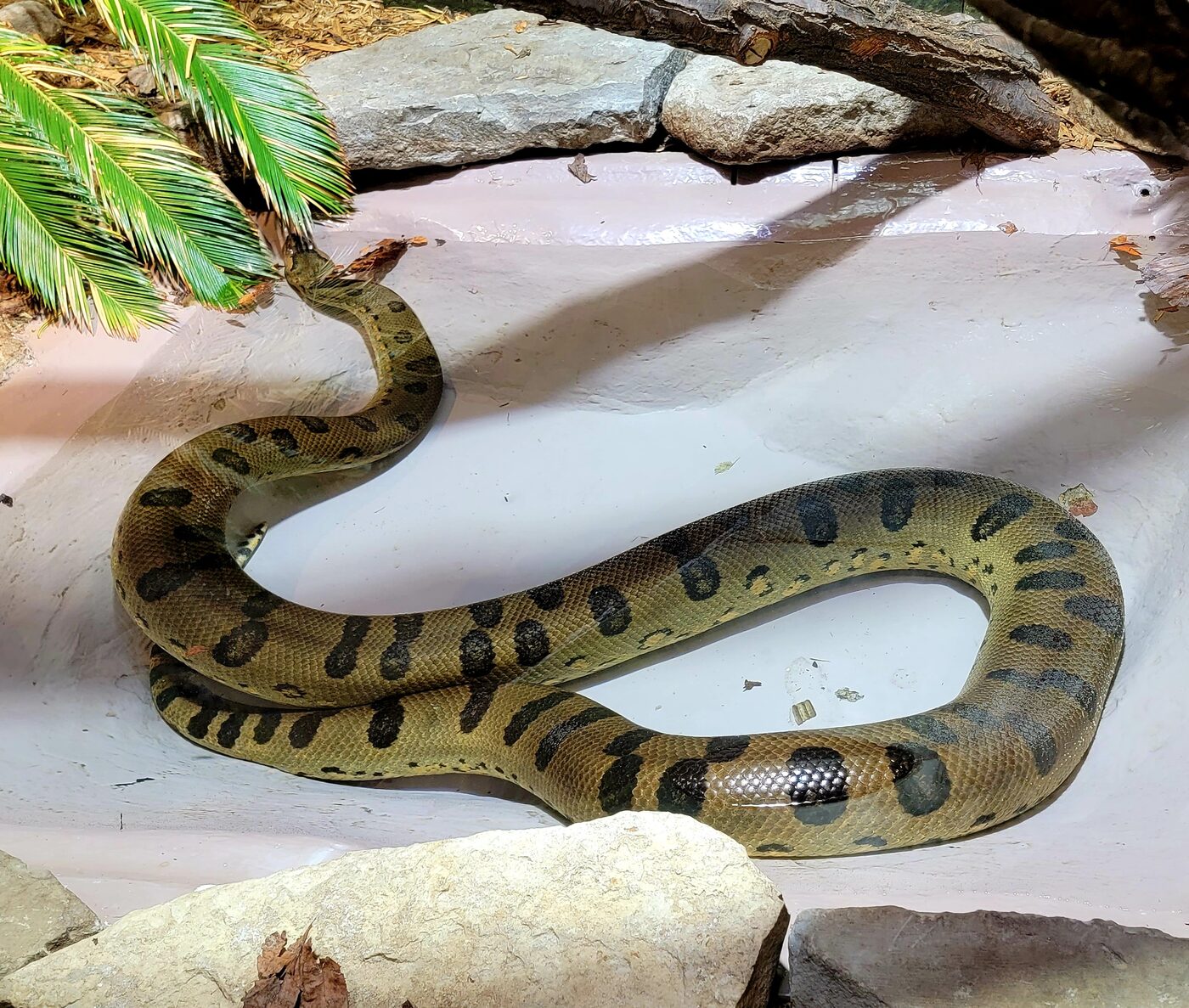
Green anacondas are semi-aquatic giants from South American wetlands, with females far larger than males. Captive-bred anacondas can be calm when raised properly, but they need big water features with filtration and expert care.
Warnings
Care guide
Enclosure
- Adult males: at least 6×3×1.5 ft; adult females at least 8×3×2 ft.
- Substrate: cardboard, newspaper or 2–4 in of cypress mulch. A snug hide with damp sphagnum moss.
Sources 22
Water
- Clean drinking water always; large defecations foul water quickly, so filtration or frequent changes matter.
Sources 22
Feeding
- Juveniles every 7 days, 4 ft+ every 7–10 days, adults every 10–14 days (rats and guinea pigs for males, rabbits for females).
- Wait 2–3 days after a meal before handling.
Sources 22
Health
- Internal parasites and husbandry-related illness are the main issues in captivity; good water hygiene is key.
Sources 21
Show the group care guide for giant constrictors
Giant constrictors
Applies to most species in this group. Habitat: Tropical forests, wetlands and savannas. Individual species can differ, so compare with the species numbers above and the linked sources.
Housing & setup
- Room-sized or custom enclosures: plan for an adult that may exceed 12–20 ft and 100+ lb.
- Large, filtered or frequently changed water features for anacondas; heavy, chew-proof hides and locks for all.
- Plan for the full adult size before buying a baby.
Climate & lighting
| Warm side / daytime | 86–92°F |
| Cool side | 78–82°F |
| Night | 75–80°F |
| Humidity | 60–80% |
Diet
- Large rodents, rabbits and poultry; adults may eat every 3–6 weeks.
- Use feeding tongs or a hook to separate feeding from handling.
Social life
- Solitary.
Handling
- Never handle a giant constrictor alone; one person per 4–5 ft of snake is a common safety rule.
Health watch
- Obesity, respiratory infections and blister disease from dirty, wet conditions.
- Bites from large constrictors need medical attention.
Understanding the animal
In the wild
In the wild
Researched for this exact species, not its family. Good care copies these conditions.1234
| Where it lives | Tropical South American wetlands, including Amazon-basin waters and seasonally flooded savannas. It uses shallow, vegetated freshwater and adjacent muddy refuges. |
| Ground it lives on | Soft wetland mud and vegetated banks; much time is spent submerged. |
| Water it lives in | Freshwater, especially shallow standing or slow-moving pools, swamps and river margins. No universal clarity, chemistry or water-temperature range was established. |
| Climate | Tropical wetland conditions; seasonal savanna populations face pronounced flooding and dry-season water loss. Numeric wild temperature and humidity ranges were not established. |
| Active | Cathemeral; can hunt at any time. Some populations become dormant in mud during drought, while river-associated animals may remain active year-round. |
| Social life | Usually solitary; temporary breeding aggregations form. Cannibalism is documented. |
| Wild diet | Fish, birds, turtles, caimans and mammals such as capybaras, with prey size changing as the snake grows. |
| Behavior to plan for | Ambushes while submerged and kills by constriction. It escapes into water or mud and may bite or release a strong cloacal odor when threatened. |
What this means for care
- Provide a large filtered swimming area with easy access to land.
- Include sheltered shallow-water resting sites.
- House individually because breeding aggregations do not imply safe group housing.
- Plan barriers and maintenance access around adult size and strength.
Native climate (measured)
Native climate (measured)
| Warm-season highs | about 89°F (up to 93°F in the hottest sampled areas) |
| Cool-season lows | about 69°F (down to 67°F in the coldest sampled areas) |
| Average temperature | 77–80°F across sampled records |
| Relative humidity | 79–84% on average (driest month about 80%) |
| Rainfall | about 2670 mm a year, spread fairly evenly |
Measured at 110 wild occurrence records sampled against WorldClim 2.1 climate data (1970–2000 averages). Air conditions in the range are ecological context, not enclosure settings: microhabitats such as burrows, leaf litter or basking rocks can be cooler, warmer or more humid.
Profile
Profile
Researched for this exact species. Sources are listed under In the wild above.
History
Linnaeus described the species in 1758 as Boa murina from immature specimens, and Wagler later established the genus Eunectes in 1830 after larger specimens became known. In herpetoculture, early availability consisted largely of wild imports, many of which suffered from parasites, stress, feeding problems, and poor survival, while later improvements in husbandry and veterinary care increased establishment and captive breeding success.
Keeper tips
- Treat the species as an expert-level large constrictor rather than a typical pet snake.
- Account for its use of both water and land when planning its environment.
- Avoid assuming movie portrayals accurately represent its behavior or husbandry.
- Captive husbandry and veterinary care have improved substantially compared with the early period of wild-import keeping.
Behaviors reported
- Spends most of its time in water.
- Also moves onto land and uses thick vegetation.
- Uses its forked tongue and Jacobson's organ in locating prey and mates and in navigation.
Unique adaptations
- Semi-aquatic body plan suited to shallow freshwater habitats.
- Narrow ventral scales and small, smooth dorsal scales.
- A forked tongue coupled with the Jacobson's organ for chemical sensing.
- Dark olive-green dorsal coloration with brown, black-bordered blotches that visually blend with its environment.
- External horny claws representing hind-limb remnants, which are more evident in males.
Remarkable facts
- The green anaconda is a non-venomous boa and one of the longest and heaviest living snake species.
- Typical wild life expectancy is stated as about 10 years, with some captive animals living longer.
- The species was originally described by Linnaeus in 1758 as Boa murina.
- Johann Georg Wagler established the genus Eunectes in 1830.
- The name murinus was based on an early description referring to the snake as a predator lying in wait for mice or rats, rather than to a mouse-gray color.
Stories
- Popular media helped turn the green anaconda into a creature of folklore and horror, while the husbandry account emphasizes that keeping the real animal is unlike its movie portrayal.
- When anacondas first became available in the hobby, wild imports commonly arrived with behavioral and health problems, and inadequate knowledge contributed to high mortality before husbandry techniques improved.
From the sources
From the sources
Quoted from the matching sections of reputable sources for this exact species. Specialist databases are used first; Wikipedia (community-edited, CC BY-SA 4.0) only fills gaps. Other sources are short credited quotes.
| Overview | The green anaconda (Eunectes murinus), common anaconda, common water boa, akayima, or sucuri, is a boa species found in South America. It is one of the longest and heaviest known extant snake species. Like all boas, it is a non-venomous constrictor. Green anacondas generally have a life expectancy of 10 years in the wild, although some specimens live longer when they are taken care of in captivity. — Wikipedia (community-edited) |
| Where it lives | Green anacondas are semi-aquatic snakes that inhabit shallow, slow-moving freshwater habitats, as well as tropical savannas, grasslands, and rainforests. — Animal Diversity Web |
| Behavior | Anacondas are readily adaptable to changes in their environment. — Animal Diversity Web |
| Reproduction | O’Shea et al. (2016) and Shibata et al. (2017) provide evidence for facultative parthenogenesis in this species. Dirksen and Böhme (1998) provided evidence for hybridization between Eunectes murinus and Eunectes notaeus. — The Reptile Database |
| Lifespan | The lifespan of green anacondas in the wild averages 10 years. — Animal Diversity Web |
| Appearance and size | Green anacondas are one of four closely related species of constrictors, the other species being Eunectes notaeus (yellow anaconda), E. deschauenseei (dark-spotted anaconda), and E. beniensis (Bolivian anaconda). — Animal Diversity Web |
| History and naming | In the famous 10th edition of Systema Naturae of 1758, Carl Linnaeus cited descriptions by Albertus Seba and by Laurens Theodorus Gronovius to erect the distinct species murina of his new genus Boa, which contained eight other species, including Boa constrictor. The generic name Boa came from an ancient Latin word for a type of large snake. — Wikipedia (community-edited) |
Data and studies
The numbers
The numbers
Each bar is what one source reports. Where several sources weigh in, the dashed gold band marks their average.
Water temperature
Maximum recorded lifespan
Longest recorded lifespan reported by each database; typical lifespans are usually shorter. The AnAge record comes from an animal in human care.
Typical adult weight
Average adult body mass in each database (FishBase gives the maximum recorded weight).
Gestation
Water temperature
Species-specific values from keeper care sheets. Basking figures are often surface readings taken with an infrared thermometer, which run hotter than air.
Care articles for this species
Care articles for this species
- Yellow Anaconda Care Sheet (Reptiles Magazine)
- Keeping The Green Anaconda (Reptiles Magazine)
- Golden Dorado Follows Green Anaconda In Potential Nuclear-Follower Feeding Association (Reptiles Magazine)
Veterinary & husbandry research
Veterinary & husbandry research
- Reproductive cycles of neotropical boid snakes evaluated by ultrasound Garcia VC et al., Zoo biology 2022
- Facultative parthenogenesis validated by DNA analyses in the green anaconda (Eunectes murinus) Shibata H et al., PloS one 2017
- Dracunculus brasiliensis sp. n. (Nematoda: Dracunculidae) from the anaconda, Eunectes murinus (Ophidia: Boidae) Moravec F et al., Parasitology research 2009
- RETROSPECTIVE REVIEW OF OPHIDIOMYCOSIS (OPHIDIOMYCES OPHIODIICOLA) AT THE SMITHSONIAN'S NATIONAL ZOOLOGICAL PARK (1983-2017) Anderson KB et al., Journal of zoo and wildlife medicine: official publication of the American Association of Zoo Veterinarians 2021
Peer-reviewed papers that mention this species alongside captivity, zoos, veterinary care or aquaculture. Some cover several species or mention it only in passing, so check the abstract. See all 8 on PubMed → 170
Sources for this sheet
- Reptiles Magazine: Keeping the green anaconda Experienced keeper or breederDetailed husbandry article from an established reptile publication.
- Animal Diversity Web: Eunectes murinus Zoo, university or veterinaryUniversity-hosted species account.
- Clint's Reptiles (YouTube): Green Anaconda, The Best Pet Snake? Expert educator & keeperClint Laidlaw, PhD in Biology Education and MS in Evolutionary Ecology; owner of Clint's Reptile Room and a longtime keeper. Rates each species on handleability, care, hardiness, availability and upfront cost.
- AnAge: The Animal Ageing and Longevity Database (Human Ageing Genomic Resources) Peer-reviewed researchCurated, referenced longevity and life-history records for thousands of species; maximum lifespans are often from zoo animals.
- Myhrvold et al. (2015). An amniote life-history database. Ecology 96: 3109 Peer-reviewed researchPeer-reviewed compilation of life-history data for over 21,000 birds, mammals and reptiles.
- Reptiles Magazine (care articles) Experienced keeper or breederEstablished reptile and amphibian hobby magazine; care articles are written by breeders, keepers and veterinarians.
- 50 CFR Part 16: Injurious wildlife (Lacey Act) Zoo, university or veterinaryCurrent federal regulation, read from eCFR.
- U.S. Association of Reptile Keepers v. Zinke (D.C. Cir. 2017) Zoo, university or veterinaryAppeals ruling that the Lacey Act's shipping ban does not cover moves between the continental states.
- Species+ (UNEP-WCMC and the CITES Secretariat) Zoo, university or veterinaryThe official database of species listed under CITES.
- USFWS International Affairs: CITES Zoo, university or veterinaryFederal agency that issues CITES permits.
- Merck Veterinary Manual: Management and husbandry of reptiles Zoo, university or veterinaryThe Merck Veterinary Manual: a standard veterinary reference written and reviewed by veterinary specialists.
- Merck Veterinary Manual: Nutritional, metabolic and endocrine diseases of reptiles Zoo, university or veterinaryThe Merck Veterinary Manual: a standard veterinary reference written and reviewed by veterinary specialists.
- Clint's Reptiles (YouTube): Green Anaconda, The Best Pet Snake? Expert educator & keeperClint Laidlaw, PhD in Biology Education and MS in Evolutionary Ecology; owner of Clint's Reptile Room and a longtime keeper. His "Best Pet?" series reviews each species' care in depth.
- The Reptile Database Peer-reviewed researchScientist-curated catalog of every reptile species, with taxonomy and literature.
- GBIF Backbone Taxonomy (Global Biodiversity Information Facility) Peer-reviewed researchInternational scientific taxonomy used here for classification.
- Wikipedia (species article) Community referenceFree encyclopedia; useful overviews with their own citations. Intro text is quoted under CC BY-SA 4.0.
- PubMed (U.S. National Library of Medicine) Peer-reviewed researchIndex of peer-reviewed veterinary, zoo and husbandry research.
- iNaturalist (captive observations) Community referenceCommunity observation platform run by the California Academy of Sciences and National Geographic; observations marked captive show animals living in homes, zoos and aquariums.