Home / Reptiles / Snakes / Common boa constrictor (red-tailed boa)
Some federal rules apply In-depth sheetCommon boa constrictor (red-tailed boa)
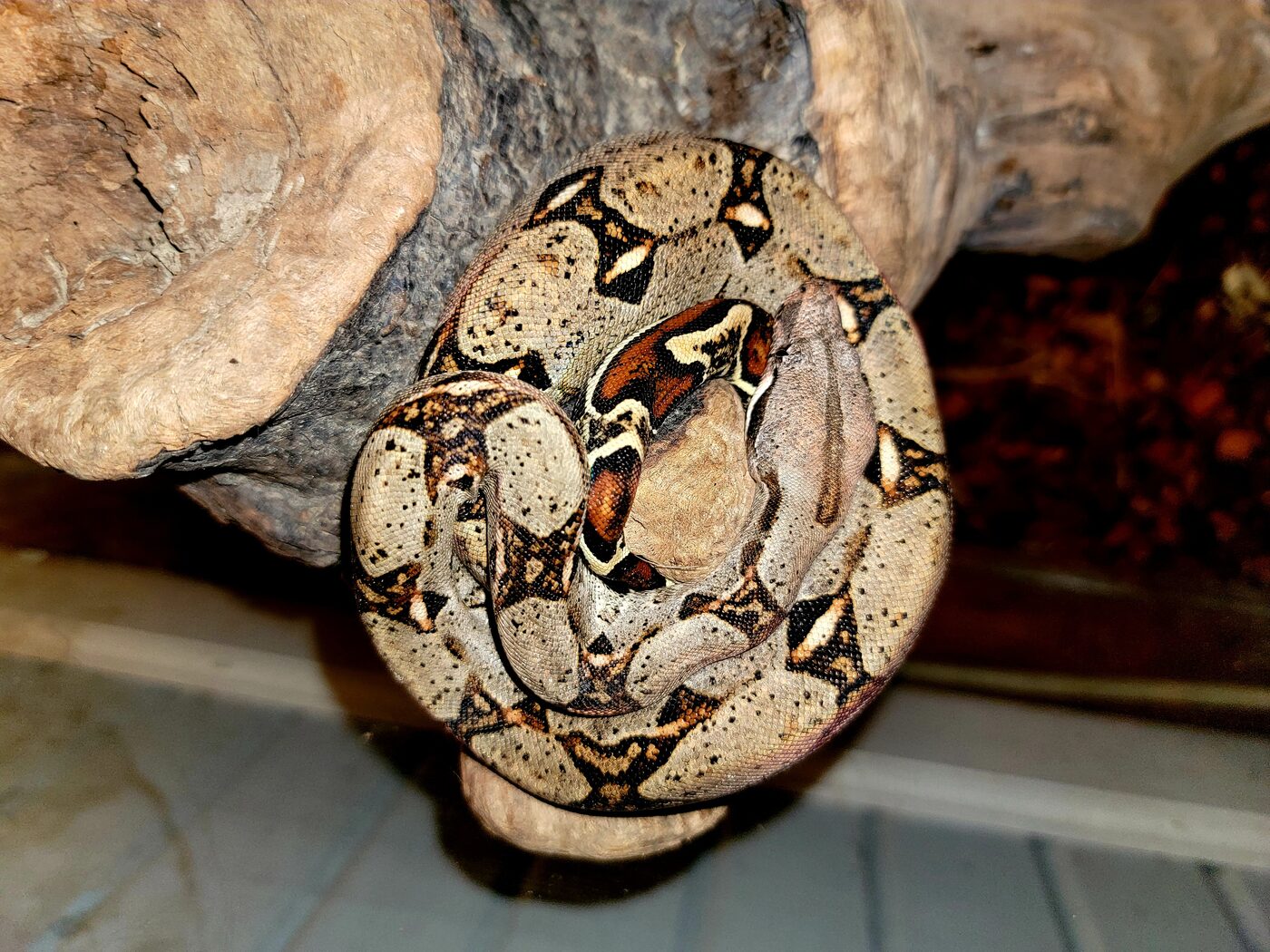
Boa constrictor
+ 31 more names
Prodigy, Squaretail, Arabesque, jaguar, Jungle, Marron, Motley, Onyx, Roswell, Fire, Inca, IMG, Pink, Avalanche, Blizzard, Ghost, Hytec, Moonglow, Paradigm, Pewter, Snow, Sunglow, Sunset, Short-Tailed Boa [amarali], Red-Tailed Boa Constrictor [constrictor], Long-Tailed Boa Constrictor [longicauda], Orton’s Boa Constrictor [ortonii], Dominican Boa Constrictor [pnebulosa], Tet’chien or St. Lucian Boa [orophias], Atlantic Boa [atlantica], Argentine Boa Constrictor [occidentalis]Reptiles › Snakes (Serpentes) › Boidae (Boas)
Boa constrictors grow to at least 6–10 feet and live 20–30 years. They're strong, so plan for space, cost and safe handling.
Care at a glance
Species-specific values
Values researched for this exact species. Where they differ from the group guide below, follow these. Air, surface and water temperatures are listed separately, and each source is kept as published rather than averaged.
| Air temperature basking zone | 86–90 °F Care manual covers Boa constrictor and Boa imperator; this is explicitly AIR | 212 |
| Cool zone temperature | 75–80 °F | 212 |
| Preferred air temperature zone | 82–88 °F (28–31 °C) Veterinary POTZ; not water or basking surface. | 218 |
| Relative humidity | 70–95 % Veterinary table; corn snake, leopard gecko, bearded dragon and savannah monitor require more humidity during shedding. | 218 |
Care guide
Enclosure
- Absolute minimum 6×3×2 ft for an adult.
Sources 30
Safety
- Consider the adult size, expense and dangers carefully before getting one.
Sources 30
Show the group care guide for boas
Boas
Applies to most species in this group. Habitat: Tropical and subtropical forests and grasslands. Individual species can differ, so compare with the species numbers above and the linked sources.
Housing & setup
- A long enclosure with secure hides on the warm and cool sides and a large water bowl.
- Sturdy branches for semi-arboreal species and juveniles.
- Moderate humidity; rainbow boas and tree boas need it higher.
Climate & lighting
| Warm side / daytime | 85–90°F |
| Cool side | 75–80°F |
| Night | 72–78°F |
| Humidity | 50–70% |
Diet
- Rodents (rats for most adults) every 1–2 weeks for young snakes, every 2–4 weeks for adults.
- Boas gain weight easily; keep meals modest.
Social life
- Solitary.
Handling
- Most captive-bred boas become calm and tolerant of handling.
Health watch
- Inclusion body disease (IBD) and other viral diseases can spread between boas; quarantine new animals.
- Respiratory infections and mites.
Understanding the animal
In the wild
In the wild
Researched for this exact species, not its family. Good care copies these conditions.12345
| Where it lives | South American forests, woodland and more open vegetated habitats, often using streamside cover. It occupies both the ground and trees; this entry excludes Central American Boa imperator. |
| Ground it lives on | Vegetated soil and forest-floor cover; also uses tree branches. |
| Active | Primarily nocturnal or crepuscular, with daytime basking in cooler conditions. |
| Social life | Generally solitary except when mating. |
| Wild diet | Small mammals, including bats, and birds; other appropriately sized vertebrates are also taken. |
| Behavior to plan for | A nonvenomous constrictor that usually ambushes prey but can hunt actively. It uses elevated branches as well as ground-level cover. |
What this means for care
- Confirm Boa constrictor identity rather than applying Boa imperator locality assumptions.
- Provide sturdy branches as well as sheltered floor space.
- Offer covered resting and ambush sites, with opportunities to choose warmth or shade.
Native climate (measured)
Native climate (measured)
| Warm-season highs | about 87°F (up to 93°F in the hottest sampled areas) |
| Cool-season lows | about 63°F (down to 51°F in the coldest sampled areas) |
| Average temperature | 69–80°F across sampled records |
| Relative humidity | 73–81% on average (driest month about 71%) |
| Rainfall | about 1500 mm a year |
Measured at 75 wild occurrence records sampled against WorldClim 2.1 climate data (1970–2000 averages). Air conditions in the range are ecological context, not enclosure settings: microhabitats such as burrows, leaf litter or basking rocks can be cooler, warmer or more humid.
Profile
Profile
Researched for this exact species. Sources are listed under In the wild above.
History
Boa constrictor has long been prominent in private collections and public displays and is frequently bred in captivity. Its taxonomy has undergone repeated revision, with several former subspecies elevated to full species and the status of some remaining forms still debated.
Keeper tips
- Plan for a large adult rather than judging space requirements from juvenile size.
- Provide opportunities for both ground movement and climbing because the species is semi-arboreal.
- Include secure refuge areas that allow the snake to withdraw from view.
Behaviors reported
- Juveniles tend to be more arboreal than adults.
- Individuals move well on the ground.
- They may occupy burrows made by medium-sized mammals.
- They are commonly encountered near streams and rivers.
Unique adaptations
- A heavy-bodied constricting form.
- Ability to use both terrestrial and arboreal environments.
- A highly variable but distinctive color pattern.
Remarkable facts
- Boa constrictor is a large, non-venomous member of the family Boidae.
- It has one of the broadest distributions among Neotropical boas.
- Reported maximum length is slightly over 4 m, while individuals are generally about 2 to 3 m long and island forms are commonly below 2 m.
- The species is frequently kept and bred in captivity.
- The Boa constrictor genome has been sequenced.
- Several forms formerly treated as Boa constrictor subspecies, including Boa imperator, Boa nebulosa, Boa orophias and Boa sigma, have been elevated to species status.
Stories
- A snake shed found in Manitoba, Canada, was identified by DNA sequencing as most likely coming from Boa constrictor.
From the sources
From the sources
Quoted from the matching sections of reputable sources for this exact species. Specialist databases are used first; Wikipedia (community-edited, CC BY-SA 4.0) only fills gaps. Other sources are short credited quotes.
| Overview | The boa constrictor (scientific name also Boa constrictor), also known as the common boa, is a species of large, non-venomous, heavy-bodied snake that is frequently kept and bred in captivity. The boa constrictor is a member of the family Boidae. The species is native to tropical South America. A staple of private collections and public displays, its color pattern is highly variable yet distinctive. — Wikipedia (community-edited) |
| Where it lives | Boa constrictors occupy a variety of habitats. — Animal Diversity Web |
| Wild diet | Their prey includes a wide variety of small to medium-sized mammals and birds. The bulk of their diet consists of rodents (such as squirrels, mice, rats and agoutis), but frogs, larger lizards (such as ameivas, iguanas and tegus) and mammals as big as monkeys, marsupials (opossums), introduced mongooses, armadillos, wild pigs, young brocket deer and ocelots are also reported to have been consumed. — Wikipedia (community-edited) |
| Behavior | Boa constrictors are solitary, associating with conspecifics only to mate. — Animal Diversity Web |
| Reproduction | ovoviviparous; Booth et al. (2010) provide evidence for parthenogenesis in B. constrictor. — The Reptile Database |
| Lifespan | Boa constrictors are potentially long-lived, perhaps averaging around 20 years old. — Animal Diversity Web |
| Appearance and size | Boa constrictor has long been famous as one of the largest species of snake. — Animal Diversity Web |
| History and naming | Named after the Latin word constrictus, meaning "to constrict or contract." — The Reptile Database |
Data and studies
Researched care notes
Researched care notes
Findings checked against veterinary, zoo, welfare, keeper and peer-reviewed sources. Air, basking-surface and water temperatures are kept separate, and where sources disagree both are shown. “Study” notes report what a paper measured, not a universal rule.
Boa Constrictor
- Provide strong climbing structures as well as floor space; boas use elevated space, so a floor-only layout is incomplete.1
- Large, well-covered enclosures can house juveniles; plentiful ground-level and elevated cover matters more than assuming every young boa requires a small bare box.1
- Keep boas individually; introducing another snake adds avoidable cohabitation risks.1
- Feed appropriately sized thawed whole rodents; living rodents can inflict serious wounds on the snake.2
The numbers
The numbers
Each bar is what one source reports. Where several sources weigh in, the dashed gold band marks their average.
Humidity
Maximum recorded lifespan
Longest recorded lifespan reported by each database; typical lifespans are usually shorter. The AnAge record comes from an animal in human care.
Typical adult weight
Average adult body mass in each database (FishBase gives the maximum recorded weight).
Cool side
Species-specific values from keeper care sheets. Basking figures are often surface readings taken with an infrared thermometer, which run hotter than air.
Night temperature
Species-specific values from keeper care sheets. Basking figures are often surface readings taken with an infrared thermometer, which run hotter than air.
Care articles for this species
Care articles for this species
- Boa Constrictor Care Sheet (Reptiles Magazine)
- Blood and Short-tailed Python Care Sheet (Reptiles Magazine)
- Boa Constrictor Health Guide (ReptiFiles)
- Boa Constrictor Enclosure Size Requirements (ReptiFiles)
- Boa Constrictor Care (ReptiFiles)
- Blood Python Care And Husbandry (Reptiles Magazine)
Veterinary & husbandry research
Veterinary & husbandry research
- Antibody response in snakes with boid inclusion body disease Windbichler K et al., PloS one 2019
- Persistent Reptarenavirus and Hartmanivirus Infection in Cultured Boid Cells Lintala A et al., Microbiology spectrum 2022
- Identification of snake arenaviruses in live boas and pythons in a zoo in Germany Aqrawi T et al., Tierarztliche Praxis. Ausgabe K, Kleintiere/Heimtiere 2015
- Novel Hepatozoon in vertebrates from the southern United States Allen KE et al., The Journal of parasitology 2011
Peer-reviewed papers that mention this species alongside captivity, zoos, veterinary care or aquaculture. Some cover several species or mention it only in passing, so check the abstract. See all 50 on PubMed → 170
Sources for this sheet
- Royal Veterinary College Exotics Service: Boa constrictor care Zoo, university or veterinaryVet-school exotics hospital factsheet, reviewed 2021–2024.
- AnAge: The Animal Ageing and Longevity Database (Human Ageing Genomic Resources) Peer-reviewed researchCurated, referenced longevity and life-history records for thousands of species; maximum lifespans are often from zoo animals.
- Myhrvold et al. (2015). An amniote life-history database. Ecology 96: 3109 Peer-reviewed researchPeer-reviewed compilation of life-history data for over 21,000 birds, mammals and reptiles.
- Reptiles Magazine (care articles) Experienced keeper or breederEstablished reptile and amphibian hobby magazine; care articles are written by breeders, keepers and veterinarians.
- ReptiFiles (care guides) Experienced keeper or breederWell-researched reptile care guides that cite herpetological literature and experienced keepers.
- Species+ (UNEP-WCMC and the CITES Secretariat) Zoo, university or veterinaryThe official database of species listed under CITES.
- USFWS International Affairs: CITES Zoo, university or veterinaryFederal agency that issues CITES permits.
- Merck Veterinary Manual: Management and husbandry of reptiles Zoo, university or veterinaryThe Merck Veterinary Manual: a standard veterinary reference written and reviewed by veterinary specialists.
- Merck Veterinary Manual: Nutritional, metabolic and endocrine diseases of reptiles Zoo, university or veterinaryThe Merck Veterinary Manual: a standard veterinary reference written and reviewed by veterinary specialists.
- Clint's Reptiles (YouTube): Common Boa (BCI), The Best Pet Snake? Expert educator & keeperClint Laidlaw, PhD in Biology Education and MS in Evolutionary Ecology; owner of Clint's Reptile Room and a longtime keeper. His "Best Pet?" series reviews each species' care in depth.
- The Reptile Database Peer-reviewed researchScientist-curated catalog of every reptile species, with taxonomy and literature.
- GBIF Backbone Taxonomy (Global Biodiversity Information Facility) Peer-reviewed researchInternational scientific taxonomy used here for classification.
- Wikipedia (species article) Community referenceFree encyclopedia; useful overviews with their own citations. Intro text is quoted under CC BY-SA 4.0.
- PubMed (U.S. National Library of Medicine) Peer-reviewed researchIndex of peer-reviewed veterinary, zoo and husbandry research.
- iNaturalist (captive observations) Community referenceCommunity observation platform run by the California Academy of Sciences and National Geographic; observations marked captive show animals living in homes, zoos and aquariums.