Home / Mammals / Rodents / Mongolian gerbil
No federal permit to keep In-depth sheetMongolian gerbil
Meriones unguiculatus
Mammals › Rodents (Rodentia) › Muridae (Rats, mice and gerbils)
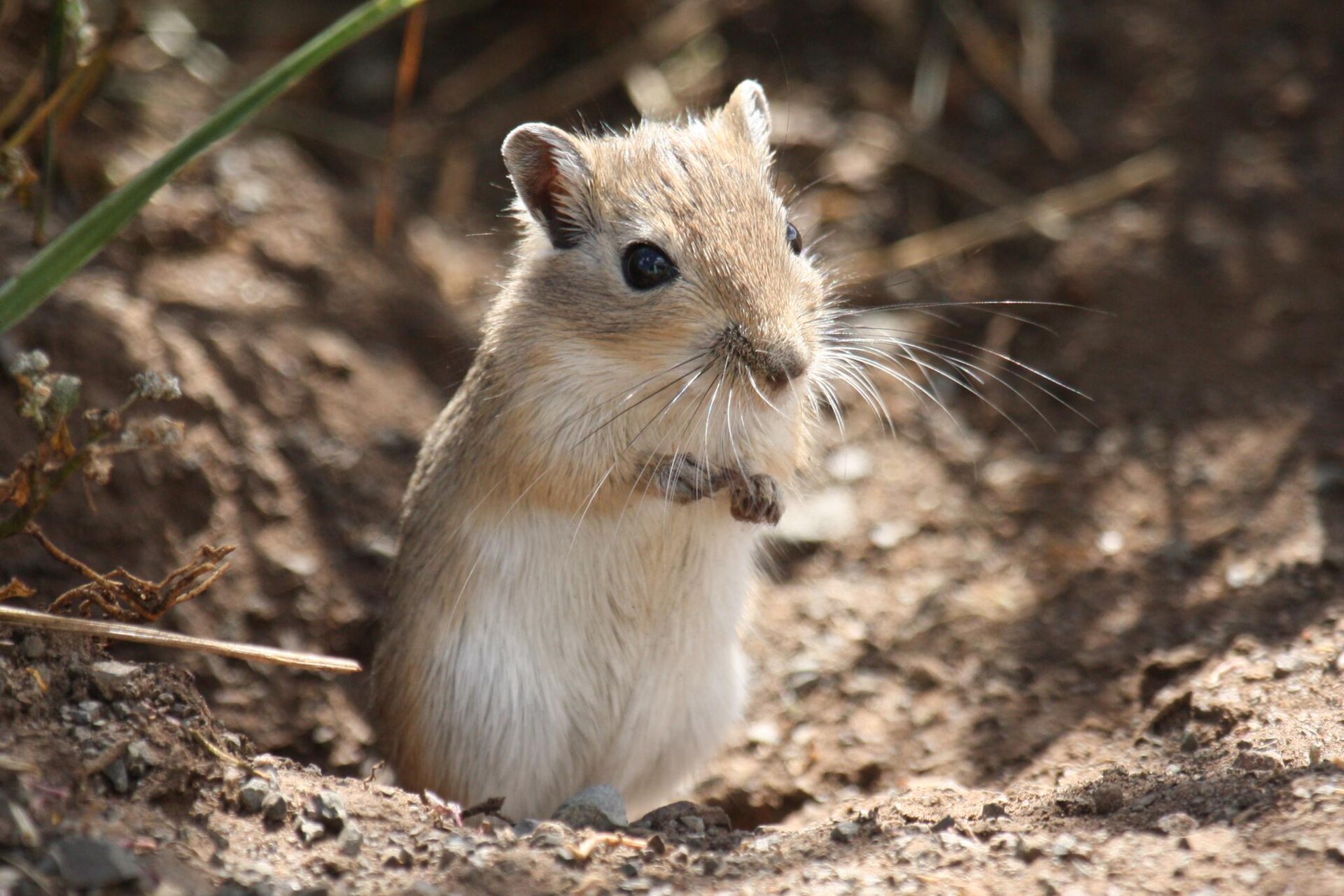
Gerbils are social desert rodents that tunnel constantly. They do best in pairs or small groups with deep bedding to dig in.
Care at a glance
Species-specific values
Values researched for this exact species. Where they differ from the group guide below, follow these. Air, surface and water temperatures are listed separately, and each source is kept as published rather than averaged.
| Lifespan typical captive | 2.5–4 years Pet-rodent table; not maximum longevity | 291 |
| Adult body mass male | 45–130 g | 291 |
| Adult body mass female | 55–135 g | 291 |
| Air temperature | 60–70 °F Pet-care recommendation for prevention of nasal dermatitis; not a surface temperature. | 298 |
| Relative humidity | max exclusive: 50 % RH Source says below 50%. | 298 |
| Diet crude protein | 18–20 % Balanced rodent pellets; the source does not explicitly state a dry-matter basis. | 126 |
| Typical captive lifespan | 2–3 years | 126 |
| Adult body mass | 70–100 g Female. | 126 |
| Adult body mass | 80–130 g Male. | 126 |
Care guide
Housing
- A deep tank of diggable bedding kept out of direct sun, since tanks overheat.
Sources 41
Breeding
- Sexually mature at 10–12 weeks; litters of 3–6. Keep same-sex groups unless breeding is planned.
Sources 41
Show the group care guide for gerbils and jirds
Gerbils and jirds
Applies to most species in this group. Habitat: Deserts and dry steppe. Individual species can differ, so compare with the species numbers above and the linked sources.
Housing & setup
- Deep bedding (8 in+) in a tank or bin for tunnels; low humidity.
Diet
- For Mongolian gerbils, use a balanced rodent pellet containing 18–20% protein; seed-based home mixtures can be deficient.
Social life
- Pairs or small groups introduced young.
Health watch
- Never lift gerbils by the tail: degloving injuries can result. Some have inherited or stress-triggered seizures; severe episodes can rarely be fatal.
Understanding the animal
In the wild
In the wild
Researched for this exact species, not its family. Good care copies these conditions.12
| Where it lives | Arid steppe, grassland, sandy or clay deserts and mountain valleys of Mongolia and adjacent northern China and Russia. Lives in self-dug burrow colonies. |
| Ground it lives on | Sandy or clay soil with burrows. |
| Climate | Continental, low-rainfall climate with long winters; ADW reports regional extremes of -40 to 122°F (-40 to 50°C), not burrow temperatures or captive targets. Relative-humidity measurements were not found. |
| Active | Cathemeral, active by day and night throughout the year; avoids daily and seasonal temperature extremes. |
| Social life | Family groups occupy territories; colonies may contain several adults and offspring. |
| Wild diet | Mugwort (Artemisia sieversiana and A. commutata), saltwort, bristle grass and lyme grass; stores seeds for winter. |
| Behavior to plan for | Excavates burrows and sand-bathes; foot drumming signals danger. |
What this means for care
- Provide deep substrate that supports tunnels and a separate sand bath.
- Keep stable compatible groups and avoid casual introductions across territories.
- Offer seed and plant foraging opportunities.
- Do not reproduce surface climate extremes without the protective burrow microclimate.
Native climate (measured)
Native climate (measured)
| Warm-season highs | about 76°F (up to 82°F in the hottest sampled areas) |
| Cool-season lows | about -13°F (down to -19°F in the coldest sampled areas) |
| Average temperature | 30–38°F across sampled records |
| Relative humidity | 48–60% on average (driest month about 41%) |
| Rainfall | about 199 mm a year, with strong wet and dry seasons |
| Winters | Cool to cold winters (lows around -13°F) in much of its native range. Seasonal slowdown may be relevant, but species-specific biology determines whether brumation or hibernation occurs. |
Measured at 104 wild occurrence records sampled against WorldClim 2.1 climate data (1970–2000 averages). Air conditions in the range are ecological context, not enclosure settings: microhabitats such as burrows, leaf litter or basking rocks can be cooler, warmer or more humid.
Profile
Profile
Researched for this exact species. Sources are listed under In the wild above.
History
Meriones unguiculatus is native to the Palearctic region of Inner Mongolia and neighboring areas. It has become a popular housepet and is also widely used in research, resulting in its presence around the world.
Keeper tips
- Provide opportunities for burrowing rather than keeping the animal only on a shallow surface layer.
- Use a substrate or structure that can support tunnels because wild burrows extend roughly 0.45-0.60 m underground.
- Include sheltered nesting areas because wild burrows contain a dedicated nest chamber.
- Provide opportunities for storing food or other materials because wild burrows include one to two storerooms.
Behaviors reported
- Lives in family groups.
- Constructs underground burrow systems.
- Often places burrows near plants to use the roots as structural support.
- Builds separate nest and storage chambers.
Unique adaptations
- Lives in an environment where temperatures can range from -40 F to 122 F.
- Uses underground burrows in extremely dry environments.
- Places burrows near plant roots that help support the tunnel structure.
Remarkable facts
- The species is native to the highlands of Inner Mongolia and adjacent parts of southern Siberia and northern China.
- Wild habitat receives less than 230 mm of precipitation annually.
- Winter in its native habitat lasts from October through April.
- Burrows extend about 0.45-0.60 m underground and average about 4 cm in diameter.
- Males average about 60 g and females about 50-55 g.
- Wild Mongolian gerbils breed from February through October and may produce up to three litters.
From the sources
From the sources
Quoted from the matching sections of reputable sources for this exact species. Specialist databases are used first; Wikipedia (community-edited, CC BY-SA 4.0) only fills gaps. Other sources are short credited quotes.
| Overview | The Mongolian gerbil, also referred to as the Mongolian jird (Meriones unguiculatus), is a rodent belonging to the subfamily Gerbillinae. Their body size is typically 110–135 mm, with a 95–120 mm tail, and body weight 60–130 g, with adult males larger than females. The animal is used in science for research or kept as a small house pet. Their use in science dates back to the later half of the 19th century, but they only started to be kept as pets in the English-speaking world after 1954, when they were brought to the United States. — Wikipedia (community-edited) |
| Where it lives | Mongolian gerbils live in the highlands in Inner Mongolia. — Animal Diversity Web |
| Wild diet | Mongolian gerbils feed mainly on mugwort ( Artemisia sieversiana and A. commutata ). — Animal Diversity Web |
| Behavior | Ehrenstein, E., V. Bruckmann. 1996. "Gerbil Behavior" (On-line). — Animal Diversity Web |
| Reproduction | Wild mongolian gerbils breed between February and October, producing up to three litters. — Animal Diversity Web |
| Appearance and size | Mongolian jird body length averages 120 mm long, tail length may range up to 120 mm. — Animal Diversity Web |
| History and naming | The first known mention of gerbils came in 1866, by Father Armand David, who sent "yellow rats" to the French National Museum of Natural History in Paris, from northern China. They were named Gerbillus unguiculatus by the scientist Alphonse Milne-Edwards in 1867. — Wikipedia (community-edited) |
| Conservation | Mongolian gerbil populations are stable. — Animal Diversity Web |
Data and studies
Researched care notes
Researched care notes
Findings checked against veterinary, zoo, welfare, keeper and peer-reviewed sources. Air, basking-surface and water temperatures are kept separate, and where sources disagree both are shown. “Study” notes report what a paper measured, not a universal rule.
Mongolian Gerbil
- RSPCA recommends 20–30 cm of burrow-supporting bedding; this is a published husbandry recommendation, not a validated universal minimum.1
- Use a secure gerbilarium with space above the deep bedding for upright movement and exercise; provide additional shelters with multiple entrances.1
- Keep established compatible same-sex pairs or groups and avoid adding unfamiliar adults to an established group.2
- Lift by cupping and supporting the body, never by the tail, which can lose its skin and leave tissue exposed.2
- Base feeding on a balanced gerbil-specific ration; supplementary produce and treats should not displace its nutrient balance.3
The numbers
The numbers
Each bar is what one source reports. Where several sources weigh in, the dashed gold band marks their average.
Room temperature
Maximum recorded lifespan
Longest recorded lifespan reported by each database; typical lifespans are usually shorter. The AnAge record comes from an animal in human care.
Typical adult weight
Average adult body mass in each database (FishBase gives the maximum recorded weight).
Veterinary & husbandry research
Veterinary & husbandry research
- Survey of intestinal helminths collected from pet rodents in México Panti-May JA et al., Parasitology research 2017
- Refinement of gerbil housing and husbandry in the laboratory Waiblinger E et al., Alternatives to laboratory animals: ATLA 2004
- Exploring the potential of flubendazole in filariasis control: evaluation of the systemic exposure for different pharmaceutical preparations Ceballos L et al., PLoS neglected tropical diseases 2014
Peer-reviewed papers that mention this species alongside captivity, zoos, veterinary care or aquaculture. Some cover several species or mention it only in passing, so check the abstract. See all 25 on PubMed → 170
Sources for this sheet
- Royal Veterinary College Exotics Service: Gerbil care Zoo, university or veterinaryVet-school exotics hospital factsheet, reviewed 2021–2024.
- AnAge: The Animal Ageing and Longevity Database (Human Ageing Genomic Resources) Peer-reviewed researchCurated, referenced longevity and life-history records for thousands of species; maximum lifespans are often from zoo animals.
- Myhrvold et al. (2015). An amniote life-history database. Ecology 96: 3109 Peer-reviewed researchPeer-reviewed compilation of life-history data for over 21,000 birds, mammals and reptiles.
- 9 CFR 2.1: Animal Welfare Act licensing (USDA) Zoo, university or veterinaryWho needs a USDA license to breed, sell or exhibit animals.
- Merck Veterinary Manual: Gerbils Zoo, university or veterinaryThe Merck Veterinary Manual: a standard veterinary reference written and reviewed by veterinary specialists.
- Merck Veterinary Manual — Disorders and Diseases of Gerbils Zoo, university or veterinaryAdded in the 2026 source-checked care-guide review.
- GBIF Backbone Taxonomy (Global Biodiversity Information Facility) Peer-reviewed researchInternational scientific taxonomy used here for classification.
- Wikipedia (species article) Community referenceFree encyclopedia; useful overviews with their own citations. Intro text is quoted under CC BY-SA 4.0.
- PubMed (U.S. National Library of Medicine) Peer-reviewed researchIndex of peer-reviewed veterinary, zoo and husbandry research.
- iNaturalist (captive observations) Community referenceCommunity observation platform run by the California Academy of Sciences and National Geographic; observations marked captive show animals living in homes, zoos and aquariums.