Home / Mammals / Rodents / Fancy mouse
No federal permit to keep In-depth sheetFancy mouse
Mus musculus
Mammals › Rodents (Rodentia) › Muridae (Rats, mice and gerbils)
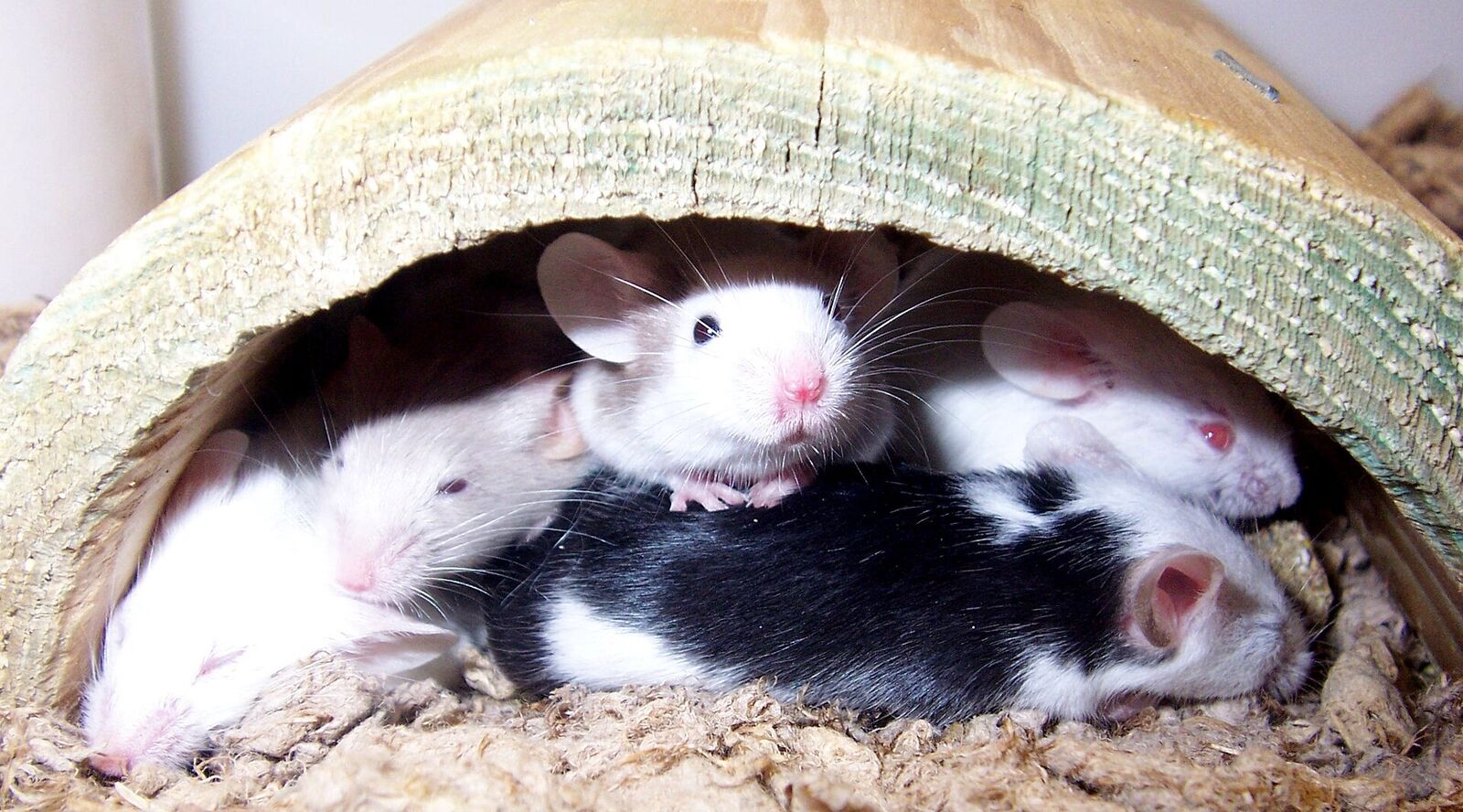
Pet mice are small, active and best kept in female groups. They breed extremely fast, so sexing matters.
Care at a glance
Species-specific values
Values researched for this exact species. Where they differ from the group guide below, follow these. Air, surface and water temperatures are listed separately, and each source is kept as published rather than averaged.
| Lifespan typical captive | 1–2 years Pet-rodent table; not maximum longevity | 291 |
| Adult body mass male | 20–30 g | 291 |
| Adult body mass female | 18–35 g | 291 |
| Social | Females usually compatible; males often need individual housing unless a carefully managed compatible group. | 128 |
Care guide
Diet
- Mouse pellets plus a small handful of vegetables and some fruit daily; remove uneaten fruit before it ferments.
Sources 49
Breeding
- Mice can have a litter every 3–4 weeks, and a female can be pregnant again within 24 hours of giving birth.
Sources 49
Show the group care guide for rats and mice
Rats and mice
Applies to most species in this group. Habitat: Varies. Individual species can differ, so compare with the species numbers above and the linked sources.
Housing & setup
- A large wire or bin cage with deep, dust-free bedding, multiple levels and hides.
- Compatible rats and female mice may share; adult male mice often require separate housing.
Diet
- Use a balanced pet-rodent diet with portion control; unlimited laboratory pellets can promote obesity.
Social life
- Rats need compatible companions; female mice commonly share, while male-mouse aggression needs separate management.
Health watch
- Respiratory infection (rats), tumors and fast breeding.
Understanding the animal
In the wild
In the wild
Researched for this exact species, not its family. Good care copies these conditions.12
| Where it lives | Originating in Eurasia and now widespread with people; occupies fields, hedgerows, barns, granaries and buildings. Nests in sheltered crevices or multi-chamber soil burrows near food. |
| Ground it lives on | field soil and plant litter; sheltered building crevices and soft nesting debris |
| Climate | The species occurs in temperate habitats, but its close association with humans has enabled it to occupy otherwise inhospitable environments including tundra and desert. Some individuals move from fields into buildings with the onset of cool autumn weather. Specific temperature and humidity ranges are not given. |
| Active | Mainly nocturnal, with occasional daytime activity in buildings. |
| Social life | Commensal colonies often contain territorial males and several females; female hierarchies are less aggressive. |
| Wild diet | Seeds, roots, leaves and stems, plus insects and occasional carrion; commensal populations exploit stored human foods. |
| Behavior to plan for | Builds concealed nests, stores food and readily climbs and jumps. Scent marking structures its small home range. |
What this means for care
- Provide deep nesting/burrowing material and concealed retreats.
- Use fine secure mesh and escape-resistant openings.
- Plan companionship by sex and compatibility, accounting for male territorial aggression.
Native climate (measured)
Native climate (measured)
| Warm-season highs | about 69°F (up to 75°F in the hottest sampled areas) |
| Cool-season lows | about 22°F (down to 12°F in the coldest sampled areas) |
| Average temperature | 37–50°F across sampled records |
| Relative humidity | 76–79% on average (driest month about 66%) |
| Rainfall | about 797 mm a year, spread fairly evenly |
| Winters | Cool to cold winters (lows around 22°F) in much of its native range. Seasonal slowdown may be relevant, but species-specific biology determines whether brumation or hibernation occurs. |
Measured at 83 wild occurrence records sampled against WorldClim 2.1 climate data (1970–2000 averages). Air conditions in the range are ecological context, not enclosure settings: microhabitats such as burrows, leaf litter or basking rocks can be cooler, warmer or more humid.
Profile
Profile
Researched for this exact species. Sources are listed under In the wild above.
History
Mus musculus may originally have ranged from the Mediterranean region to China but was spread around the world by humans. It was domesticated as both the fancy mouse and laboratory mouse, and the complete mouse reference genome was sequenced in 2002.
Keeper tips
- Use secure housing because house mice can jump vertically up to about 18 inches.
- When examining newborns, males have an anogenital distance about twice that of females.
- From about ten days old, females have five pairs of mammary glands and nipples, while males lack nipples.
- In sexually mature males, the comparatively large testicles are an obvious sex characteristic and can be retracted into the body.
Behaviors reported
- Can jump vertically up to about 18 inches.
- Uses its long tail for balance.
- Some individuals move from fields into barns and houses when autumn weather becomes cool.
- Produces a high-pitched squeak.
Unique adaptations
- Close association with humans allows house mice to occupy environments such as tundra and desert that they could not inhabit independently.
- The long tail functions in balance.
- Seasonal movement into buildings allows some individuals to shift from fields to sheltered human structures as weather cools.
Remarkable facts
- Typical adult body length is about 3 to 4 inches excluding the tail.
- The tail is about 2 to 4 inches long and has little hair.
- Typical reported weight is roughly 11 to 30 g.
- Wild individuals range from gray and light brown to black, while domesticated fancy mice occur in many additional colors.
- The house mouse has been domesticated both as the fancy mouse and as the laboratory mouse.
- The complete mouse reference genome was sequenced in 2002.
From the sources
From the sources
Quoted from the matching sections of reputable sources for this exact species. Specialist databases are used first; Wikipedia (community-edited, CC BY-SA 4.0) only fills gaps. Other sources are short credited quotes.
| Overview | The house mouse (Mus musculus) is a small mammal of the rodent family Muridae, characteristically having a pointed snout, large rounded ears, and a long and almost hairless tail. It is one of the most abundant species of the genus Mus. Although a wild animal, the house mouse has benefited significantly from associating with human habitation to the point that truly wild population are significantly less common than the synanthropic populations near human activity. — Wikipedia (community-edited) |
| Where it lives | House mice generally live in close association with humans-- in houses, barns, granaries, etc. — Animal Diversity Web |
| Social life and communication | House mice have excellent vision and hearing, a keen sense of smell, and use their whiskers to feel air movements and surface textures. — Animal Diversity Web |
| Wild diet | In the wild, house mice eat many kinds of plant matter, such as seeds, fleshy roots, leaves and stems. — Animal Diversity Web |
| Behavior | House mice usually run, walk, or stand on all fours, but when eating, fighting, or orienting themselves, they rear up on their hind legs with additional support from the tail – a behavior known as "tripoding". Mice are good jumpers, climbers, and swimmers, and are generally considered to be thigmotactic. Mice are mostly crepuscular or nocturnal and are averse to bright lights. — Wikipedia (community-edited) |
| Reproduction | House mice have a polygynous mating system. — Animal Diversity Web |
| Lifespan | If a house mouse is a pet, the average life span is about 2 years, but mutant and calorie-restricted captive individuals have lived for as long as 5 years. — Animal Diversity Web |
| Appearance and size | House mice are from 65 to 95 mm long from the tip of their nose to the end of their body, their tails are 60 to 105 mm long. — Animal Diversity Web |
| History and naming | Mice are boreoeutherian placental mammals of the Glires clade, which means they are amongst the closest relatives of humans other than lagomorphs, treeshrews, flying lemurs and other primates. — Wikipedia (community-edited) |
Data and studies
Researched care notes
Researched care notes
Findings checked against veterinary, zoo, welfare, keeper and peer-reviewed sources. Air, basking-surface and water temperatures are kept separate, and where sources disagree both are shown. “Study” notes report what a paper measured, not a universal rule.
Fancy Mouse
- Provide nesting material, digging bedding and plentiful cover; a running wheel does not replace other enrichment.1
- Running wheels should have a solid running surface without an axle that can trap the animal.1
- RSPCA recommends compatible single-sex mouse groups, with particular caution about unfamiliar males and exposure of male groups to female scent.2
- Male-housing qualification: RSPCA strongly discourages isolation, but NC3Rs favors individual housing over severe unresolved aggression; laboratory findings do not establish that every fancy male can share a cage.2,3
- Use a complete mouse ration, such as nutritionally balanced nuggets, rather than offering only loose seeds or preferred treats.4
The numbers
The numbers
Each bar is what one source reports. Where several sources weigh in, the dashed gold band marks their average.
Lifespan
Maximum recorded lifespan
Longest recorded lifespan reported by each database; typical lifespans are usually shorter. The AnAge record comes from an animal in human care.
Typical adult weight
Average adult body mass in each database (FishBase gives the maximum recorded weight).
Veterinary & husbandry research
Veterinary & husbandry research
- Modeling asthma: Pitfalls, promises, and the road ahead Rosenberg HF et al., Journal of leukocyte biology 2018
- Alternative Animal Models of Aging Research Holtze S et al., Frontiers in molecular biosciences 2021
- Transgenes of genetically modified animals detected non-invasively via environmental DNA Xu CCY et al., PloS one 2021
- Neurogenetics of aggressive behavior: studies in rodents Takahashi A et al., Current topics in behavioral neurosciences 2014
Peer-reviewed papers that mention this species alongside captivity, zoos, veterinary care or aquaculture. Some cover several species or mention it only in passing, so check the abstract. See all 127 on PubMed → 170
Sources for this sheet
- Royal Veterinary College Exotics Service: Mouse care Zoo, university or veterinaryVet-school exotics hospital factsheet, reviewed 2021–2024.
- AnAge: The Animal Ageing and Longevity Database (Human Ageing Genomic Resources) Peer-reviewed researchCurated, referenced longevity and life-history records for thousands of species; maximum lifespans are often from zoo animals.
- Myhrvold et al. (2015). An amniote life-history database. Ecology 96: 3109 Peer-reviewed researchPeer-reviewed compilation of life-history data for over 21,000 birds, mammals and reptiles.
- Merck Veterinary Manual: Mice and rats as pets Zoo, university or veterinaryThe Merck Veterinary Manual: a standard veterinary reference written and reviewed by veterinary specialists.
- Royal Veterinary College Exotics Service: Rat care Zoo, university or veterinaryVet-school exotics hospital factsheet, reviewed 2021–2024.
- GBIF Backbone Taxonomy (Global Biodiversity Information Facility) Peer-reviewed researchInternational scientific taxonomy used here for classification.
- Wikipedia (species article) Community referenceFree encyclopedia; useful overviews with their own citations. Intro text is quoted under CC BY-SA 4.0.
- PubMed (U.S. National Library of Medicine) Peer-reviewed researchIndex of peer-reviewed veterinary, zoo and husbandry research.
- iNaturalist (captive observations) Community referenceCommunity observation platform run by the California Academy of Sciences and National Geographic; observations marked captive show animals living in homes, zoos and aquariums.