Home / Amphibians / Frogs and toads / Argentine horned frog
No federal permit to keepArgentine horned frog
Ceratophrys ornata
Amphibians › Frogs and toads (Anura) › Ceratophryidae (Horned and Budgett's frogs)
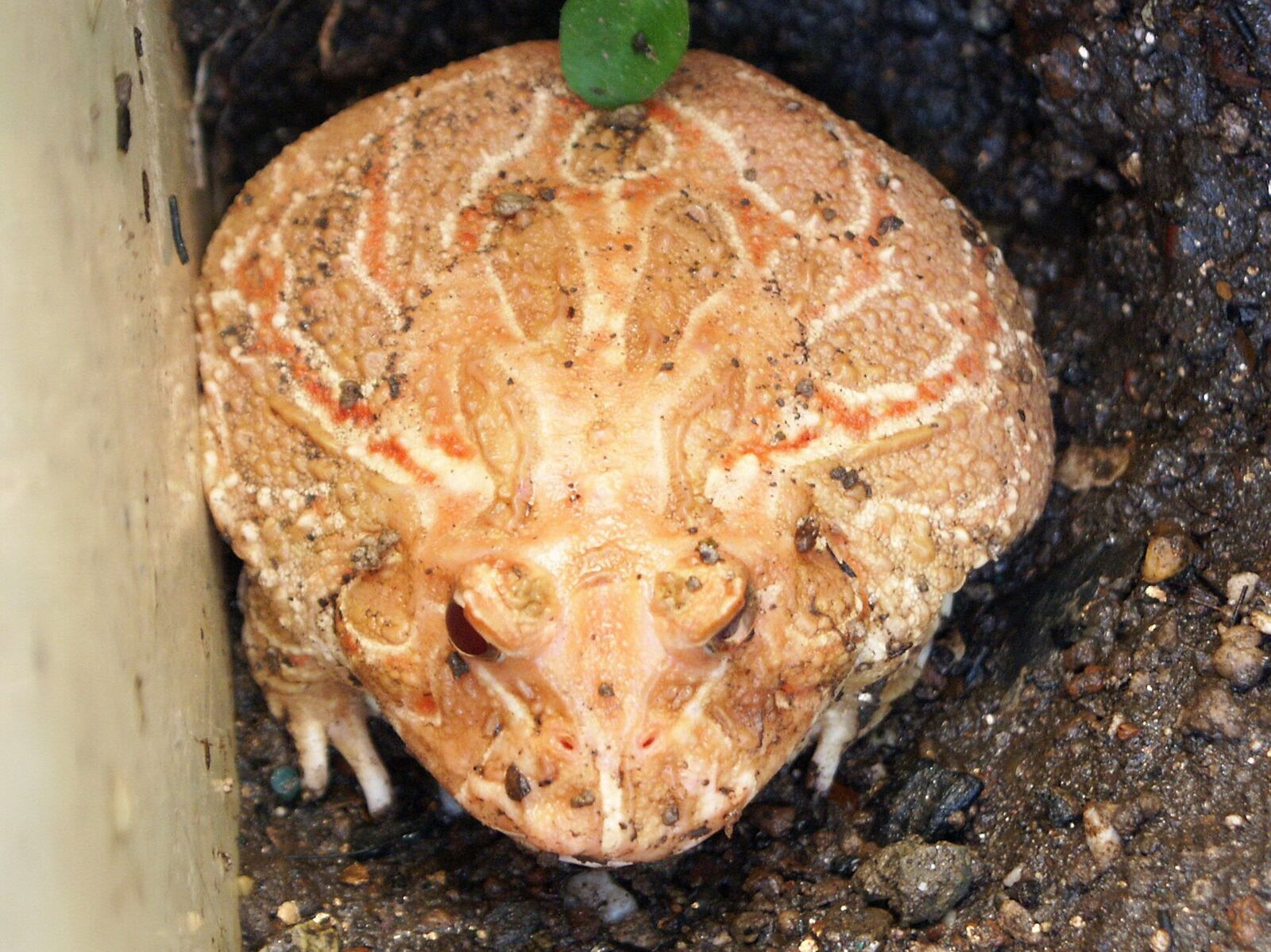
The Argentine horned frog (Ceratophrys ornata), also known as the Argentine wide-mouthed frog, ornate horned frog, ornate horned toad, ornate pacman frog, or just the pacman frog, is a species of frog in the family Ceratophryidae.

Care at a glance
Species-specific values
Values researched for this exact species. Where they differ from the group guide below, follow these. Air, surface and water temperatures are listed separately, and each source is kept as published rather than averaged.
| Air temperature day | 79–82 °F | 214 |
| Air temperature night | 75 °F | 214 |
| Humidity | approximate: 70 % RH | 214 |
| Substrate depth | 4–6 in Adult burrowing depth | 214 |
| Adult length | 4–6 in Source’s average adult range | 214 |
Care guide
Horned frogs and Budgett's frogs
Applies to most species in this group. Habitat: South American grassland and seasonal pools. Individual species can differ, so compare with the species numbers above and the linked sources.
Housing & setup
- Ceratophrys need burrowing substrate; active-season Lepidobatrachus laevis need filtered aquatic housing with an accessible dry platform.
- Warm temperatures; keep one frog per enclosure.
Climate & lighting
Starting point only: Terrestrial Ceratophrys air conditions cannot serve as aquatic Lepidobatrachus water temperatures. Check the species-specific values for this animal where shown.
| Warm side / daytime | 78–84°F |
| Cool side | 72–76°F |
| Humidity | 60–80% |
Diet
- Insects and worms; occasional small fish. Avoid feeding mice often (obesity).
Social life
- Solitary; they will eat tankmates.
Health watch
- Obesity, impaction and cannibalism if housed together. Bites are strong.
Understanding the animal
About this animal
About this animal
The species is endemic to South America. It is the most common species of horned frog, in the grasslands of Argentina, Uruguay and Brazil.
Quoted from the Wikipedia article “Argentine horned frog” (CC BY-SA 4.0) 174
In the wild
In the wild
Researched for this exact species, not its family. Good care copies these conditions.123
| Where it lives | Temperate Pampas grasslands of Argentina, Uruguay and southern Brazil, often near swamps and rivers. It conceals itself in mud or beneath leaves to ambush prey. |
| Ground it lives on | Loose soil, mud and leaf cover. |
| Water it lives in | Freshwater breeding pools and larval habitat; terrestrial adults ambush near wet areas. Numerical water temperature and chemistry ranges were not established. |
| Climate | Temperate grassland habitat with drought periods; buried cocoons conserve moisture. Numerical wild microhabitat temperature and humidity ranges were not established. |
| Active | Predominantly nocturnal movement, with daytime movement also documented; drought aestivation. |
| Social life | Cannibalistic predation makes close association hazardous; detailed wild territorial organization was not established. |
| Wild diet | Frogs, insects, lizards, snakes, small mammals and birds; tadpoles are also predators. |
| Behavior to plan for | It waits partly buried and snaps at passing prey or perceived threats. During drought it buries itself and forms a moisture-retaining skin cocoon. |
What this means for care
- Provide loose substrate for full burial.
- House individually because other frogs can become prey.
- Avoid assuming the constantly hot rainforest climate of other horned frogs.
- Use feeding tools to avoid defensive or feeding bites.
Native climate (measured)
Native climate (measured)
| Warm-season highs | about 86°F (up to 88°F in the hottest sampled areas) |
| Cool-season lows | about 41°F (down to 35°F in the coldest sampled areas) |
| Average temperature | 59–64°F across sampled records |
| Relative humidity | 70–74% on average (driest month about 63%) |
| Rainfall | about 1018 mm a year, spread fairly evenly |
Measured at 61 wild occurrence records sampled against WorldClim 2.1 climate data (1970–2000 averages). Air conditions in the range are ecological context, not enclosure settings: microhabitats such as burrows, leaf litter or basking rocks can be cooler, warmer or more humid.
Profile
Profile
Researched for this exact species. Sources are listed under In the wild above.
Keeper tips
- Provide substrate deep enough for partial burial.
- Maintain access to clean moisture without forcing the frog to remain aquatic.
- House individually.
- Offer appropriately sized animal prey.
Behaviors reported
- Ambushes prey from a partly buried position.
- Uses a disproportionately large mouth to capture relatively large prey.
Unique adaptations
- A broad head and large mouth permit capture of large prey.
- Cryptic coloration helps conceal the frog in vegetation and soil.
Remarkable facts
- The species is commonly called the Argentine horned frog or ornate horned frog.
- It is one of the frogs commonly called Pac-Man frogs.
From the sources
From the sources
Quoted from the matching sections of reputable sources for this exact species. Specialist databases are used first; Wikipedia (community-edited, CC BY-SA 4.0) only fills gaps. Other sources are short credited quotes.
| Overview | The Argentine horned frog (Ceratophrys ornata), also known as the Argentine wide-mouthed frog, ornate horned frog, ornate horned toad, ornate pacman frog, or just the pacman frog, is a species of frog in the family Ceratophryidae. The species is endemic to South America. It is the most common species of horned frog, in the grasslands of Argentina, Uruguay and Brazil. A voracious eater, it will attempt to swallow anything that moves close to its wide mouth, such as insects, rodents, passerine birds, snakes, lizards, and other frogs, even if this predator would suffocate in the process. — Wikipedia (community-edited) |
| Wild diet | All horned frogs, species of the genus Ceratophrys, hunt by remaining motionless, and waiting for prey. They will try to eat anything that can fit in their mouths and some things that can't. Argentine horned frogs have fat bodies that they can draw on as an emergency food source during the dry season or when food is scarce. — Wikipedia (community-edited) |
| Reproduction | Argentine horned frogs reproduce sexually. The Argentine horned frog's females deposit about 2,000 eggs in water and within two weeks they become tadpoles. A male Argentinian frog will use its nuptial pads to grasp the female while the eggs are fertilized. — Wikipedia (community-edited) |
| Appearance and size | The females of C. ornata can grow to be 16.5 cm SVL and the males to 11.5 cm SVL. The average lifespan is 6 to 7 years, however they can live up to 10 years or more in captivity. A horned frog's most prominent feature is its mouth, which accounts for roughly half of the animal's overall size. — Wikipedia (community-edited) |
Data and studies
Researched care notes
Researched care notes
Findings checked against veterinary, zoo, welfare, keeper and peer-reviewed sources. Air, basking-surface and water temperatures are kept separate, and where sources disagree both are shown. “Study” notes report what a paper measured, not a universal rule.
Pac-Man Frog
Researched for this genus; applies to its species unless a species note says otherwise.
- House horned frogs individually because cohabitation can result in territorial conflict and cannibalism.1
- Provide a secure enclosure wider than tall, with space and substrate for burrowing.1
- PetMD gives daytime enclosure temperatures of 75–83°F and nighttime 70–75°F; it does not specify a separate water or measured basking-surface target.1
- PetMD lists 70–80% enclosure relative humidity, monitored with a hygrometer; this is a published guide range, not a species-wide experimental optimum.1
- Offer varied suitably sized insects and worms with feeding tongs, keeping fingers away from the frog's feeding response.1
The numbers
The numbers
Each bar is what one source reports. Where several sources weigh in, the dashed gold band marks their average.
Maximum recorded lifespan
Longest recorded lifespan reported by each database; typical lifespans are usually shorter. The AnAge record comes from an animal in human care.
Veterinary & husbandry research
Veterinary & husbandry research
- A Brucella spp. Isolate from a Pac-Man Frog (Ceratophrys ornata) Reveals Characteristics Departing from Classical Brucellae Soler-Lloréns PF et al., Frontiers in cellular and infection microbiology 2016
- Hormonal induction of spawning in 4 species of frogs by coinjection with a gonadotropin-releasing hormone agonist and a dopamine antagonist Trudeau VL et al., Reproductive biology and endocrinology: RB&E 2010
- Widespread occurrence of the amphibian chytrid panzootic lineage in Uruguay is constrained by climate Borteiro C et al., Diseases of aquatic organisms 2024
Peer-reviewed papers that mention this species alongside captivity, zoos, veterinary care or aquaculture. Some cover several species or mention it only in passing, so check the abstract. 170
Sources for this sheet
- AnAge: The Animal Ageing and Longevity Database (Human Ageing Genomic Resources) Peer-reviewed researchCurated, referenced longevity and life-history records for thousands of species; maximum lifespans are often from zoo animals.
- Merck Veterinary Manual: Environment and husbandry for amphibians Zoo, university or veterinaryThe Merck Veterinary Manual: a standard veterinary reference written and reviewed by veterinary specialists.
- Merck Veterinary Manual: Overview of amphibians Zoo, university or veterinaryThe Merck Veterinary Manual: a standard veterinary reference written and reviewed by veterinary specialists.
- Clint's Reptiles (YouTube): Pac-man Frog, The Best Pet Amphibian? Expert educator & keeperClint Laidlaw, PhD in Biology Education and MS in Evolutionary Ecology; owner of Clint's Reptile Room and a longtime keeper. Rates each species on handleability, care, hardiness, availability and upfront cost.
- Reptiles Magazine: Pac-Man Frog Care and Information — Andrew Tillson-Willis Experienced keeper or breederAdded in the 2026 source-checked care-guide review.
- Andrew Tilson-Willis, Reptiles Magazine: Budgett’s Frogs (2011; updated 2020) Experienced keeper or breederAdded in the 2026 source-checked care-guide review.
- Clint's Reptiles (YouTube): Pac-man Frog, The Best Pet Amphibian? Expert educator & keeperClint Laidlaw, PhD in Biology Education and MS in Evolutionary Ecology; owner of Clint's Reptile Room and a longtime keeper. His "Best Pet?" series reviews each species' care in depth.
- AmphibiaWeb (University of California, Berkeley) Peer-reviewed researchUniversity-hosted database of amphibian biology and conservation.
- GBIF Backbone Taxonomy (Global Biodiversity Information Facility) Peer-reviewed researchInternational scientific taxonomy used here for classification.
- Wikipedia (species article) Community referenceFree encyclopedia; useful overviews with their own citations. Intro text is quoted under CC BY-SA 4.0.
- PubMed (U.S. National Library of Medicine) Peer-reviewed researchIndex of peer-reviewed veterinary, zoo and husbandry research.
- iNaturalist (captive observations) Community referenceCommunity observation platform run by the California Academy of Sciences and National Geographic; observations marked captive show animals living in homes, zoos and aquariums.