Home / Amphibians / Frogs and toads / Budgett's frog
No federal permit to keepBudgett's frog
Lepidobatrachus laevis
Amphibians › Frogs and toads (Anura) › Ceratophryidae (Horned and Budgett's frogs)
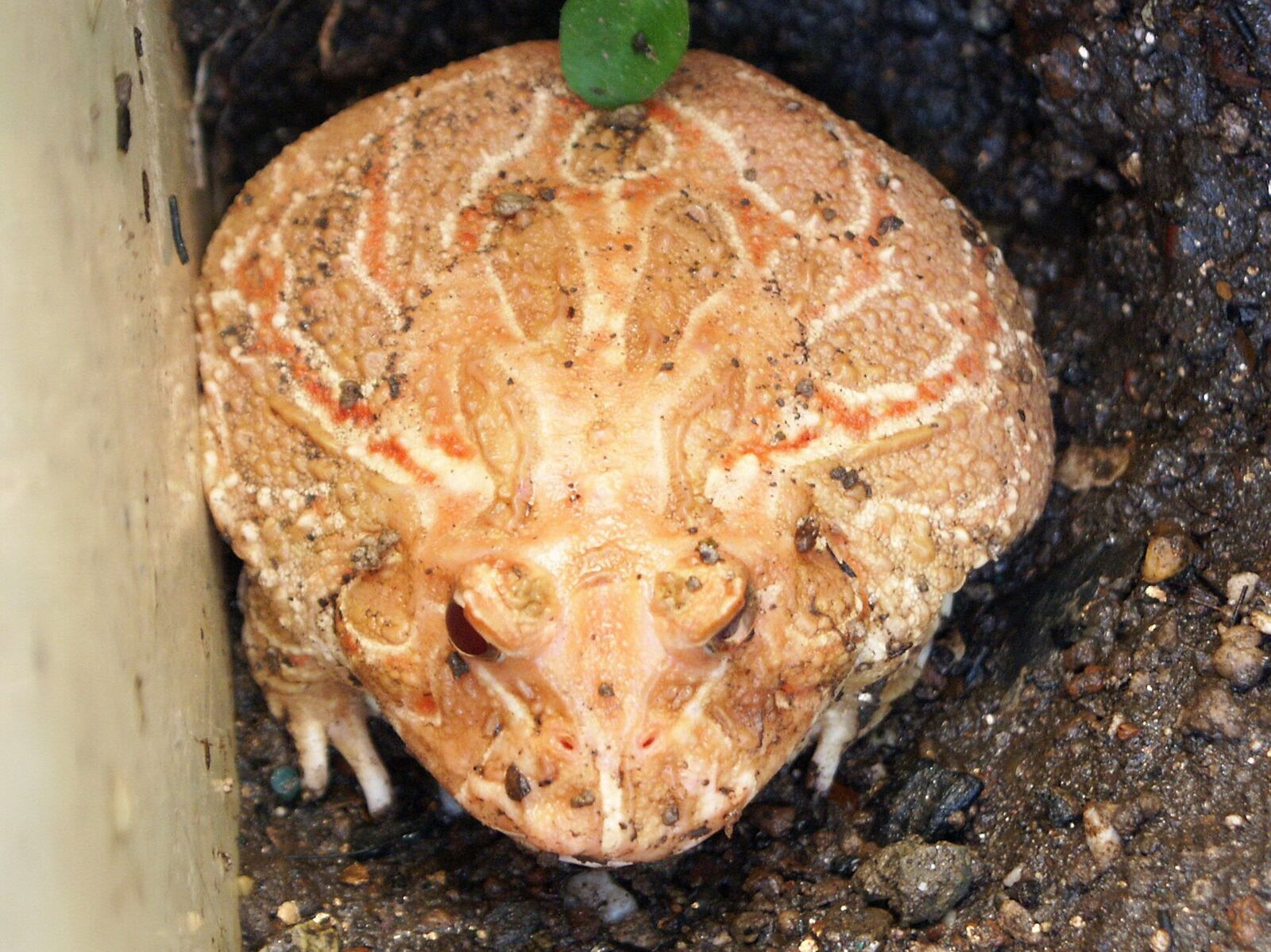
Lepidobatrachus laevis, widely known as Budgett's frog, is a species of frog in the family Ceratophryidae, discovered by John Samuel Budgett.

Care at a glance
Species-specific values
Values researched for this exact species. Where they differ from the group guide below, follow these. Air, surface and water temperatures are listed separately, and each source is kept as published rather than averaged.
| Water temperature | 77–82 °F Active-season recommendation | 215 |
| Enclosure minimum | length: 24 in; width: 12 in; height: 15 in Source recommendation for average adult | 215 |
| Water depth | 6–9 in Source adult recommendation; dry exit platform required | 215 |
| Social | House individually outside controlled breeding. | 215 |
Care guide
Budgett’s frogs
Applies to most species in this group. Habitat: Seasonal Gran Chaco pools; aquatic during the active phase, burrowing during dry-season aestivation. [rm-budgett]. Individual species can differ, so compare with the species numbers above and the linked sources.
Housing & setup
- Published adult example: 24 × 12 × 15 inches, with 6–9 inches of water, secure resting terraces and a platform allowing complete exit.
- Use dechlorinated water, low-disturbance filtration and bare-bottom housing; furnishings must be too large to swallow. Secure the thermostatic heater against displacement.
Sources 215
Climate & lighting
| Water | 77–82°F |
- UVB: The keeper account reports no UVB requirement; that is husbandry experience, not a controlled demonstration of benefit or absence of benefit.
Sources 215
Diet
- Varied earthworms and insects; juveniles daily, adults two or three meals weekly. Provide calcium/vitamin support for growing frogs and avoid overfeeding.
Sources 215
Social life
- House singly: cannibalism remains possible even between well-fed adults.
Sources 215
Handling
- Use feeding tongs and avoid fingers near the mouth; bites can draw blood.
Sources 215
Health watch
- Remove feces promptly; watch for swallowed objects, obesity and deteriorating water quality.
Sources 215
Understanding the animal
About this animal
About this animal
It is often kept as a pet. It has acquired a number of popular nicknames, including hippo frog, Freddy Krueger frog, and escuerzo de agua.
Quoted from the Wikipedia article “Lepidobatrachus laevis” (CC BY-SA 4.0) 174
In the wild
In the wild
Quoted from the matching sections of reputable sources for this exact species. Specialist databases are used first; Wikipedia (community-edited, CC BY-SA 4.0) only fills gaps. Other sources are short credited quotes.
| Overview | Lepidobatrachus laevis, widely known as Budgett's frog, is a species of frog in the family Ceratophryidae, discovered by John Samuel Budgett. It is often kept as a pet. It has acquired a number of popular nicknames, including hippo frog, Freddy Krueger frog, and escuerzo de agua. — Wikipedia (community-edited) |
| Where it lives | It is commonly observed in Paraguay and Bolivia, and less frequently in Argentina. Its natural habitats are the dry and wet Chaco. Breeding may take place in shallow temporary pools and artificial ponds. — Wikipedia (community-edited) |
| Wild diet | The wide-mouth frog is well adapted to its environment, notably the harsh winter. During this time it will remain inactive underground in a cocoon of shed dead skin which protects it from losing water until it emerges. This species is generally very aggressive and will puff up when threatened to appear larger. — Wikipedia (community-edited) |
| Reproduction | L. laevis can produce up to 1400 eggs in a single mating. A pair will reproduce and deposit a mass of fertilized eggs in temporary pools of water. The embryo develops at a rapid rate over two weeks, in order to metamorphize into mobile adolescent form before the breeding pool dries up. — Wikipedia (community-edited) |
| Appearance and size | This frog has become popular in pet stores due to its comical flat appearance and intelligent behavior. Females reach a size of 100 mm while males sometimes only grow half as large. They have a large head that makes up to 1/3 of the body, with a notably large mouth. — Wikipedia (community-edited) |
Native climate (measured)
Native climate (measured)
| Warm-season highs | about 94°F (up to 96°F in the hottest sampled areas) |
| Cool-season lows | about 50°F (down to 47°F in the coldest sampled areas) |
| Average temperature | 71–77°F across sampled records |
| Relative humidity | 62–65% on average (driest month about 50%) |
| Rainfall | about 749 mm a year |
Measured at 37 wild occurrence records sampled against WorldClim 2.1 climate data (1970–2000 averages). Air conditions in the range are ecological context, not enclosure settings: microhabitats such as burrows, leaf litter or basking rocks can be cooler, warmer or more humid.
Data and studies
Veterinary & husbandry research
Veterinary & husbandry research
- Pathologic Lesions of the Budgett Frog (Lepidobatrachus laevis), an Emerging Laboratory Animal Model Womble MA et al., Comparative medicine 2020
Peer-reviewed papers that mention this species alongside captivity, zoos, veterinary care or aquaculture. Some cover several species or mention it only in passing, so check the abstract. 170
Sources for this sheet
- Andrew Tilson-Willis, Reptiles Magazine: Budgett’s Frogs (2011; updated 2020) Experienced keeper or breederAdded in the 2026 source-checked care-guide review.
- AmphibiaWeb (University of California, Berkeley) Peer-reviewed researchUniversity-hosted database of amphibian biology and conservation.
- GBIF Backbone Taxonomy (Global Biodiversity Information Facility) Peer-reviewed researchInternational scientific taxonomy used here for classification.
- Wikipedia (species article) Community referenceFree encyclopedia; useful overviews with their own citations. Intro text is quoted under CC BY-SA 4.0.
- PubMed (U.S. National Library of Medicine) Peer-reviewed researchIndex of peer-reviewed veterinary, zoo and husbandry research.
- iNaturalist (captive observations) Community referenceCommunity observation platform run by the California Academy of Sciences and National Geographic; observations marked captive show animals living in homes, zoos and aquariums.