Home / Fishes / Freshwater stingrays / Xingu River ray
Some federal rules applyXingu River ray
Potamotrygon leopoldi
Fishes › Freshwater stingrays (Myliobatiformes) › Potamotrygonidae (Freshwater stingrays)
The Xingu River ray, River stingray, white-blotched river stingray, or polka-dot stingray (Potamotrygon leopoldi) is a species of freshwater fish in the family Potamotrygonidae.

Care at a glance
Species-specific aquarium care
- Tank: An adult reaches about 43.7 in (111 cm). That needs a pond or public-aquarium-scale system, far beyond a home aquarium.
- Water: Freshwater.
- Temperature: 68–77°F (range recorded for this species).
- pH: 6–6.8.
- Layout: Uses both the bottom and open water: give open swimming space plus cover near the substrate.
- Availability: Mostly kept by public aquariums; private keeping is uncommon.
Calculated from this species' own FishBase record: tank size from its typical adult length and swimming zone, water values from its recorded ranges. The group guide below fills in general care.
Care guide
Species care notes
- Tank: a base of at least 94 × 35 in (roughly 428 US gallons); space needed is rated “very large tank”.
- Water: a fairly wide range, from slightly acidic to slightly alkaline, 68–84 °F, pH 6–7.5, 0–5 dGH.
- Difficulty: Moderate (Seriously Fish rating).
Short excerpts from the species profile:
- Setup: “Strictly speaking, decor isn't really necessary in a tank set up to house rays.”
- Diet: “Wild rays feed chiefly on other fish and aquatic invertebrates, including worms and crustaceans.”
- Tankmates: “Rays are among the top predators in the ecosystems they populate in nature and are unsafe to keep with most other species.”
- Breeding: “Potamotrygon species utilise a breeding strategy known as matrotrophic viviparity.”
From the Seriously Fish profile for this species, which has the full habitat, maintenance, diet, behaviour and breeding write-up 167
Freshwater stingrays
Applies to most species in this group. Habitat: South American rivers. Individual species can differ, so compare with the species numbers above and the linked sources.
Housing & setup
- Large tanks (often 6×3 ft+ footprint for one adult) with fine sand and excellent filtration.
Diet
- Earthworms, shrimp and fish.
Health watch
- Venomous barb; banned in some states.
Understanding the animal
About this animal
About this animal
It is endemic to the Xingu River basin in Brazil and as such prefers clear waters with rocky bottoms. It is sometimes kept in aquaria, like its more common relative the Motoro.
Quoted from the Wikipedia article “Xingu River ray” (CC BY-SA 4.0) 174
In the wild
In the wild
From this species’ own FishBase record (habitat, bottom type, water and breeding data), not its family. Good care copies these conditions.1
| Where it lives | Lives in freshwater. Uses both the bottom and open water. Buried in sand during day, hunting for benthic invertebrates during night. |
| Water it lives in | Freshwater, 68–77 °F (20–25 °C), pH 6–6.8. |
| Climate | Tropical climate. |
| Behavior to plan for | Breeding: internal live bearers. |
What this means for care
- Keep water within its wild range, 68–77 °F.
Native climate (measured)
Native climate (measured)
| Warm-season highs | about 91°F (up to 93°F in the hottest sampled areas) |
| Cool-season lows | about 66°F (down to 62°F in the coldest sampled areas) |
| Average temperature | 77–79°F across sampled records |
| Relative humidity | 83–85% on average (driest month about 76%) |
| Rainfall | about 2012 mm a year |
Measured at 17 wild occurrence records sampled against WorldClim 2.1 climate data (1970–2000 averages). Air conditions in the range are ecological context, not enclosure settings: microhabitats such as burrows, leaf litter or basking rocks can be cooler, warmer or more humid.
From the sources
From the sources
Quoted from the matching sections of reputable sources for this exact species. Specialist databases are used first; Wikipedia (community-edited, CC BY-SA 4.0) only fills gaps. Other sources are short credited quotes.
| Overview | The Xingu River ray, River stingray, white-blotched river stingray, or polka-dot stingray (Potamotrygon leopoldi) is a species of freshwater fish in the family Potamotrygonidae. It is endemic to the Xingu River basin in Brazil and as such prefers clear waters with rocky bottoms. It is sometimes kept in aquaria, like its more common relative the Motoro. — Wikipedia (community-edited) |
| Where it lives | Home ranges Population dynamics Growth parameters Max. ages / sizes Length-weight rel. Length-frequencies Mass conversion Recruitment Abundance Life cycle Reproduction Maturity Maturity/Gills rel. — FishBase |
| Appearance and size | Maximum length 111 cm wd male/unsexed; maximum published weight 17.0 kg. — FishBase |
| Biology | Buried in sand during day, hunting for benthic invertebrates during night. — FishBase |
| History and naming | The fish is named in honor of King Leopold III (1901–1983) of Belgium, who sponsored many scientific studies at the Institut Royal des Sciences Naturelles de Belgique. — Wikipedia (community-edited) |
Data and studies
The numbers
The numbers
Each bar is what one source reports. Where several sources weigh in, the dashed gold band marks their average.
Typical adult weight
Average adult body mass in each database (FishBase gives the maximum recorded weight).
Adult length
Maximum recorded length. Measured as disc width. Fish in home aquariums often stay smaller than wild records.
Water temperature
Range the species tolerates in nature; aim for the middle.
Water hardness
Minimum tank footprint
Seriously Fish recommends a tank base of at least 94 × 35 in (about 428 US gallons).
Veterinary & husbandry research
Veterinary & husbandry research
- Age and growth of the endemic Xingu River stingray Potamotrygon leopoldi validated using fluorescent dyes Charvet P et al., Journal of fish biology 2018
Peer-reviewed papers that mention this species alongside captivity, zoos, veterinary care or aquaculture. Some cover several species or mention it only in passing, so check the abstract. 170
Sources for this sheet
- FishBase (Froese & Pauly, eds.), version 24.07 Peer-reviewed researchThe global scientific database on fishes, maintained by a consortium of research institutions; every value is referenced.
- Seriously Fish species profiles Experienced keeper or breederLong-running aquarium reference written and peer-checked by experienced fishkeepers and ichthyologists; each profile covers habitat, tank size, water, diet, behaviour and breeding.
- Species+ (UNEP-WCMC and the CITES Secretariat) Zoo, university or veterinaryThe official database of species listed under CITES.
- USFWS International Affairs: CITES Zoo, university or veterinaryFederal agency that issues CITES permits.
- Merck Veterinary Manual: Management of aquarium fish Zoo, university or veterinaryThe Merck Veterinary Manual: a standard veterinary reference written and reviewed by veterinary specialists.
- Merck Veterinary Manual: Types and features of aquatic systems Zoo, university or veterinaryThe Merck Veterinary Manual: a standard veterinary reference written and reviewed by veterinary specialists.
- Merck Veterinary Manual: Nutritional diseases of fish Zoo, university or veterinaryThe Merck Veterinary Manual: a standard veterinary reference written and reviewed by veterinary specialists.
- Wikipedia (species article) Community referenceFree encyclopedia; useful overviews with their own citations. Intro text is quoted under CC BY-SA 4.0.
- PubMed (U.S. National Library of Medicine) Peer-reviewed researchIndex of peer-reviewed veterinary, zoo and husbandry research.
- iNaturalist (captive observations) Community referenceCommunity observation platform run by the California Academy of Sciences and National Geographic; observations marked captive show animals living in homes, zoos and aquariums.
More freshwater stingrays

Bigtooth river stingray
Potamotrygon henlei
Aquarium hobby
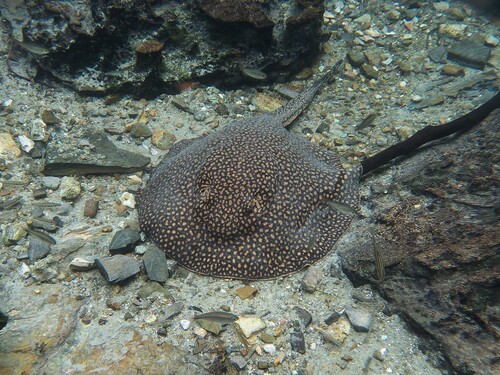
Largespot river stingray
Potamotrygon falkneri
Aquarium hobby

Ocellate river stingray
Potamotrygon motoro
Aquarium hobby
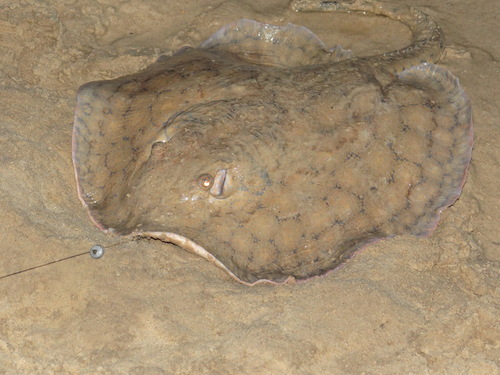
Smooth back river stingray
Potamotrygon orbignyi
Aquarium hobby
Maracaibo river stingray
Potamotrygon yepezi
Aquarium hobby
Raspy river stingray
Potamotrygon scobina
Aquarium hobby