Home / Mammals / Two-toed sloths / Linnaeus's two-toed sloth
Some federal rules apply In-depth sheetLinnaeus's two-toed sloth
Choloepus didactylus
Mammals › Two-toed sloths (Pilosa) › Choloepodidae (Two-toed sloths)
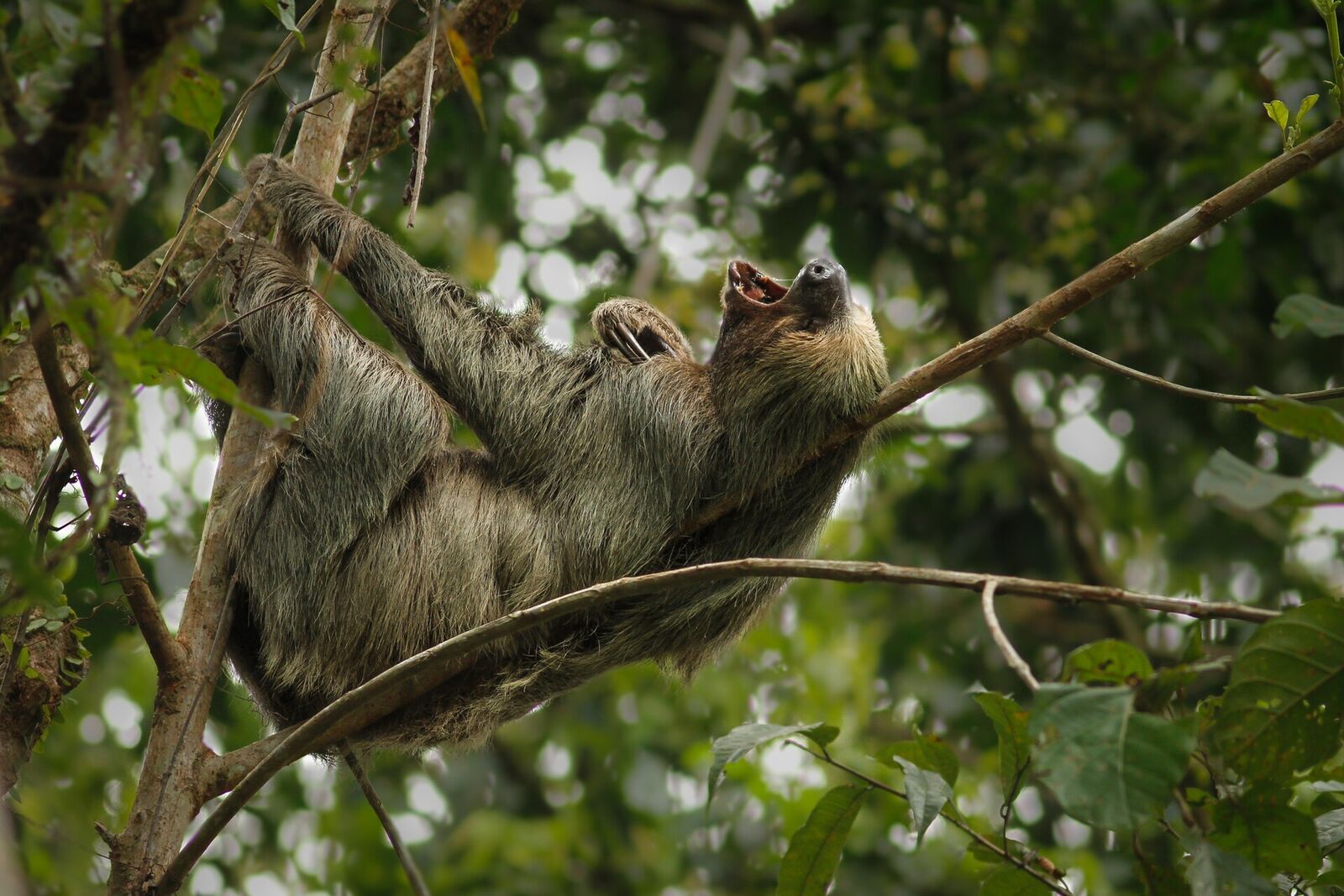
Two-toed sloths are nocturnal, arboreal leaf- and fruit-eaters with a very slow metabolism. They need warm, humid, climbable housing.
Care guide
Housing
- High humidity, tropical warmth and plenty of hanging branches; they move poorly on the ground.
Sources 74
Diet
- Leaves, fruit, berries and twigs; digestion can take about a month and they defecate about once a week.
Sources 74
Show the group care guide for sloths
Sloths
Applies to most species in this group. Habitat: Neotropical rainforest canopy. Individual species can differ, so compare with the species numbers above and the linked sources.
Housing & setup
- Warm (75–85 °F), humid enclosures with ropes and branches; they rarely come down.
Diet
- Leafy greens, vegetables and leaf-eater biscuits; very slow digestion.
Health watch
- Overheating, chilling and obesity.
Understanding the animal
In the wild
In the wild
Researched for this exact species, not its family. Good care copies these conditions.123
| Where it lives | Tropical forest canopy in the Guianas and Amazon basin, extending from Venezuela south into Brazil and west into Ecuador and Peru. Spends most of its life suspended from branches. |
| Ground it lives on | Arboreal; descends infrequently to defecate or change trees. |
| Active | Primarily nocturnal, resting extensively during daylight. |
| Social life | Mostly solitary; females may sometimes occupy the same tree. |
| Wild diet | Leaves, small twigs, fruit and berries; obtains moisture from vegetation and dew. |
| Behavior to plan for | Moves and feeds while hanging beneath branches and is awkward on land, although it swims well. Can defend itself with claws and teeth. |
What this means for care
- Provide a continuous network of overhead supports for inverted movement.
- Make browse accessible while hanging and maintain ground access for defecation.
- Allow undisturbed daytime rest and individual feeding space.
Native climate (measured)
Native climate (measured)
| Warm-season highs | about 89°F (up to 90°F in the hottest sampled areas) |
| Cool-season lows | about 70°F (down to 68°F in the coldest sampled areas) |
| Average temperature | 77–80°F across sampled records |
| Relative humidity | 82–85% on average (driest month about 81%) |
| Rainfall | about 2725 mm a year |
Measured at 129 wild occurrence records sampled against WorldClim 2.1 climate data (1970–2000 averages). Air conditions in the range are ecological context, not enclosure settings: microhabitats such as burrows, leaf litter or basking rocks can be cooler, warmer or more humid.
Profile
Profile
Researched for this exact species. Sources are listed under In the wild above.
History
Linnaeus's two-toed sloth is a South American member of the family Choloepodidae, one of the two modern sloth families distinguished by the number of toes on the front feet. Choloepodidae also included extinct ground sloths.
Keeper tips
- Prioritize elevated, interconnected climbing structures because the species naturally stays high in the canopy.
- Provide supports that allow use of its long limbs and curved claws.
- Design the environment around arboreal rather than ground-level movement.
- Account for the species' leaf-cropping adaptations when considering feeding behavior.
Behaviors reported
- It is described as strictly arboreal and stays high in rainforest canopy.
- Newborns cling to their mother's belly for about five weeks.
Unique adaptations
- Four long limbs of approximately equal length end in two curved claws.
- Grooves in individual hairs collect algae, producing a greenish tint that helps camouflage the animal.
- Belly hair grows from the stomach toward the back, opposite the direction typical of most mammals.
- Small, continuously growing molars are worn down by chewing.
- Hardened lips compensate for the lack of sharp teeth by shearing and cropping leaves.
Remarkable facts
- It is the largest living sloth species according to the supplied Wikipedia source.
- Adults are reported at approximately 21 to 35 inches long and about 9 to 24 lb in the Wikipedia source.
- Males and females are approximately the same size.
- The species lacks incisors and has only a small number of remaining teeth.
- Females reach sexual maturity at about three years, while males mature at about four to five years.
- Females give birth to one offspring at a time according to the supplied Animal Diversity Web material.
From the sources
From the sources
Quoted from the matching sections of reputable sources for this exact species. Specialist databases are used first; Wikipedia (community-edited, CC BY-SA 4.0) only fills gaps. Other sources are short credited quotes.
| Overview | Linnaeus's two-toed sloth (Choloepus didactylus), also known as the southern two-toed sloth, unau, or Linne's two-toed sloth is a species of sloth from South America, found in Venezuela, Suriname, Guyana, French Guiana, Colombia, Ecuador, Peru, and Brazil north of the Amazon River. There is now evidence suggesting the species' range expands into Bolivia. It's the largest extant sloth species. — Wikipedia (community-edited) |
| Where it lives | Choloepus didactylus is strictly arboreal, staying high in the canopy of the tropical rain forests, and maintaining a range of about 10-acres. — Animal Diversity Web |
| Wild diet | Choloepus didactylus feed primarily on vegetation, including berries, leaves, small twigs, and fruits, cropping the leaves with their lips. — Animal Diversity Web |
| Behavior | Sloths move slowly and deliberately. — Animal Diversity Web |
| Reproduction | Females of this species of sloth reach sexual maturity at 3 years of age, males reach sexual maturity between 4 and 5. — Animal Diversity Web |
| Appearance and size | Two-toed sloths have been called the slowest animals on earth. — Animal Diversity Web |
| Conservation | Two-toed sloths are in serious danger of losing their habitat due to logging of rain forests. — Animal Diversity Web |
Data and studies
The numbers
The numbers
Each bar is what one source reports. Where several sources weigh in, the dashed gold band marks their average.
Lifespan in care
Maximum recorded lifespan
Longest recorded lifespan reported by each database; typical lifespans are usually shorter. The AnAge record comes from an animal in human care.
Typical adult weight
Average adult body mass in each database (FishBase gives the maximum recorded weight).
Veterinary & husbandry research
Veterinary & husbandry research
- Natural Canine Distemper Virus Infection in Linnaeus's 2-Toed Sloths (Choloepus didactylus) Watson AM et al., Veterinary pathology 2020
- Systemic Streptococcus agalactiae infection with meningo-ventriculitis in a Linnaeus's two-toed sloth (Choloepus didactylus) Yoshida K et al., The Journal of veterinary medical science 2022
- Characterization of the ovarian cycle in the two-toed sloths (Choloepus didactylus): an innovative, reliable, and noninvasive method using fecal hormone analyses Troll S et al., Theriogenology 2013
- Environmental enrichment for a mixed-species nocturnal mammal exhibit Clark FE et al., Zoo biology 2012
Peer-reviewed papers that mention this species alongside captivity, zoos, veterinary care or aquaculture. Some cover several species or mention it only in passing, so check the abstract. See all 21 on PubMed → 170
Sources for this sheet
- Animal Diversity Web (University of Michigan): Choloepus didactylus Zoo, university or veterinaryUniversity-hosted species account, mostly wild biology.
- AnAge: The Animal Ageing and Longevity Database (Human Ageing Genomic Resources) Peer-reviewed researchCurated, referenced longevity and life-history records for thousands of species; maximum lifespans are often from zoo animals.
- Myhrvold et al. (2015). An amniote life-history database. Ecology 96: 3109 Peer-reviewed researchPeer-reviewed compilation of life-history data for over 21,000 birds, mammals and reptiles.
- Species+ (UNEP-WCMC and the CITES Secretariat) Zoo, university or veterinaryThe official database of species listed under CITES.
- USFWS International Affairs: CITES Zoo, university or veterinaryFederal agency that issues CITES permits.
- 9 CFR 2.1: Animal Welfare Act licensing (USDA) Zoo, university or veterinaryWho needs a USDA license to breed, sell or exhibit animals.
- Merck Veterinary Manual: Management of zoo animals Zoo, university or veterinaryThe Merck Veterinary Manual: a standard veterinary reference written and reviewed by veterinary specialists.
- Merck Veterinary Manual: Nutrition: exotic and zoo animals Zoo, university or veterinaryThe Merck Veterinary Manual: a standard veterinary reference written and reviewed by veterinary specialists.
- GBIF Backbone Taxonomy (Global Biodiversity Information Facility) Peer-reviewed researchInternational scientific taxonomy used here for classification.
- Wikipedia (species article) Community referenceFree encyclopedia; useful overviews with their own citations. Intro text is quoted under CC BY-SA 4.0.
- PubMed (U.S. National Library of Medicine) Peer-reviewed researchIndex of peer-reviewed veterinary, zoo and husbandry research.