Home / Fishes / Carp, barbs, minnows, loaches / Cyprinidae / Ticto barb
No federal permit to keepTicto barb
Pethia ticto
Fishes › Carp, barbs, minnows, loaches (Cypriniformes) › Cyprinidae (Carps and barbs)
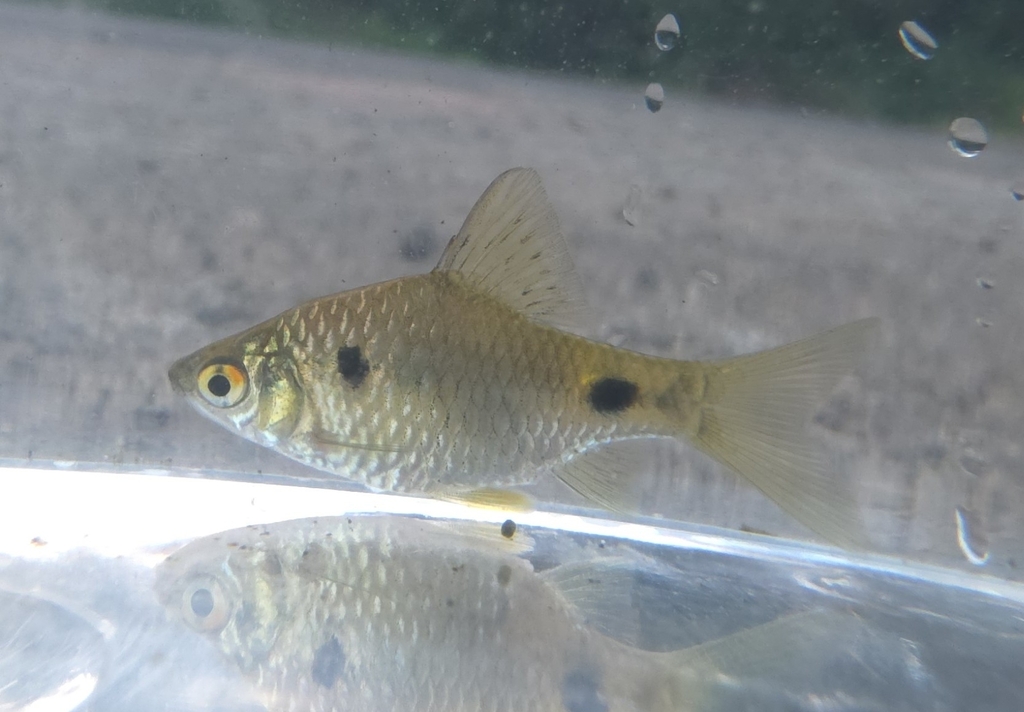
The ticto barb or twospot barb (Pethia ticto) is a species of subtropical freshwater fish belonging to the family Cyprinidae.
Care at a glance
Species-specific aquarium care
- Tank: At least 24 in long and 12 in front to back for one adult (adults commonly reach about 4.9 in / 12.52 cm).
- Water: Freshwater (tolerates brackish).
- Temperature: 57–72°F (range recorded for this species).
- pH: 6.5–7.
- Hardness: 0–10 dGH.
- Layout: Uses both the bottom and open water: give open swimming space plus cover near the substrate.
- Diet: Eats a varied diet: mix quality prepared foods with frozen and live foods. FishBase classes it as a omnivore.
Calculated from this species' own FishBase record: tank size from its typical adult length and swimming zone, water values from its recorded ranges. The group guide below fills in general care.
Care guide
Species care notes
- Tank: a base of at least 31 × 12 in (roughly 19 US gallons); space needed is rated “modest tank”.
- Water: a fairly wide range, from slightly acidic to slightly alkaline, 64–77 °F, pH 6–7.5, 2–12 dGH.
- Behaviour: temperament peaceful; a shoaling fish best kept in a group of six or more; suited to a community tank.
- Difficulty: Easy (Seriously Fish rating).
Short excerpts from the species profile:
- Setup: “Choice of décor is not especially critical though it tends to show better colouration in a heavily-planted set-up with a dark substrate.”
- Diet: “Likely to be a foraging omnivore feeding on worms, insects and other small invertebrates, as well as plant material and organic detritus.”
- Tankmates: “Generally very peaceful making it an ideal resident of the well-researched community aquarium.”
- Breeding: “Like most small cyprinids Pethia spp.”
From the Seriously Fish profile for this species, which has the full habitat, maintenance, diet, behaviour and breeding write-up 167
Carps and barbs
Applies to most species in this group. Habitat: The listed barbs and freshwater sharks occupy Asian streams, rivers and floodplain waters, with bala sharks also using natural lakes. Individual species can differ, so compare with the species numbers above and the linked sources.
Housing & setup
- Tiger barbs need a base at least 80 × 30 cm (about 31 × 12 inches), with vegetation and driftwood cover.
- Adult bala shark groups need a base at least 240 × 60 cm (about 96 × 24 inches), ample open swimming space and a heavy, tight lid.
- Red-tailed black sharks need a base at least 120 × 45 cm (about 48 × 18 inches), with rocky refuges.
- Use efficient filtration, water movement and high oxygenation for riverine bala and red-tailed sharks.
Climate & lighting
| Water | 68–78.8°F |
Diet
- Quality flakes or granules containing plant material.
- Live or frozen Daphnia, Artemia and bloodworms.
- For larger bala sharks: chopped earthworms, prawns or mussels.
- For bala sharks: shelled peas, blanched courgette or spinach.
Social life
- Keep tiger barbs in at least 8–10 and bala sharks in at least five. Avoid timid or long-finned companions for tiger barbs. Red-tailed black sharks become territorial toward similar-looking fishes.
Health watch
- Ammonia toxicity.
- Nutritional deficiencies.
Understanding the animal
About this animal
About this animal
It is a native of the upper Mekong, Salwen, Irrawaddy, Meklong and upper Charo Phraya basins in the countries of Nepal, India, Pakistan, Myanmar, Bangladesh, Thailand, and Sri Lanka. It has frequently been confused with the Odessa barb in the aquarium trade, but in that species the male is reddish-orange (lacking in P. ticto).
Quoted from the Wikipedia article “Ticto barb” (CC BY-SA 4.0) 174
In the wild
In the wild
From this species’ own FishBase record (habitat, bottom type, water and breeding data), not its family. Good care copies these conditions.1
| Where it lives | Lives in freshwater and brackish water, in rivers and streams, lakes, rice paddies. Uses both the bottom and open water. Found in still, shallow, marginal waters of tanks and rivers, mostly with muddy bottoms. They browse close to the substrate in shallow water. Feed on crustaceans, insects and plankton. About 150 eggs are laid in batches of about 20 at a time; eggs hatch in about a day, and fry are free-swimming the next day. Aquarium keeping: in groups of 5 or more individuals; minimum aquarium size 60 cm. |
| Water it lives in | Freshwater / brackish water, 57–72 °F (14–22 °C), pH 6.5–7, hardness 10 dH. |
| Climate | Subtropical climate. |
| Wild diet | Troph of juv./adults from 1 study. |
| Behavior to plan for | Breeding: open water/substratum egg scatterers. |
What this means for care
- Keep water within its wild range, 57–72 °F.
- It tolerates or needs brackish water; check salinity needs before setup.
Native climate (measured)
Native climate (measured)
| Warm-season highs | about 96°F (up to 106°F in the hottest sampled areas) |
| Cool-season lows | about 52°F (down to 44°F in the coldest sampled areas) |
| Average temperature | 73–81°F across sampled records |
| Relative humidity | 60–74% on average (driest month about 51%) |
| Rainfall | about 1531 mm a year, with strong wet and dry seasons |
Measured at 109 wild occurrence records sampled against WorldClim 2.1 climate data (1970–2000 averages). Air conditions in the range are ecological context, not enclosure settings: microhabitats such as burrows, leaf litter or basking rocks can be cooler, warmer or more humid.
From the sources
From the sources
Quoted from the matching sections of reputable sources for this exact species. Specialist databases are used first; Wikipedia (community-edited, CC BY-SA 4.0) only fills gaps. Other sources are short credited quotes.
| Overview | The ticto barb or twospot barb (Pethia ticto) is a species of subtropical freshwater fish belonging to the family Cyprinidae. It is a native of the upper Mekong, Salwen, Irrawaddy, Meklong and upper Charo Phraya basins in the countries of Nepal, India, Pakistan, Myanmar, Bangladesh, Thailand, and Sri Lanka. It has frequently been confused with the Odessa barb in the aquarium trade, but in that species the male is reddish-orange (lacking in P. ticto). The ticto barb is silver and gold with two black spots; one just before the pectoral fin and one near the back tail. — Wikipedia (community-edited) |
| Where it lives | Home ranges Population dynamics Growth parameters Max. ages / sizes Length-weight rel. Length-frequencies Mass conversion Recruitment Abundance Life cycle Reproduction Maturity Maturity/Gills rel. — FishBase |
| Reproduction | Assumed to be like Barbus conchonius. — FishBase |
| Appearance and size | Maximum length 12.5 cm tl male/unsexed. — FishBase |
| Biology | Found in still, shallow, marginal waters of tanks and rivers, mostly with muddy bottoms. They browse close to the substrate in shallow water. Feed on crustaceans, insects and plankton. — FishBase |
Data and studies
The numbers
The numbers
Each bar is what one source reports. Where several sources weigh in, the dashed gold band marks their average.
Adult length
Maximum recorded length. Measured as total length. Fish in home aquariums often stay smaller than wild records.
Water temperature
Range the species tolerates in nature; aim for the middle.
Water hardness
Minimum tank footprint
Seriously Fish recommends a tank base of at least 31 × 12 in (about 19 US gallons).
Veterinary & husbandry research
Veterinary & husbandry research
- Morphological and molecular detection of myxosporean parasites in freshwater fish in Myanmar Thu MM et al., Journal of parasitic diseases: official organ of the Indian Society for Parasitology 2023
Peer-reviewed papers that mention this species alongside captivity, zoos, veterinary care or aquaculture. Some cover several species or mention it only in passing, so check the abstract. 170
Sources for this sheet
- FishBase (Froese & Pauly, eds.), version 24.07 Peer-reviewed researchThe global scientific database on fishes, maintained by a consortium of research institutions; every value is referenced.
- Seriously Fish species profiles Experienced keeper or breederLong-running aquarium reference written and peer-checked by experienced fishkeepers and ichthyologists; each profile covers habitat, tank size, water, diet, behaviour and breeding.
- Seriously Fish — Puntigrus tetrazona Experienced keeper or breederAdded in the 2026 source-checked care-guide review.
- Seriously Fish — Balantiocheilos melanopterus Experienced keeper or breederAdded in the 2026 source-checked care-guide review.
- Seriously Fish — Epalzeorhynchos bicolor Experienced keeper or breederAdded in the 2026 source-checked care-guide review.
- Merck Veterinary Manual — Disorders and Diseases of Fish Zoo, university or veterinaryAdded in the 2026 source-checked care-guide review.
- Wikipedia (species article) Community referenceFree encyclopedia; useful overviews with their own citations. Intro text is quoted under CC BY-SA 4.0.
- PubMed (U.S. National Library of Medicine) Peer-reviewed researchIndex of peer-reviewed veterinary, zoo and husbandry research.
- iNaturalist (captive observations) Community referenceCommunity observation platform run by the California Academy of Sciences and National Geographic; observations marked captive show animals living in homes, zoos and aquariums.
More carps and barbs
Acrossocheilus parallens
Acrossocheilus parallens
Aquarium hobby
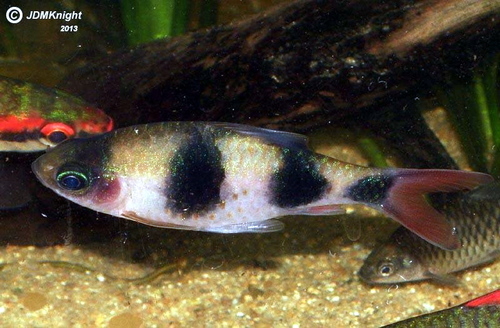
Arulius barb
Dawkinsia arulius
Aquarium hobby

Bala shark
Balantiocheilos melanopterus
Aquarium hobby

Beardless barb
Cyclocheilichthys apogon
Aquarium hobby

Bigspot barb
Barbodes dunckeri
Aquarium hobby

Black ruby barb
Pethia nigrofasciata
Aquarium hobby