Home / Fishes / Killifish and livebearers / Tequila splitfin
No federal permit to keepTequila splitfin
Zoogoneticus tequila
Fishes › Killifish and livebearers (Cyprinodontiformes) › Goodeidae (Goodeid livebearers and killifish)
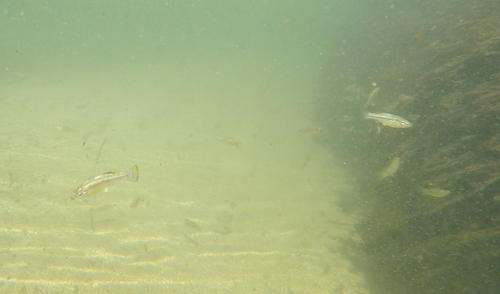
Zoogoneticus tequila, Tequila splitfin or simply Tequila fish, is a species of goodeid fish (family Goodeidae) from Mexico.

Care at a glance
Species-specific aquarium care
- Tank: At least 24 in long and 12 in front to back for one adult (adults commonly reach about 2.4 in / 6 cm).
- Water: Freshwater.
- Temperature: 68–75°F (range recorded for this species).
- pH: 6.5–7.5.
- Layout: Uses both the bottom and open water: give open swimming space plus cover near the substrate.
Calculated from this species' own FishBase record: tank size from its typical adult length and swimming zone, water values from its recorded ranges. The group guide below fills in general care.
Care guide
Species care notes
- Tank: a base of at least 35 × 12 in (roughly 21 US gallons); space needed is rated “large tank”.
- Water: a fairly wide range, from slightly acidic to slightly alkaline, 63–81 °F, pH 6.8–7.6, 8–20 dGH.
- Behaviour: a shoaling fish best kept in a group of six or more; not a community fish.
- Difficulty: Moderate (Seriously Fish rating).
Short excerpts from the species profile:
- Setup: “These fish are unfussy with regards to the decoration of an aquarium, though fine leaved plants may be damaged.”
- Diet: “Conical shaped teeth and a short gut would point to a chiefly carnivorous nature, unlike many other livebearers.”
- Tankmates: “Quite a nippy species, tankmates are very limited.”
- Breeding: “As with other livebearers, this species carries out internal fertilisation.”
From the Seriously Fish profile for this species, which has the full habitat, maintenance, diet, behaviour and breeding write-up 167
Goodeid livebearers and killifish
Applies to most species in this group. Habitat: Goodeids occupy freshwater springs and their outflows, including Mexican splitfin habitats and isolated Nevada poolfish springs. Individual species can differ, so compare with the species numbers above and the linked sources.
Housing & setup
- For Ameca splendens, provide at least 250 litres (66 US gallons); for Empetrichthys latos, at least 150 litres (40 US gallons), favouring broad tanks over height.
- Provide roots, rocks and dense vegetation patches that interrupt sightlines while leaving swimming space.
- Provide moderate to swift circulation; Ameca requires strongly oxygenated water, with the working group recommending at least 8 mg/L dissolved oxygen.
- The working group recommends weekly 60–80% water changes for these spring-associated species; match replacement chemistry and temperature carefully.
- Keep species and documented populations separately to preserve conservation stock identity.
Diet
- Algae and aufwuchs, especially for Ameca
- Vegetable supplements and plant-rich foods for Ameca
- Quality flakes, granules or tablets
- Artemia
- Daphnia or mysids, particularly for Empetrichthys
Social life
- Maintain breeding colonies with cover and room for subordinates; Ameca males can fight and nip other fishes. Fry are often tolerated when shelter and feeding are adequate.
Health watch
- Reduced disease resistance and accelerated ageing in Ameca kept persistently warm with inadequate water renewal
- Aggression-related fin damage
- General aquarium-fish water-quality disease and malnutrition; family-specific prevalence is not established
Understanding the animal
About this animal
About this animal
Viviparous topminnows make up 36 of the species within it this family. Z. tequila, one of these 36 species, has a very limited population endemic to Mexico.
Quoted from the Wikipedia article “Zoogoneticus tequila” (CC BY-SA 4.0) 174
In the wild
In the wild
From this species’ own FishBase record (habitat, bottom type, water and breeding data), not its family. Good care copies these conditions.1
| Where it lives | Lives in freshwater. Uses both the bottom and open water. This fish generally inhabits rivers, but now appears to only occur in one small pond in Mexico. The locality was at an elevation of 1311 m and specimens were usually caught in the quiet part of the river, at a depth of less than 1 m., with mud and silt, and was nearly continuously stirred by domestic livestock. It was reported that the only known extant population inhabits a spring pool, 4 m in diameter with an average depth of 20 cm. Little is known about the species in the wild. However, in aquaria, sexual maturity can be reached within six to ten weeks and broods are known to number as man as 20-29 offspring, but females in their first year of reproduction are reported to have fewer than ten. |
| Water it lives in | Freshwater, 68–75 °F (20–24 °C), pH 6.5–7.5. |
| Climate | Tropical climate. |
| Behavior to plan for | Breeding: internal live bearers. |
What this means for care
- Keep water within its wild range, 68–75 °F.
From the sources
From the sources
Quoted from the matching sections of reputable sources for this exact species. Specialist databases are used first; Wikipedia (community-edited, CC BY-SA 4.0) only fills gaps. Other sources are short credited quotes.
| Overview | Zoogoneticus tequila, Tequila splitfin or simply Tequila fish, is a species of goodeid fish (family Goodeidae) from Mexico. Viviparous topminnows make up 36 of the species within it this family. Z. tequila, one of these 36 species, has a very limited population endemic to Mexico. The specific epithet, tequila, derives from the Tequila Volcano, which looms near the type locality. — Wikipedia (community-edited) |
| Where it lives | Home ranges Population dynamics Growth parameters Max. ages / sizes Length-weight rel. Length-frequencies Mass conversion Recruitment Abundance Life cycle Reproduction Maturity Maturity/Gills rel. — FishBase |
| Wild diet | Much of the wild diet and eating patterns of Z. tequila are inferred from congeners such as Z. quitzeoensis, which consists of amphipods, insects, ostracods, and detritus. In their existing location in the spring pool, Z. tequila fish typically eat various zooplankton and insect larvae, with chironomid larvae being most popular. — Wikipedia (community-edited) |
| Reproduction | Up to 15 young are born after up to 65 days. — FishBase |
| Appearance and size | Along with other Mexican goodeids, Zoogoneticus tequila are viviparous; this led the genus to be originally included in family Poeciliidae. The clutch size is up to 29 young. Males are smaller than females, with standard length up to 4.1 cm in males and up to 5.8 cm in females. — Wikipedia (community-edited) |
| Biology | This fish generally inhabits rivers, but now appears to only occur in one small pond in Mexico. The locality was at an elevation of 1311 m and specimens were usually caught in the quiet part of the river, at a depth of less than 1 m., with mud and silt, and was nearly continuously stirred by domestic livestock. — FishBase |
| Conservation | After a few successful reintroductions of Z. tequila in the wild became established, the International Union for Conservation of Nature declared this species endangered. However, it is still considered by many to be extinct in the wild. — Wikipedia (community-edited) |
Data and studies
The numbers
The numbers
Each bar is what one source reports. Where several sources weigh in, the dashed gold band marks their average.
Adult length
Maximum recorded length. Measured as total length. Fish in home aquariums often stay smaller than wild records.
Water temperature
Range the species tolerates in nature; aim for the middle.
Water hardness
Minimum tank footprint
Seriously Fish recommends a tank base of at least 35 × 12 in (about 21 US gallons).
Veterinary & husbandry research
Veterinary & husbandry research
- Beyond the point of no return? A comparison of genetic diversity in captive and wild populations of two nearly extinct species of Goodeid fish reveals that one is inbred in the wild Bailey NW et al., Heredity 2007
- Pathology survey on a captive-bred colony of the Mexican Goodeid, nearly extinct in the wild, Zoogoneticus tequila (Webb & Miller 1998) Arbuatti A et al., TheScientificWorldJournal 2013
Peer-reviewed papers that mention this species alongside captivity, zoos, veterinary care or aquaculture. Some cover several species or mention it only in passing, so check the abstract. 170
Sources for this sheet
- FishBase (Froese & Pauly, eds.), version 24.07 Peer-reviewed researchThe global scientific database on fishes, maintained by a consortium of research institutions; every value is referenced.
- Seriously Fish species profiles Experienced keeper or breederLong-running aquarium reference written and peer-checked by experienced fishkeepers and ichthyologists; each profile covers habitat, tank size, water, diet, behaviour and breeding.
- Goodeid Working Group: Ameca splendens Experienced keeper or breederAdded in the 2026 source-checked care-guide review.
- Goodeid Working Group: Empetrichthys latos Experienced keeper or breederAdded in the 2026 source-checked care-guide review.
- Goodeid Working Group: Objectives Experienced keeper or breederAdded in the 2026 source-checked care-guide review.
- Merck Veterinary Manual: Disorders and Diseases of Fish Zoo, university or veterinaryAdded in the 2026 source-checked care-guide review.
- Wikipedia (species article) Community referenceFree encyclopedia; useful overviews with their own citations. Intro text is quoted under CC BY-SA 4.0.
- PubMed (U.S. National Library of Medicine) Peer-reviewed researchIndex of peer-reviewed veterinary, zoo and husbandry research.
- iNaturalist (captive observations) Community referenceCommunity observation platform run by the California Academy of Sciences and National Geographic; observations marked captive show animals living in homes, zoos and aquariums.
More goodeid livebearers and killifish

Butterfly splitfin
Ameca splendens
Aquarium hobby
Goldbreast splitfin
Ilyodon furcidens
Aquarium hobby

Rainbow goodeid
Characodon lateralis
Aquarium hobby

Redtail splitfin
Xenotoca eiseni
Aquarium hobby