Home / Fishes / Tetras, piranhas and pacus / Spotted pike-characin
No federal permit to keepSpotted pike-characin
Boulengerella maculata
Fishes › Tetras, piranhas and pacus (Characiformes) › Ctenoluciidae (Pike characins)
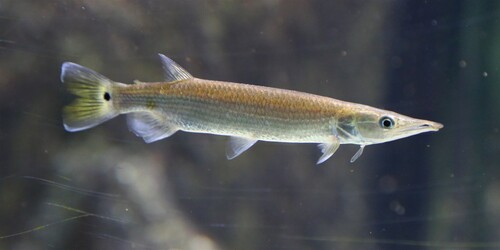
Boulengerella maculata, the spotted pike-characin or agujeta, is a species of freshwater ray-finned fish belonging to the family Ctenoluciidae, the pike-characins.
Care at a glance
Species-specific aquarium care
- Tank: At least 78 in long and 24 in front to back for one adult (adults commonly reach about 12.6 in / 31.9 cm).
- Water: Freshwater.
- Temperature: 73–81°F (range recorded for this species).
- pH: 6–7.5.
- Hardness: 0–18 dGH.
- Layout: An open-water swimmer: needs long, open swimming space with few obstacles.
- Diet: A predator: feed meaty foods sized to its mouth (frozen fish, shrimp, worms); it will eat tankmates that fit in its mouth. FishBase classes it as a carnivore.
- Availability: Mostly kept by public aquariums; private keeping is uncommon.
Calculated from this species' own FishBase record: tank size from its typical adult length and swimming zone, water values from its recorded ranges. The group guide below fills in general care.
Care guide
Species care notes
- Tank: a base of at least 94 × 35 in (roughly 514 US gallons); space needed is rated “very large tank”.
- Water: a fairly wide range, from slightly acidic to slightly alkaline, 72–82 °F, pH 5–7.5, 1–12 dGH.
- Behaviour: temperament predatory; a shoaling fish best kept in a group of six or more; not a community fish.
- Difficulty: Moderate (Seriously Fish rating).
Short excerpts from the species profile:
- Setup: “Relatively unfussy although some surface cover in the form of floating or overhanging vegetation or branches is appreciated.”
- Diet: “An obligate predator feeding mostly on smaller fishes and insects in nature but in most cases adapting well to dead alternatives in captivity.”
- Tankmates: “Peaceful with anything too large to swallow and can be maintained in a community provided tankmates are chosen with care.”
From the Seriously Fish profile for this species, which has the full habitat, maintenance, diet, behaviour and breeding write-up 167
Pike characins
Applies to most species in this group. Habitat: These South American predators hunt in upper freshwater layers, from sheltered vegetated waters used by Ctenolucius to blackwater tributaries used by B. lateristriga and main channels and floodplain lakes used by B. lucius. [fg276-hujeta, fg276-striped, fg276-golden]. Individual species can differ, so compare with the species numbers above and the linked sources.
Housing & setup
- Provide C. hujeta a footprint of at least 180 × 60 cm with at least 30 cm water depth.
- For B. lateristriga and B. maculata, cited profiles recommend at least 240 × 90 cm footprints; B. lucius needs public or exceptionally large private facilities.
- Fit a tightly secured lid; these fish are powerful jumpers.
- Provide floating or overhanging cover without obstructing surface swimming.
- Use mature, efficient filtration, good oxygenation and weekly 30–50% water changes; avoid turbulent returns for C. hujeta.
- Cover the back and sides of Boulengerella housing to reduce collisions by startled fish.
Climate & lighting
| Water | 71.6–82.4°F |
Diet
- Suitably sized fish flesh.
- Whole prawns or shrimp and mussel flesh.
- Earthworms and bloodworms for smaller specimens.
- Gut-loaded insects such as crickets.
Social life
- C. hujeta is best kept in a group of four or more; choose placid companions too large to swallow and avoid competing surface predators. Juveniles school, but adult size must govern stocking.
Health watch
- Snout/body injury from startling and striking glass.
- Parasites introduced with feeder fish.
- Fat deposition and organ degeneration associated with mammalian or avian meat.
Understanding the animal
About this animal
About this animal
This species is found in tropical South America.
Quoted from the Wikipedia article “Boulengerella maculata” (CC BY-SA 4.0) 174
In the wild
In the wild
From this species’ own FishBase record (habitat, bottom type, water and breeding data), not its family. Good care copies these conditions.1
| Where it lives | Lives in freshwater. |
| Water it lives in | Freshwater, 73–81 °F (23–27 °C), pH 6–7.5, hardness 18 dH. |
| Climate | Tropical climate. |
| Wild diet | Hunting macrofauna (predator). |
What this means for care
- Keep water within its wild range, 73–81 °F.
Native climate (measured)
Native climate (measured)
| Warm-season highs | about 90°F (up to 94°F in the hottest sampled areas) |
| Cool-season lows | about 70°F (down to 66°F in the coldest sampled areas) |
| Average temperature | 78–81°F across sampled records |
| Relative humidity | 81–85% on average (driest month about 78%) |
| Rainfall | about 2423 mm a year |
Measured at 237 wild occurrence records sampled against WorldClim 2.1 climate data (1970–2000 averages). Air conditions in the range are ecological context, not enclosure settings: microhabitats such as burrows, leaf litter or basking rocks can be cooler, warmer or more humid.
From the sources
From the sources
Quoted from the matching sections of reputable sources for this exact species. Specialist databases are used first; Wikipedia (community-edited, CC BY-SA 4.0) only fills gaps. Other sources are short credited quotes.
| Overview | Boulengerella maculata, the spotted pike-characin or agujeta, is a species of freshwater ray-finned fish belonging to the family Ctenoluciidae, the pike-characins. This species is found in tropical South America. — Wikipedia (community-edited) |
| Where it lives | Home ranges Population dynamics Growth parameters Max. ages / sizes Length-weight rel. Length-frequencies Mass conversion Recruitment Abundance Life cycle Reproduction Maturity Maturity/Gills rel. — FishBase |
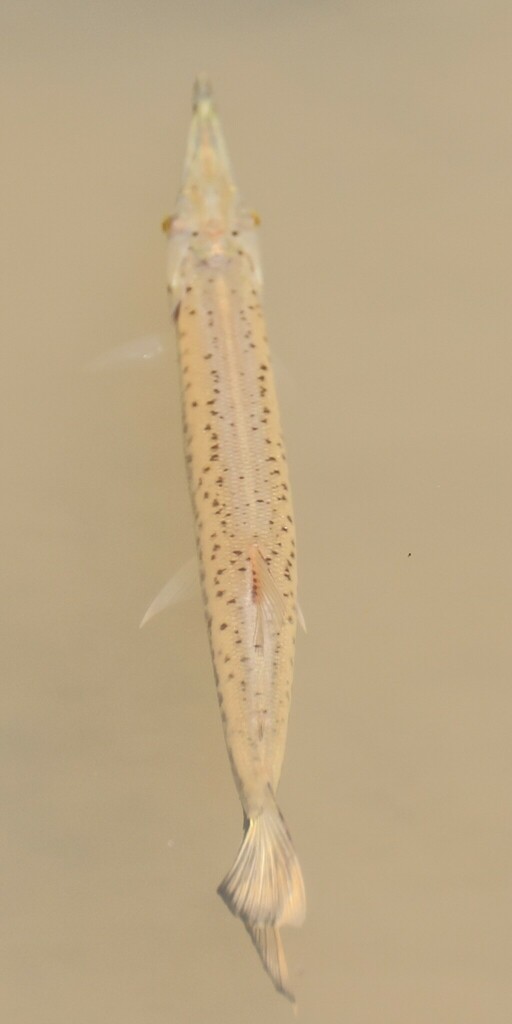
| Appearance and size | Boulengerella maculata has a maximum standard length of 31.9 cm. The dorsal fin is supported by between 9 and 11 soft rays while the anal fin contains between 10 and 12 soft rays. The dorsal fin is largely to the rear of the anal fin, a character shared with B. lateristriga, but not with any other species in the genus Boulengerella. — Wikipedia (community-edited) |
| Biology | Boulengerella maculata is a predatory species. The fishes in genus Boulengerella hunt by hiding in the shade on the margins of the lake or river. When they see potential prey, typically smaller fishes, they use their pectoral fins to propel them, stealthily, towards the prey and to manoeuvre around the prey. — Wikipedia (community-edited) |
| History and naming | Boulengerella maculata was first formally described as Xiphostoma maculatum by the French zoologist Achille Valenciennes in Volume 22 of Histoire naturelle des poissons, coauthored with Georges Cuvier, which was published in 1850. The type locality was given as the Amazon River in Brazil. — Wikipedia (community-edited) |
Data and studies
The numbers
The numbers
Each bar is what one source reports. Where several sources weigh in, the dashed gold band marks their average.
Adult length
Maximum recorded length. Measured as standard length (snout to the base of the tail, not counting the tail fin). Fish in home aquariums often stay smaller than wild records.
Water temperature
Range the species tolerates in nature; aim for the middle.
Water hardness
Minimum tank footprint
Seriously Fish recommends a tank base of at least 94 × 35 in (about 514 US gallons).
Veterinary & husbandry research
Veterinary & husbandry research
- Rare neural crest tumor in teleost species: olfactory neuroblastoma in a spotted pike-characin Boulengerella maculata Gould AC et al., Diseases of aquatic organisms 2020
Peer-reviewed papers that mention this species alongside captivity, zoos, veterinary care or aquaculture. Some cover several species or mention it only in passing, so check the abstract. 170
Sources for this sheet
- FishBase (Froese & Pauly, eds.), version 24.07 Peer-reviewed researchThe global scientific database on fishes, maintained by a consortium of research institutions; every value is referenced.
- Seriously Fish species profiles Experienced keeper or breederLong-running aquarium reference written and peer-checked by experienced fishkeepers and ichthyologists; each profile covers habitat, tank size, water, diet, behaviour and breeding.
- Seriously Fish — Ctenolucius hujeta Experienced keeper or breederAdded in the 2026 source-checked care-guide review.
- Seriously Fish — Boulengerella lateristriga Experienced keeper or breederAdded in the 2026 source-checked care-guide review.
- Seriously Fish — Boulengerella lucius Experienced keeper or breederAdded in the 2026 source-checked care-guide review.
- Seriously Fish — Boulengerella species profiles Experienced keeper or breederAdded in the 2026 source-checked care-guide review.
- Wikipedia (species article) Community referenceFree encyclopedia; useful overviews with their own citations. Intro text is quoted under CC BY-SA 4.0.
- PubMed (U.S. National Library of Medicine) Peer-reviewed researchIndex of peer-reviewed veterinary, zoo and husbandry research.
- iNaturalist (captive observations) Community referenceCommunity observation platform run by the California Academy of Sciences and National Geographic; observations marked captive show animals living in homes, zoos and aquariums.