Home / Fishes / Gouramis, bettas, snakeheads / Ornate paradisefish
No federal permit to keepOrnate paradisefish
Malpulutta kretseri
Fishes › Gouramis, bettas, snakeheads (Anabantiformes) › Osphronemidae (Gouramis and bettas)
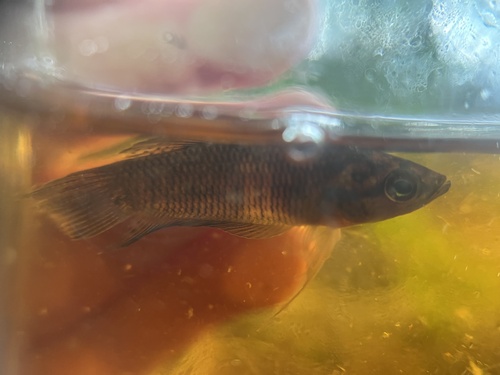
The ornate paradisefish (Malpulutta kretseri) or spotted gourami, is a species of gourami endemic to Sri Lanka.

Care at a glance
Species-specific aquarium care
- Tank: At least 24 in long and 12 in front to back for one adult (adults commonly reach about 0.8 in / 2 cm; the largest recorded was 1.6 in).
- Water: Freshwater.
- Temperature: 75–82°F (range recorded for this species).
- pH: 5.5–7.5.
- Hardness: 0–20 dGH.
- Layout: Lives on or near the bottom: floor space and hiding places matter more than height.
- Diet: Eats a varied diet: mix quality prepared foods with frozen and live foods. FishBase classes it as a carnivore.
Calculated from this species' own FishBase record: tank size from its typical adult length and swimming zone, water values from its recorded ranges. The group guide below fills in general care.
Care guide
Species care notes
- Tank: a base of at least 16 × 8 in (roughly 4 US gallons); space needed is rated “any tank”.
- Water: a fairly wide range, from slightly acidic to slightly alkaline, 61–72 °F, pH 5–7.5, 1–8 dGH.
- Behaviour: in a pair; not a community fish.
- Difficulty: Easy (Seriously Fish rating).
Short excerpts from the species profile:
- Setup: “Can be maintained in a fully-decorated aquarium although many breeders prefer not to use a substrate for ease of maintenance.”
- Diet: “Likely to prey on insect larvae and suchlike in nature, and should be offered small live or frozen Daphnia, Artemia, white worm, grindal worm, etc., in captivity.”
- Tankmates: “Best maintained in the absence of other fishes since captive breeding should be the priority given its conservation status and rarity in the aquarium hobby.”
- Breeding: “Secretive bubble nester, with males preferring to contruct nests under an overhang or in a cavity if available though if not surface vegetation, leaves or roots may be chosen.”
From the Seriously Fish profile for this species, which has the full habitat, maintenance, diet, behaviour and breeding write-up 167
Gouramis and labyrinth fish
Applies to most species in this group. Habitat: Warm, still, vegetated waters. Individual species can differ, so compare with the species numbers above and the linked sources.
Housing & setup
- Planted, calm tanks with floating plants; they breathe air at the surface, so leave a gap under the lid.
Diet
- Food acceptance is species-specific. Parosphromenus deissneri needs tiny live invertebrate foods and commonly refuses dried foods; a pellet/flake staple cannot cover every labyrinth fish.
Health watch
- Males are territorial; dwarf gourami iridovirus.
Understanding the animal
About this animal
About this animal
It is the only recognized species in its genus. It inhabits shallow, slow-flowing streams in forested areas shaded with plentiful vegetation near the edges and a substrate covered by leaf litter.
Quoted from the Wikipedia article “Ornate paradisefish” (CC BY-SA 4.0) 174
In the wild
In the wild
From this species’ own FishBase record (habitat, bottom type, water and breeding data), not its family. Good care copies these conditions.1
| Where it lives | Lives in freshwater, in rivers and streams. Stays near the bottom. Restricted to forested areas and small, shallow, slow flowing silted streams with leaf debris and thick marginal vegetation. Stays close to the substrate and is very seldom found in unshaded waters. Feeds on fish fry, plankton and insect larvae. Bubble nest builder. |
| Water it lives in | Freshwater, 75–82 °F (24–28 °C), pH 5.5–7.5, hardness 20 dH. |
| Climate | Tropical climate. |
| Behavior to plan for | Breeding: nesters. |
What this means for care
- Keep water within its wild range, 75–82 °F.
From the sources
From the sources
Quoted from the matching sections of reputable sources for this exact species. Specialist databases are used first; Wikipedia (community-edited, CC BY-SA 4.0) only fills gaps. Other sources are short credited quotes.
| Overview | The ornate paradisefish (Malpulutta kretseri) or spotted gourami, is a species of gourami endemic to Sri Lanka. It is the only recognized species in its genus. It inhabits shallow, slow-flowing streams in forested areas shaded with plentiful vegetation near the edges and a substrate covered by leaf litter. It is a carnivore, preying on plankton, fish fry, and the larvae of insects. — Wikipedia (community-edited) |
| Where it lives | Home ranges Population dynamics Growth parameters Max. ages / sizes Length-weight rel. Length-frequencies Mass conversion Recruitment Abundance Life cycle Reproduction Maturity Maturity/Gills rel. — FishBase |
| Reproduction | Male builds the bubble nest. Spawns 100 to 200 whitish eggs in batches in the course of a period between 1 to 12 hours. Eggs sink to the bottom and both parents pick them up and place them in the nest, usually built under a submerged leaf, after fertilization. — FishBase |
| Biology | Facultative air-breathing; Restricted to forested areas and small, shallow, slow flowing silted streams with leaf debris and thick marginal vegetation. Stays close to the substrate and is very seldom found in unshaded waters. Feeds on fish fry, plankton and insect larvae. — FishBase |
Data and studies
The numbers
The numbers
Each bar is what one source reports. Where several sources weigh in, the dashed gold band marks their average.
Adult length
Common length to maximum recorded length. Measured as total length. Fish in home aquariums often stay smaller than wild records.
Water temperature
Range the species tolerates in nature; aim for the middle.
Water hardness
Minimum tank footprint
Seriously Fish recommends a tank base of at least 16 × 8 in (about 4 US gallons).
Sources for this sheet
- FishBase (Froese & Pauly, eds.), version 24.07 Peer-reviewed researchThe global scientific database on fishes, maintained by a consortium of research institutions; every value is referenced.
- Seriously Fish species profiles Experienced keeper or breederLong-running aquarium reference written and peer-checked by experienced fishkeepers and ichthyologists; each profile covers habitat, tank size, water, diet, behaviour and breeding.
- Merck Veterinary Manual: Management of aquarium fish Zoo, university or veterinaryThe Merck Veterinary Manual: a standard veterinary reference written and reviewed by veterinary specialists.
- Merck Veterinary Manual: Types and features of aquatic systems Zoo, university or veterinaryThe Merck Veterinary Manual: a standard veterinary reference written and reviewed by veterinary specialists.
- Merck Veterinary Manual: Nutritional diseases of fish Zoo, university or veterinaryThe Merck Veterinary Manual: a standard veterinary reference written and reviewed by veterinary specialists.
- Seriously Fish — Parosphromenus deissneri Zoo, university or veterinaryAdded in the 2026 source-checked care-guide review.
- Wikipedia (species article) Community referenceFree encyclopedia; useful overviews with their own citations. Intro text is quoted under CC BY-SA 4.0.
More gouramis and bettas

Alfred's Licorice Gourami
Parosphromenus alfredi
Aquarium hobby

Banded gourami
Trichogaster fasciata
Aquarium hobby

Barito Betta
Betta pallifina
Aquarium hobby
Betta hipposideros
Betta hipposideros
Aquarium hobby

Betta stigmosa
Betta stigmosa
Aquarium hobby

Betta uberis
Betta uberis
Aquarium hobby