Home / Fishes / Gouramis, bettas, snakeheads / Northern snakehead
Federal restrictions applyNorthern snakehead
Channa argus
Fishes › Gouramis, bettas, snakeheads (Anabantiformes) › Channidae (Snakeheads)
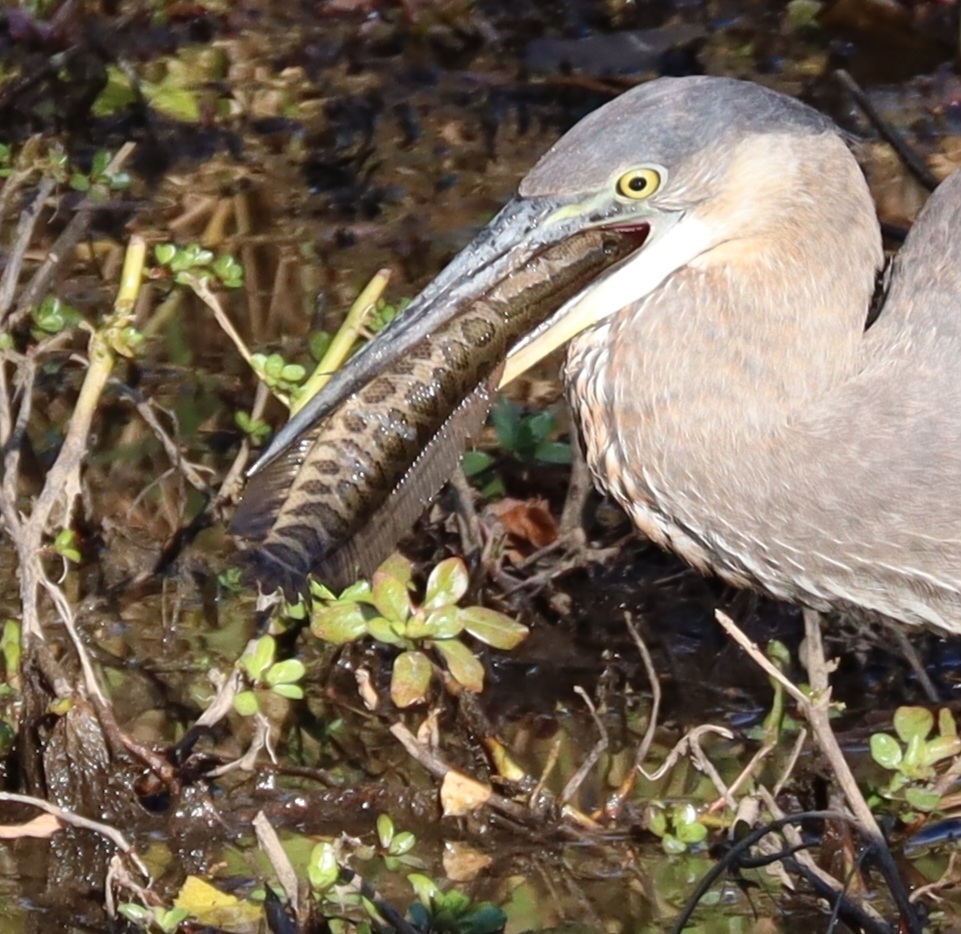
The northern snakehead also known as Chesapeake Channa (Channa argus) in Maryland U.S is a species of snakehead fish native to temperate East Asia, in China, Russia, North Korea, and South Korea.
Care at a glance
Species-specific aquarium care
- Tank: An adult reaches about 39.4 in (100 cm). That needs a pond or public-aquarium-scale system, far beyond a home aquarium.
- Water: Freshwater.
- Temperature: 39–72°F (range recorded for this species).
- Layout: Uses both the bottom and open water: give open swimming space plus cover near the substrate.
- Diet: A predator: feed meaty foods sized to its mouth (frozen fish, shrimp, worms); it will eat tankmates that fit in its mouth. FishBase classes it as a carnivore.
- Availability: Mostly kept by public aquariums; private keeping is uncommon.
Calculated from this species' own FishBase record: tank size from its typical adult length and swimming zone, water values from its recorded ranges. The group guide below fills in general care.
Warnings
Care guide
Species care notes
- Water: a fairly wide range, from slightly acidic to slightly alkaline, 32–86 °F, pH 6–8, 5–25 dGH.
- Behaviour: kept alone; not a community fish.
- Difficulty: Moderate (Seriously Fish rating).
Short excerpts from the species profile:
- Setup: “Relatively unfussy although some surface cover in the form of floating or overhanging vegetation or branches is appreciated.”
- Diet: “An obligate predator feeding on smaller fishes, amphibians, crustaceans and other invertebrates in nature but in most cases adapting well to dead alternatives in captivity.”
- Breeding: “Unrecorded in aquaria but bred in large scale outdoor aquaculture projects in China.”
From the Seriously Fish profile for this species, which has the full habitat, maintenance, diet, behaviour and breeding write-up 167
Snakeheads
Applies to most species in this group. Habitat: Asian and African rivers. Individual species can differ, so compare with the species numbers above and the linked sources.
Housing & setup
- Not available legally in most of the U.S.
Diet
- Predatory: fish and meaty foods.
Health watch
- All snakeheads are federally listed injurious wildlife.
Understanding the animal
About this animal
About this animal
Their natural range goes from the Amur River watershed in Siberia and Manchuria down to Hainan. It is an important food fish and one of the most cultivated in its native region, with 510,000 tonnes annual production worldwide.
Quoted from the Wikipedia article “Northern snakehead” (CC BY-SA 4.0) 174
In the wild
In the wild
From this species’ own FishBase record (habitat, bottom type, water and breeding data), not its family. Good care copies these conditions.1
| Where it lives | Lives in freshwater, in rivers and streams, lakes. Uses both the bottom and open water. Can stay out of the water for 3 to 4 days at temperatures ranging from 10 to 15°C. |
| Water it lives in | Freshwater, 39–72 °F (4–22 °C). |
| Climate | Subtropical climate. |
| Wild diet | Hunting macrofauna (predator). |
| Behavior to plan for | Breeding: clutch tenders. |
What this means for care
- Keep water within its wild range, 39–72 °F.
Native climate (measured)
Native climate (measured)
| Warm-season highs | about 85°F (up to 89°F in the hottest sampled areas) |
| Cool-season lows | about 26°F (down to 10°F in the coldest sampled areas) |
| Average temperature | 48–62°F across sampled records |
| Relative humidity | 68–75% on average (driest month about 63%) |
| Rainfall | about 1250 mm a year |
| Winters | Cool to cold winters (lows around 26°F) in much of its native range. Seasonal slowdown may be relevant, but species-specific biology determines whether brumation or hibernation occurs. |
Measured at 220 wild occurrence records sampled against WorldClim 2.1 climate data (1970–2000 averages). Air conditions in the range are ecological context, not enclosure settings: microhabitats such as burrows, leaf litter or basking rocks can be cooler, warmer or more humid.
From the sources
From the sources
Quoted from the matching sections of reputable sources for this exact species. Specialist databases are used first; Wikipedia (community-edited, CC BY-SA 4.0) only fills gaps. Other sources are short credited quotes.
| Overview | The northern snakehead also known as Chesapeake Channa (Channa argus) in Maryland U.S is a species of snakehead fish native to temperate East Asia, in China, Russia, North Korea, and South Korea. Their natural range goes from the Amur River watershed in Siberia and Manchuria down to Hainan. It is an important food fish and one of the most cultivated in its native region, with 510,000 tonnes annual production worldwide. Due to this, the northern snakehead has been exported throughout the world and has managed to establish non-native populations in Central Asia and North America. — Wikipedia (community-edited) |
| Where it lives | Home ranges Population dynamics Growth parameters Max. ages / sizes Length-weight rel. Length-frequencies Mass conversion Recruitment Abundance Life cycle Reproduction Maturity Maturity/Gills rel. — FishBase |
| Behavior | The northern snakehead is a freshwater fish and cannot tolerate salinity in excess of 10 parts per million. It is a facultative air breather, using a suprabranchial organ and a bifurcated ventral aorta that permit both aquatic and aeria respiration. This unusual respiratory system allows it to live outside of water for several days. — Wikipedia (community-edited) |
| Reproduction | Both male and female northern snakeheads help to build a nest in shallow, stagnant water when spawning. — Animal Diversity Web |
| Appearance and size | Maximum length 100.0 cm tl male/unsexed; maximum published weight 9.5 kg. — FishBase |
| Biology | Obligate air-breathing; Individuals can stay out of the water for 3 to 4 days at temperatures ranging from 10 to 15°C. They are typical ambush predators that lie waiting for prey on the bottom. They hunt mainly in the morning and in the evening, feeding primarily on fish. — FishBase |
Data and studies
The numbers
The numbers
Each bar is what one source reports. Where several sources weigh in, the dashed gold band marks their average.
Typical adult weight
Average adult body mass in each database (FishBase gives the maximum recorded weight).
Adult length
Maximum recorded length. Measured as total length. Fish in home aquariums often stay smaller than wild records.
Water temperature
Range the species tolerates in nature; aim for the middle.
pH
Water hardness
Veterinary & husbandry research
Veterinary & husbandry research
- Bioflocs attenuates lipopolysaccharide-induced inflammation, immunosuppression and oxidative stress in Channa argus Yu Z et al., Fish & shellfish immunology 2021
- Splenic hemangioendothelial neoplasm in a captive Northern Snakehead from the Potomac River Walsh HL et al., Journal of aquatic animal health 2024
- Arsenic contamination in the freshwater fish ponds of Pearl River Delta: bioaccumulation and health risk assessment Cheng Z et al., Environmental science and pollution research international 2013
- Genome-Wide Association Studies (GWAS) and Transcriptome Analysis Reveal Male Heterogametic Sex-Determining Regions and Candidate Genes in Northern Snakeheads (Channa argus) Liu H et al., International journal of molecular sciences 2024
Peer-reviewed papers that mention this species alongside captivity, zoos, veterinary care or aquaculture. Some cover several species or mention it only in passing, so check the abstract. See all 49 on PubMed → 170
Sources for this sheet
- FishBase (Froese & Pauly, eds.), version 24.07 Peer-reviewed researchThe global scientific database on fishes, maintained by a consortium of research institutions; every value is referenced.
- Seriously Fish species profiles Experienced keeper or breederLong-running aquarium reference written and peer-checked by experienced fishkeepers and ichthyologists; each profile covers habitat, tank size, water, diet, behaviour and breeding.
- 50 CFR Part 16: Injurious wildlife (Lacey Act) Zoo, university or veterinaryCurrent federal regulation, read from eCFR.
- U.S. Association of Reptile Keepers v. Zinke (D.C. Cir. 2017) Zoo, university or veterinaryAppeals ruling that the Lacey Act's shipping ban does not cover moves between the continental states.
- Merck Veterinary Manual: Management of aquarium fish Zoo, university or veterinaryThe Merck Veterinary Manual: a standard veterinary reference written and reviewed by veterinary specialists.
- Merck Veterinary Manual: Types and features of aquatic systems Zoo, university or veterinaryThe Merck Veterinary Manual: a standard veterinary reference written and reviewed by veterinary specialists.
- Merck Veterinary Manual: Nutritional diseases of fish Zoo, university or veterinaryThe Merck Veterinary Manual: a standard veterinary reference written and reviewed by veterinary specialists.
- Wikipedia (species article) Community referenceFree encyclopedia; useful overviews with their own citations. Intro text is quoted under CC BY-SA 4.0.
- PubMed (U.S. National Library of Medicine) Peer-reviewed researchIndex of peer-reviewed veterinary, zoo and husbandry research.
- iNaturalist (captive observations) Community referenceCommunity observation platform run by the California Academy of Sciences and National Geographic; observations marked captive show animals living in homes, zoos and aquariums.
More snakeheads
Assamese snakehead
Channa stewartii
Aquarium hobby
Baram snakehead
Channa baramensis
Aquarium hobby

Barca snakehead
Channa barca
Aquarium hobby

Blotched snakehead
Channa maculata
Aquarium hobby

Bluefinned snakehead
Channa bleheri
Aquarium hobby

Ceylon snakehead
Channa orientalis
Aquarium hobby