Home / Mammals / Cats, dogs and other carnivores / Serval
Some federal rules apply In-depth sheetServal
Leptailurus serval
Mammals › Cats, dogs and other carnivores (Carnivora) › Felidae (Cats)
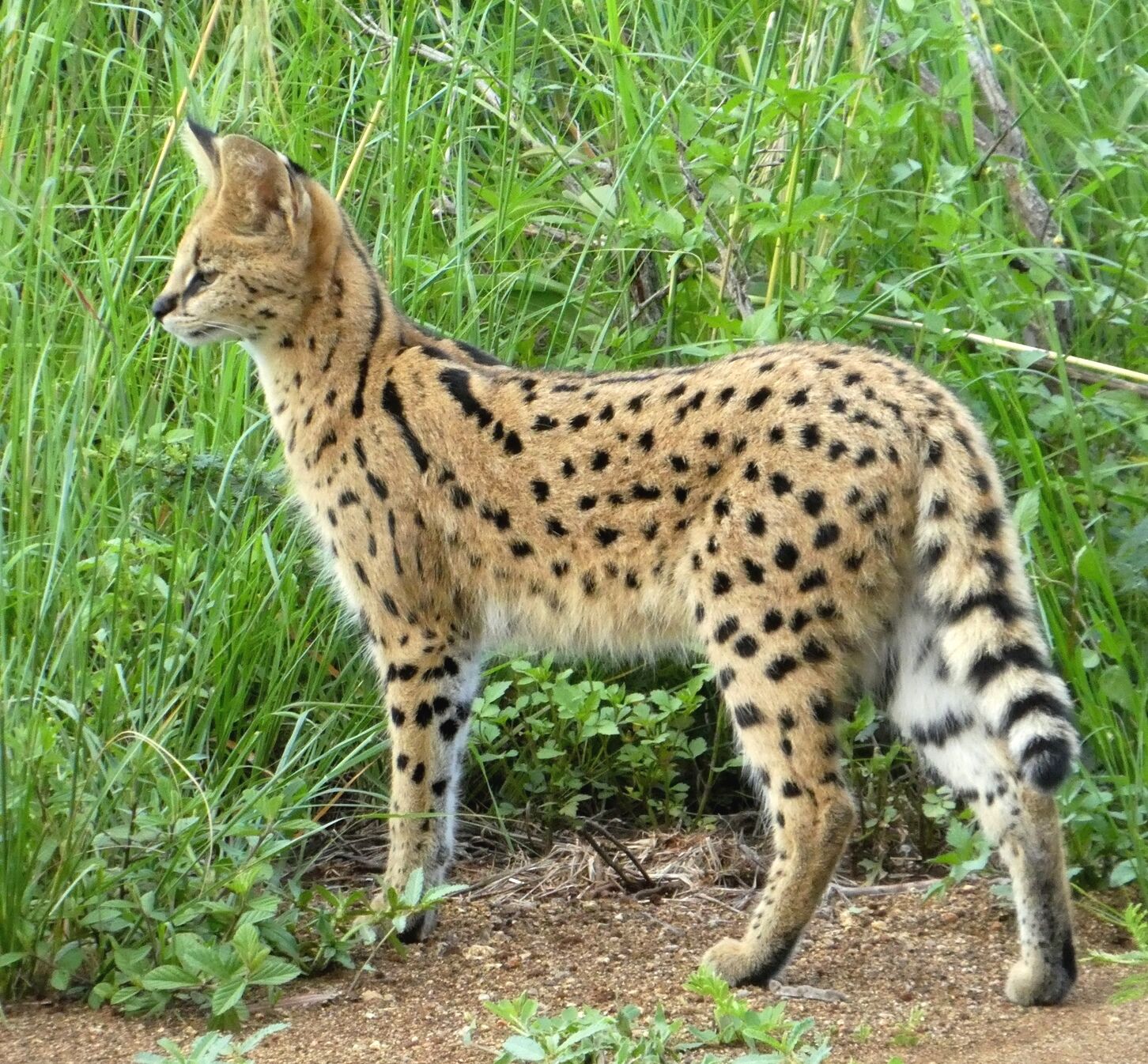
Servals are solitary, athletic wild cats with the longest legs and ears for their size of any cat. They need huge secure enclosures and expert care.
Care guide
Behavior
- Can leap more than 6.5 ft (2 m) straight up to catch birds; hunting success near 48% in the wild.
- Mark territory with urine spray.
Sources 76
Diet
- Carnivores: in the wild about 93.5% small mammals and 5% birds.
Sources 76
Show the group care guide for small wild cats
Small wild cats
Applies to most species in this group. Habitat: Forest, savanna and desert. Individual species can differ, so compare with the species numbers above and the linked sources.
Housing & setup
- Large, roofed enclosures with climbing structures, platforms, dens and enrichment.
- Strong spraying and marking behavior; not housebroken like domestic cats.
Diet
- Whole prey or complete carnivore diets with taurine; never plain meat.
Health watch
- Spraying, destructive behavior and bites; specialized veterinary care is hard to find.
Understanding the animal
In the wild
In the wild
Researched for this exact species, not its family. Good care copies these conditions.12
| Where it lives | Sub-Saharan African grasslands and wetlands, particularly tall grass, reed beds, marsh edges and brush. Dense cover and abundant small mammals are important hunting resources. |
| Ground it lives on | grass-covered soil and reed litter; sheltered dens in brush or abandoned holes |
| Climate | Its geographic range includes temperate and tropical areas. Animal Diversity Web gives an average annual temperature of 13.7 C (56.7 F) and average rainfall of 826 mm per year across its range. In the Ngorongoro Crater, winters are mild and occasional snowfall occurs; humidity was not stated. |
| Active | Often crepuscular; may hunt by day or night and become more nocturnal near people. |
| Social life | Predominantly solitary and territorial; males and females sometimes associate briefly. |
| Wild diet | Mainly small mammals such as rats, mice and shrews; also birds and occasional frogs, lizards and insects. |
| Behavior to plan for | Locates prey by sound, then makes long or high pounces. Digs after hidden prey and marks territory with urine, rubbing and scratching. |
What this means for care
- Provide tall-cover-like retreats and room for running and pouncing.
- Use fully secure containment that accounts for strong jumping.
- Offer appropriate carnivore nutrition and search/pounce enrichment.
- Provide individual housing or reliable separation.
Native climate (measured)
Native climate (measured)
| Warm-season highs | about 82°F (up to 91°F in the hottest sampled areas) |
| Cool-season lows | about 52°F (down to 44°F in the coldest sampled areas) |
| Average temperature | 61–73°F across sampled records |
| Relative humidity | 66–69% on average (driest month about 61%) |
| Rainfall | about 795 mm a year |
Measured at 89 wild occurrence records sampled against WorldClim 2.1 climate data (1970–2000 averages). Air conditions in the range are ecological context, not enclosure settings: microhabitats such as burrows, leaf litter or basking rocks can be cooler, warmer or more humid.
Profile
Profile
Researched for this exact species. Sources are listed under In the wild above.
History
The name "serval" derives from Portuguese lobo-cerval, a term used by Georges-Louis Leclerc, Comte de Buffon in 1765 for a spotted cat kept in the Royal Menagerie at Versailles. Johann Christian Daniel von Schreber first described Felis serval in 1776; the species was formerly classified in Felis.
Keeper tips
- Plan around the species' strong jumping ability; wild servals can leap more than 2 m vertically while hunting.
- Provide opportunities compatible with its natural reliance on hearing and active prey-location behavior.
- Account for scent marking with feces and saliva when designing and maintaining its living area.
- Remember that the species is naturally solitary even though male and female home ranges can overlap.
- Its wild habitat is structurally varied, including grasslands, reed beds, wetlands, bamboo thickets, and brush.
Behaviors reported
- Locates prey using hearing.
- Leaps more than 2 m above the ground to pounce on prey with the forefeet.
- Kills prey with a bite to the neck or head.
- Marks its home range with feces and saliva.
- Young begin hunting independently at about six months.
Unique adaptations
- Has the longest legs of any cat relative to body size.
- Has very large ears relative to its size.
- Its long legs and jumping ability support its distinctive pouncing hunting method.
Remarkable facts
- It is the sole member of the genus Leptailurus.
- Three subspecies are recognized.
- Adults stand about 54-62 cm (21-24 in) at the shoulder and weigh approximately 9-18 kg (20-40 lb).
- Its coat is golden-yellow to buff or copper-hued with black spots and stripes.
- Grassland individuals are reported to tend to have larger spots than forest individuals.
- Litters contain one to four kittens after a gestation of roughly two to three months.
Stories
- In 1765, Buffon used the name lobo-cerval for a spotted cat that was being kept in the Royal Menagerie at Versailles.
From the sources
From the sources
Quoted from the matching sections of reputable sources for this exact species. Specialist databases are used first; Wikipedia (community-edited, CC BY-SA 4.0) only fills gaps. Other sources are short credited quotes.
| Overview | The serval (Leptailurus serval) is a wild small cat native to Africa. It is widespread in sub-Saharan countries, where it inhabits grasslands, wetlands, moorlands and bamboo thickets. Across its range, it occurs in protected areas, and hunting it is either prohibited or regulated in range countries. It is the sole member of the genus Leptailurus. — Wikipedia (community-edited) |
| Where it lives | African servals are most commonly found in reed beds and grasslands, which primarily consist of Themeda triandra. — Animal Diversity Web |
| Social life and communication | Being a solitary animal, African servals only interact with other members of their species when mating, caring for young, or fighting for territory. — Animal Diversity Web |
| Wild diet | African servals are crepuscular, hunting several times a night and early morning. — Animal Diversity Web |
| Behavior | African servals hunt during early morning and late afternoon and rest at mid-day and occasionally at night. — Animal Diversity Web |
| Reproduction | African servals are solitary animals except when breeding. — Animal Diversity Web |
| Lifespan | African servals are estimated to live 10 years in the wild. — Animal Diversity Web |
| Appearance and size | Adult African servals are slender, agile, and approximately 60 cm in length from shoulder to tail. — Animal Diversity Web |
| History and naming | Felis serval was first described by Johann Christian Daniel von Schreber in 1776. — Wikipedia (community-edited) |
Data and studies
The numbers
The numbers
Each bar is what one source reports. Where several sources weigh in, the dashed gold band marks their average.
Lifespan in care
Maximum recorded lifespan
Longest recorded lifespan reported by each database; typical lifespans are usually shorter. The AnAge record comes from an animal in human care.
Typical adult weight
Average adult body mass in each database (FishBase gives the maximum recorded weight).
Litter size
Average per litter or clutch.
Veterinary & husbandry research
Veterinary & husbandry research
- Evaluation of the effects of naloxone on recovery time and quality after ketamine-medetomidine-butorphanol anesthesia in servals (Leptailurus serval) Moresco A et al., Journal of zoo and wildlife medicine: official publication of the American Association of Zoo Veterinarians 2009
- PREVALENCE OF CYSTINURIA IN SERVALS ( LEPTAILURUS SERVAL) IN THE UNITED STATES Cannizzo SA et al., Journal of zoo and wildlife medicine: official publication of the American Association of Zoo Veterinarians 2017
- Isolation of Malassezia spp. from cerumen of wild felids Coutinho SD et al., Medical mycology 2006
- Toxoplasma gondii antibodies in exotic wild felids from Brazilian zoos Silva JC et al., Journal of zoo and wildlife medicine: official publication of the American Association of Zoo Veterinarians 2001
Peer-reviewed papers that mention this species alongside captivity, zoos, veterinary care or aquaculture. Some cover several species or mention it only in passing, so check the abstract. See all 13 on PubMed → 170
Sources for this sheet
- Animal Diversity Web (University of Michigan): Leptailurus serval Zoo, university or veterinaryUniversity-hosted species account, mostly wild biology.
- AnAge: The Animal Ageing and Longevity Database (Human Ageing Genomic Resources) Peer-reviewed researchCurated, referenced longevity and life-history records for thousands of species; maximum lifespans are often from zoo animals.
- Myhrvold et al. (2015). An amniote life-history database. Ecology 96: 3109 Peer-reviewed researchPeer-reviewed compilation of life-history data for over 21,000 birds, mammals and reptiles.
- 50 CFR 17.11: Endangered and threatened wildlife Zoo, university or veterinaryCurrent federal Endangered Species Act list.
- Species+ (UNEP-WCMC and the CITES Secretariat) Zoo, university or veterinaryThe official database of species listed under CITES.
- USFWS International Affairs: CITES Zoo, university or veterinaryFederal agency that issues CITES permits.
- 9 CFR 2.1: Animal Welfare Act licensing (USDA) Zoo, university or veterinaryWho needs a USDA license to breed, sell or exhibit animals.
- Merck Veterinary Manual: Management of zoo animals Zoo, university or veterinaryThe Merck Veterinary Manual: a standard veterinary reference written and reviewed by veterinary specialists.
- Merck Veterinary Manual: Nutrition: exotic and zoo animals Zoo, university or veterinaryThe Merck Veterinary Manual: a standard veterinary reference written and reviewed by veterinary specialists.
- GBIF Backbone Taxonomy (Global Biodiversity Information Facility) Peer-reviewed researchInternational scientific taxonomy used here for classification.
- Wikipedia (species article) Community referenceFree encyclopedia; useful overviews with their own citations. Intro text is quoted under CC BY-SA 4.0.
- PubMed (U.S. National Library of Medicine) Peer-reviewed researchIndex of peer-reviewed veterinary, zoo and husbandry research.
- iNaturalist (captive observations) Community referenceCommunity observation platform run by the California Academy of Sciences and National Geographic; observations marked captive show animals living in homes, zoos and aquariums.