Home / Mammals / Kangaroos, wallabies, possums / Yellow-footed rock-wallaby
Federal restrictions applyYellow-footed rock-wallaby
Petrogale xanthopus
Mammals › Kangaroos, wallabies, possums (Diprotodontia) › Macropodidae (Kangaroos and wallabies)
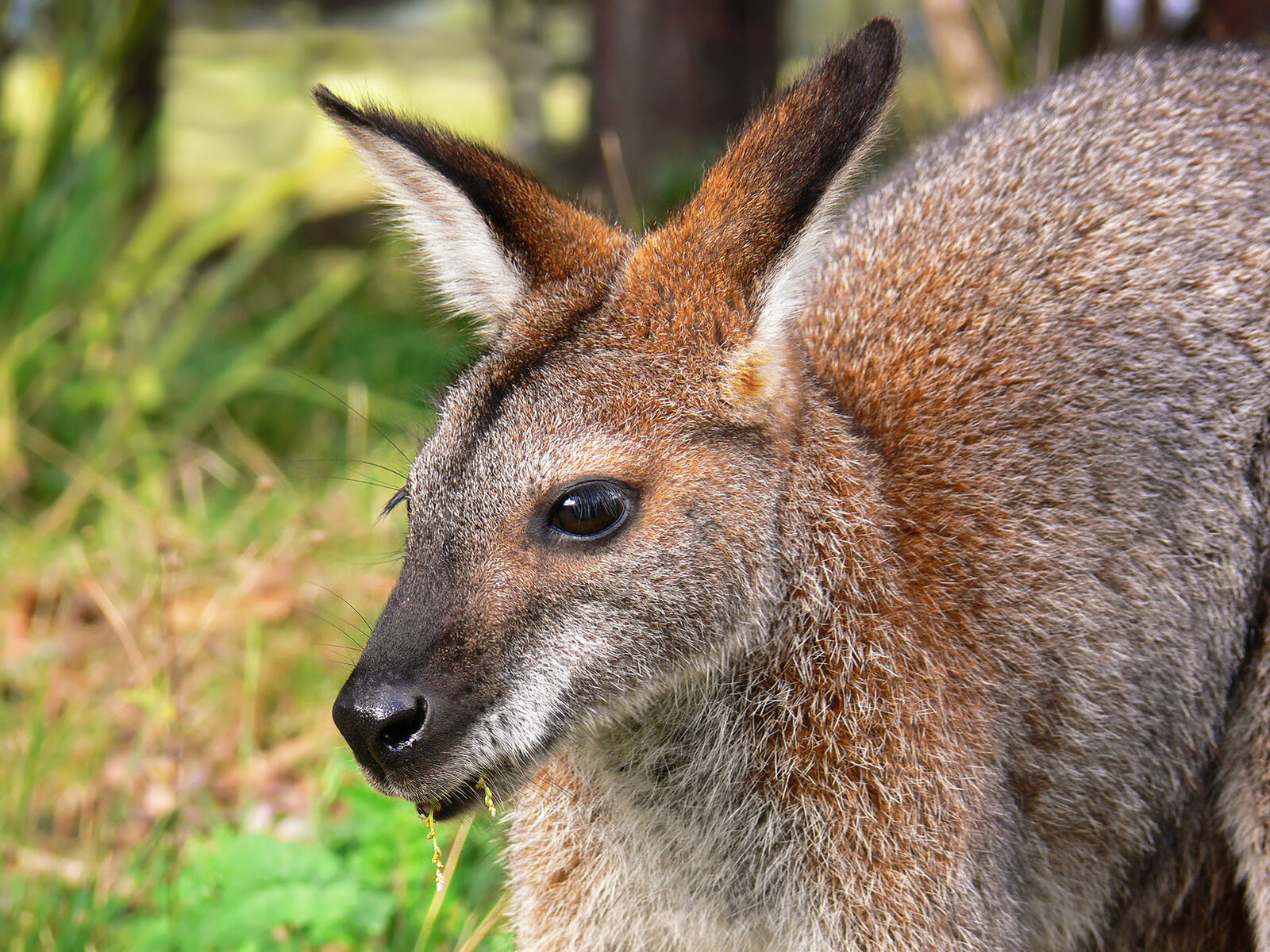
The yellow-footed rock-wallaby (Petrogale xanthopus), formerly known as the ring-tailed rock-wallaby, is a member of the macropod family (the marsupial family that includes the kangaroos, wallabies, tree-kangaroos, and wallaroos).
Intro from Wikipedia (CC BY-SA 4.0)

Warnings
Care guide
Kangaroos, wallabies and rat-kangaroos
Applies to most species in this group. Habitat: Australian grassland and forest. Individual species can differ, so compare with the species numbers above and the linked sources.
Housing & setup
- Large grassy paddocks with 6–8 ft fencing, shelter from heat and cold, and soft ground.
- Tree-kangaroos need tall, enriched, climbing habitats.
Diet
- Grass hay, browse and macropod pellets.
Social life
- Groups.
Health watch
- Lumpy jaw (bacterial jaw infection), toxoplasmosis and capture stress.
Understanding the animal
In the wild
In the wild
Quoted from the matching sections of reputable sources for this exact species. Specialist databases are used first; Wikipedia (community-edited, CC BY-SA 4.0) only fills gaps. Other sources are short credited quotes.
| Overview | The yellow-footed rock-wallaby (Petrogale xanthopus), formerly known as the ring-tailed rock-wallaby, is a member of the macropod family (the marsupial family that includes the kangaroos, wallabies, tree-kangaroos, and wallaroos). — Wikipedia (community-edited) |
| Where it lives | As their common name implies, yellow-footed rock wallabies live on cliff faces and rocky ramparts on mountain tops. — Animal Diversity Web |
| Wild diet | Petrogale xanthopus are herbivores that rely on browsing and grazing. — Animal Diversity Web |
| Behavior | Petrogale xanthopus are thought to be nocturnal, spending their days hidden in rock crevices and caves. — Animal Diversity Web |
| Reproduction | Given good nutrition and living conditions, Petrogale xanthopus breed all year long. — Animal Diversity Web |
| Appearance and size | Petrogale xanthopus are medium-sized wallabies with a stocky build. — Animal Diversity Web |
| History and naming | This species was first described by John Edward Grey in 1855 in the Proceedings of the Zoological Society of London. The description was based on two specimens (a male and a female), which were possibly collected from the Richmond River. The illustration that accompanied the published description was produced by Joseph Wolf. — Wikipedia (community-edited) |
| Conservation | Yellow-footed rock wallabies' numbers are steadily falling. — Animal Diversity Web |
Native climate (measured)
Native climate (measured)
| Warm-season highs | about 94°F (up to 98°F in the hottest sampled areas) |
| Cool-season lows | about 41°F (down to 38°F in the coldest sampled areas) |
| Average temperature | 62–72°F across sampled records |
| Relative humidity | 39–45% on average (driest month about 30%) |
| Rainfall | about 309 mm a year, spread fairly evenly |
| Winters | Cool to cold winters (lows around 41°F) in much of its native range. Seasonal slowdown may be relevant, but species-specific biology determines whether brumation or hibernation occurs. |
Measured at 75 wild occurrence records sampled against WorldClim 2.1 climate data (1970–2000 averages). Air conditions in the range are ecological context, not enclosure settings: microhabitats such as burrows, leaf litter or basking rocks can be cooler, warmer or more humid.
Profile
Profile
Researched for this exact species. Sources are listed under In the wild above.
History
This species was first described by John Edward Grey in 1855 in the Proceedings of the Zoological Society of London. The description was based on two specimens (a male and a female), which were possibly collected from the Richmond River. The illustration that accompanied the published description was produced by Joseph Wolf.
Data and studies
Researched care notes
Researched care notes
Findings checked against veterinary, zoo, welfare, keeper and peer-reviewed sources. Air, basking-surface and water temperatures are kept separate, and where sources disagree both are shown. “Study” notes report what a paper measured, not a universal rule.
Yellow-Footed Rock Wallaby (species)
- Rock-climbing behaviour requires usable vertical structures; floor area alone poorly describes the habitat.1
- The guideline recommends indoor air around 18°C in its temperate-zoo context.1
- Restrict excess sugars and starch. The guideline favours grass hay and discusses avoiding lucerne because of urolith concerns. This species-specific advice is not a blanket rule for every macropod.1
The numbers
The numbers
Each bar is what one source reports. Where several sources weigh in, the dashed gold band marks their average.
Maximum recorded lifespan
Longest recorded lifespan reported by each database; typical lifespans are usually shorter. The AnAge record comes from an animal in human care.
Typical adult weight
Average adult body mass in each database (FishBase gives the maximum recorded weight).
Litter size
Average per litter or clutch.
Veterinary & husbandry research
Veterinary & husbandry research
- Review of surrogacy program for endangered victorian brush-tailed rock wallaby (Petrogale penicillata) with special reference to animal husbandry and veterinary considerations Schultz DJ et al., Journal of zoo and wildlife medicine: official publication of the American Association of Zoo Veterinarians 2006
- Inactivated Toxoplasma gondii nanovaccine boosts T-cell memory response in a seropositive yellow-footed rock wallaby (Petrogale xanthopus) - A case report from Copenhagen Zoo Ogonczyk-Makowska D et al., International journal for parasitology. Parasites and wildlife 2024
- Seroprevalence of retrovirus in North American captive macropodidae Georoff TA et al., Journal of zoo and wildlife medicine: official publication of the American Association of Zoo Veterinarians 2008
- Successful transfer of a Goodfellow's tree kangaroo (Dendrolagus goodfellowi) pouch young to a yellow-footed rock wallaby (Petrogale xanthopus) surrogate McLelland DJ et al., Zoo biology 2015
Peer-reviewed papers that mention this species alongside captivity, zoos, veterinary care or aquaculture. Some cover several species or mention it only in passing, so check the abstract. See all 5 on PubMed → 170
Sources for this sheet
- AnAge: The Animal Ageing and Longevity Database (Human Ageing Genomic Resources) Peer-reviewed researchCurated, referenced longevity and life-history records for thousands of species; maximum lifespans are often from zoo animals.
- Myhrvold et al. (2015). An amniote life-history database. Ecology 96: 3109 Peer-reviewed researchPeer-reviewed compilation of life-history data for over 21,000 birds, mammals and reptiles.
- 50 CFR 17.11: Endangered and threatened wildlife Zoo, university or veterinaryCurrent federal Endangered Species Act list.
- 9 CFR 2.1: Animal Welfare Act licensing (USDA) Zoo, university or veterinaryWho needs a USDA license to breed, sell or exhibit animals.
- Animal Diversity Web (University of Michigan): Macropus rufogriseus Zoo, university or veterinaryUniversity-hosted species account, mostly wild biology.
- Merck Veterinary Manual: Management of zoo animals Zoo, university or veterinaryThe Merck Veterinary Manual: a standard veterinary reference written and reviewed by veterinary specialists.
- Merck Veterinary Manual: Nutrition: exotic and zoo animals Zoo, university or veterinaryThe Merck Veterinary Manual: a standard veterinary reference written and reviewed by veterinary specialists.
- Wikipedia (species article) Community referenceFree encyclopedia; useful overviews with their own citations. Intro text is quoted under CC BY-SA 4.0.
- PubMed (U.S. National Library of Medicine) Peer-reviewed researchIndex of peer-reviewed veterinary, zoo and husbandry research.
- iNaturalist (captive observations) Community referenceCommunity observation platform run by the California Academy of Sciences and National Geographic; observations marked captive show animals living in homes, zoos and aquariums.