Home / Fishes / Cichlids / Cichlidae / Pungu
No federal permit to keepPungu
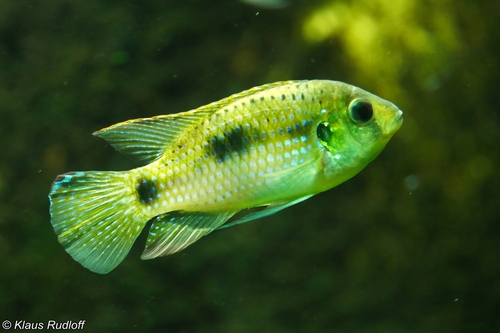
Pungu maclareni
Fishes › Cichlids (Cichliformes) › Cichlidae (Cichlids)
The pungu (Pungu maclareni) is a species of cichlid endemic to Lake Barombi Mbo in Cameroon where it prefers shallow waters of about 1 to 3 metres (3.3 to 9.8 ft) in depth.

Care at a glance
Species-specific aquarium care
- Tank: At least 24 in long and 12 in front to back for one adult (adults commonly reach about 3.9 in / 10 cm).
- Water: Freshwater.
- Temperature: 82–86°F (range recorded for this species).
- Layout: Lives on or near the bottom: floor space and hiding places matter more than height.
- Diet: Eats a varied diet: mix quality prepared foods with frozen and live foods. FishBase classes it as a omnivore.
- Availability: Rarely or never seen in the aquarium trade; expect to source it from specialists or not at all.
Calculated from this species' own FishBase record: tank size from its typical adult length and swimming zone, water values from its recorded ranges. The group guide below fills in general care.
Care guide
Species care notes
- Tank: a base of at least 30 × 12 in (roughly 18 US gallons); space needed is rated “modest tank”.
- Water: hard, alkaline water, 82–86 °F, pH 7.5–8.5, 4–12 dGH.
- Difficulty: Moderate (Seriously Fish rating).
Short excerpts from the species profile:
- Setup: “Not much is written about the fish's natural biotope.”
- Diet: “The species has developed unique dentition to allow it to consume freshwater sponges that exist abundantly in the lake.”
- Tankmates: “It is best kept in a species tank to give you the highest possible chances of a successful spawn.”
- Breeding: “Has been achieved in captivity but little information is available.”
From the Seriously Fish profile for this species, which has the full habitat, maintenance, diet, behaviour and breeding write-up 167
Cichlids
Applies to most species in this group. Habitat: Lakes and rivers of Africa, the Americas and Asia. Individual species can differ, so compare with the species numbers above and the linked sources.
Housing & setup
- Rift-lake cichlids (Malawi and Tanganyika) need hard, alkaline water and rockwork; many South American cichlids prefer softer, slightly acidic water. Check this species' numbers above.
- Plan space for territorial behavior, especially when breeding.
Diet
- Choose food by species: Labidochromis caeruleus consumes animal prey as well as accepting prepared foods, while Tropheus moorii needs a vegetable-based staple. Avoid a universal low-protein rule for mbuna.
Social life
- Often territorial; research compatible tankmates.
Health watch
- Aggression and water quality require monitoring; do not attribute all abdominal swelling to dietary protein. Match feeding to the species and seek a fish veterinarian for illness.
Understanding the animal
About this animal
About this animal
It feeds on invertebrates, sponges, diatoms and macrophytes. This species can reach a length of 10 centimetres (3.9 in) SL. It is currently the only known member of its genus, nested within the Sarotherodon.
Quoted from the Wikipedia article “Pungu” (CC BY-SA 4.0) 174
In the wild
In the wild
From this species’ own FishBase record (habitat, bottom type, water and breeding data), not its family. Good care copies these conditions.1
| Where it lives | Lives in freshwater, in lakes. Stays near the bottom. Usually found in smaller groups. |
| Water it lives in | Freshwater, 82–86 °F (28–30 °C). |
| Climate | Tropical climate. |
| Behavior to plan for | Breeding: external brooders. |
What this means for care
- Keep water within its wild range, 82–86 °F.
From the sources
From the sources
Quoted from the matching sections of reputable sources for this exact species. Specialist databases are used first; Wikipedia (community-edited, CC BY-SA 4.0) only fills gaps. Other sources are short credited quotes.
| Overview | The pungu (Pungu maclareni) is a species of cichlid endemic to Lake Barombi Mbo in Cameroon where it prefers shallow waters of about 1 to 3 m in depth. It feeds on invertebrates, sponges, diatoms and macrophytes. This species can reach a length of 10 cm SL. It is currently the only known member of its genus, nested within the Sarotherodon. — Wikipedia (community-edited) |
| Where it lives | Home ranges Population dynamics Growth parameters Max. ages / sizes Length-weight rel. Length-frequencies Mass conversion Recruitment Abundance Life cycle Reproduction Maturity Maturity/Gills rel. — FishBase |
| Reproduction | Eggs green (, 53940, 58527 ) and ovoid, large (4x3mm) and few in number (, 53940 ). Female is mouthbrooding, but possibly variable biparental mouthbrooder (variably one of the parents or both incubate eggs). — FishBase |
| Biology | Usually found in smaller groups in shallow waters of lake shore ( 26185 ). Feeds mainly on benthic invertebrates (mayfly, caddis and chironomid midge larvae) and the endemic sponge Corvospongilla thysi (, 58527, 81260 ), but diatoms and terrestrial macrophytes are also sometimes eaten in quantity. Maternal mouthbrooder (, 52307, 58527 ). — FishBase |
Data and studies
The numbers
The numbers
Each bar is what one source reports. Where several sources weigh in, the dashed gold band marks their average.
Adult length
Maximum recorded length. Measured as standard length (snout to the base of the tail, not counting the tail fin). Fish in home aquariums often stay smaller than wild records.
Water temperature
Range the species tolerates in nature; aim for the middle.
pH
Water hardness
Minimum tank footprint
Seriously Fish recommends a tank base of at least 30 × 12 in (about 18 US gallons).
Sources for this sheet
- FishBase (Froese & Pauly, eds.), version 24.07 Peer-reviewed researchThe global scientific database on fishes, maintained by a consortium of research institutions; every value is referenced.
- Seriously Fish species profiles Experienced keeper or breederLong-running aquarium reference written and peer-checked by experienced fishkeepers and ichthyologists; each profile covers habitat, tank size, water, diet, behaviour and breeding.
- Merck Veterinary Manual: Management of aquarium fish Zoo, university or veterinaryThe Merck Veterinary Manual: a standard veterinary reference written and reviewed by veterinary specialists.
- Merck Veterinary Manual: Types and features of aquatic systems Zoo, university or veterinaryThe Merck Veterinary Manual: a standard veterinary reference written and reviewed by veterinary specialists.
- Merck Veterinary Manual: Nutritional diseases of fish Zoo, university or veterinaryThe Merck Veterinary Manual: a standard veterinary reference written and reviewed by veterinary specialists.
- Seriously Fish — Labidochromis caeruleus Zoo, university or veterinaryAdded in the 2026 source-checked care-guide review.
- Seriously Fish — Tropheus moorii Zoo, university or veterinaryAdded in the 2026 source-checked care-guide review.
- Wikipedia (species article) Community referenceFree encyclopedia; useful overviews with their own citations. Intro text is quoted under CC BY-SA 4.0.
More cichlids

Agassiz's dwarf cichlid
Apistogramma agassizii
Aquarium hobby

Altolamprologus calvus
Altolamprologus calvus
Aquarium hobby

Altum Angel
Pterophyllum altum
Aquarium hobby
Anomalochromis thomasi
Anomalochromis thomasi
Aquarium hobby

Apistogramma eremnopyge
Apistogramma eremnopyge
Aquarium hobby
Argentine humphead
Gymnogeophagus balzanii
Aquarium hobby