Home / Fishes / Spiny eels and swamp eels / Pipe fish
No federal permit to keepPipe fish
Indostomus paradoxus
Fishes › Spiny eels and swamp eels (Synbranchiformes) › Indostomidae (Armored sticklebacks)
Care follows the fishes guide below.
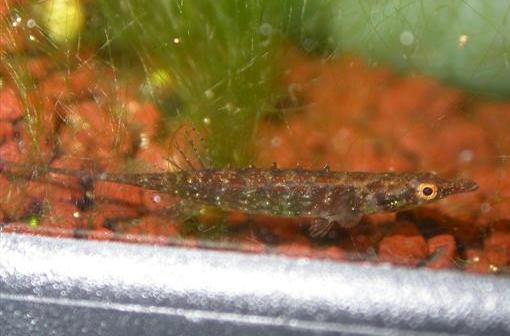
Care at a glance
Species-specific aquarium care
- Tank: At least 24 in long and 12 in front to back for one adult (adults commonly reach about 1.2 in / 3 cm).
- Water: Freshwater.
- Temperature: 75–82°F (range recorded for this species).
- Layout: Uses both the bottom and open water: give open swimming space plus cover near the substrate.
- Diet: FishBase classes it as a carnivore.
Calculated from this species' own FishBase record: tank size from its typical adult length and swimming zone, water values from its recorded ranges. The group guide below fills in general care.
Care guide
Species care notes
- Tank: a base of at least 16 × 8 in (roughly 4 US gallons); space needed is rated “any tank”.
- Water: a fairly wide range, from slightly acidic to slightly alkaline, 72–81 °F, pH 6.5–7.5, 2–12 dGH.
- Behaviour: temperament territorial; a shoaling fish best kept in a group of six or more; not a community fish.
- Difficulty: Moderate (Seriously Fish rating).
Short excerpts from the species profile:
- Setup: “Fares best in a well-planted set-up with a soft substrate although fine-grade gravel is acceptable.”
- Diet: “Chiefly a micropredator feeding on tiny aquatic crustaceans, worms, insect larvae and other zooplankton.”
- Tankmates: “A poor competitor and will be preyed upon by larger fishes so it's best kept alone or with similarly-sized, placid species such as members of Boraras, Danionella or Dario.”
- Breeding: “Has been bred in aquaria on numerous occasions.”
From the Seriously Fish profile for this species, which has the full habitat, maintenance, diet, behaviour and breeding write-up 167
Fishes
Applies to most species in this group. Habitat: Varies. Individual species can differ, so compare with the species numbers above and the linked sources.
Housing & setup
- Cycle the aquarium before adding fish so beneficial bacteria can handle ammonia and nitrite.
- Size filtration and partial water changes to stocking and measured water quality. Topping up evaporated water does not replace a water change; treat incoming tap water appropriately.
- Test ammonia, nitrite, nitrate and pH regularly.
Diet
- A varied diet of quality prepared foods plus frozen or live foods suited to the species; feed only what's eaten in a few minutes.
Health watch
- Quarantine new fish for at least 30 days; longer may be needed. Use a separate system and dedicated nets, buckets and siphons.
- Never release aquarium fish or plants into the wild.
Understanding the animal
In the wild
In the wild
From this species’ own FishBase record (habitat, bottom type, water and breeding data), not its family. Good care copies these conditions.1
| Where it lives | Lives in freshwater, in rivers and streams, marshes and swamps, mangroves. Uses both the bottom and open water. Occur along the bottom in stagnant waters of canals, ditches and swamps. A sedentary, slowly moving species that spends most of its time resting on the bottom. Feeds on worms and other slowly moving benthic invertebrates. Relatively inedible, because of its small size and strong body armor. Not seen in markets. |
| Water it lives in | Freshwater, 75–82 °F (24–28 °C), pH 6.5, hardness 6 dH. |
| Climate | Tropical climate. |
What this means for care
- Keep water within its wild range, 75–82 °F.
Native climate (measured)
Native climate (measured)
| Warm-season highs | about 91°F (up to 98°F in the hottest sampled areas) |
| Cool-season lows | about 63°F (down to 49°F in the coldest sampled areas) |
| Average temperature | 74–83°F across sampled records |
| Relative humidity | 75–79% on average (driest month about 64%) |
| Rainfall | about 2103 mm a year, with strong wet and dry seasons |
Measured at 8 wild occurrence records sampled against WorldClim 2.1 climate data (1970–2000 averages). Air conditions in the range are ecological context, not enclosure settings: microhabitats such as burrows, leaf litter or basking rocks can be cooler, warmer or more humid.
From the sources
From the sources
Quoted from the matching sections of reputable sources for this exact species. Specialist databases are used first; Wikipedia (community-edited, CC BY-SA 4.0) only fills gaps. Other sources are short credited quotes.
| Where it lives | Home ranges Population dynamics Growth parameters Max. ages / sizes Length-weight rel. Length-frequencies Mass conversion Recruitment Abundance Life cycle Reproduction Maturity Maturity/Gills rel. — FishBase |
| Biology | Occur along the bottom in stagnant waters of canals, ditches and swamps. A sedentary, slowly moving species that spends most of its time resting on the bottom. Feeds on worms and other slowly moving benthic invertebrates. — FishBase |
Data and studies
The numbers
The numbers
Each bar is what one source reports. Where several sources weigh in, the dashed gold band marks their average.
Adult length
Maximum recorded length. Measured as standard length (snout to the base of the tail, not counting the tail fin). Fish in home aquariums often stay smaller than wild records.
Water temperature
Range the species tolerates in nature; aim for the middle.
pH
Water hardness
Minimum tank footprint
Seriously Fish recommends a tank base of at least 16 × 8 in (about 4 US gallons).
Sources for this sheet
- FishBase (Froese & Pauly, eds.), version 24.07 Peer-reviewed researchThe global scientific database on fishes, maintained by a consortium of research institutions; every value is referenced.
- Seriously Fish species profiles Experienced keeper or breederLong-running aquarium reference written and peer-checked by experienced fishkeepers and ichthyologists; each profile covers habitat, tank size, water, diet, behaviour and breeding.
- Merck Veterinary Manual: Management of aquarium fish Zoo, university or veterinaryThe Merck Veterinary Manual: a standard veterinary reference written and reviewed by veterinary specialists.
- Merck Veterinary Manual: Types and features of aquatic systems Zoo, university or veterinaryThe Merck Veterinary Manual: a standard veterinary reference written and reviewed by veterinary specialists.
- Merck Veterinary Manual: Nutritional diseases of fish Zoo, university or veterinaryThe Merck Veterinary Manual: a standard veterinary reference written and reviewed by veterinary specialists.