Home / Fishes / Catfish / Pimelodus maculatus
No federal permit to keepPimelodus maculatus
Pimelodus maculatus
Fishes › Catfish (Siluriformes) › Pimelodidae (Long-whiskered catfish)
Pimelodus maculatus is a fish in the family Pimelodidae.
Intro from Wikipedia (CC BY-SA 4.0)
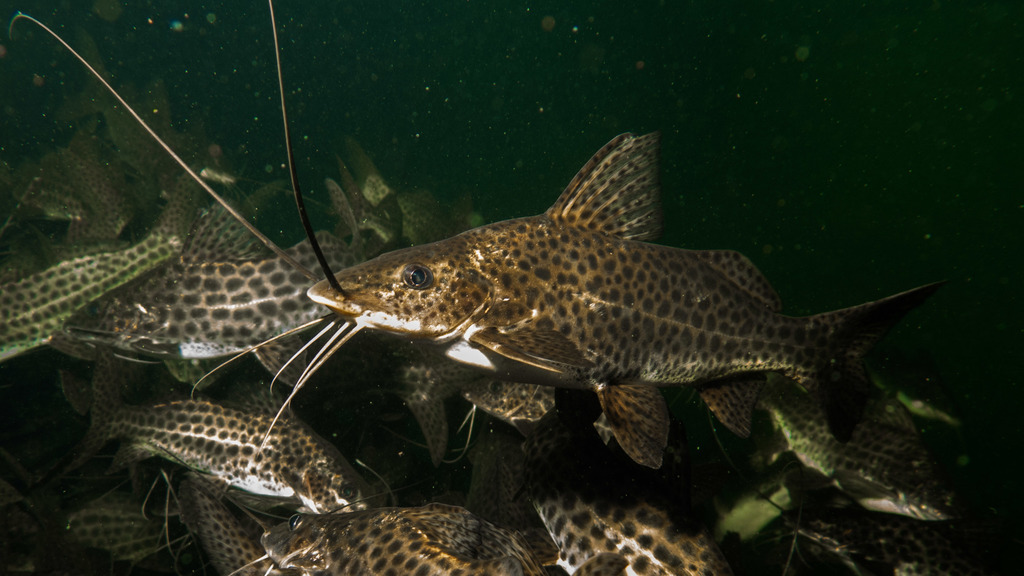
Care at a glance
Species-specific aquarium care
- Tank: At least 72 in long and 27 in front to back for one adult (adults commonly reach about 14.2 in / 36 cm; the largest recorded was 20.1 in).
- Water: Freshwater.
- Temperature: 68–75°F (range recorded for this species).
- pH: 6.8–7.8.
- Hardness: 5–20 dGH.
- Layout: Uses both the bottom and open water: give open swimming space plus cover near the substrate.
- Diet: FishBase classes it as a carnivore.
- Availability: Rarely or never seen in the aquarium trade; expect to source it from specialists or not at all.
Calculated from this species' own FishBase record: tank size from its typical adult length and swimming zone, water values from its recorded ranges. The group guide below fills in general care.
Care guide
Species care notes
- Tank: a base of at least 47 × 24 in (roughly 114 US gallons); space needed is rated “large tank”.
- Water: a fairly wide range, from slightly acidic to slightly alkaline, 68–75 °F, pH 6.4–7.4, 5–20 dGH.
- Behaviour: temperament predatory; a shoaling fish best kept in a group of six or more.
- Difficulty: Moderate (Seriously Fish rating).
Short excerpts from the species profile:
- Setup: “Does best in a dimly lit environment with plenty of swimming space, and a few hiding places to provide security.”
- Diet: “Very easy to feed, although you might need to add food at night until the fish are acclimatised to their surroundings.”
- Tankmates: “Peaceful enough but bear in mind this is a predatory species and will eat smaller fish.”
- Breeding: “There are no reports of successful breeding in the hobby.”
From the Seriously Fish profile for this species, which has the full habitat, maintenance, diet, behaviour and breeding write-up 167
Long-whiskered catfish
Applies to most species in this group. Habitat: South American pimelodids occupy river channels and tributaries, with redtails and shovelnoses also using flooded forests. [fg178-pictus, fg178-redtail, fg178-sorubim]. Individual species can differ, so compare with the species numbers above and the linked sources.
Housing & setup
- For P. pictus, use at least 120 × 45 × 45 cm (about 243 L), with open swimming space.
- Adult redtails and P. fasciatum require facility-scale housing: approximately 360 × 240 × 120 cm (10,368 L) is explicitly only a minimum in the reference.
- Provide dim lighting and appropriately sized shelters; use fine sand for pictus.
- For giant species, secure heavy furnishings and avoid swallowable gravel; bare bottoms or large smooth pebbles are alternatives.
- Use efficient biological filtration, regular partial water changes and, for giants, equipment protected in an external sump.
Climate & lighting
| Water | 71.6–77°F |
Diet
- Pictus: sinking prepared foods and frozen bloodworms.
- Earthworms, sized for the fish.
- Giant predators: prawns and mussels.
- Giant predators: white-fish portions; vary foods and reduce feeding frequency as adults mature.
Social life
- Pictus are shoaling fish, preferably six or more in adequate space; adult redtails and shovelnoses can be territorial towards other large pimelodids. Companions must be too large to swallow.
Health watch
- Barbel erosion with deteriorating water quality.
- White spot and poor condition in newly imported pictus.
- Obesity and fatty organ damage from overfeeding or inappropriate mammal meat.
Understanding the animal
In the wild
In the wild
From this species’ own FishBase record (habitat, bottom type, water and breeding data), not its family. Good care copies these conditions.1
| Where it lives | Lives in freshwater, in rivers and streams. Uses both the bottom and open water. |
| Water it lives in | Freshwater, 68–75 °F (20–24 °C), pH 6.8–7.8, hardness 5–20 dH. |
| Climate | Subtropical climate. |
What this means for care
- Keep water within its wild range, 68–75 °F.
Native climate (measured)
Native climate (measured)
| Warm-season highs | about 87°F (up to 91°F in the hottest sampled areas) |
| Cool-season lows | about 51°F (down to 44°F in the coldest sampled areas) |
| Average temperature | 64–77°F across sampled records |
| Relative humidity | 72–77% on average (driest month about 66%) |
| Rainfall | about 1390 mm a year |
Measured at 452 wild occurrence records sampled against WorldClim 2.1 climate data (1970–2000 averages). Air conditions in the range are ecological context, not enclosure settings: microhabitats such as burrows, leaf litter or basking rocks can be cooler, warmer or more humid.
From the sources
From the sources
Quoted from the matching sections of reputable sources for this exact species. Specialist databases are used first; Wikipedia (community-edited, CC BY-SA 4.0) only fills gaps. Other sources are short credited quotes.
| Where it lives | Home ranges Population dynamics Growth parameters Max. ages / sizes Length-weight rel. Length-frequencies Mass conversion Recruitment Abundance Life cycle Reproduction Maturity Maturity/Gills rel. — FishBase |
| Appearance and size | Maximum length 51.0 cm tl male/unsexed; maximum published weight 2.4 kg. — FishBase |
Data and studies
The numbers
The numbers
Each bar is what one source reports. Where several sources weigh in, the dashed gold band marks their average.
Typical adult weight
Average adult body mass in each database (FishBase gives the maximum recorded weight).
Adult length
Common length to maximum recorded length. Measured as total length. Fish in home aquariums often stay smaller than wild records.
Water temperature
Range the species tolerates in nature; aim for the middle.
Minimum tank footprint
Seriously Fish recommends a tank base of at least 47 × 24 in (about 114 US gallons).
Sources for this sheet
- FishBase (Froese & Pauly, eds.), version 24.07 Peer-reviewed researchThe global scientific database on fishes, maintained by a consortium of research institutions; every value is referenced.
- Seriously Fish species profiles Experienced keeper or breederLong-running aquarium reference written and peer-checked by experienced fishkeepers and ichthyologists; each profile covers habitat, tank size, water, diet, behaviour and breeding.
- Seriously Fish: Pimelodus pictus Experienced keeper or breederAdded in the 2026 source-checked care-guide review.
- Seriously Fish: Phractocephalus hemioliopterus Experienced keeper or breederAdded in the 2026 source-checked care-guide review.
- Seriously Fish: Pseudoplatystoma fasciatum Experienced keeper or breederAdded in the 2026 source-checked care-guide review.
- Wikipedia (species article) Community referenceFree encyclopedia; useful overviews with their own citations. Intro text is quoted under CC BY-SA 4.0.
- iNaturalist (captive observations) Community referenceCommunity observation platform run by the California Academy of Sciences and National Geographic; observations marked captive show animals living in homes, zoos and aquariums.
More long-whiskered catfish

Barred sorubim
Pseudoplatystoma fasciatum
Aquarium hobby

Bolt Catfish
Aguarunichthys torosus
Aquarium hobby

Duckbill catfish
Sorubim lima
Aquarium hobby

Kumakuma
Brachyplatystoma filamentosum
Aquarium hobby
Laulao catfish
Brachyplatystoma vaillantii
Aquarium hobby

Leiarius longibarbis
Leiarius longibarbis
Aquarium hobby