Home / Fishes / Cichlids / Cichlidae / Pearl cichlid
No federal permit to keepPearl cichlid
Geophagus brasiliensis
Fishes › Cichlids (Cichliformes) › Cichlidae (Cichlids)
The pearl cichlid (Geophagus brasiliensis) is a species of fish in the South American cichlid family.

Care at a glance
Species-specific aquarium care
- Tank: At least 24 in long and 12 in front to back for one adult (adults commonly reach about 3.5 in / 9 cm; the largest recorded was 11.0 in).
- Water: Freshwater (tolerates brackish).
- Temperature: 52–99°F (range recorded for this species).
- pH: 6.5–7.
- Hardness: 5–10 dGH.
- Layout: Uses both the bottom and open water: give open swimming space plus cover near the substrate.
- Diet: FishBase classes it as a omnivore.
Calculated from this species' own FishBase record: tank size from its typical adult length and swimming zone, water values from its recorded ranges. The group guide below fills in general care.
Care guide
Species care notes
- Tank: a base of at least 59 × 18 in (roughly 80 US gallons); space needed is rated “very large tank”.
- Water: a fairly wide range, from slightly acidic to slightly alkaline, 64–82 °F, pH 6–8, 1–15 dGH.
- Behaviour: temperament territorial; in a pair; not a community fish.
- Difficulty: Moderate (Seriously Fish rating).
Short excerpts from the species profile:
- Setup: “Ideally a soft, sandy substrate should be employed though it's not essential.”
- Diet: “Studies have revealed it to be a generalised omnivore with the natural diet composed of plant material, aquatic invertebrates (particularly chironomid larvae, ostracods and cladocerans), fish scales and fry.”
- Tankmates: “Males are territorial, particularly when spawning, while very small tankmates may be predated upon.”
- Breeding: “Biparental substrate spawner.”
From the Seriously Fish profile for this species, which has the full habitat, maintenance, diet, behaviour and breeding write-up 167
Oscars, peacock bass, pike cichlids and eartheaters
Applies to most species in this group. Habitat: Large South American rivers. Individual species can differ, so compare with the species numbers above and the linked sources.
Housing & setup
- For one adult Astronotus ocellatus, plan at least a 150 × 60 cm base according to Seriously Fish; pairs and groups need more space. Use separate adult plans for Cichla and each eartheater species.
- Soft sand for eartheaters (Geophagus, Satanoperca), which sift substrate through their gills.
Climate & lighting
Starting point only: The blanket warm-water interval excludes the subtropical seasonal requirements of G. balzanii; use overrides. Check the species-specific values for this animal where shown.
| Water | 77–84°F |
Diet
- Astronotus ocellatus is an omnivore with a preference for animal foods; offer quality pellets and varied suitable foods rather than feeder-fish dependence. Cichla and substrate-sifting eartheaters require separate feeding plans.
Health watch
- Hole-in-the-head disease and lateral line erosion in poor water; eartheaters suffer on sharp gravel.
Understanding the animal
About this animal
About this animal
It is native to southeastern Brazil (north to Bahia), Paraguay, Uruguay and far northeastern Argentina, where it is found in rivers, lakes, and nearby slightly brackish lagoons. It has been introduced to several countries far from its native range, including the United States, Australia, the Philippines, and Taiwan.
Quoted from the Wikipedia article “Pearl cichlid” (CC BY-SA 4.0) 174
In the wild
In the wild
From this species’ own FishBase record (habitat, bottom type, water and breeding data), not its family. Good care copies these conditions.1
| Where it lives | Lives in freshwater and brackish water, in rivers and streams. Uses both the bottom and open water. |
| Water it lives in | Freshwater / brackish water, 52–99 °F (11–37 °C), pH 6.5–7, hardness 5–10 dH. |
| Climate | Tropical climate. |
| Behavior to plan for | Breeding: clutch tenders. |
What this means for care
- Keep water within its wild range, 52–99 °F.
- It tolerates or needs brackish water; check salinity needs before setup.
Native climate (measured)
Native climate (measured)
| Warm-season highs | about 84°F (up to 88°F in the hottest sampled areas) |
| Cool-season lows | about 51°F (down to 45°F in the coldest sampled areas) |
| Average temperature | 63–75°F across sampled records |
| Relative humidity | 75–81% on average (driest month about 74%) |
| Rainfall | about 1409 mm a year |
Measured at 734 wild occurrence records sampled against WorldClim 2.1 climate data (1970–2000 averages). Air conditions in the range are ecological context, not enclosure settings: microhabitats such as burrows, leaf litter or basking rocks can be cooler, warmer or more humid.
From the sources
From the sources
Quoted from the matching sections of reputable sources for this exact species. Specialist databases are used first; Wikipedia (community-edited, CC BY-SA 4.0) only fills gaps. Other sources are short credited quotes.
| Overview | The pearl cichlid (Geophagus brasiliensis) is a species of fish in the South American cichlid family. It is native to southeastern Brazil (north to Bahia), Paraguay, Uruguay and far northeastern Argentina, where it is found in rivers, lakes, and nearby slightly brackish lagoons. It has been introduced to several countries far from its native range, including the United States, Australia, the Philippines, and Taiwan. This species is popular among aquarists. — Wikipedia (community-edited) |
| Where it lives | Home ranges Population dynamics Growth parameters Max. ages / sizes Length-weight rel. Length-frequencies Mass conversion Recruitment Abundance Life cycle Reproduction Maturity Maturity/Gills rel. — FishBase |
| Reproduction | The sex of the fish is often unclear until it reaches adult size, at which point the size difference between the genders becomes pronounced. Breeders often attempt to pair the fish without sexing them; two females may pair up in which case the fish lay eggs that never hatch. Once a male-female pair is found, they tend to yield 150–200 offspring after successfully mating. — Wikipedia (community-edited) |
| Appearance and size | Maximum length 28.0 cm tl male/unsexed. — FishBase |
| Biology | Quite popular with aquarists. — FishBase |
| History and naming | G. brasiliensis is part of a species complex that also includes the rarer G. diamantinensis, G. iporangensis, G. itapicuruensis, G. multiocellus, G. obscurus, G. rufomarginatus and G. santosi from the Brazilian state of Bahia (most species) or São Paulo (G. iporangensis). — Wikipedia (community-edited) |
Data and studies
The numbers
The numbers
Each bar is what one source reports. Where several sources weigh in, the dashed gold band marks their average.
Adult length
Common length to maximum recorded length. Measured as total length. Fish in home aquariums often stay smaller than wild records.
Water temperature
Range the species tolerates in nature; aim for the middle.
Minimum tank footprint
Seriously Fish recommends a tank base of at least 59 × 18 in (about 80 US gallons).
Veterinary & husbandry research
Veterinary & husbandry research
- Influence of temperature on larval ontogenesis of Geophagus brasiliensis (Quoy & Gaimard, 1824) (Pisces: Cichlidae) Melo MDV et al., Zygote (Cambridge, England) 2021
- Geophagus brasiliensis (Teleostei: Cichlidae) as an indicator of toxicity of ornamental stone processing wastes Venturoti GP et al., Comparative biochemistry and physiology. Toxicology & pharmacology: CBP 2019
- Time-place learning in individually reared angelfish, but not in pearl cichlid Barreto RE et al., Behavioural processes 2006
- Effect of 2,4-D herbicide (2,4-dichlorophenoxyacetic acid) on oxygen consumption and ammonium excretion of juveniles of Geophagus brasiliensis (Quoy & Gaimard, 1824) (Osteichthyes, Cichlidae) Barbieri E et al., Ecotoxicology (London, England) 2009
Peer-reviewed papers that mention this species alongside captivity, zoos, veterinary care or aquaculture. Some cover several species or mention it only in passing, so check the abstract. 170
Sources for this sheet
- FishBase (Froese & Pauly, eds.), version 24.07 Peer-reviewed researchThe global scientific database on fishes, maintained by a consortium of research institutions; every value is referenced.
- Seriously Fish species profiles Experienced keeper or breederLong-running aquarium reference written and peer-checked by experienced fishkeepers and ichthyologists; each profile covers habitat, tank size, water, diet, behaviour and breeding.
- Merck Veterinary Manual: Management of aquarium fish Zoo, university or veterinaryThe Merck Veterinary Manual: a standard veterinary reference written and reviewed by veterinary specialists.
- Merck Veterinary Manual: Types and features of aquatic systems Zoo, university or veterinaryThe Merck Veterinary Manual: a standard veterinary reference written and reviewed by veterinary specialists.
- Seriously Fish: Gymnogeophagus balzanii Experienced keeper or breederAdded in the 2026 source-checked care-guide review.
- Seriously Fish — Astronotus ocellatus Zoo, university or veterinaryAdded in the 2026 source-checked care-guide review.
- Wikipedia (species article) Community referenceFree encyclopedia; useful overviews with their own citations. Intro text is quoted under CC BY-SA 4.0.
- PubMed (U.S. National Library of Medicine) Peer-reviewed researchIndex of peer-reviewed veterinary, zoo and husbandry research.
- iNaturalist (captive observations) Community referenceCommunity observation platform run by the California Academy of Sciences and National Geographic; observations marked captive show animals living in homes, zoos and aquariums.
More cichlids

Agassiz's dwarf cichlid
Apistogramma agassizii
Aquarium hobby

Altolamprologus calvus
Altolamprologus calvus
Aquarium hobby

Altum Angel
Pterophyllum altum
Aquarium hobby
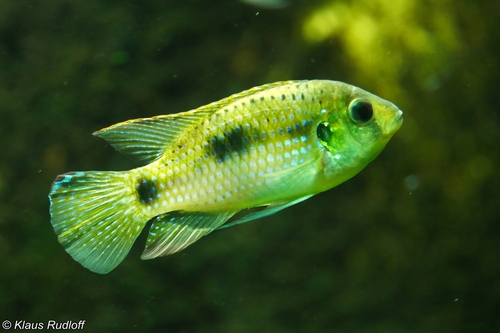
Anomalochromis thomasi
Anomalochromis thomasi
Aquarium hobby

Apistogramma eremnopyge
Apistogramma eremnopyge
Aquarium hobby
Argentine humphead
Gymnogeophagus balzanii
Aquarium hobby