Home / Fishes / Gouramis, bettas, snakeheads / Black Mask Chocolate Gourami
No federal permit to keepBlack Mask Chocolate Gourami
Parasphaerichthys lineatus
Fishes › Gouramis, bettas, snakeheads (Anabantiformes) › Osphronemidae (Gouramis and bettas)
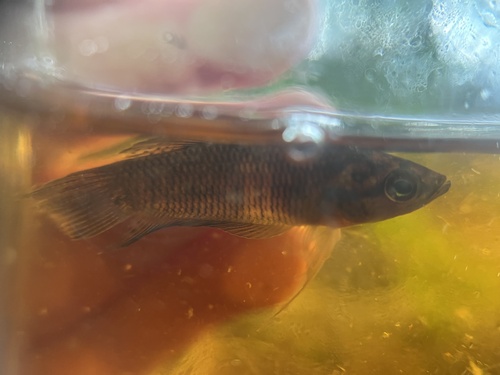
Parasphaerichthys lineatus is a species of gourami.
Care at a glance
Species-specific aquarium care
- Tank: At least 24 in long and 12 in front to back for one adult (adults commonly reach about 0.7 in / 1.87 cm).
- Water: Freshwater.
- Layout: Uses both the bottom and open water: give open swimming space plus cover near the substrate.
- Availability: Rarely or never seen in the aquarium trade; expect to source it from specialists or not at all.
Calculated from this species' own FishBase record: tank size from its typical adult length and swimming zone, water values from its recorded ranges. The group guide below fills in general care.
Care guide
Species care notes
- Tank: a base of at least 16 × 8 in (roughly 4 US gallons); space needed is rated “any tank”.
- Water: a fairly wide range, from slightly acidic to slightly alkaline, 72–81 °F, pH 6.5–8, 2–12 dGH.
- Behaviour: a shoaling fish best kept in a group of six or more; not a community fish.
- Difficulty: Easy (Seriously Fish rating).
Short excerpts from the species profile:
- Setup: “Fares best in a well-planted set-up with a soft substrate although fine-grade gravel is acceptable.”
- Diet: “Chiefly a micropredator feeding on small aquatic crustaceans, worms, insect larvae and other zooplankton.”
- Tankmates: “Given its rarity in the hobby, and possibly nature, the emphasis should be on captive reproduction but if you intend to house it in a community tankmates must be chosen with care.”
- Breeding: “The first recorded account of captive-spawning in this species was published in the original description by Britz and Kottelat (2002) [2].”
From the Seriously Fish profile for this species, which has the full habitat, maintenance, diet, behaviour and breeding write-up 167
Gouramis and labyrinth fish
Applies to most species in this group. Habitat: Warm, still, vegetated waters. Individual species can differ, so compare with the species numbers above and the linked sources.
Housing & setup
- Planted, calm tanks with floating plants; they breathe air at the surface, so leave a gap under the lid.
Diet
- Food acceptance is species-specific. Parosphromenus deissneri needs tiny live invertebrate foods and commonly refuses dried foods; a pellet/flake staple cannot cover every labyrinth fish.
Health watch
- Males are territorial; dwarf gourami iridovirus.
Understanding the animal
About this animal
About this animal
It is native to Asia, where it is known only from southern Myanmar. The species reaches 1.9 cm (0.7 inches) in standard length and is known to be a facultative air-breather.
Quoted from the Wikipedia article “Parasphaerichthys lineatus” (CC BY-SA 4.0) 174
In the wild
In the wild
From this species’ own FishBase record (habitat, bottom type, water and breeding data), not its family. Good care copies these conditions.1
| Where it lives | Lives in freshwater. Uses both the bottom and open water. |
| Water it lives in | Freshwater. |
| Climate | Tropical climate. |
| Behavior to plan for | Breeding: nesters. |
From the sources
From the sources
Quoted from the matching sections of reputable sources for this exact species. Specialist databases are used first; Wikipedia (community-edited, CC BY-SA 4.0) only fills gaps. Other sources are short credited quotes.
| Overview | Parasphaerichthys lineatus is a species of gourami. It is native to Asia, where it is known only from southern Myanmar. The species reaches 1.9 cm (0.7 inches) in standard length and is known to be a facultative air-breather. Observations of the species in captivity suggest that males pick up released eggs and store them in nests adhered to the corners of small stones. — Wikipedia (community-edited) |
| Where it lives | Home ranges Population dynamics Growth parameters Max. ages / sizes Length-weight rel. Length-frequencies Mass conversion Recruitment Abundance Life cycle Reproduction Maturity Maturity/Gills rel. — FishBase |
| Reproduction | In captivity, the male predominantly picks up the released egss from the bottom of the tank and stores them in a nest built beneath a projecting corner of a small stone. The nest has a number of small air bubbles and several dozen eggs that together formed a compact mass that adhered to the stone. — FishBase |
Data and studies
The numbers
The numbers
Each bar is what one source reports. Where several sources weigh in, the dashed gold band marks their average.
Adult length
Maximum recorded length. Measured as standard length (snout to the base of the tail, not counting the tail fin). Fish in home aquariums often stay smaller than wild records.
Water temperature
Range the species tolerates; aim for the middle.
pH
Water hardness
Minimum tank footprint
Seriously Fish recommends a tank base of at least 16 × 8 in (about 4 US gallons).
Sources for this sheet
- FishBase (Froese & Pauly, eds.), version 24.07 Peer-reviewed researchThe global scientific database on fishes, maintained by a consortium of research institutions; every value is referenced.
- Seriously Fish species profiles Experienced keeper or breederLong-running aquarium reference written and peer-checked by experienced fishkeepers and ichthyologists; each profile covers habitat, tank size, water, diet, behaviour and breeding.
- Merck Veterinary Manual: Management of aquarium fish Zoo, university or veterinaryThe Merck Veterinary Manual: a standard veterinary reference written and reviewed by veterinary specialists.
- Merck Veterinary Manual: Types and features of aquatic systems Zoo, university or veterinaryThe Merck Veterinary Manual: a standard veterinary reference written and reviewed by veterinary specialists.
- Merck Veterinary Manual: Nutritional diseases of fish Zoo, university or veterinaryThe Merck Veterinary Manual: a standard veterinary reference written and reviewed by veterinary specialists.
- Seriously Fish — Parosphromenus deissneri Zoo, university or veterinaryAdded in the 2026 source-checked care-guide review.
- Wikipedia (species article) Community referenceFree encyclopedia; useful overviews with their own citations. Intro text is quoted under CC BY-SA 4.0.
More gouramis and bettas

Alfred's Licorice Gourami
Parosphromenus alfredi
Aquarium hobby

Banded gourami
Trichogaster fasciata
Aquarium hobby

Barito Betta
Betta pallifina
Aquarium hobby
Betta hipposideros
Betta hipposideros
Aquarium hobby

Betta stigmosa
Betta stigmosa
Aquarium hobby

Betta uberis
Betta uberis
Aquarium hobby