Home / Mammals / Opossums / Virginia opossum
No federal permit to keep In-depth sheetVirginia opossum
Didelphis virginiana
Mammals › Opossums (Didelphimorphia) › Didelphidae (Opossums)
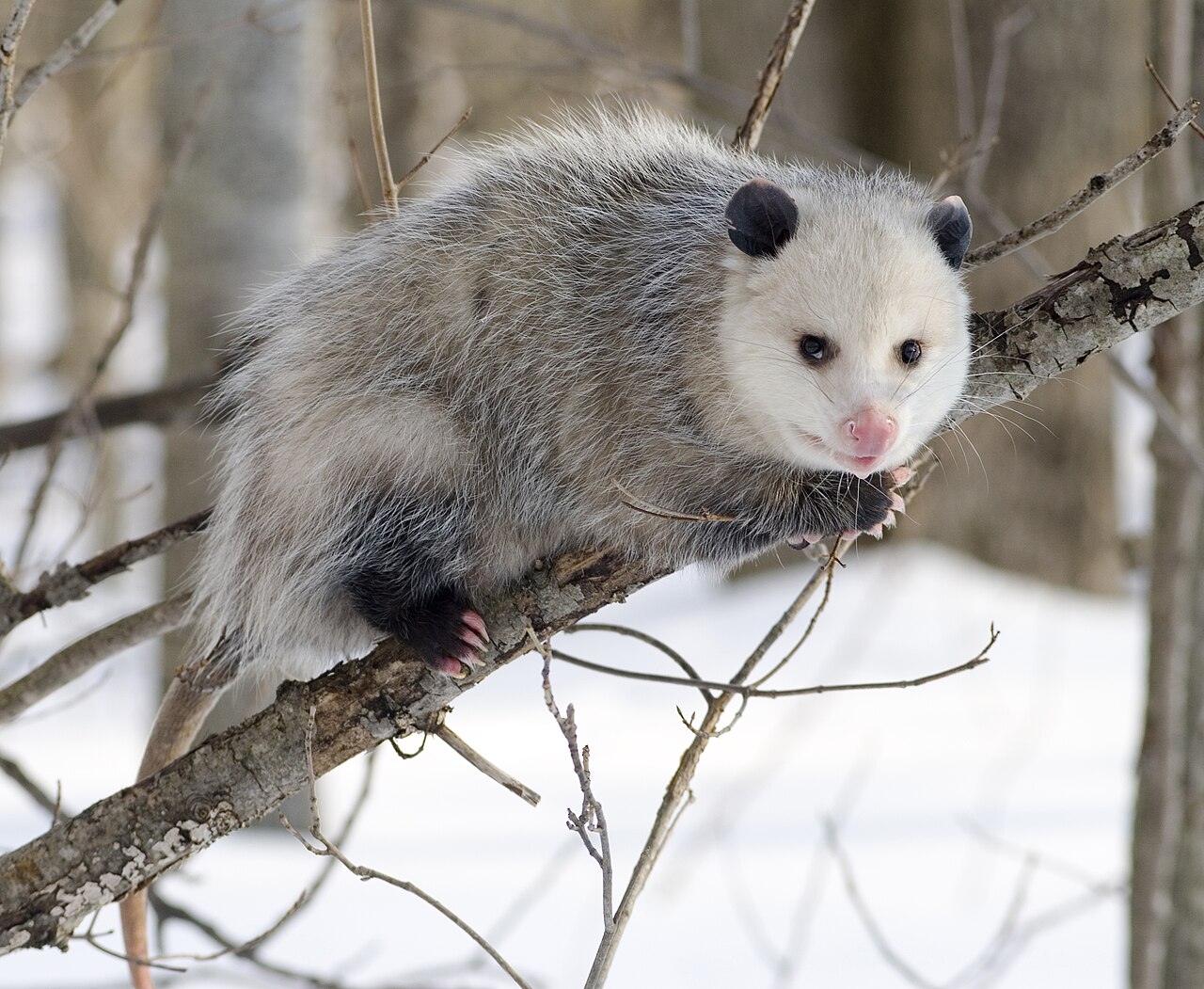
Virginia opossums are solitary, nocturnal marsupials that climb well and famously play dead. Captive opossums can be litter-trained, but their diet must be carefully balanced to avoid obesity and metabolic bone disease.
Care guide
Housing
- A large cage or room with branches for climbing, a big nest box and a litter area.
- House alone unless raised together; they're solitary.
Diet
- Omnivores: fruits, vegetables, insects, eggs and lean protein, with an emphasis on high-calcium foods like leafy greens, squash and sweet potato.
- Calcium and the calcium-to-phosphorus balance are critical. Discuss supplements with your vet.
- They have a big appetite and a slow metabolism; measure portions.
Behavior & enrichment
- Very curious: they'll get into anything not locked. Supervised exercise outside the cage every day.
- "Playing possum" is an involuntary response that can last from a minute to several hours; give them quiet time to recover.
Health & vet care
- Metabolic bone disease (nutritional secondary hyperparathyroidism) is a serious risk from poor diet. Signs include a swollen face, weakness and trouble walking.
- Obesity is common in captivity.
Show the group care guide for opossums
Opossums
Applies to most species in this group. Habitat: Forests and suburbs. Individual species can differ, so compare with the species numbers above and the linked sources.
Housing & setup
- A large cage or room with climbing branches, a nest box and a litter area.
Sources 8
Diet
- A balanced omnivore diet with an emphasis on calcium-rich foods; insects and fruit.
Sources 8
Health watch
- Metabolic bone disease and obesity on poor diets.
Sources 8
Understanding the animal
In the wild
In the wild
Researched for this exact species, not its family. Good care copies these conditions.12
| Where it lives | Woodlands, thickets and human settlements from Central America into southern Canada; often near streams or swamps. Shelters in hollow trees, brush piles and abandoned burrows. |
| Ground it lives on | Soil and leaf litter; also climbs trees and uses leaf-lined dens. |
| Climate | Tropical to temperate conditions, including cold northern winters; exposed ears and tail are vulnerable to frostbite. Measured ambient temperature and relative-humidity ranges were not found. |
| Active | Nocturnal, beginning around dusk; reduces activity in severe cold but does not hibernate. |
| Social life | Usually solitary; home ranges may overlap and encounters can be aggressive. |
| Wild diet | Insects, earthworms, snails, small vertebrates, carrion, fruits, seeds and other plant material; more vertebrate food in colder seasons. |
| Behavior to plan for | Climbs and swims to escape threats. Threatened animals may bare their teeth or enter involuntary death-feigning immobility. |
What this means for care
- Provide ground foraging space plus sturdy climbing routes and enclosed dens.
- House adults separately unless compatibility is established.
- Protect ears and tail from freezing; northern occurrence does not imply cold tolerance.
Native climate (measured)
Native climate (measured)
| Warm-season highs | about 90°F (up to 95°F in the hottest sampled areas) |
| Cool-season lows | about 31°F (down to 15°F in the coldest sampled areas) |
| Average temperature | 47–71°F across sampled records |
| Relative humidity | 65–72% on average (driest month about 62%) |
| Rainfall | about 1132 mm a year, spread fairly evenly |
| Winters | Cool to cold winters (lows around 31°F) in much of its native range. Seasonal slowdown may be relevant, but species-specific biology determines whether brumation or hibernation occurs. |
Measured at 96 wild occurrence records sampled against WorldClim 2.1 climate data (1970–2000 averages). Air conditions in the range are ecological context, not enclosure settings: microhabitats such as burrows, leaf litter or basking rocks can be cooler, warmer or more humid.
Profile
Profile
Researched for this exact species. Sources are listed under In the wild above.
History
The ancestors of Virginia opossums evolved in South America and later moved into North America during the Great American Interchange, with Didelphis apparently arriving about 0.8 million years ago. European forest clearing and reductions in major predators helped the species expand north of its earlier range.
Keeper tips
- Account for its nocturnal schedule rather than expecting daytime activity to represent its normal behavior.
- Provide access to secure shelter because wild opossums commonly nest in brush piles, hollow trees, and drainage areas.
- Take its poor physiological tolerance of severe cold seriously; frostbite is reported in northern populations.
- Remember that the species is naturally solitary.
- Its success in human-altered environments reflects highly opportunistic use of available shelter and food sources.
Behaviors reported
- Is primarily nocturnal and solitary.
- Readily inhabits urban and other human-altered environments.
- Uses brush piles, hollow trees, drainage areas, and human structures as shelter.
- Scavenges roadside carrion and opportunistically exploits human-associated food sources.
- Modifies its behavior during extreme temperatures.
Unique adaptations
- Its small body size, nocturnal habits, and high reproductive output are identified as factors assisting its success in urban environments.
- Behavioral changes during extreme temperatures and use of human structures help compensate for relatively poor cold tolerance.
Remarkable facts
- It is the northernmost marsupial in the world.
- Its modern range extends from Costa Rica to southern Ontario.
- It occurs from near sea level to about 3,000 m elevation.
- Its ancestors evolved in South America and spread north during the Great American Interchange.
- Didelphis apparently entered North America about 0.8 million years ago.
- Its range continues to expand northward, northwestward, and northeastward.
From the sources
From the sources
Quoted from the matching sections of reputable sources for this exact species. Specialist databases are used first; Wikipedia (community-edited, CC BY-SA 4.0) only fills gaps. Other sources are short credited quotes.
| Overview | The Virginia opossum (Didelphis virginiana), also known as the North American opossum, is a member of the opossum family found from southern Canada to northern Costa Rica, making it the northernmost marsupial in the world. Commonly referred to simply as the possum, it is a solitary nocturnal animal about the size of a domestic cat, and a successful opportunist. Opossums are familiar to many North Americans as they frequently inhabit settled areas near food sources like trash cans, pet food, compost piles, gardens or housemice. — Wikipedia (community-edited) |
| Where it lives | Virginia opossums may be found in a fairly wide range of habitats; however, they typically prefer areas near a water source, such as a stream or swamp. — Animal Diversity Web |
| Wild diet | Opossums are omnivorous and eat a wide range of plant-based food, as well as animal-based food like small invertebrates, carrion, eggs, fish, amphibians, reptiles, birds, small mammals, and other small animals. Insects such as grasshoppers, crickets, and beetles make up the bulk of the animal foods eaten by opossums. — Wikipedia (community-edited) |
| Reproduction | Didelphid marsupials engage in a polygynous mating system, in which males vie for reproductive females. — Animal Diversity Web |
| Appearance and size | Virginia opossums are robust marsupials, with short legs and thick bodies. — Animal Diversity Web |
Data and studies
Researched care notes
Researched care notes
Findings checked against veterinary, zoo, welfare, keeper and peer-reviewed sources. Air, basking-surface and water temperatures are kept separate, and where sources disagree both are shown. “Study” notes report what a paper measured, not a universal rule.
Virginia Opossum (species)
The numbers
The numbers
Each bar is what one source reports. Where several sources weigh in, the dashed gold band marks their average.
Lifespan in care
Wild opossums usually live only 1.5–2 years; well-kept captive ones can reach 8–10.
Room temperature
About 71°F is ideal; humidity at least 50% helps prevent dry skin.
Maximum recorded lifespan
Longest recorded lifespan reported by each database; typical lifespans are usually shorter. The AnAge record comes from an animal in human care.
Typical adult weight
Average adult body mass in each database (FishBase gives the maximum recorded weight).
Litter size
Average per litter or clutch.
Veterinary & husbandry research
Veterinary & husbandry research
- West Nile Virus Associations in Wild Mammals: An Update Root JJ et al., Viruses 2019
- Trypanosoma cruzi Transmission Among Captive Nonhuman Primates, Wildlife, and Vectors Hodo CL et al., EcoHealth 2018
- Behavioral and nutritional aspects of the Virginian opossum (Didelphis virginiana) McRuer DL et al., The veterinary clinics of North America. Exotic animal practice 2009
- Novel Hepatozoon in vertebrates from the southern United States Allen KE et al., The Journal of parasitology 2011
Peer-reviewed papers that mention this species alongside captivity, zoos, veterinary care or aquaculture. Some cover several species or mention it only in passing, so check the abstract. See all 35 on PubMed → 170
Sources for this sheet
- Exotic Nutrition: Keeping a pet opossum Experienced keeper or breederLong-running exotic-diet company with practical keeper advice; they also sell the diets they mention.
- Animal Diversity Web: Didelphis virginiana Zoo, university or veterinaryUniversity-hosted species account.
- University of Illinois Wildlife Medical Clinic: Nutritional secondary hyperparathyroidism Zoo, university or veterinaryVeterinary teaching hospital describing a real opossum case.
- AnAge: The Animal Ageing and Longevity Database (Human Ageing Genomic Resources) Peer-reviewed researchCurated, referenced longevity and life-history records for thousands of species; maximum lifespans are often from zoo animals.
- Myhrvold et al. (2015). An amniote life-history database. Ecology 96: 3109 Peer-reviewed researchPeer-reviewed compilation of life-history data for over 21,000 birds, mammals and reptiles.
- 9 CFR 2.1: Animal Welfare Act licensing (USDA) Zoo, university or veterinaryWho needs a USDA license to breed, sell or exhibit animals.
- GBIF Backbone Taxonomy (Global Biodiversity Information Facility) Peer-reviewed researchInternational scientific taxonomy used here for classification.
- Wikipedia (species article) Community referenceFree encyclopedia; useful overviews with their own citations. Intro text is quoted under CC BY-SA 4.0.
- PubMed (U.S. National Library of Medicine) Peer-reviewed researchIndex of peer-reviewed veterinary, zoo and husbandry research.
- iNaturalist (captive observations) Community referenceCommunity observation platform run by the California Academy of Sciences and National Geographic; observations marked captive show animals living in homes, zoos and aquariums.