Home / Fishes / Tetras, piranhas and pacus / Leporellus vittatus
No federal permit to keepLeporellus vittatus
Leporellus vittatus
Fishes › Tetras, piranhas and pacus (Characiformes) › Anostomidae (Headstanders)
Care follows the headstanders guide below.
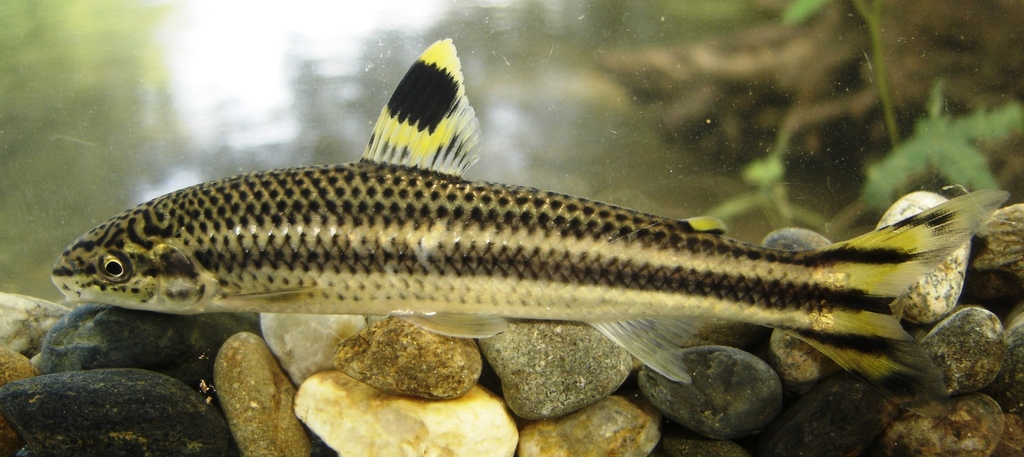
Care at a glance
Species-specific aquarium care
- Tank: At least 60 in long and 24 in front to back for one adult (adults commonly reach about 11.4 in / 28.9 cm).
- Water: Freshwater.
- Temperature: 72–77°F (range recorded for this species).
- pH: 6–6.5.
- Hardness: 0–12 dGH.
- Layout: Uses both the bottom and open water: give open swimming space plus cover near the substrate.
Calculated from this species' own FishBase record: tank size from its typical adult length and swimming zone, water values from its recorded ranges. The group guide below fills in general care.
Care guide
Species care notes
- Tank: a base of at least 83 × 24 in (roughly 200 US gallons); space needed is rated “very large tank”.
- Water: a fairly wide range, from slightly acidic to slightly alkaline, 64–79 °F, pH 5.5–7.5, 1–12 dGH.
- Behaviour: a shoaling fish best kept in a group of six or more; not a community fish.
- Difficulty: Moderate (Seriously Fish rating).
Short excerpts from the species profile:
- Setup: “The aquarium should ideally be designed to resemble a flowing stream or river with a substrate of variably-sized rocks, sand, fine gravel, and some larger water-worn boulders.”
- Diet: “Said to be predominantly herbivorous by nature but quite unfussy in the aquarium and will accept most things offered, although products high in protein are best avoided.”
- Tankmates: “Not recommended for the general community aquarium given its adult size but can be maintained alongside comparably-sized cichlids, catfishes and other species which enjoy similar conditions.”
From the Seriously Fish profile for this species, which has the full habitat, maintenance, diet, behaviour and breeding write-up 167
Headstanders
Applies to most species in this group. Habitat: South American headstanders occupy rivers and floodplain waters, with Anostomus grazing rocky fast-flowing margins and Leporinus fasciatus using channels, tributaries, lakes and flooded forest. Individual species can differ, so compare with the species numbers above and the linked sources.
Housing & setup
- For Anostomus anostomus, at least 120 × 30 cm (48 × 12 in) is the smallest footprint to consider; groups need larger housing.
- For Leporinus fasciatus, provide at least a 210 × 60 cm (84 × 24 in) footprint.
- Fit a secure lid: anostomids are strong jumpers.
- Use sand, smooth rocks and roots or branches; preserve swimming room and expect plants to be eaten.
- Provide mature biological filtration and good oxygenation; Anostomus benefit from water movement and lighting supporting algal grazing.
Climate & lighting
| Water | 68–82°F |
Diet
- For Anostomus, algae wafers and algae growing on solid surfaces.
- Blanched spinach or lettuce, cucumber or courgette.
- Small live or frozen aquatic invertebrates within an omnivorous diet; adjust the plant-to-animal balance to the identified species.
Social life
- A. anostomus can be quarrelsome in small groups: keep one or at least six in a substantially larger tank. Choose robust, suitably sized companions rather than assuming peaceful tetra-like behavior.
Health watch
- Injuries from jumping or territorial aggression.
- Ammonia-related illness in immature aquaria.
- Nutritional deficiencies from an inappropriate diet.
Understanding the animal
In the wild
In the wild
From this species’ own FishBase record (habitat, bottom type, water and breeding data), not its family. Good care copies these conditions.1
| Where it lives | Lives in freshwater, in rivers and streams. Uses both the bottom and open water. Distinct pairs breed on densely grown weedy places. |
| Water it lives in | Freshwater, 72–77 °F (22–25 °C), pH 6–6.5, hardness 12 dH. |
| Climate | Tropical climate. |
| Behavior to plan for | Breeding: nesters. |
What this means for care
- Keep water within its wild range, 72–77 °F.
Native climate (measured)
Native climate (measured)
| Warm-season highs | about 88°F (up to 92°F in the hottest sampled areas) |
| Cool-season lows | about 55°F (down to 49°F in the coldest sampled areas) |
| Average temperature | 69–79°F across sampled records |
| Relative humidity | 72–76% on average (driest month about 64%) |
| Rainfall | about 1503 mm a year |
Measured at 167 wild occurrence records sampled against WorldClim 2.1 climate data (1970–2000 averages). Air conditions in the range are ecological context, not enclosure settings: microhabitats such as burrows, leaf litter or basking rocks can be cooler, warmer or more humid.
From the sources
From the sources
Quoted from the matching sections of reputable sources for this exact species. Specialist databases are used first; Wikipedia (community-edited, CC BY-SA 4.0) only fills gaps. Other sources are short credited quotes.
| Where it lives | Home ranges Population dynamics Growth parameters Max. ages / sizes Length-weight rel. Length-frequencies Mass conversion Recruitment Abundance Life cycle Reproduction Maturity Maturity/Gills rel. — FishBase |
| Reproduction | Distinct pairs breed on densely grown weedy places. — FishBase |
Data and studies
The numbers
The numbers
Each bar is what one source reports. Where several sources weigh in, the dashed gold band marks their average.
Adult length
Common length to maximum recorded length. Measured as standard length (snout to the base of the tail, not counting the tail fin). Fish in home aquariums often stay smaller than wild records.
Water temperature
Range the species tolerates in nature; aim for the middle.
Water hardness
Minimum tank footprint
Seriously Fish recommends a tank base of at least 83 × 24 in (about 200 US gallons).
Sources for this sheet
- FishBase (Froese & Pauly, eds.), version 24.07 Peer-reviewed researchThe global scientific database on fishes, maintained by a consortium of research institutions; every value is referenced.
- Seriously Fish species profiles Experienced keeper or breederLong-running aquarium reference written and peer-checked by experienced fishkeepers and ichthyologists; each profile covers habitat, tank size, water, diet, behaviour and breeding.
- Seriously Fish — anostomus Experienced keeper or breederAdded in the 2026 source-checked care-guide review.
- Seriously Fish — leporinus fasciatus Experienced keeper or breederAdded in the 2026 source-checked care-guide review.
- Merck Veterinary Manual — Disorders and Diseases of Fish Zoo, university or veterinaryAdded in the 2026 source-checked care-guide review.
More headstanders

Banded leporinus
Leporinus fasciatus
Aquarium hobby

Laemolyta taeniata
Laemolyta taeniata
Aquarium hobby

Marbled headstander
Abramites hypselonotus
Aquarium hobby

Red Banded Leporinus
Synaptolaemus latofasciatus
Aquarium hobby

Striped headstander
Anostomus anostomus
Aquarium hobby

Threespot headstander
Pseudanos trimaculatus
Aquarium hobby