Home / Reptiles / Lizards / Leopard gecko
No federal permit to keep In-depth sheetLeopard gecko
Eublepharis macularius
Reptiles › Lizards (Lacertilia) › Eublepharidae (Leopard, banded and cave geckos)
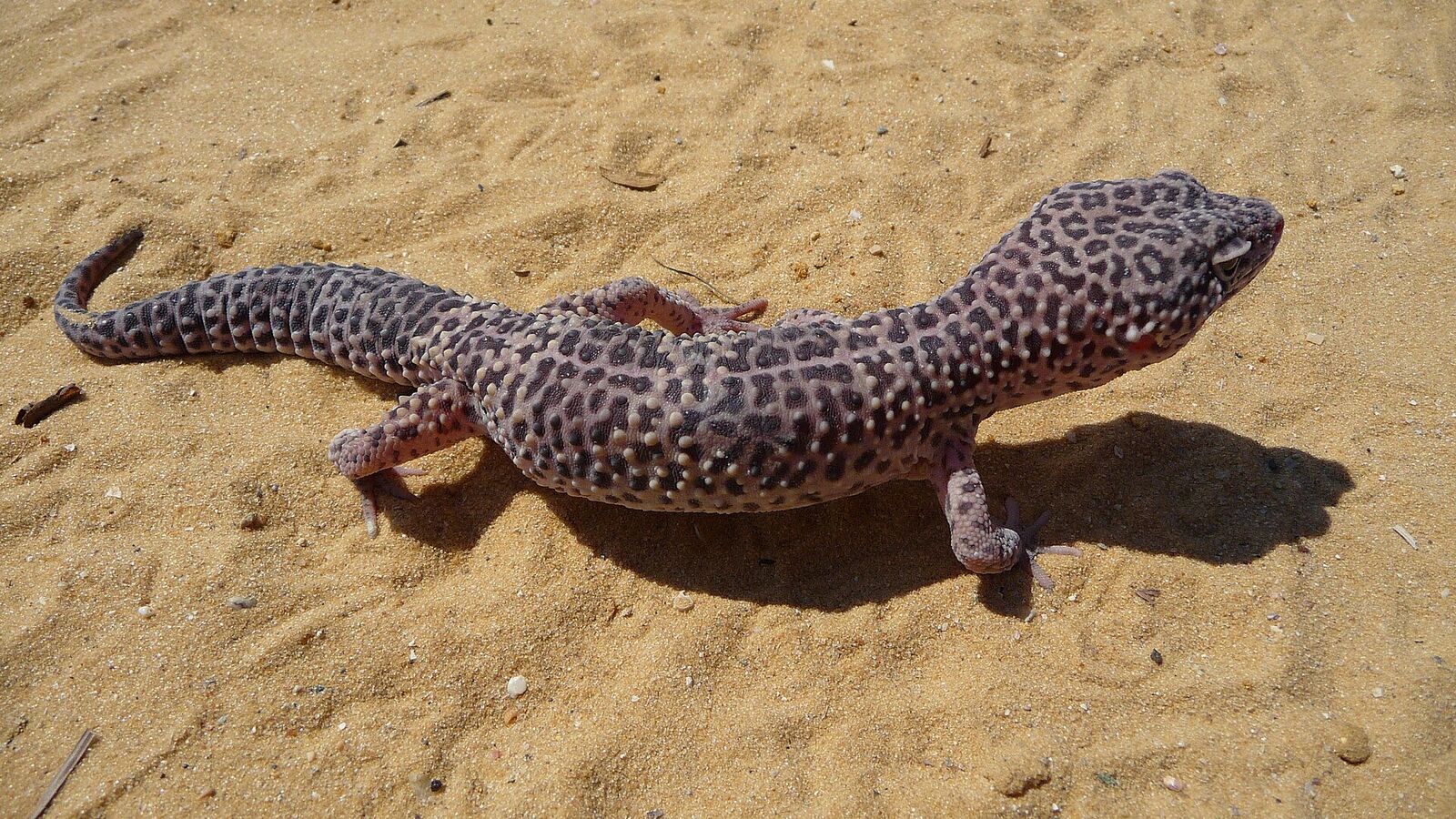
Leopard geckos are small, gentle insect-eaters that are easy to house and handle. Clint's Reptiles scores them 4.4/5.
Care at a glance
Species-specific values
Values researched for this exact species. Where they differ from the group guide below, follow these. Air, surface and water temperatures are listed separately, and each source is kept as published rather than averaged.
| Basking surface temperature | 94–97 °F Wild-type pigmentation for UV; hide measurement not classified as air | 200 |
| Warm hide temperature | 90–92 °F Wild-type pigmentation for UV; hide measurement not classified as air | 200 |
| Cool zone temperature | 70–77 °F Wild-type pigmentation for UV; hide measurement not classified as air | 200 |
| Air temperature night minimum tolerated | 60 °F Wild-type pigmentation for UV; hide measurement not classified as air | 200 |
| Humidity day | 30–40 % RH Wild-type pigmentation for UV; hide measurement not classified as air | 200 |
| Humid hide humidity | 70–80 % RH Wild-type pigmentation for UV; hide measurement not classified as air | 200 |
| Uv index basking | 0.5–1.5 UVI Wild-type pigmentation for UV; hide measurement not classified as air | 200 |
| Uv index basking | 0.5–0.7 UVI Hypopigmented morphs | 200 |
| Enclosure minimum | length: 36 in; width: 18 in; height: 18 in Single adult | 201 |
| Social | Single housing recommended for pet keepers. | 201 |
| Air temperature environmental | approximate: 86 °F VCA describes mid-80s; not a surface temperature or an enclosure-wide mandate | 60 |
| Air temperature night minimum tolerated | 70 °F VCA recommendation; retain separately from ReptiFiles 60°F tolerance | 60 |
| Preferred air temperature zone | 77–86 °F (25–30 °C) Veterinary POTZ; not water or basking surface. | 218 |
| Relative humidity | 20–30 % Veterinary table; corn snake, leopard gecko, bearded dragon and savannah monitor require more humidity during shedding. | 218 |
Care guide
Enclosure
- RVC recommends at least 36×18×18 in; humidity 30–40%; nights no lower than about 68–70°F.
Diet
- Juveniles every 1–2 days, adults 2–3 times a week. Dust insects with calcium and gut-load them for 24 hours.
Sources 60
Show the group care guide for eyelid geckos (leopard, fat-tailed and cave geckos)
Eyelid geckos (leopard, fat-tailed and cave geckos)
Applies to most species in this group. Habitat: Arid scrub to humid forest floor. Individual species can differ, so compare with the species numbers above and the linked sources.
Housing & setup
- Floor space over height; a warm hide, a cool hide and a humid hide.
- For leopard geckos, overhead heating is preferred; any supplemental heat mat must be thermostat-controlled.
Climate & lighting
Starting point only: Leopard and African fat-tailed geckos need substantially different moisture regimes; family-wide values are misleading. Check the species-specific values for this animal where shown.
| Warm side / daytime | 88–92°F |
| Cool side | 72–78°F |
| Humidity | 30–50% |
- UVB: Low-level UVB recommended.
Diet
- Insects (crickets, roaches, mealworms) dusted with calcium and multivitamins.
- Never use loose sand for juveniles; impaction risk.
Health watch
- Hardy. Watch for stuck shed on toes and for weight loss.
- Cave geckos (Goniurosaurus) need cooler, more humid setups than leopard geckos.
Understanding the animal
In the wild
In the wild
Researched for this exact species, not its family. Good care copies these conditions.12345
| Where it lives | Dry and semiarid grassland and scrub from eastern Afghanistan and eastern Iran through Pakistan and northwestern India to Nepal. It shelters beneath rocks and in burrows during daylight. |
| Ground it lives on | Ground-level soil and rocky cover, with burrows and spaces beneath stones. |
| Climate | Arid to semi-arid. Winter temperatures within its range may fall below 50°F, at which point leopard geckos can retreat underground and brumate. Specific wild humidity values and warmer-season temperatures are not provided. |
| Active | Nocturnal; daylight is spent under cover. A verified wild dormancy schedule was not found. |
| Wild diet | Ground-dwelling arthropods, including beetles, spiders, centipedes and scorpions. |
| Behavior to plan for | A terrestrial gecko with claws rather than adhesive toe pads; it can climb rough rocks and branches. It can shed its tail defensively. |
What this means for care
- Prioritize floor space, rock-like refuges and accessible burrowing cover.
- Offer low, rough climbing structures rather than relying on smooth vertical surfaces.
- Use a varied insect diet instead of fruit-based feeding.
- Provide undisturbed daytime shelter and avoid grasping the tail.
Native climate (measured)
Native climate (measured)
| Warm-season highs | about 101°F (up to 106°F in the hottest sampled areas) |
| Cool-season lows | about 43°F (down to 32°F in the coldest sampled areas) |
| Average temperature | 65–80°F across sampled records |
| Relative humidity | 51–59% on average (driest month about 39%) |
| Rainfall | about 424 mm a year, with strong wet and dry seasons |
Measured at 35 wild occurrence records sampled against WorldClim 2.1 climate data (1970–2000 averages). Air conditions in the range are ecological context, not enclosure settings: microhabitats such as burrows, leaf litter or basking rocks can be cooler, warmer or more humid.
Profile
Profile
Researched for this exact species. Sources are listed under In the wild above.
History
Edward Blyth described Eublepharis macularius in 1854. Extensive captive breeding has made it an extremely popular pet, and it has sometimes been described as the first domesticated lizard species.
Keeper tips
- Provide multiple secure terrestrial hides resembling the holes and crevices used in nature.
- Use a ground setup emphasizing packed-earth or rocky characteristics rather than making loose sand the dominant substrate.
- Design for a ground-dwelling animal; leopard geckos lack the adhesive toe structures used by many other geckos to climb vertical surfaces.
- Feed primarily appropriate invertebrate prey in keeping with their predominantly insectivorous wild diet.
- Expect a potentially long-lived pet; captive leopard geckos commonly live about 15-20 years.
Behaviors reported
- Crepuscular activity.
- Retreats underground and brumates during sufficiently cold winter conditions.
- Uses holes, rock crevices, stones, loose bark, and old stone walls as shelters.
- Can voluntarily detach the tail and subsequently regenerate it.
- Females seek damp, humid sites and bury their eggs in substrate.
Unique adaptations
- A spotted pattern provides camouflage among packed earth, rocks, dry grasses, and shrubs.
- The tail can be detached and regenerated.
- Unlike many geckos, leopard geckos have movable eyelids.
- They lack adhesive toe pads and instead have clawed toes.
- They can survive winter brumation underground using stored fat reserves.
Remarkable facts
- Adults are generally about 7-10 in long, with females usually smaller.
- Leopard geckos were first described by Edward Blyth in 1854.
- The genus name Eublepharis refers to the animal's well-developed eyelids.
- Sex is influenced by incubation temperature.
- Captive leopard geckos commonly live about 15-20 years.
- Evidence reported from a 2018 study suggests leopard geckos can regenerate brain cells as well as regenerating their tails.
Stories
- In Pakistan, a documented local superstition claims leopard geckos are associated with the common black cobra and are venomous, with myths claiming their bite can liquefy a victim's body and that their skin is poisonous.
From the sources
From the sources
Quoted from the matching sections of reputable sources for this exact species. Specialist databases are used first; Wikipedia (community-edited, CC BY-SA 4.0) only fills gaps. Other sources are short credited quotes.
| Overview | The leopard gecko or common leopard gecko (Eublepharis macularius) is a ground-dwelling gecko native primarily to the rocky dry grassland and desert regions of Afghanistan, Iran, Pakistan, India, and Nepal. The leopard gecko is a popular pet, and due to extensive captive breeding it is sometimes considered as the first domesticated species of lizard. — Wikipedia (community-edited) |
| Where it lives | Range: E Afghanistan, Pakistan, NW India (Rajasthan, Ajmer, Madar foot hills, Punhab, Jammu), Nepal, E Iran (fide CARRIÓN et al. 2003). — The Reptile Database |
| Wild diet | Leopard geckoes are very adaptable, and are known to eat scorpions, centipedes, spiders, and beetles in the wild (Hunziker 1994). — Animal Diversity Web |
| Behavior | Leopard geckoes are nocturnal, sheltering under rocks or in burrows in daylight (Henkel 1995, Hunziker 1994). — Animal Diversity Web |
| Reproduction | Temperature-dependent sex determination (TSD) (Shine 1999, Shoemaker & Crews 2009). — The Reptile Database |
| Appearance and size | Diagnosis: (Fig. 56 in Anderson 1999: 120) Subdigital lamellae each with several distinct small tubercles (Fig. E in key, Anderson 1999: 117); mid-dorsal tubercles generally larger than intertubercular spaces; chin shields usually in contact with first lower labials (Fig. C in key, page 117); elements of dorsal color pattern not linearly arranged. — The Reptile Database |
| Biology | Wild leopard geckos are generally considered to be nocturnal by field biology sources, academic herpetology sources, and some animal husbandry guides. During the day they retreat to burrows and sheltered hiding spots, becoming active at dusk when the temperature is favorable. — Wikipedia (community-edited) |
| History and naming | From Latin “macul-” (small) spots + Latin -arius connected with, belong to, having (Partridge, 1966). — The Reptile Database |
| Conservation | No information was found on the status of this species in the wild. — Animal Diversity Web |
Data and studies
Researched care notes
Researched care notes
Findings checked against veterinary, zoo, welfare, keeper and peer-reviewed sources. Air, basking-surface and water temperatures are kept separate, and where sources disagree both are shown. “Study” notes report what a paper measured, not a universal rule.
Leopard Gecko (species)
- RSPCA gives a 28–30°C basking zone and a 24–26°C cool end. Its instructions include a digital probe above substrate and surface verification.1
- ReptiFiles separates a 34–36°C basking surface, 32–33°C warm hide, and 21–25°C cool end.2
- Both guides describe approximately 30–40% ambient RH plus a separate humid hide.1
- RSPCA advises supplemental night heat if the room falls below 18°C, using non-light-emitting air heat around 18–20°C. This is conditional night guidance.1
- RSPCA publishes 60 cm length × 30 cm depth × 40 cm height as its minimum for one adult and encourages more space. This single-source minimum is not an established project welfare optimum.1
- Offer varied, appropriately sized feeder invertebrates, with nutritional preparation and supplements matched to the whole feeding and UV plan.1
- Provide clean shallow drinking water and replace it promptly when soiled.1
The numbers
The numbers
Each bar is what one source reports. Where several sources weigh in, the dashed gold band marks their average.
Warm side / basking
Lifespan
Maximum recorded lifespan
Longest recorded lifespan reported by each database; typical lifespans are usually shorter. The AnAge record comes from an animal in human care.
Typical adult weight
Average adult body mass in each database (FishBase gives the maximum recorded weight).
Cool side
Species-specific values from keeper care sheets. Basking figures are often surface readings taken with an infrared thermometer, which run hotter than air.
Night temperature
Species-specific values from keeper care sheets. Basking figures are often surface readings taken with an infrared thermometer, which run hotter than air.
Humidity
Species-specific values from keeper care sheets. Basking figures are often surface readings taken with an infrared thermometer, which run hotter than air.
Care articles for this species
Care articles for this species
- Leopard Gecko Care Guide (ReptiFiles)
- Leopard Gecko Care Sheet (Reptiles Magazine)
- Feeding Your Leopard Gecko (ReptiFiles)
- Environmental Enrichment: Decorating Your Leopard Gecko’s Enclosure (ReptiFiles)
- Choosing a Leopard Gecko Enclosure (ReptiFiles)
- Zoo Med 40 Gallon ReptiHabitat Naturalistic Enclosure Build For Leopard Geckos (Reptiles Magazine)
Veterinary & husbandry research
Veterinary & husbandry research
- Reptile embryology Vickaryous MK et al., Methods in molecular biology (Clifton, N.J.) 2011
- Reptile Embryology and Regeneration Vickaryous MK et al., Methods in molecular biology (Clifton, N.J.) 2019
- Ocular findings in a group of healthy captive leopard geckos Camacho-Luna P et al., Veterinary ophthalmology 2020
- Cryptosporidium varanii infection in leopard geckos (Eublepharis macularius) in Argentina Dellarupe A et al., Open veterinary journal 2016
Peer-reviewed papers that mention this species alongside captivity, zoos, veterinary care or aquaculture. Some cover several species or mention it only in passing, so check the abstract. See all 29 on PubMed → 170
Sources for this sheet
- Royal Veterinary College Exotics Service: Leopard gecko care Zoo, university or veterinaryVet-school exotics hospital factsheet, reviewed 2021–2024.
- VCA Animal Hospitals: Leopard geckos, care Zoo, university or veterinaryLarge veterinary hospital network; vet-written client handouts.
- ReptiFiles: Leopard gecko care Experienced keeper or breederWell-researched care guide.
- Clint's Reptiles (YouTube): Leopard Gecko, The Best Pet Reptile? Expert educator & keeperClint Laidlaw, PhD in Biology Education and MS in Evolutionary Ecology; owner of Clint's Reptile Room and a longtime keeper. Rates each species on handleability, care, hardiness, availability and upfront cost.
- AnAge: The Animal Ageing and Longevity Database (Human Ageing Genomic Resources) Peer-reviewed researchCurated, referenced longevity and life-history records for thousands of species; maximum lifespans are often from zoo animals.
- Myhrvold et al. (2015). An amniote life-history database. Ecology 96: 3109 Peer-reviewed researchPeer-reviewed compilation of life-history data for over 21,000 birds, mammals and reptiles.
- ReptiFiles (care guides) Experienced keeper or breederWell-researched reptile care guides that cite herpetological literature and experienced keepers.
- Merck Veterinary Manual: Management and husbandry of reptiles Zoo, university or veterinaryThe Merck Veterinary Manual: a standard veterinary reference written and reviewed by veterinary specialists.
- Merck Veterinary Manual: Nutritional, metabolic and endocrine diseases of reptiles Zoo, university or veterinaryThe Merck Veterinary Manual: a standard veterinary reference written and reviewed by veterinary specialists.
- ReptiFiles: Leopard gecko lighting, temperatures and humidity Experienced keeper or breederAdded in the 2026 source-checked care-guide review.
- ReptiFiles: African fat-tailed gecko care sheet Experienced keeper or breederAdded in the 2026 source-checked care-guide review.
- Clint's Reptiles (YouTube): Leopard Gecko, The Best Pet Reptile? Expert educator & keeperClint Laidlaw, PhD in Biology Education and MS in Evolutionary Ecology; owner of Clint's Reptile Room and a longtime keeper. His "Best Pet?" series reviews each species' care in depth.
- The Reptile Database Peer-reviewed researchScientist-curated catalog of every reptile species, with taxonomy and literature.
- GBIF Backbone Taxonomy (Global Biodiversity Information Facility) Peer-reviewed researchInternational scientific taxonomy used here for classification.
- Wikipedia (species article) Community referenceFree encyclopedia; useful overviews with their own citations. Intro text is quoted under CC BY-SA 4.0.
- PubMed (U.S. National Library of Medicine) Peer-reviewed researchIndex of peer-reviewed veterinary, zoo and husbandry research.
- iNaturalist (captive observations) Community referenceCommunity observation platform run by the California Academy of Sciences and National Geographic; observations marked captive show animals living in homes, zoos and aquariums.
- Reptiles Magazine (care articles) Experienced keeper or breederEstablished reptile and amphibian hobby magazine; care articles are written by breeders, keepers and veterinarians.
