Home / Fishes / Tetras, piranhas and pacus / Colombian Tetra
No federal permit to keepColombian Tetra
Hyphessobrycon columbianus
Fishes › Tetras, piranhas and pacus (Characiformes) › Characidae (Tetras)
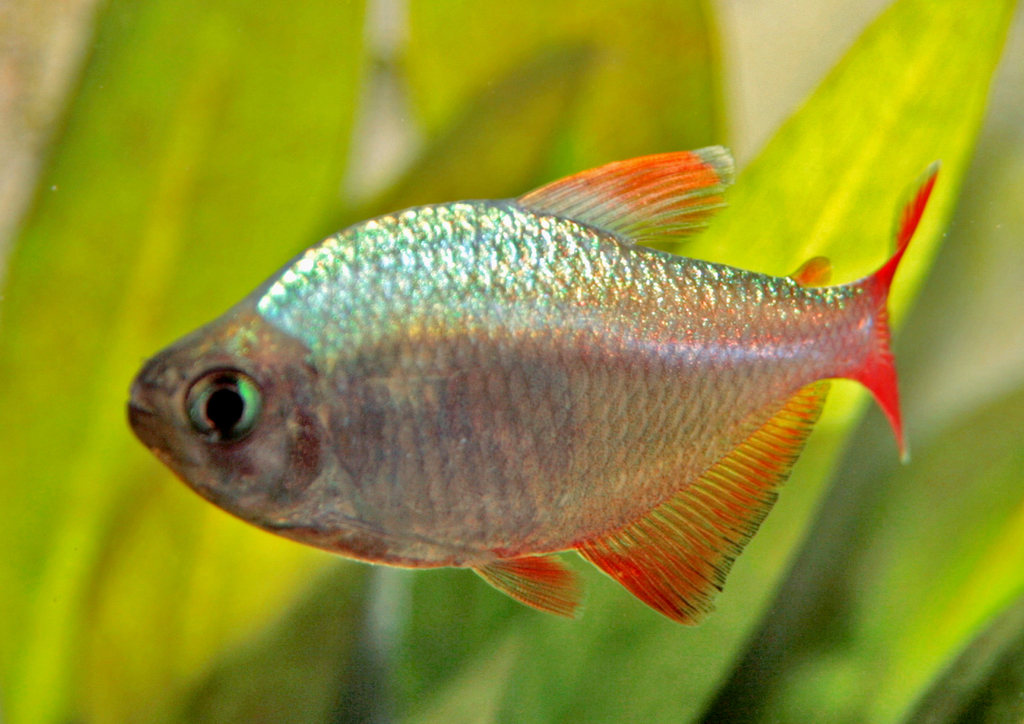
Hyphessobrycon columbianus, the Colombian tetra or blue-red Colombian tetra, is a species of freshwater ray-finned fish belonging to the family Acestrorhamphidae, the American characins.
Care at a glance
Species-specific aquarium care
- Tank: At least 24 in long and 12 in front to back for one adult (adults commonly reach about 2.8 in / 7 cm).
- Water: Freshwater.
- Layout: An open-water swimmer: needs long, open swimming space with few obstacles.
Calculated from this species' own FishBase record: tank size from its typical adult length and swimming zone, water values from its recorded ranges. The group guide below fills in general care.
Care guide
Species care notes
- Tank: a base of at least 35 × 12 in (roughly 21 US gallons); space needed is rated “large tank”.
- Water: a fairly wide range, from slightly acidic to slightly alkaline, 68–82 °F, pH 5–7.5, 1–10 dGH.
- Behaviour: temperament peaceful; a shoaling fish best kept in a group of six or more; suited to a community tank.
- Difficulty: Easy (Seriously Fish rating).
Short excerpts from the species profile:
- Setup: “Choice of décor is not especially critical though it tends to show better colouration in a well-structured, ideally planted, set-up.”
- Diet: “Probably a foraging omnivore feeding primarily on worms, insects and other zooplankton, as well as smaller amounts of plant material and organic detritus in nature.”
- Tankmates: “Generally peaceful making it an ideal resident of the well-researched community aquarium.”
- Breeding: “An egg-scattering free spawner exhibiting no parental care.”
From the Seriously Fish profile for this species, which has the full habitat, maintenance, diet, behaviour and breeding write-up 167
Tetras
Applies to most species in this group. Habitat: The covered characids include South American river and tributary fishes, from vegetation-shaded bloodfin habitats to sandy flowing rivers occupied by Exodon. [fg156-bloodfin, fg156-exodon]. Individual species can differ, so compare with the species numbers above and the linked sources.
Housing & setup
- For glass bloodfins, use at least 60 × 38 × 30 cm (24 × 15 × 12 in), retaining open upper-water swimming space.
- Provide planted margins and floating vegetation for bloodfins; fit a tight lid for Aphyocharax anisitsi.
- For bucktooth tetras use at least 120 × 45 × 45 cm (48 × 18 × 18 in), efficient filtration and planted refuges from bullying.
- For glass bloodfins maintain pH 6.0–7.5; for Exodon, pH 5.5–7.5.
Climate & lighting
| Water | 73.4–80.6°F |
Diet
- Small dried foods for glass and ordinary bloodfins.
- Daphnia, Cyclops and bloodworms for glass bloodfins.
- For Exodon, chopped prawns, mussels, earthworms and fish rather than live feeder fish.
Social life
- Glass bloodfins need 6–8 or more; ordinary bloodfins at least six. Exodon requires a species aquarium and at least 12 introduced together; small groups can kill one another.
Health watch
- Freshwater ich (white spot disease), a general aquarium risk.
- Bacterial infections associated with stress and poor water quality.
- Fin and scale damage from aggression, especially Exodon.
Understanding the animal
About this animal
About this animal
It is native to the Acandi River near Acandí) in northwestern Colombia. The Colombian tetra's habitat tends to be slow-flowing creeks and tributaries.
Quoted from the Wikipedia article “Hyphessobrycon columbianus” (CC BY-SA 4.0) 174
In the wild
In the wild
From this species’ own FishBase record (habitat, bottom type, water and breeding data), not its family. Good care copies these conditions.1
| Where it lives | Lives in freshwater. |
| Water it lives in | Freshwater. |
| Climate | Tropical climate. |
From the sources
From the sources
Quoted from the matching sections of reputable sources for this exact species. Specialist databases are used first; Wikipedia (community-edited, CC BY-SA 4.0) only fills gaps. Other sources are short credited quotes.
| Overview | Hyphessobrycon columbianus, the Colombian tetra or blue-red Colombian tetra, is a species of freshwater ray-finned fish belonging to the family Acestrorhamphidae, the American characins. It is native to the Acandi River near Acandí) in northwestern Colombia. The Colombian tetra's habitat tends to be slow-flowing creeks and tributaries. Only recently introduced to the aquarium trade, it is one of the more expensive tetras. — Wikipedia (community-edited) |
| Where it lives | Home ranges Population dynamics Growth parameters Max. ages / sizes Length-weight rel. Length-frequencies Mass conversion Recruitment Abundance Life cycle Reproduction Maturity Maturity/Gills rel. — FishBase |
| Appearance and size | Growing to about 6.5 cm in total length, the Colombian tetra is silver-grey in colour. It has a turquoise blue tinge of increasing intensity from the lateral line upwards, which becomes a prominent stripe across the anterior dorsal ridge. The fins are predominantly scarlet red but the colour will fade as the fish rests. — Wikipedia (community-edited) |
| History and naming | Prior to 2002, live individuals of Hyphessobrycon columbianus had already been known to aquarium hobbyists and kept in captivity for over five years under the name "blue-red Colombian tetra", but the scientific name of this fish had not been determined. — Wikipedia (community-edited) |
Data and studies
The numbers
The numbers
Each bar is what one source reports. Where several sources weigh in, the dashed gold band marks their average.
Adult length
Maximum recorded length. Measured as total length. Fish in home aquariums often stay smaller than wild records.
Water temperature
Range the species tolerates; aim for the middle.
pH
Water hardness
Minimum tank footprint
Seriously Fish recommends a tank base of at least 35 × 12 in (about 21 US gallons).
Sources for this sheet
- FishBase (Froese & Pauly, eds.), version 24.07 Peer-reviewed researchThe global scientific database on fishes, maintained by a consortium of research institutions; every value is referenced.
- Seriously Fish species profiles Experienced keeper or breederLong-running aquarium reference written and peer-checked by experienced fishkeepers and ichthyologists; each profile covers habitat, tank size, water, diet, behaviour and breeding.
- Seriously Fish: Prionobrama filigera Experienced keeper or breederAdded in the 2026 source-checked care-guide review.
- Seriously Fish: Exodon paradoxus Experienced keeper or breederAdded in the 2026 source-checked care-guide review.
- Seriously Fish: Aphyocharax anisitsi Experienced keeper or breederAdded in the 2026 source-checked care-guide review.
- Merck Veterinary Manual: Disorders and Diseases of Fish Zoo, university or veterinaryAdded in the 2026 source-checked care-guide review.
- Wikipedia (species article) Community referenceFree encyclopedia; useful overviews with their own citations. Intro text is quoted under CC BY-SA 4.0.
More tetras

Axelrodia stigmatias
Axelrodia stigmatias
Aquarium hobby

Black neon tetra
Hyphessobrycon herbertaxelrodi
Aquarium hobby

Black phantom tetra
Hyphessobrycon megalopterus
Aquarium hobby

Black tetra
Gymnocorymbus ternetzi
Aquarium hobby

Blackline penguinfish
Thayeria boehlkei
Aquarium hobby

Bleeding heart tetra
Hyphessobrycon erythrostigma
Aquarium hobby