Home / Mammals / Hedgehogs / Four-toed (African pygmy) hedgehog
No federal permit to keep In-depth sheetFour-toed (African pygmy) hedgehog
Atelerix albiventris
Mammals › Hedgehogs (Erinaceomorpha) › Erinaceidae (Hedgehogs)
African pygmy hedgehogs are solitary insectivores that need warmth and a carefully portioned diet to avoid obesity.
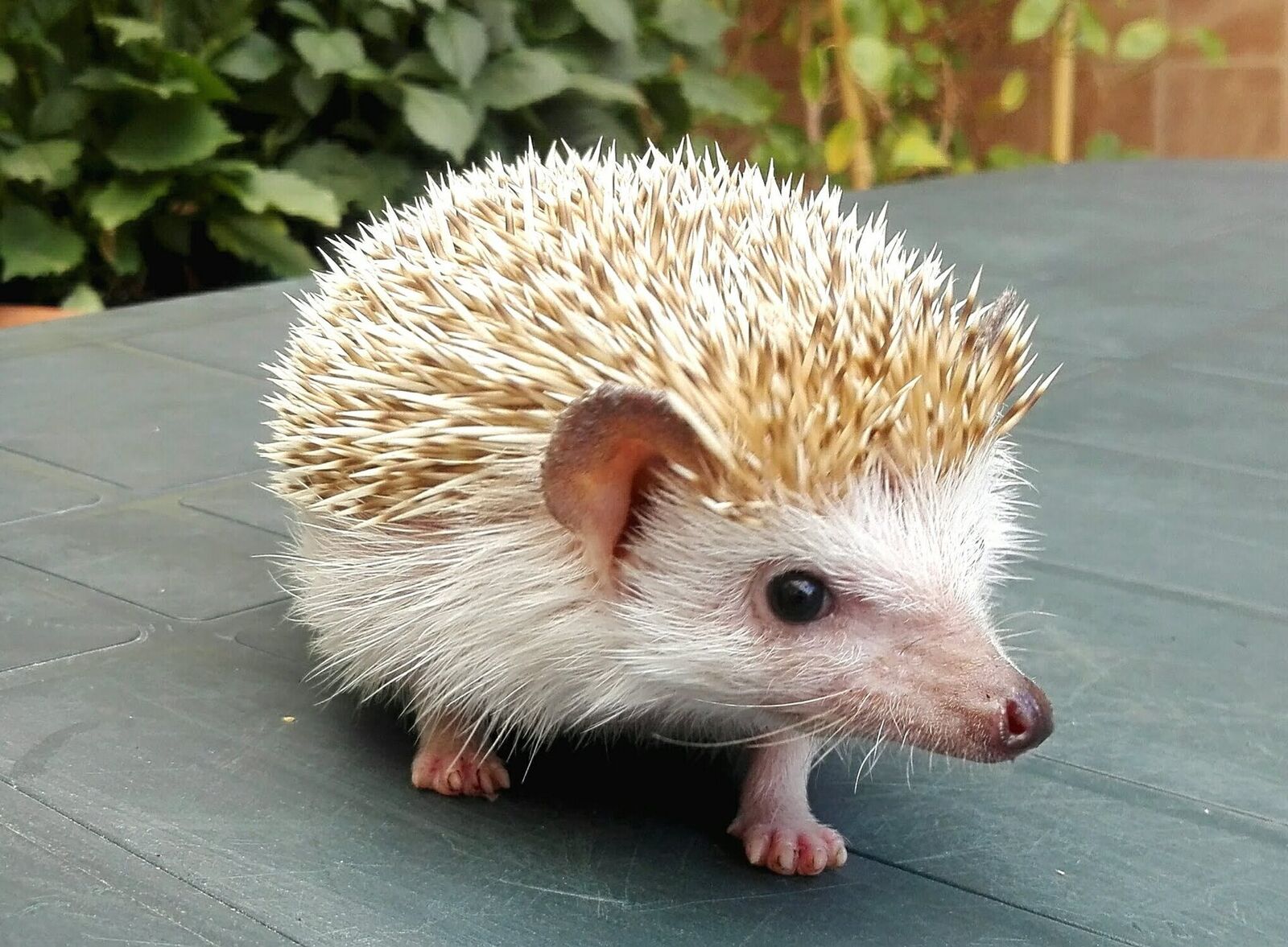
Care at a glance
Species-specific values
Values researched for this exact species. Where they differ from the group guide below, follow these. Air, surface and water temperatures are listed separately, and each source is kept as published rather than averaged.
| Lifespan typical captive | 4–6 years | 296 |
| Adult body mass male | 400–600 g | 296 |
| Adult body mass female | 300–400 g | 296 |
| Diet nutrient profile | crude protein: 22 %; fat: 5 %; acid detergent fibre or chitin: 15 % Suggested dietary profile in the veterinary source; use a complete balanced diet. Percent basis is not explicitly specified. | 303 |
Care guide
Diet
- Each night: about 2 tablespoons of dry reduced-calorie cat food plus 1–2 tablespoons of mixed vegetables with a vitamin/mineral powder.
- Several times a week: 3–5 insects or a teaspoon of egg or meat.
Sources 28
Housing
- House individually; they're solitary.
Sources 28
Show the group care guide for hedgehogs
Hedgehogs
Applies to most species in this group. Habitat: Savanna, steppe and woodland. Individual species can differ, so compare with the species numbers above and the linked sources.
Housing & setup
- A large enclosure with a solid wheel, hide and soft bedding; keep warm (72–80 °F) to prevent hibernation attempts.
Diet
- Hedgehog or quality low-fat cat food plus insects; avoid obesity.
Social life
- Solitary.
Health watch
- Obesity, wobbly hedgehog syndrome, dental disease and tumors.
Understanding the animal
In the wild
In the wild
Researched for this exact species, not its family. Good care copies these conditions.123
| Where it lives | Sub-Saharan African savanna, steppe, scrub and open woodland, from western Africa through eastern Africa. It forages at ground level and shelters in burrows or protective vegetation. |
| Ground it lives on | Soil beneath grass, scrub and scattered woodland cover, with sheltered burrows. |
| Climate | Seasonal tropical savanna conditions; eastern African records show reduced visibility during the height of the dry season and more observations during rainy periods. Numeric wild temperature and relative-humidity ranges were not established. |
| Active | Nocturnal; aestivation or cold-related dormancy is reported, but field timing is poorly quantified in the sources used. |
| Social life | Solitary; individuals usually keep their distance and are not described as strongly territorial. |
| Wild diet | Termites, beetles, earthworms, millipedes, ants, grasshoppers, slugs and other invertebrates; also small vertebrates, eggs and some plant matter. |
| Behavior to plan for | Searches widely at night and digs for prey. It rolls into a protective spiny ball and may self-anoint with frothy saliva after encountering unfamiliar odors. |
What this means for care
- Provide individual housing with a secluded daytime nest.
- Include ground-level exercise and insect-search enrichment.
- Base feeding on its predominantly invertebrate-eating ecology.
- Avoid assuming the winter dormancy pattern of European hedgehogs applies.
Native climate (measured)
Native climate (measured)
| Warm-season highs | about 88°F (up to 91°F in the hottest sampled areas) |
| Cool-season lows | about 57°F (down to 48°F in the coldest sampled areas) |
| Average temperature | 66–79°F across sampled records |
| Relative humidity | 67–78% on average (driest month about 64%) |
| Rainfall | about 840 mm a year, with strong wet and dry seasons |
Measured at 64 wild occurrence records sampled against WorldClim 2.1 climate data (1970–2000 averages). Air conditions in the range are ecological context, not enclosure settings: microhabitats such as burrows, leaf litter or basking rocks can be cooler, warmer or more humid.
Profile
Profile
Researched for this exact species. Sources are listed under In the wild above.
History
The four-toed hedgehog is native to a broad portion of Africa and is also widely known as the African pygmy hedgehog. it has become a popular small pet and has been successfully domesticated and bred in captivity.
Keeper tips
- Expect a threatened animal to curl into a tight defensive ball and erect its quills.
- Recognize that relaxed quills normally lie flat against the body.
- Account for the species' primarily solitary natural history when considering social housing.
- Do not assume the presence of five hind toes; the species typically has four toes on each hind foot.
Behaviors reported
- Rolls into a compact ball when threatened.
- Forces the quills outward during its defensive curl.
- Normally keeps the quills flat against the body when relaxed.
- Typically encounters the opposite sex for mating rather than living as a continuously social species.
Unique adaptations
- Muscles allow the animal to roll into a compact defensive ball.
- Spines project outward in all directions when the animal curls defensively.
- Relatively large ears and whiskers are described as implying well-developed senses.
- The hind feet typically have only four toes and lack the hallux.
Remarkable facts
- Adults are approximately 8.3 inches long and weigh about 250 to 600 grams.
- Typical wild animals have brown or gray spines with white or cream-colored tips.
- The species usually has four toes on each hind foot.
- It is rated Least Concern by the IUCN because of its extensive range and stable wild population.
- It is a popular small pet in various countries and has been successfully domesticated and bred in captivity.
From the sources
From the sources
Quoted from the matching sections of reputable sources for this exact species. Specialist databases are used first; Wikipedia (community-edited, CC BY-SA 4.0) only fills gaps. Other sources are short credited quotes.
| Overview | The four-toed hedgehog (Atelerix albiventris), also known as the African pygmy hedgehog, is a species of hedgehog found throughout much of central and eastern Africa. Populations tend to be scattered between suitable savannah or cropland habitats, avoiding forested areas. The species common name is derived from the number of toes found on its hind feet. Due to its extensive range and stable wild population, the species is rated as least concern by the IUCN. — Wikipedia (community-edited) |
| Where it lives | The four-toed hedgehog is found across a wide swathe of central Africa, from Gambia and Senegal in the west, to Somalia in the east, and also in eastern Africa, as far south as Mozambique. It prefers grassy environments or open woodland, and is found at elevations as high as 2000 m, although it is more common in lowland areas. — Wikipedia (community-edited) |
| Wild diet | Atelerix albiventris is omnivorous but primarily insectivorous. — Animal Diversity Web |
| Behavior | The African pygmy hedgehog is a solitary animal. — Animal Diversity Web |
| Reproduction | Atelerix albiventris generally breeds once or twice a year. — Animal Diversity Web |
| Appearance and size | A relaxed Atelerix albiventris has a generally oval shape. — Animal Diversity Web |
| History and naming | The four-toed hedgehog is one of the most popular species of domesticated hedgehog sold in the exotic pet trade. It is bred extensively for color and temperament and is even displayed in competitive hedgehog shows. Lifespan is typically 4–6 years. — Wikipedia (community-edited) |
| Conservation | In addition to the wild animals found in African deserts, a closed breeding stock exists in the United States to service the pet trade market. — Animal Diversity Web |
Data and studies
Researched care notes
Researched care notes
Findings checked against veterinary, zoo, welfare, keeper and peer-reviewed sources. Air, basking-surface and water temperatures are kept separate, and where sources disagree both are shown. “Study” notes report what a paper measured, not a universal rule.
African Pygmy Hedgehog
- VCA recommends individual housing for pet African hedgehogs rather than routine cohabitation.1
- Enclosure-air disagreement: Merck identifies 24–29°C as optimal within a broader 22–32°C range, while VCA gives 21–29°C and warns of heatstroke above 29°C; do not use 32°C as a routine target.2,1
- Provide an exercise wheel with a solid running surface, because wire wheels can trap the legs.2
- Merck favors a commercially prepared hedgehog or insectivore diet, with suitable low-fat cat food as an alternative rather than an insect-only ration.2
- Ration adult food and weigh the hedgehog weekly; obesity management depends on weight and activity rather than unrestricted kibble.2
Insectivorous Small Mammals (feeding group)
Researched for this whole family or group; check species differences before applying.
- The reference discusses suitable complete insectivore feeds and invertebrates; match the ration to the actual taxon. Hedgehogs, armadillos, and aardvarks do not share one interchangeable recipe.3
The numbers
The numbers
Each bar is what one source reports. Where several sources weigh in, the dashed gold band marks their average.
Room temperature
Keep out of direct sunlight.
Maximum recorded lifespan
Longest recorded lifespan reported by each database; typical lifespans are usually shorter. The AnAge record comes from an animal in human care.
Typical adult weight
Average adult body mass in each database (FishBase gives the maximum recorded weight).
Veterinary & husbandry research
Veterinary & husbandry research
- Feeding behavior and nutrition of the african pygmy hedgehog (Atelerix albiventris) Dierenfeld ES et al., The veterinary clinics of North America. Exotic animal practice 2009
- The Pathology of Wobbly Hedgehog Syndrome Díaz-Delgado J et al., Veterinary pathology 2018
- Comprehensive Surveillance of Virus Infection among Captive African Pygmy Hedgehogs in Japan Koizumi I et al., Viruses 2022
- A retrospective study of disease incidence in African pygmy hedgehogs (Atelerix albiventris) Okada K et al., The Journal of veterinary medical science 2018
Peer-reviewed papers that mention this species alongside captivity, zoos, veterinary care or aquaculture. Some cover several species or mention it only in passing, so check the abstract. See all 49 on PubMed → 170
Sources for this sheet
- Royal Veterinary College Exotics Service: African pygmy hedgehog care Zoo, university or veterinaryVet-school exotics hospital factsheet, reviewed 2021–2024.
- AnAge: The Animal Ageing and Longevity Database (Human Ageing Genomic Resources) Peer-reviewed researchCurated, referenced longevity and life-history records for thousands of species; maximum lifespans are often from zoo animals.
- Myhrvold et al. (2015). An amniote life-history database. Ecology 96: 3109 Peer-reviewed researchPeer-reviewed compilation of life-history data for over 21,000 birds, mammals and reptiles.
- 9 CFR 2.1: Animal Welfare Act licensing (USDA) Zoo, university or veterinaryWho needs a USDA license to breed, sell or exhibit animals.
- Merck Veterinary Manual: Management of four-toed hedgehogs Zoo, university or veterinaryThe Merck Veterinary Manual: a standard veterinary reference written and reviewed by veterinary specialists.
- MSD Veterinary Manual: Overview of Four-Toed (African Pygmy) Hedgehogs Zoo, university or veterinaryAdded in the 2026 source-checked care-guide review.
- Clint's Reptiles (YouTube): Hedgehog, The Best Pet Mammal? Expert educator & keeperClint Laidlaw, PhD in Biology Education and MS in Evolutionary Ecology; owner of Clint's Reptile Room and a longtime keeper. His "Best Pet?" series reviews each species' care in depth.
- GBIF Backbone Taxonomy (Global Biodiversity Information Facility) Peer-reviewed researchInternational scientific taxonomy used here for classification.
- Wikipedia (species article) Community referenceFree encyclopedia; useful overviews with their own citations. Intro text is quoted under CC BY-SA 4.0.
- PubMed (U.S. National Library of Medicine) Peer-reviewed researchIndex of peer-reviewed veterinary, zoo and husbandry research.
- iNaturalist (captive observations) Community referenceCommunity observation platform run by the California Academy of Sciences and National Geographic; observations marked captive show animals living in homes, zoos and aquariums.