Home / Reptiles / Lizards / Green iguana
Some federal rules apply In-depth sheetGreen iguana
Iguana iguana
Reptiles › Lizards (Lacertilia) › Iguanidae (Iguanas)
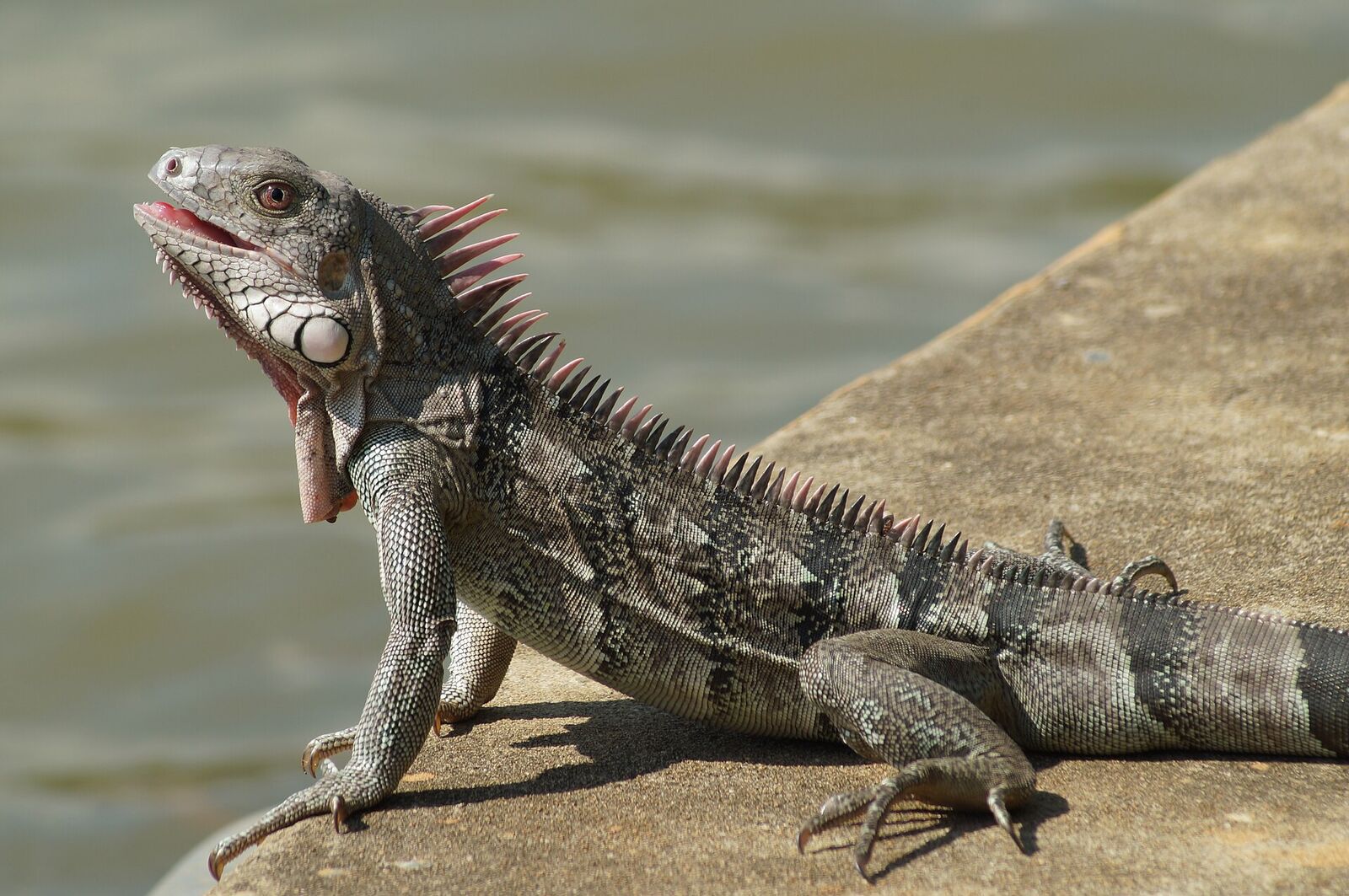
Green iguanas grow to about 6 feet and can live 20+ years. They're strict herbivores and among the most common rescue reptiles; Clint's Reptiles scores them 2.6/5.
Care at a glance
Species-specific values
Values researched for this exact species. Where they differ from the group guide below, follow these. Air, surface and water temperatures are listed separately, and each source is kept as published rather than averaged.
| Preferred air temperature zone | 84–91 °F (29–33 °C) Veterinary POTZ; not water or basking surface. | 218 |
| Relative humidity | 60–85 % Veterinary table; corn snake, leopard gecko, bearded dragon and savannah monitor require more humidity during shedding. | 218 |
| Minimum enclosure dimensions | length: 10 ft; width: 5 ft; height: 6 ft One adult; secure climbing structures. | 228 |
| Basking surface temperature | 120 °F Approximate RF surface target, not air temperature. | 228 |
| Day air temperature | 75–88 °F | 228 |
| Night air temperature | 73–84 °F | 228 |
| Day relative humidity | 60–80 % | 228 |
| Night relative humidity | up to 100 % Nighttime peak. | 228 |
| Diet composition | leafy greens: 60 %; other vegetables: 30 %; fruit: 10 % RF offered-diet proportions; basis not specified; not transferable to all herbivorous reptiles. | 228 |
Care guide
Diet
- Leafy greens and plants, high in calcium and low in phosphorus. Iguanas are herbivores at every age; don't feed insects or other animal protein.
Sources 79
Housing
- Tall, arboreal enclosure with basking perches; adults need room-sized space.
Sources 79
Show the group care guide for iguanas
Iguanas
Applies to most species in this group. Habitat: Tropical forest to dry islands. Individual species can differ, so compare with the species numbers above and the linked sources.
Housing & setup
- For one adult Iguana iguana, RF recommends at least 10 x 5 x 6 ft with secure climbing structures; increase space where possible.
- Strong UVB and a hot basking area.
Climate & lighting
Starting point only: Separates basking surface from air; source alternatives are retained in overrides. Check the species-specific values for this animal where shown.
| Basking spot | 95–100°F |
| Warm side / daytime | 85–90°F |
| Cool side | 75–80°F |
| Humidity | 50–70% |
- UVB: Required (strong).
Diet
- Strict herbivores: dark leafy greens, vegetables and some fruit. No animal protein.
Health watch
- MBD, kidney disease from protein-rich diets, and tail or claw injuries.
- Adult males can become aggressive during breeding season.
Understanding the animal
In the wild
In the wild
Researched for this exact species, not its family. Good care copies these conditions.12345
| Where it lives | Tropical forests and wooded river margins in Central and South America. Adults use high canopy branches, often above water; juveniles occupy lower vegetation. |
| Ground it lives on | Mostly arboreal; females descend to dig nests in sunlit soil. |
| Climate | Tropical conditions with wet and dry seasons; breeding commonly occurs in the dry season and hatching in the wet season. Species-wide wild air-temperature and relative-humidity ranges were not established in these sources. |
| Active | Diurnal; basks to warm before feeding. |
| Social life | Adults defend access to basking sites; males are especially territorial during breeding. Juveniles may associate in small groups. |
| Wild diet | Primarily leaves, flowers and fruit; occasional invertebrates or carrion are reported. |
| Behavior to plan for | Climbs and escapes predators by diving from branches into water. A restrained animal may bite, twist or whip its tail. |
What this means for care
- Provide an adult-sized canopy of strong branches and elevated basking perches.
- Base the diet on leafy vegetation rather than generic omnivorous-lizard feeding.
- Provide deep digging space for egg-laying females.
- Allow visual separation and retreat from territorial animals.
Native climate (measured)
Native climate (measured)
| Warm-season highs | about 90°F (up to 92°F in the hottest sampled areas) |
| Cool-season lows | about 64°F (down to 58°F in the coldest sampled areas) |
| Average temperature | 75–80°F across sampled records |
| Relative humidity | 72–79% on average (driest month about 71%) |
| Rainfall | about 1525 mm a year |
Measured at 109 wild occurrence records sampled against WorldClim 2.1 climate data (1970–2000 averages). Air conditions in the range are ecological context, not enclosure settings: microhabitats such as burrows, leaf litter or basking rocks can be cooler, warmer or more humid.
Profile
Profile
Researched for this exact species. Sources are listed under In the wild above.
History
Iguana iguana was formally described by Carl Linnaeus in 1758. Numerous regional forms were later treated as subspecies, although subsequent genetic work complicated or rejected several of those classifications and revealed deep genetic divisions between some populations.
Keeper tips
- Plan for an exceptionally large adult rather than the much smaller juvenile sold in the pet trade.
- Provide substantial climbing and elevated space to accommodate the species' arboreal behavior.
- Do not underestimate lighting and heating requirements; the sources specifically identify adequate space, lighting, and heat as difficult requirements for many hobbyists to meet.
- Expect a long commitment: captive green iguanas can live 15-20+ years.
- Consider adoption from a reptile rescue, as one cited care source specifically recommends this because many purchased iguanas eventually outgrow what their keepers can provide.
Behaviors reported
- Lives and basks high in trees.
- Excellent swimmer that can dive underwater to avoid predators.
- Females descend from the canopy to dig burrows for egg laying.
- Juveniles tend to occupy lower canopy levels than mature animals.
Unique adaptations
- Strong limbs, long toes, and a long muscular tail accompany its arboreal lifestyle.
- The species has undergone significant locomotor adaptations associated with its herbivorous diet.
- It has significant osmoregulatory adaptations associated with its herbivorous diet.
- Swimming and underwater diving provide an escape response against predators.
Remarkable facts
- Green iguanas may reach around 6-7 ft in large males, while females rarely exceed about 5 ft.
- Some specimens have exceeded 2 m in total length and 9 kg in body weight.
- Adult coloration can include gray-green, brown-green, bright green, orange, red, yellow, blue, or combinations of these colors.
- The species is native from Mexico through Central America and much of South America and has also been introduced to places including Florida, Hawaii, Taiwan, Singapore, and Thailand.
- It is highly invasive in many tropical and subtropical environments.
- Green iguanas can live 15-20+ years in captivity.
From the sources
From the sources
Quoted from the matching sections of reputable sources for this exact species. Specialist databases are used first; Wikipedia (community-edited, CC BY-SA 4.0) only fills gaps. Other sources are short credited quotes.
| Overview | The green iguana (Iguana iguana), also known as the American iguana or the common green iguana, is a large, arboreal, mostly herbivorous species of lizard of the genus Iguana. Usually, this animal is simply called the iguana. The green iguana ranges over a large geographic area; it is native from southern Brazil and Paraguay as far north as Mexico. It is highly invasive in many subtropical and tropical environments throughout the world. — Wikipedia (community-edited) |
| Where it lives | Green Iguanas are arboreal lizards that live high in the tree canopy. — Animal Diversity Web |
| Reproduction | Iguana delicatissima and I. iguana hybridize in nature (Breuil et al. 2009). — The Reptile Database |
| Appearance and size | Diagnosis (genus): differs from all other iguanid genera in possessing the following combination of character states: a) large ventral process of squamosal abuts dorsal edge of tympanic crest of quadrate, b) cristae ventrolaterales of parabasisphenoid barely constricted behind basipterygoid processes, c) crowns of posterior marginal teeth serrate, with numerous small accessory cusps, d) entire pterygoid tooth patch double ontogenetically, e) posterolateral processes of pleurapophyses of second sacral vertebra absent, f) thin midsaggital processes on anterodorsal surfaces of caudal centra relatively small and confined to anterior fifth of caudal sequence, g) coeliac artery arises posterior to mesenteric arteries, between mesenteric arteries, or continuous with mesenteric arteries rather than anterior to them, h) snout covered by large, platelike scales, i) large dewlap present, k) gular crest of enlarged scales present (John Iverson et al., pers. comm.). — The Reptile Database |
| History and naming | The species was first officially described by Swedish botanist Carl Linnaeus in 1758. Since then, numerous subspecies have been identified, but later classified as merely regional variants of the same species. Using nuclear and mitochondrial DNA-sequence data to explore the phylogenic history of the green iguana, scientists from El Salvador, Mexico, and the United States studied animals collected from 17 countries. — Wikipedia (community-edited) |
Data and studies
The numbers
The numbers
Each bar is what one source reports. Where several sources weigh in, the dashed gold band marks their average.
Active temperature range
Maximum recorded lifespan
Longest recorded lifespan reported by each database; typical lifespans are usually shorter. The AnAge record comes from an animal in human care.
Typical adult weight
Average adult body mass in each database (FishBase gives the maximum recorded weight).
Incubation
Night temperature
Species-specific values from keeper care sheets. Basking figures are often surface readings taken with an infrared thermometer, which run hotter than air.
Humidity
Species-specific values from keeper care sheets. Basking figures are often surface readings taken with an infrared thermometer, which run hotter than air.
Basking spot
Species-specific values from keeper care sheets. Basking figures are often surface readings taken with an infrared thermometer, which run hotter than air.
Daytime air temperature
Species-specific values from keeper care sheets. Basking figures are often surface readings taken with an infrared thermometer, which run hotter than air.
Care articles for this species
Care articles for this species
- Green Iguana Care Sheet (ReptiFiles)
- Green Iguana Care Sheet (Reptiles Magazine)
- Caring For The Green Iguana (Reptiles Magazine)
- Green Iguana Care (Reptiles Magazine)
Veterinary & husbandry research
Veterinary & husbandry research
- Green iguana nephrology: a review of diagnostic techniques Hernandez-Divers SJ et al., The veterinary clinics of North America. Exotic animal practice 2003
- Isolation and identification of mycobacteria from captive reptiles Ebani VV et al., Research in veterinary science 2012
- Growth of juvenile green iguanas (Iguana iguana) fed four diets Donoghue S et al., The Journal of nutrition 1994
- Treatment of cryptosporidiosis in captive green iguanas (Iguana iguana) Gałęcki R et al., Veterinary parasitology 2018
Peer-reviewed papers that mention this species alongside captivity, zoos, veterinary care or aquaculture. Some cover several species or mention it only in passing, so check the abstract. See all 63 on PubMed → 170
Sources for this sheet
- Animal Diversity Web (University of Michigan): Iguana iguana Zoo, university or veterinaryUniversity-hosted species account, mostly wild biology.
- Clint's Reptiles (YouTube): Green Iguana, The Best Pet Lizard? Expert educator & keeperClint Laidlaw, PhD in Biology Education and MS in Evolutionary Ecology; owner of Clint's Reptile Room and a longtime keeper. Rates each species on handleability, care, hardiness, availability and upfront cost.
- AnAge: The Animal Ageing and Longevity Database (Human Ageing Genomic Resources) Peer-reviewed researchCurated, referenced longevity and life-history records for thousands of species; maximum lifespans are often from zoo animals.
- Myhrvold et al. (2015). An amniote life-history database. Ecology 96: 3109 Peer-reviewed researchPeer-reviewed compilation of life-history data for over 21,000 birds, mammals and reptiles.
- ReptiFiles (care guides) Experienced keeper or breederWell-researched reptile care guides that cite herpetological literature and experienced keepers.
- Reptiles Magazine (care articles) Experienced keeper or breederEstablished reptile and amphibian hobby magazine; care articles are written by breeders, keepers and veterinarians.
- Species+ (UNEP-WCMC and the CITES Secretariat) Zoo, university or veterinaryThe official database of species listed under CITES.
- USFWS International Affairs: CITES Zoo, university or veterinaryFederal agency that issues CITES permits.
- Merck Veterinary Manual: Management and husbandry of reptiles Zoo, university or veterinaryThe Merck Veterinary Manual: a standard veterinary reference written and reviewed by veterinary specialists.
- Merck Veterinary Manual: Nutritional, metabolic and endocrine diseases of reptiles Zoo, university or veterinaryThe Merck Veterinary Manual: a standard veterinary reference written and reviewed by veterinary specialists.
- ReptiFiles: Green iguana care sheet Zoo, university or veterinaryAdded in the 2026 source-checked care-guide review.
- Merck Veterinary Manual: Important Husbandry Requirements for Selected Reptiles Zoo, university or veterinaryAdded in the 2026 source-checked care-guide review.
- Clint's Reptiles (YouTube): Green Iguana, The Best Pet Lizard? Expert educator & keeperClint Laidlaw, PhD in Biology Education and MS in Evolutionary Ecology; owner of Clint's Reptile Room and a longtime keeper. His "Best Pet?" series reviews each species' care in depth.
- The Reptile Database Peer-reviewed researchScientist-curated catalog of every reptile species, with taxonomy and literature.
- GBIF Backbone Taxonomy (Global Biodiversity Information Facility) Peer-reviewed researchInternational scientific taxonomy used here for classification.
- Wikipedia (species article) Community referenceFree encyclopedia; useful overviews with their own citations. Intro text is quoted under CC BY-SA 4.0.
- PubMed (U.S. National Library of Medicine) Peer-reviewed researchIndex of peer-reviewed veterinary, zoo and husbandry research.
- iNaturalist (captive observations) Community referenceCommunity observation platform run by the California Academy of Sciences and National Geographic; observations marked captive show animals living in homes, zoos and aquariums.