Home / Fishes / Gouramis, bettas, snakeheads / Giant gourami
No federal permit to keepGiant gourami
Osphronemus goramy
Fishes › Gouramis, bettas, snakeheads (Anabantiformes) › Osphronemidae (Gouramis and bettas)
The giant gourami (Osphronemus goramy) is a species of large gourami native to freshwater habitats in Southeast Asia.

Care at a glance
Species-specific aquarium care
- Tank: At least 90 in long and 36 in front to back for one adult (adults commonly reach about 17.7 in / 45 cm; the largest recorded was 27.6 in).
- Water: Freshwater (tolerates brackish).
- Temperature: 68–86°F (range recorded for this species).
- pH: 6.5–8.
- Hardness: 0–25 dGH.
- Layout: Uses both the bottom and open water: give open swimming space plus cover near the substrate.
- Diet: A grazer on plants and algae: base the diet on vegetable foods (algae wafers, blanched vegetables, spirulina). FishBase classes it as a herbivore.
Calculated from this species' own FishBase record: tank size from its typical adult length and swimming zone, water values from its recorded ranges. The group guide below fills in general care.
Care guide
Species care notes
- Tank: a base of at least 72 × 24 in (roughly 180 US gallons); space needed is rated “very large tank”.
- Water: a fairly wide range, from slightly acidic to slightly alkaline, 68–86 °F, pH 6.5–8, 5–25 dGH.
- Behaviour: temperament predatory.
- Difficulty: Moderate (Seriously Fish rating).
Short excerpts from the species profile:
- Setup: “Provide hiding places in the form of robust large rocks and bogwood.”
- Tankmates: “Will eat smaller fish but is generally peaceful with other large fish.”
- Breeding: “Relatively easy but a truly huge tank is required to breed fully grown adults.”
From the Seriously Fish profile for this species, which has the full habitat, maintenance, diet, behaviour and breeding write-up 167
Gouramis and labyrinth fish
Applies to most species in this group. Habitat: Warm, still, vegetated waters. Individual species can differ, so compare with the species numbers above and the linked sources.
Housing & setup
- Planted, calm tanks with floating plants; they breathe air at the surface, so leave a gap under the lid.
Diet
- Food acceptance is species-specific. Parosphromenus deissneri needs tiny live invertebrate foods and commonly refuses dried foods; a pellet/flake staple cannot cover every labyrinth fish.
Health watch
- Males are territorial; dwarf gourami iridovirus.
Understanding the animal
About this animal
About this animal
It has also been introduced elsewhere. The species is commercially important as a food fish and is also farmed.
Quoted from the Wikipedia article “Giant gourami” (CC BY-SA 4.0) 174
In the wild
In the wild
From this species’ own FishBase record (habitat, bottom type, water and breeding data), not its family. Good care copies these conditions.1
| Where it lives | Lives in freshwater and brackish water, in rivers and streams, lakes, rice paddies. Uses both the bottom and open water. Inhabits swamps, lakes and rivers. |
| Water it lives in | Freshwater / brackish water, 68–86 °F (20–30 °C), pH 6.5–8, hardness 25 dH. |
| Climate | Tropical climate. |
| Wild diet | Grazing on aquatic plants. |
| Behavior to plan for | Breeding: nesters. |
What this means for care
- Keep water within its wild range, 68–86 °F.
- It tolerates or needs brackish water; check salinity needs before setup.
Native climate (measured)
Native climate (measured)
| Warm-season highs | about 90°F (up to 96°F in the hottest sampled areas) |
| Cool-season lows | about 70°F (down to 62°F in the coldest sampled areas) |
| Average temperature | 76–82°F across sampled records |
| Relative humidity | 74–81% on average (driest month about 72%) |
| Rainfall | about 2179 mm a year |
Measured at 109 wild occurrence records sampled against WorldClim 2.1 climate data (1970–2000 averages). Air conditions in the range are ecological context, not enclosure settings: microhabitats such as burrows, leaf litter or basking rocks can be cooler, warmer or more humid.
From the sources
From the sources
Quoted from the matching sections of reputable sources for this exact species. Specialist databases are used first; Wikipedia (community-edited, CC BY-SA 4.0) only fills gaps. Other sources are short credited quotes.
| Overview | The giant gourami (Osphronemus goramy) is a species of large gourami native to freshwater habitats in Southeast Asia. It has also been introduced elsewhere. The species is commercially important as a food fish and is also farmed. It can be found in the aquarium trade, as well. — Wikipedia (community-edited) |
| Where it lives | Home ranges Population dynamics Growth parameters Max. ages / sizes Length-weight rel. Length-frequencies Mass conversion Recruitment Abundance Life cycle Reproduction Maturity Maturity/Gills rel. — FishBase |
| Wild diet | In the wild, the giant gourami is omnivorous, feeding on fish, frogs, earthworms, and sometimes dead animals, as well as some aquatic weeds. Gourami tend towards herbivory, preferring algae-based foods, but will eat meaty foods. An algae-based flake food, along with freeze-dried bloodworms, tubifex, and brine shrimp, provides these fish with the proper nutrition while young. — Wikipedia (community-edited) |
| Reproduction | Adults make nests made of plant fibers instead of bubble nests as some publications have claimed. This error comes from a misidentification of a species according to Bhimachar et al. (1944). — FishBase |
| Biology | Obligate air-breathing; Inhabits swamps, lakes and rivers, among vegetation. Found in medium to large rivers and stagnant water bodies including sluggish flowing canals. Feeds on both plants and animals such as some aquatic weeds, fish, frogs, earthworms and sometimes dead animals. — FishBase |
Data and studies
The numbers
The numbers
Each bar is what one source reports. Where several sources weigh in, the dashed gold band marks their average.
Adult length
Common length to maximum recorded length. Measured as standard length (snout to the base of the tail, not counting the tail fin). Fish in home aquariums often stay smaller than wild records.
Water temperature
Range the species tolerates in nature; aim for the middle.
Water hardness
Minimum tank footprint
Seriously Fish recommends a tank base of at least 72 × 24 in (about 180 US gallons).
Veterinary & husbandry research
Veterinary & husbandry research
- Understanding the gastrointestinal physiology and responses to feeding in air-breathing Anabantiform fishes Goodrich HR et al., Journal of fish biology 2020
- Nutrient loading and farm characteristics of giant gourami fish aquaculture systems in Lake Maninjau, Indonesia: basic knowledge of production performance Syandri H et al., F1000Research 2021
- Effect of feed enriched by products formulated from coconut water, palm sap sugar, and mushroom on the chemical composition of feed and carcass, growth performance, body indices, and gut micromorphology of giant gourami, Osphronemus goramy (Lacepède, 1801), juveniles Azrita A et al., F1000Research 2023
- Reproductive characteristics of the giant gurami sago strain ( Osphronemus goramy Lacepède, 1801): basic knowledge for a future hatchery development strategy Azrita A et al., F1000Research 2021
Peer-reviewed papers that mention this species alongside captivity, zoos, veterinary care or aquaculture. Some cover several species or mention it only in passing, so check the abstract. See all 10 on PubMed → 170
Sources for this sheet
- FishBase (Froese & Pauly, eds.), version 24.07 Peer-reviewed researchThe global scientific database on fishes, maintained by a consortium of research institutions; every value is referenced.
- Seriously Fish species profiles Experienced keeper or breederLong-running aquarium reference written and peer-checked by experienced fishkeepers and ichthyologists; each profile covers habitat, tank size, water, diet, behaviour and breeding.
- Merck Veterinary Manual: Management of aquarium fish Zoo, university or veterinaryThe Merck Veterinary Manual: a standard veterinary reference written and reviewed by veterinary specialists.
- Merck Veterinary Manual: Types and features of aquatic systems Zoo, university or veterinaryThe Merck Veterinary Manual: a standard veterinary reference written and reviewed by veterinary specialists.
- Merck Veterinary Manual: Nutritional diseases of fish Zoo, university or veterinaryThe Merck Veterinary Manual: a standard veterinary reference written and reviewed by veterinary specialists.
- Seriously Fish — Parosphromenus deissneri Zoo, university or veterinaryAdded in the 2026 source-checked care-guide review.
- Wikipedia (species article) Community referenceFree encyclopedia; useful overviews with their own citations. Intro text is quoted under CC BY-SA 4.0.
- PubMed (U.S. National Library of Medicine) Peer-reviewed researchIndex of peer-reviewed veterinary, zoo and husbandry research.
- iNaturalist (captive observations) Community referenceCommunity observation platform run by the California Academy of Sciences and National Geographic; observations marked captive show animals living in homes, zoos and aquariums.
More gouramis and bettas

Alfred's Licorice Gourami
Parosphromenus alfredi
Aquarium hobby

Banded gourami
Trichogaster fasciata
Aquarium hobby

Barito Betta
Betta pallifina
Aquarium hobby
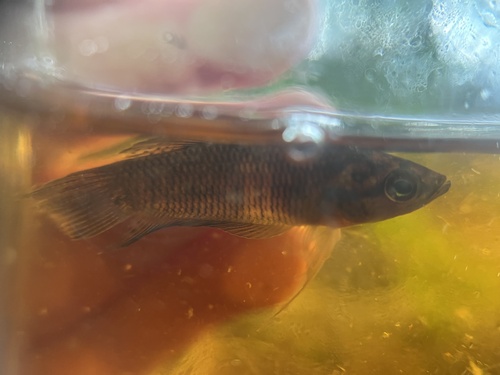
Betta hipposideros
Betta hipposideros
Aquarium hobby

Betta stigmosa
Betta stigmosa
Aquarium hobby

Betta uberis
Betta uberis
Aquarium hobby