Home / Fishes / Cichlids / Cichlidae / Freshwater angelfish
No federal permit to keepFreshwater angelfish
Pterophyllum scalare
Fishes › Cichlids (Cichliformes) › Cichlidae (Cichlids)
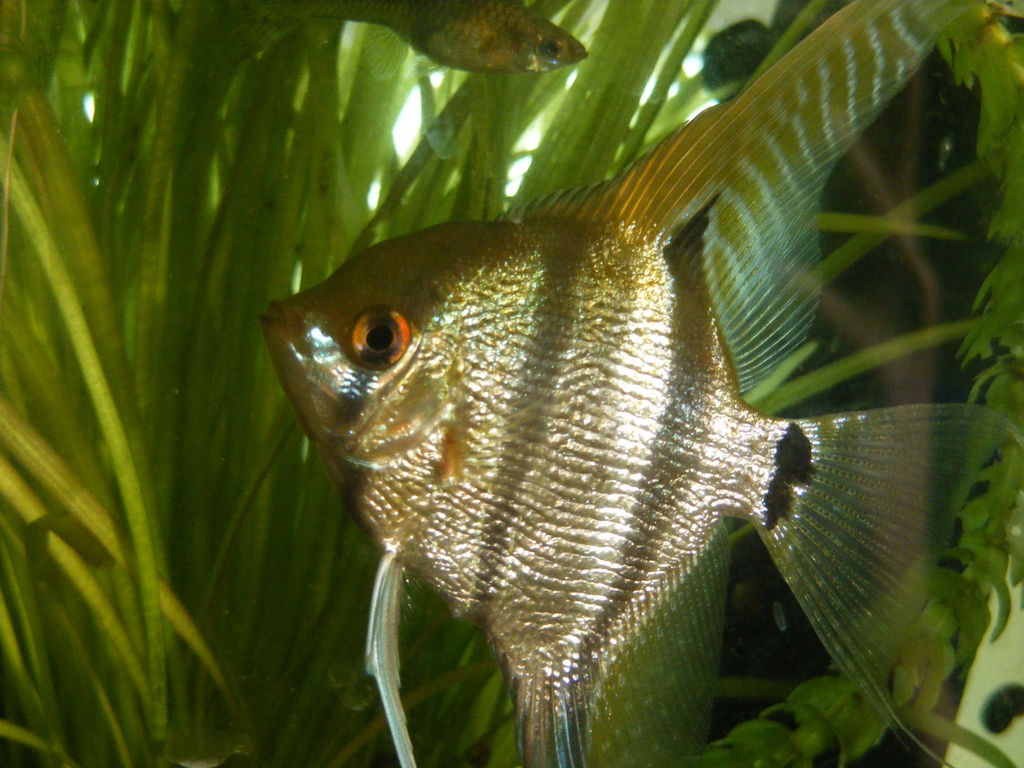
Pterophyllum scalare, most commonly referred to as angelfish or freshwater angelfish, is the most common species of Pterophyllum kept in captivity.
Care at a glance
Species-specific values
Values researched for this exact species. Where they differ from the group guide below, follow these. Air, surface and water temperatures are listed separately, and each source is kept as published rather than averaged.
| Water temperature | 75–86 °F (24–30 °C) Seriously Fish aquarium recommendation; not a wild collection measurement. | 268 |
| Water pH | 6–7.4 pH Seriously Fish aquarium recommendation; not a wild collection measurement. | 268 |
| Water general hardness | 0–15 dGH Seriously Fish aquarium recommendation; not a wild collection measurement. | 268 |
| Maximum standard length | 150 mm SL Source maximum; not total length or a guaranteed adult size. | 268 |
| Minimum tank dimensions | length: 100 cm; width: 40 cm; height: 50 cm Adult setup; additional space depends on stocking and compatibility. | 268 |
Species-specific aquarium care
- Tank: At least 24 in long and 12 in front to back for one adult (adults commonly reach about 4.1 in / 10.5 cm).
- Water: Freshwater.
- Temperature: 75–85°F (range recorded for this species).
- pH: 6–8.
- Hardness: 5–13 dGH.
- Layout: Uses both the bottom and open water: give open swimming space plus cover near the substrate.
- Diet: FishBase classes it as a carnivore.
Calculated from this species' own FishBase record: tank size from its typical adult length and swimming zone, water values from its recorded ranges. The group guide below fills in general care.
Care guide
Species care notes
- Tank: a base of at least 39 × 16 in (roughly 53 US gallons); space needed is rated “large tank”.
- Water: a fairly wide range, from slightly acidic to slightly alkaline, 75–86 °F, pH 6–7.4, 0–15 dGH.
- Behaviour: temperament peaceful.
- Difficulty: Easy (Seriously Fish rating).
Short excerpts from the species profile:
- Setup: “Well planted with tall leafy plants such as Amazon Swords.”
- Diet: “Omnivorous but wild fish feed predominantly on various items of zoobenthos such as small crustaceans and other aquatic invertebrates.”
- Tankmates: “Generally a peaceful cichild but may squabble with it's own kind, so best kept in small groups.”
- Breeding: “Angels spawn on vertical surfaces such as slate, broad-leaved plants or even the aquarium glass.”
From the Seriously Fish profile for this species, which has the full habitat, maintenance, diet, behaviour and breeding write-up 167
Freshwater angelfish
Applies to most species in this group. Habitat: Slow, vegetated Amazon waters. Individual species can differ, so compare with the species numbers above and the linked sources.
Housing & setup
- For adult Pterophyllum scalare, Seriously Fish recommends at least 100 × 40 × 50 cm, including 50 cm height; tank volume alone misses fin height. Use the species water parameters and compatible stocking.
- Avoid fin-nipping tankmates.
Climate & lighting
| Water | 76–84°F |
Diet
- Flakes, pellets and frozen foods; they eat small fish like neon tetras as adults.
Health watch
- Ich, fin rot and angelfish virus in crowded tanks.
Understanding the animal
About this animal
About this animal
It is native to the Amazon Basin in Peru, Colombia, and Brazil. Particularly to the Ucayali river in Peru, the Oyapock River in French Guiana, the Essequibo River in Guyana, the Solimões, the Amapá, and the Amazon rivers in Brazil.
Quoted from the Wikipedia article “Pterophyllum scalare” (CC BY-SA 4.0) 174
In the wild
In the wild
From this species’ own FishBase record (habitat, bottom type, water and breeding data), not its family. Good care copies these conditions.1
| Where it lives | Lives in freshwater. Uses both the bottom and open water. Inhabit swamps or flooded grounds where the aquatic and riverine vegetation are dense and the water is either clear or silty. Its color is deeper in clear water. |
| Water it lives in | Freshwater, 75–85 °F (24–29.5 °C), pH 6–8, hardness 5–13 dH. |
| Climate | Tropical climate. |
| Behavior to plan for | Breeding: clutch tenders. |
What this means for care
- Keep water within its wild range, 75–85 °F.
From the sources
From the sources
Quoted from the matching sections of reputable sources for this exact species. Specialist databases are used first; Wikipedia (community-edited, CC BY-SA 4.0) only fills gaps. Other sources are short credited quotes.
| Overview | Pterophyllum scalare, most commonly referred to as angelfish or freshwater angelfish, is the most common species of Pterophyllum kept in captivity. It is native to the Amazon Basin in Peru, Colombia, and Brazil. Particularly to the Ucayali river in Peru, the Oyapock River in French Guiana, the Essequibo River in Guyana, the Solimões, the Amapá, and the Amazon rivers in Brazil. It is found in swamps or flooded grounds where vegetation is dense and the water is either clear or silty. — Wikipedia (community-edited) |
| Where it lives | Home ranges Population dynamics Growth parameters Max. ages / sizes Length-weight rel. Length-frequencies Mass conversion Recruitment Abundance Life cycle Reproduction Maturity Maturity/Gills rel. — FishBase |
| Reproduction | Males court females during the breeding season. Both male and female guard the eggs which are attached to the surface of aquatic vegetation in a nest area. During the entire brooding cycle, bonding of the original pair of parents is maintained complete with defence of each partner against aggression or potential rivals. — FishBase |
| Biology | Adults inhabit swamps or flooded grounds where the aquatic and riverine vegetation are dense and the water is either clear or silty. Its color is deeper in clear water. One of the most popular of all the tropical aquarium fish. — FishBase |
Data and studies
The numbers
The numbers
Each bar is what one source reports. Where several sources weigh in, the dashed gold band marks their average.
Typical adult weight
Average adult body mass in each database (FishBase gives the maximum recorded weight).
Adult length
Maximum recorded length. Measured as total length. Fish in home aquariums often stay smaller than wild records.
Water temperature
Range the species tolerates in nature; aim for the middle.
Minimum tank footprint
Seriously Fish recommends a tank base of at least 39 × 16 in (about 53 US gallons).
Veterinary & husbandry research
Veterinary & husbandry research
- Fecundity, growth, and survival of the angelfish Pterophyllum scalare (Perciformes: Cichlidae) under laboratory conditions Ortega-Salas AA et al., Revista de biologia tropical 2009
- Understanding behaviour to improve the welfare of an ornamental fish Brandão ML et al., Journal of fish biology 2021
- Pathogenesis of mixed infection by Spironucleus sp. and Citrobacter freundii in freshwater angelfish Pterophyllum scalare Gallani SU et al., Microbial pathogenesis 2016
- Survey of parasitic fauna of different ornamental freshwater fish species in Iran Adel M et al., Veterinary research forum: an international quarterly journal 2015
Peer-reviewed papers that mention this species alongside captivity, zoos, veterinary care or aquaculture. Some cover several species or mention it only in passing, so check the abstract. See all 15 on PubMed → 170
Sources for this sheet
- FishBase (Froese & Pauly, eds.), version 24.07 Peer-reviewed researchThe global scientific database on fishes, maintained by a consortium of research institutions; every value is referenced.
- Seriously Fish species profiles Experienced keeper or breederLong-running aquarium reference written and peer-checked by experienced fishkeepers and ichthyologists; each profile covers habitat, tank size, water, diet, behaviour and breeding.
- Merck Veterinary Manual: Management of aquarium fish Zoo, university or veterinaryThe Merck Veterinary Manual: a standard veterinary reference written and reviewed by veterinary specialists.
- Merck Veterinary Manual: Types and features of aquatic systems Zoo, university or veterinaryThe Merck Veterinary Manual: a standard veterinary reference written and reviewed by veterinary specialists.
- Seriously Fish — Pterophyllum scalare Zoo, university or veterinaryAdded in the 2026 source-checked care-guide review.
- Wikipedia (species article) Community referenceFree encyclopedia; useful overviews with their own citations. Intro text is quoted under CC BY-SA 4.0.
- PubMed (U.S. National Library of Medicine) Peer-reviewed researchIndex of peer-reviewed veterinary, zoo and husbandry research.
- iNaturalist (captive observations) Community referenceCommunity observation platform run by the California Academy of Sciences and National Geographic; observations marked captive show animals living in homes, zoos and aquariums.
More cichlids

Agassiz's dwarf cichlid
Apistogramma agassizii
Aquarium hobby

Altolamprologus calvus
Altolamprologus calvus
Aquarium hobby

Altum Angel
Pterophyllum altum
Aquarium hobby
Anomalochromis thomasi
Anomalochromis thomasi
Aquarium hobby

Apistogramma eremnopyge
Apistogramma eremnopyge
Aquarium hobby
Argentine humphead
Gymnogeophagus balzanii
Aquarium hobby