Home / Fishes / Carp, barbs, minnows, loaches / Cyprinidae / Flying fox
No federal permit to keepFlying fox
Epalzeorhynchos kalopterum
Fishes › Carp, barbs, minnows, loaches (Cypriniformes) › Cyprinidae (Carps and barbs)
Pteropus (suborder Yinpterochiroptera) is a genus of megabats which are among the largest bats in the world.
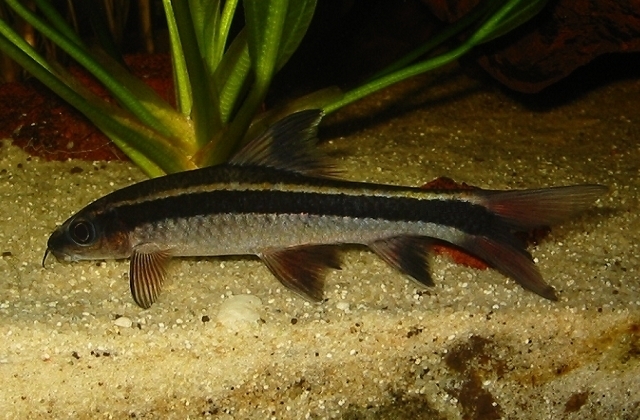
Care at a glance
Species-specific aquarium care
- Tank: At least 24 in long and 12 in front to back for one adult (adults commonly reach about 6.3 in / 16 cm).
- Water: Freshwater.
- Temperature: 75–79°F (range recorded for this species).
- pH: 6.5–7.
- Hardness: 5–8 dGH.
- Layout: Lives on or near the bottom: floor space and hiding places matter more than height.
- Diet: Eats a varied diet: mix quality prepared foods with frozen and live foods. FishBase classes it as a omnivore.
Calculated from this species' own FishBase record: tank size from its typical adult length and swimming zone, water values from its recorded ranges. The group guide below fills in general care.
Care guide
Species care notes
- Tank: a base of at least 47 × 18 in (roughly 64 US gallons); space needed is rated “large tank”.
- Water: a fairly wide range, from slightly acidic to slightly alkaline, 68–79 °F, pH 6–7.5, 2–12 dGH.
- Behaviour: temperament territorial; kept alone; not a community fish.
- Difficulty: Moderate (Seriously Fish rating).
Short excerpts from the species profile:
- Setup: “Provided sufficient cover is available this species is relatively unfussy in terms of décor, and should not harm softer-leaved plants.”
- Diet: “Primarily an aufwuchs grazer feeding on algae, small crustaceans, insect larvae, etc., and for it to develop its best colours and condition it should be offered regular meals of small live and frozen foods such as chironomid larvae (bloodworm), Daphnia and…”
- Tankmates: “A slightly better choice for the community tank than its congener E.”
- Breeding: “As far as we know it's not been bred in private aquaria, but large numbers are farmed for the ornamental trade with the aid of hormones.”
From the Seriously Fish profile for this species, which has the full habitat, maintenance, diet, behaviour and breeding write-up 167
Carps and barbs
Applies to most species in this group. Habitat: The listed barbs and freshwater sharks occupy Asian streams, rivers and floodplain waters, with bala sharks also using natural lakes. Individual species can differ, so compare with the species numbers above and the linked sources.
Housing & setup
- Tiger barbs need a base at least 80 × 30 cm (about 31 × 12 inches), with vegetation and driftwood cover.
- Adult bala shark groups need a base at least 240 × 60 cm (about 96 × 24 inches), ample open swimming space and a heavy, tight lid.
- Red-tailed black sharks need a base at least 120 × 45 cm (about 48 × 18 inches), with rocky refuges.
- Use efficient filtration, water movement and high oxygenation for riverine bala and red-tailed sharks.
Climate & lighting
| Water | 68–78.8°F |
Diet
- Quality flakes or granules containing plant material.
- Live or frozen Daphnia, Artemia and bloodworms.
- For larger bala sharks: chopped earthworms, prawns or mussels.
- For bala sharks: shelled peas, blanched courgette or spinach.
Social life
- Keep tiger barbs in at least 8–10 and bala sharks in at least five. Avoid timid or long-finned companions for tiger barbs. Red-tailed black sharks become territorial toward similar-looking fishes.
Health watch
- Ammonia toxicity.
- Nutritional deficiencies.
Understanding the animal
About this animal
About this animal
They are commonly known as fruit bats or flying foxes, among other colloquial names. They live in South Asia, Southeast Asia, Australia, East Africa, and some oceanic islands in the Indian and Pacific Oceans.
Quoted from the Wikipedia article “Pteropus” (CC BY-SA 4.0) 174
In the wild
In the wild
From this species’ own FishBase record (habitat, bottom type, water and breeding data), not its family. Good care copies these conditions.1
| Where it lives | Lives in freshwater. Stays near the bottom. Commonly collected from the lower surface of floating objects such as boats and floating houses. |
| Water it lives in | Freshwater, 75–79 °F (24–26 °C), pH 6.5–7, hardness 5–8 dH. |
| Climate | Tropical climate. |
What this means for care
- Keep water within its wild range, 75–79 °F.
From the sources
From the sources
Quoted from the matching sections of reputable sources for this exact species. Specialist databases are used first; Wikipedia (community-edited, CC BY-SA 4.0) only fills gaps. Other sources are short credited quotes.
| Overview | Pteropus (suborder Yinpterochiroptera) is a genus of megabats which are among the largest bats in the world. They are commonly known as fruit bats or flying foxes, among other colloquial names. They live in South Asia, Southeast Asia, Australia, East Africa, and some oceanic islands in the Indian and Pacific Oceans. There are at least 60 extant species in the genus. — Wikipedia (community-edited) |
| Where it lives | Home ranges Population dynamics Growth parameters Max. ages / sizes Length-weight rel. Length-frequencies Mass conversion Recruitment Abundance Life cycle Reproduction Maturity Maturity/Gills rel. — FishBase |
| Biology | Commonly collected from the lower surface of floating objects such as boats and floating houses. Feeds on worms, crustaceans, insects and plant matter. Aquarium keeping: solitary species, adults territorial; minimum aquarium size 100 cm. — FishBase |
| History and naming | The genus name Pteropus, from Ancient Greek 'πτερόν' (pterón), meaning "wing", and 'πούς' (poús), meaning "foot", was coined by French zoologist Mathurin Jacques Brisson in 1762. Prior to 1998, genus authority was sometimes given to German naturalist Johann Christian Polycarp Erxleben. — Wikipedia (community-edited) |
Data and studies
The numbers
The numbers
Each bar is what one source reports. Where several sources weigh in, the dashed gold band marks their average.
Adult length
Maximum recorded length. Measured as total length. Fish in home aquariums often stay smaller than wild records.
Water temperature
Range the species tolerates in nature; aim for the middle.
Minimum tank footprint
Seriously Fish recommends a tank base of at least 47 × 18 in (about 64 US gallons).
Sources for this sheet
- FishBase (Froese & Pauly, eds.), version 24.07 Peer-reviewed researchThe global scientific database on fishes, maintained by a consortium of research institutions; every value is referenced.
- Seriously Fish species profiles Experienced keeper or breederLong-running aquarium reference written and peer-checked by experienced fishkeepers and ichthyologists; each profile covers habitat, tank size, water, diet, behaviour and breeding.
- Seriously Fish — Puntigrus tetrazona Experienced keeper or breederAdded in the 2026 source-checked care-guide review.
- Seriously Fish — Balantiocheilos melanopterus Experienced keeper or breederAdded in the 2026 source-checked care-guide review.
- Seriously Fish — Epalzeorhynchos bicolor Experienced keeper or breederAdded in the 2026 source-checked care-guide review.
- Merck Veterinary Manual — Disorders and Diseases of Fish Zoo, university or veterinaryAdded in the 2026 source-checked care-guide review.
- Wikipedia (species article) Community referenceFree encyclopedia; useful overviews with their own citations. Intro text is quoted under CC BY-SA 4.0.
- iNaturalist (captive observations) Community referenceCommunity observation platform run by the California Academy of Sciences and National Geographic; observations marked captive show animals living in homes, zoos and aquariums.
More carps and barbs
Acrossocheilus parallens
Acrossocheilus parallens
Aquarium hobby
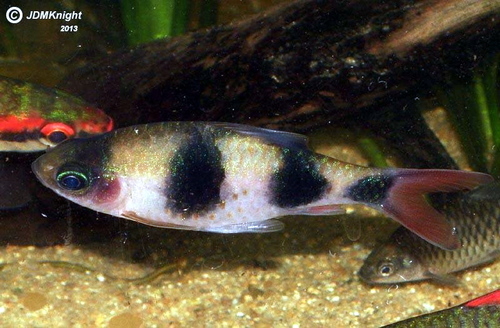
Arulius barb
Dawkinsia arulius
Aquarium hobby

Bala shark
Balantiocheilos melanopterus
Aquarium hobby

Beardless barb
Cyclocheilichthys apogon
Aquarium hobby

Bigspot barb
Barbodes dunckeri
Aquarium hobby

Black ruby barb
Pethia nigrofasciata
Aquarium hobby