Home / Amphibians / Frogs and toads / Oriental fire-bellied toad
No federal permit to keep In-depth sheetOriental fire-bellied toad
Bombina orientalis
Amphibians › Frogs and toads (Anura) › Bombinatoridae (Fire-bellied toads)
Fire-bellied toads are hardy, semi-aquatic and active by day. Their skin secretions irritate eyes and mouths, so wash hands after handling.
Care guide
Care
- A half-water, half-land setup with clean, chemical-free water; usually no extra heat needed.
Safety
- Skin toxins aren't harmful to intact skin but sting eyes, mouth or cuts.
Sources 83
Show the group care guide for fire-bellied toads
Fire-bellied toads
Applies to most species in this group. Habitat: Ponds and slow streams. Individual species can differ, so compare with the species numbers above and the linked sources.
Housing & setup
- Half-water, half-land setups with clean, dechlorinated water.
- Conditions differ among Bombina species: B. maxima requires cooler conditions, while B. pachypus is maintained with seasonally warmer conditions. Identify the species before setting heating.
Climate & lighting
| Warm side / daytime | 70–78°F |
| Cool side | 64–70°F |
| Humidity | 60–80% |
Diet
- Small insects and worms.
Social life
- Do well in small groups.
Health watch
- Skin secretions irritate eyes and mouths; wash hands.
Understanding the animal
In the wild
In the wild
Researched for this exact species, not its family. Good care copies these conditions.123
| Where it lives | Temperate forests, river valleys, marshy scrub and meadows in northeastern China, Korea and the Russian Far East. It occupies shallow waters and their margins, sometimes moving farther onto land in late summer. |
| Ground it lives on | Damp shoreline soil and leaf litter, with rotten wood and stones used as terrestrial refuges. |
| Water it lives in | Freshwater ponds, puddles, ditches, marshes, springs and streams; both standing and running water are used, including muddy water. Chemistry and typical water-temperature ranges were not established. |
| Climate | Strong temperate seasonality, with a warm breeding season and cold winters. Numeric wild temperature and relative-humidity ranges were not established. |
| Active | Mostly diurnal; hibernation generally spans late September to late April or May, depending on locality. |
| Social life | Usually solitary outside reproduction; one to six animals may share an overwintering refuge. |
| Wild diet | Adults eat terrestrial invertebrates; tadpoles consume algae, detritus and other small food material. |
| Behavior to plan for | Uses both water and land. Defensive skin secretions and an arched posture exposing its bright underside deter predators. |
What this means for care
- Provide shallow water with easy exits and a substantial damp land area.
- Include concealed terrestrial resting sites.
- Avoid mixing it with other species exposed to its skin secretions.
- Recognize winter cooling as part of its natural seasonal cycle.
Native climate (measured)
Native climate (measured)
| Warm-season highs | about 82°F (up to 86°F in the hottest sampled areas) |
| Cool-season lows | about 15°F (down to -1°F in the coldest sampled areas) |
| Average temperature | 41–55°F across sampled records |
| Relative humidity | 65–70% on average (driest month about 57%) |
| Rainfall | about 1154 mm a year, with strong wet and dry seasons |
| Winters | Cool to cold winters (lows around 15°F) in much of its native range. Seasonal slowdown may be relevant, but species-specific biology determines whether brumation or hibernation occurs. |
Measured at 231 wild occurrence records sampled against WorldClim 2.1 climate data (1970–2000 averages). Air conditions in the range are ecological context, not enclosure settings: microhabitats such as burrows, leaf litter or basking rocks can be cooler, warmer or more humid.
Profile
Profile
Researched for this exact species. Sources are listed under In the wild above.
History
George Albert Boulenger first described the species as Bombinator orientalis using 19 British Museum specimens. Leonhard Stejneger moved it into the genus Bombina in 1907. It was divided into two subspecies in 1972, but newer research cited in the source found few genetic differences between them and supports treatment as a monotypic species.
Keeper tips
- Use a land-and-water vivarium that reflects the species' semiaquatic habits.
- For breeding conditioning, cool the frogs to the 60s F for at least two months.
- During that cooling period, reduce lighting to about 10 hours per day.
- After conditioning, return them to normal temperatures and increase the photoperiod to about 14 hours per day.
- Captive animals may breed spontaneously in spring and summer even without special breeding preparation.
- Under intensive rearing conditions sexual maturity can occur at about nine months, although around twelve months is more usual.
Behaviors reported
- Breeding males produce a soft "oo oo oo" call.
- Receptive females move toward calling males.
- Amplexus occurs around the pelvic or hip region.
- Nonreceptive females extend their hind legs and produce silent release calls felt as body vibrations.
- Breeding usually takes place in the evening.
Unique adaptations
- Mild toxins can be excreted through the skin.
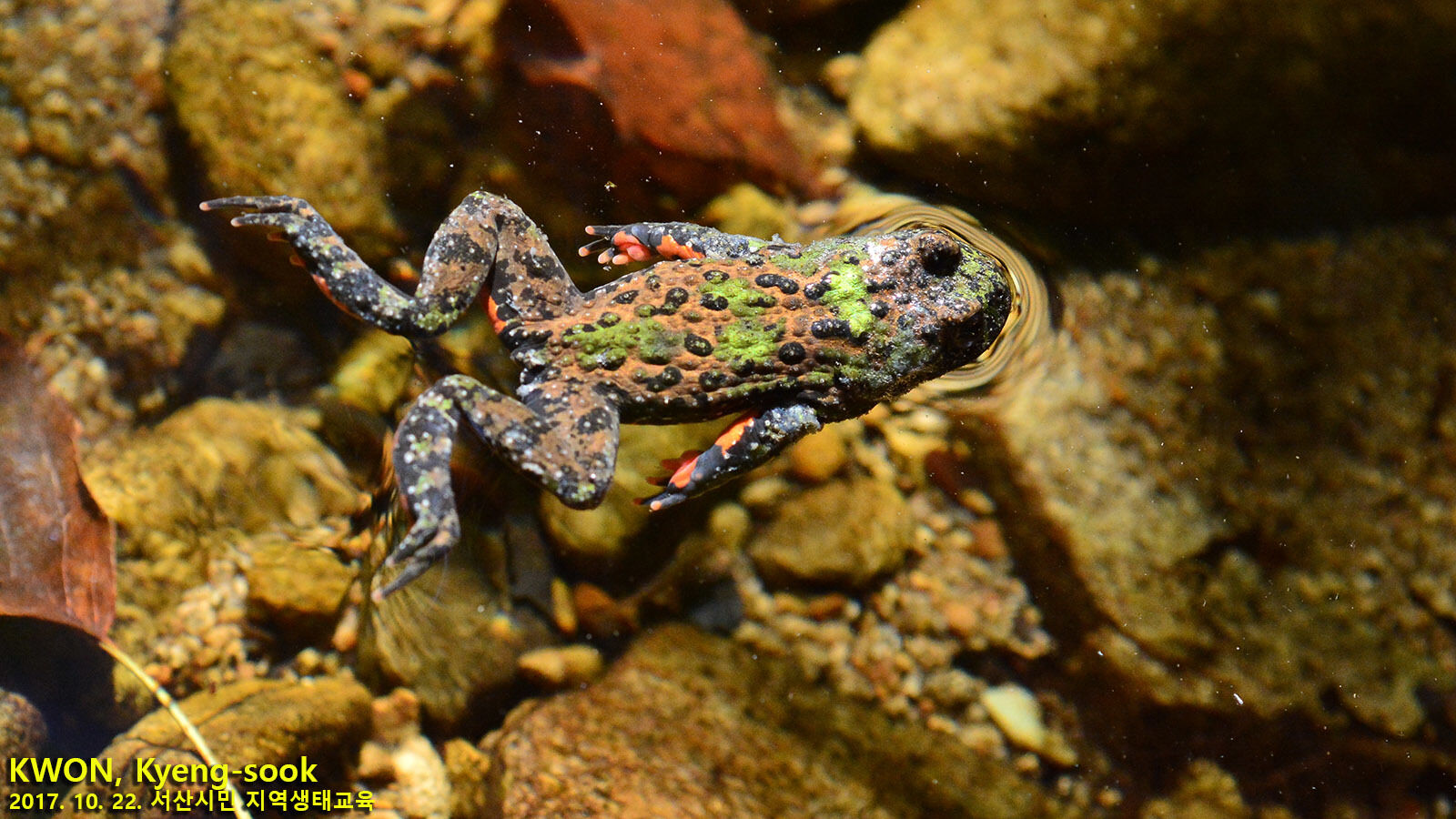
- The bright red-orange or yellow ventral coloration serves as a warning associated with the skin toxins.
- The species is semiaquatic and can occupy both terrestrial habitats and many forms of freshwater.
- Its skin has pronounced tubercles that give it a toadlike appearance despite it not being a true toad.
Remarkable facts
- Its dorsal coloration ranges from brownish-gray to bright green, while the belly has bright red-orange or yellow patterns with dark markings.
- It has triangular pupils and lacks a tympanic membrane.
- Females are generally larger than males.
- The IUCN assessment cited in the source rates the species as Least Concern despite a declining population.
- It is commonly kept as a pet and is also used in research on behavior, vocalization and learning.
From the sources
From the sources
Quoted from the matching sections of reputable sources for this exact species. Specialist databases are used first; Wikipedia (community-edited, CC BY-SA 4.0) only fills gaps. Other sources are short credited quotes.
| Overview | The Oriental fire-bellied toad (Bombina orientalis) is a small semiaquatic frog species found in northeastern Asia, where they primarily dwell in slow-moving bodies of water and temperate forests. Quite common throughout much of their range, these frogs have mild toxins that can be excreted through their skin, with their vibrant underbellies serving as a warning of this. While not a true toad, their green and black skin is covered in small tubercles, giving them a toadlike appearance. Their sounds, mainly produced by males during the mating season, are very unlike those of other frogs. — Wikipedia (community-edited) |
| Where it lives | Oriental fire-bellied toads occupy a variety of different habitats. — Animal Diversity Web |
| Social life and communication | Vocalizations are the primary form of communication and are mostly used during the mating season. — Animal Diversity Web |
| Wild diet | Oriental fire-bellied toads, like most frogs and toads, primarily perceive prey through movement. — Animal Diversity Web |
| Behavior | Oriental fire-bellied toads hibernate from late September to late April or May. — Animal Diversity Web |
| Reproduction | Males court females by continuously calling while floating in shallow water. — Animal Diversity Web |
| Lifespan | Bombina orientalis can live up to a maximum of 30 years in captivity. — Animal Diversity Web |
| Appearance and size | Oriental fire-bellied toads are dark-colored dorsally, ranging from brownish-gray to bright green. — Animal Diversity Web |
| History and naming | The Oriental fire-bellied toad was first described by George Albert Boulenger as Bombinator orientalis, who placed it within the same genus as the European fire-bellied toad and the Apennine yellow-bellied toad, noting their many similarities. He considered it an "intermediate" between the latter two species, although he thought it was closer to the Apennine yellow-bellied toad overall. — Wikipedia (community-edited) |
Data and studies
Researched care notes
Researched care notes
Findings checked against veterinary, zoo, welfare, keeper and peer-reviewed sources. Air, basking-surface and water temperatures are kept separate, and where sources disagree both are shown. “Study” notes report what a paper measured, not a universal rule.
Fire-Bellied Toad
Researched for this genus; applies to its species unless a species note says otherwise.
- Provide both accessible land and shallow water, with a slope or other safe transition between them.1
- For the Oriental fire-bellied toad described, PetMD recommends a semi-aquatic setup with approximately half land and half water; this is design guidance, not a universal measured optimum.1
- Compatible same-species groups may be housed together, but introductions require observation and fighting animals require separation.1
- PetMD gives 75–78°F for enclosure temperature and 65–82°F as broader limits; it does not provide separately measured air, water and surface temperatures.1
- Minimize handling and avoid transferring skin secretions to eyes, mouth or open wounds.1
- Feed varied appropriately sized invertebrates on the dry part of the habitat; PetMD recommends prey no wider than the toad's head.1
The numbers
The numbers
Each bar is what one source reports. Where several sources weigh in, the dashed gold band marks their average.
Maximum recorded lifespan
Longest recorded lifespan reported by each database; typical lifespans are usually shorter. The AnAge record comes from an animal in human care.
Care articles for this species
Care articles for this species
- Breeding Oriental Fire-Bellied Toads (Reptiles Magazine)
Veterinary & husbandry research
Veterinary & husbandry research
- Novel chytrid pathogen variants and the global amphibian pet trade Fu M et al., Conservation biology: the journal of the Society for Conservation Biology 2022
- Microbiome Variation Across Amphibian Skin Regions: Implications for Chytridiomycosis Mitigation Efforts Bataille A et al., Microbial ecology 2016
- Impacts of UVB provision and dietary calcium content on serum vitamin D3, growth rates, skeletal structure and coloration in captive oriental fire-bellied toads (Bombina orientalis) Michaels CJ et al., Journal of animal physiology and animal nutrition 2015
- Composition of the Cutaneous Bacterial Community in Japanese Amphibians: Effects of Captivity, Host Species, and Body Region Sabino-Pinto J et al., Microbial ecology 2016
Peer-reviewed papers that mention this species alongside captivity, zoos, veterinary care or aquaculture. Some cover several species or mention it only in passing, so check the abstract. See all 7 on PubMed → 170
Sources for this sheet
- Clint's Reptiles (YouTube): Fire-Bellied Toad, The Best Pet Frog? Expert educator & keeperClint Laidlaw, PhD in Biology Education and MS in Evolutionary Ecology; owner of Clint's Reptile Room and a longtime keeper. Rates each species on handleability, care, hardiness, availability and upfront cost.
- Animal Diversity Web (University of Michigan): Bombina orientalis Zoo, university or veterinaryUniversity-hosted species account, mostly wild biology.
- AnAge: The Animal Ageing and Longevity Database (Human Ageing Genomic Resources) Peer-reviewed researchCurated, referenced longevity and life-history records for thousands of species; maximum lifespans are often from zoo animals.
- Merck Veterinary Manual: Environment and husbandry for amphibians Zoo, university or veterinaryThe Merck Veterinary Manual: a standard veterinary reference written and reviewed by veterinary specialists.
- Merck Veterinary Manual: Overview of amphibians Zoo, university or veterinaryThe Merck Veterinary Manual: a standard veterinary reference written and reviewed by veterinary specialists.
- Reptiles Magazine: Care and Breeding Fire-bellied Toads (2024) Experienced keeper or breederAdded in the 2026 source-checked care-guide review.
- Clint's Reptiles (YouTube): Fire-Bellied Toad, The Best Pet Frog? Expert educator & keeperClint Laidlaw, PhD in Biology Education and MS in Evolutionary Ecology; owner of Clint's Reptile Room and a longtime keeper. His "Best Pet?" series reviews each species' care in depth.
- AmphibiaWeb (University of California, Berkeley) Peer-reviewed researchUniversity-hosted database of amphibian biology and conservation.
- GBIF Backbone Taxonomy (Global Biodiversity Information Facility) Peer-reviewed researchInternational scientific taxonomy used here for classification.
- Wikipedia (species article) Community referenceFree encyclopedia; useful overviews with their own citations. Intro text is quoted under CC BY-SA 4.0.
- PubMed (U.S. National Library of Medicine) Peer-reviewed researchIndex of peer-reviewed veterinary, zoo and husbandry research.
- iNaturalist (captive observations) Community referenceCommunity observation platform run by the California Academy of Sciences and National Geographic; observations marked captive show animals living in homes, zoos and aquariums.
- Reptiles Magazine (care articles) Experienced keeper or breederEstablished reptile and amphibian hobby magazine; care articles are written by breeders, keepers and veterinarians.