Home / Mammals / Cats, dogs and other carnivores / Fennec fox
Some federal rules apply In-depth sheetFennec fox
Vulpes zerda
Mammals › Cats, dogs and other carnivores (Carnivora) › Canidae (Dogs, wolves and foxes)
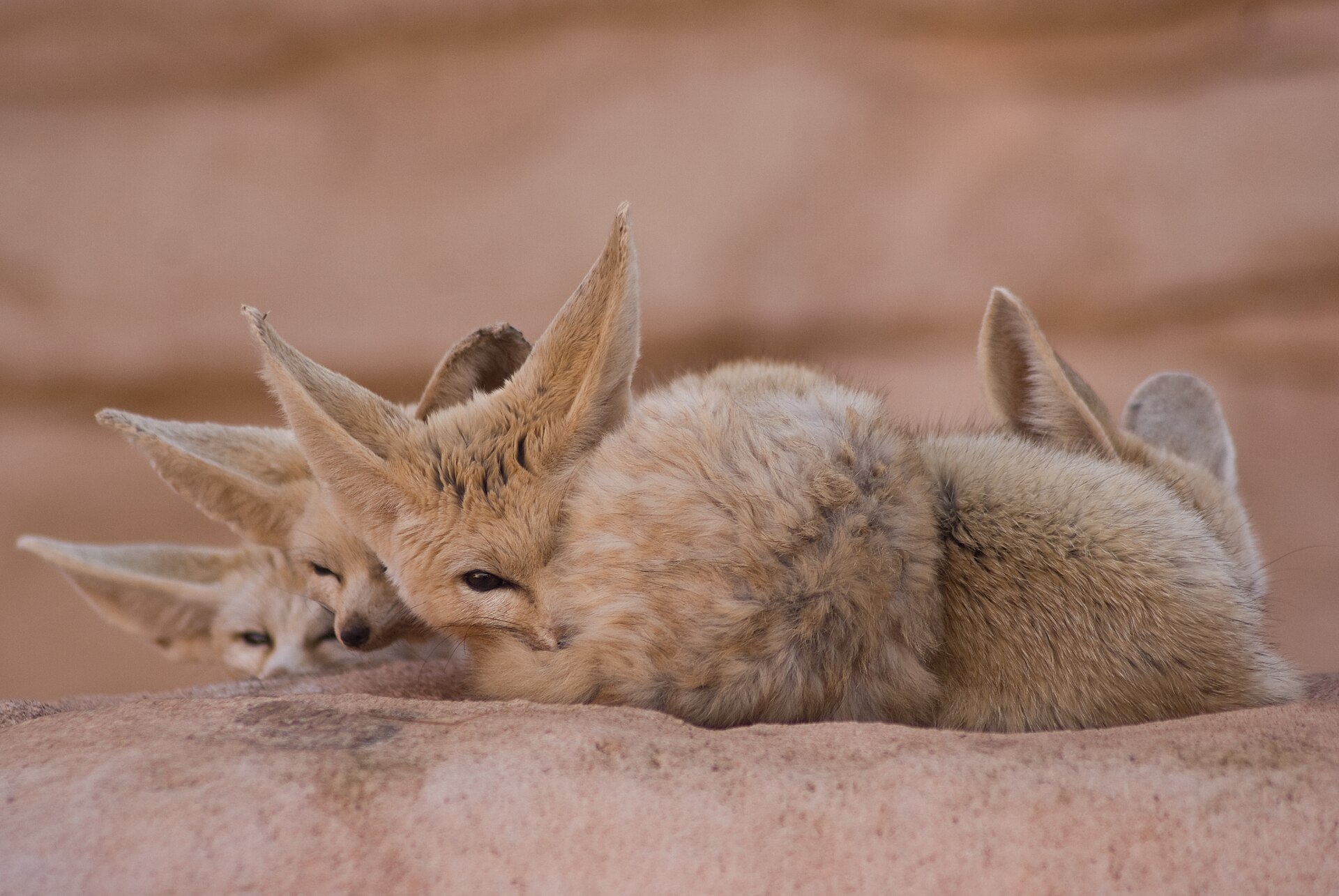
Fennec foxes are the smallest foxes, desert diggers with huge ears for shedding heat. They're social, nocturnal and very active.
Care guide
Behavior
- Instinctive diggers, even when raised in captivity. Provide dig boxes and secure, dig-proof housing.
- Can jump about 2.3 ft straight up.
Sources 67
Diet
- Omnivores: small prey, insects, eggs, fruit and plant matter.
Sources 67
Show the group care guide for foxes
Foxes
Applies to most species in this group. Habitat: Desert, forest and tundra. Individual species can differ, so compare with the species numbers above and the linked sources.
Housing & setup
- Secure, dig-proof outdoor enclosures with roofs; fennecs can live indoors with escape-proofing.
- Daily exercise and enrichment.
Diet
- Balanced canid diet with insects, whole prey and some produce.
Health watch
- Strong musky scent (red foxes); escape artists.
Understanding the animal
In the wild
In the wild
Researched for this exact species, not its family. Good care copies these conditions.12
| Where it lives | Saharan and adjoining North African sandy deserts, especially dunes and arid plains with sparse grasses or shrubs. Dens are often beneath bushes whose roots support the tunnels. |
| Ground it lives on | loose desert sand with sparse shrub roots and lined burrow chambers |
| Climate | Arid desert conditions with daytime heat and cooler nights; underground dens reduce exposure. Quantitative wild temperature and relative-humidity ranges were not established. |
| Active | Nocturnal. |
| Social life | Territorial family groups with a breeding pair and offspring; generally hunts alone. |
| Wild diet | Small rodents, lizards, birds, eggs and insects, plus fruit, roots and leaves. |
| Behavior to plan for | Excavates escape tunnels, hears prey beneath sand and pounces to capture it. Caches extra food and can jump surprisingly high. |
What this means for care
- Provide deep digging substrate and enclosed daytime dens.
- Secure both floor and upper enclosure boundary.
- Allow compatible family-style contact with separation options.
- Offer animal and plant foods; desert adaptations do not justify withholding drinking water.
Native climate (measured)
Native climate (measured)
| Warm-season highs | about 107°F (up to 110°F in the hottest sampled areas) |
| Cool-season lows | about 40°F (down to 38°F in the coldest sampled areas) |
| Average temperature | 71–75°F across sampled records |
| Relative humidity | 32–49% on average (driest month about 18%) |
| Rainfall | about 74 mm a year |
| Winters | Cool to cold winters (lows around 40°F) in much of its native range. Seasonal slowdown may be relevant, but species-specific biology determines whether brumation or hibernation occurs. |
Measured at 106 wild occurrence records sampled against WorldClim 2.1 climate data (1970–2000 averages). Air conditions in the range are ecological context, not enclosure settings: microhabitats such as burrows, leaf litter or basking rocks can be cooler, warmer or more humid.
Profile
Profile
Researched for this exact species. Sources are listed under In the wild above.
History
Eberhardt Zimmermann scientifically described the species as Canis zerda in 1780. It subsequently received numerous scientific names and synonyms from later authors before its modern placement as Vulpes zerda.
Keeper tips
- Allow for substantial digging behavior because wild families excavate large burrow systems in sand.
- Recognize that desert grasses and light scrub are used to strengthen, shelter, and line natural dens.
- Account for the species' extreme adaptation to hot, dry environments rather than assuming needs based on temperate foxes.
- Its hearing is specialized for detecting movement beneath sand, so opportunities for natural searching behavior are relevant.
- The source describes fennecs as monogamous and family-associated, while also noting that knowledge of their social interactions is limited.
Behaviors reported
- Excavates burrows in sand for habitation and protection.
- Family burrows may cover about 120 m2 and adjoin burrows belonging to other families.
- Uses its oversized ears and enlarged auditory bullae to locate prey moving beneath sand.
- May eat nearby vegetation when water is needed.
Unique adaptations
- Very large ears dissipate heat and help detect prey beneath sand.
- Enlarged auditory bullae aid in locating underground prey.
- Its coat, ears, and kidney functions are described as adaptations to high desert temperatures and limited water.
- It is sufficiently adapted to the Saharan environment that the source states it need not drink under normal conditions.
Remarkable facts
- The fennec is the smallest fox species and the smallest canid described.
- Females are reported at about 0.8 kg and males up to about 1.5 kg.
- The ears can be about 15 cm long.
- Its tail is 18-30 cm long and accounts for nearly 60% of its 30-40 cm body length.
- It stands about 18-22 cm at the shoulder.
- The source reports a lifespan of up to 14 years in captivity and about 10 years in the wild.
From the sources
From the sources
Quoted from the matching sections of reputable sources for this exact species. Specialist databases are used first; Wikipedia (community-edited, CC BY-SA 4.0) only fills gaps. Other sources are short credited quotes.
| Overview | The fennec fox (Vulpes zerda) is a small fox native to the deserts of North Africa, ranging from Western Sahara and Mauritania to the Sinai Peninsula. Its most distinctive feature is its unusually large ears, which serve to dissipate heat and listen for underground prey. The fennec is the smallest fox species. Its coat, ears, and kidney functions have adapted to the desert environment with high temperatures and little water. — Wikipedia (community-edited) |
| Where it lives | Fennecs are highly specialized to desert life and found almost exclusively in arid, sandy regions. — Animal Diversity Web |
| Social life and communication | Vulpes zerda perceives its environment primarily through highly developed senses of hearing and smell. — Animal Diversity Web |
| Wild diet | The fennec fox is omnivorous, feeding on small rodents, lizards (geckos and skinks), small birds and their eggs, insects, fruits, leaves, roots and also some tubers. It relies on the moisture content of prey, but drinks water when available. It hunts alone and digs in the sand for small vertebrates and insects. — Wikipedia (community-edited) |
| Behavior | Fennecs are highly social animals, living together in family groups which may contain up to 10 individuals. — Animal Diversity Web |
| Reproduction | Little is known about how fennecs attract or defend their mates, though reproductive opportunity may be affected by social position. — Animal Diversity Web |
| Lifespan | Fennecs can live for up to 10 years in the wild, a common lifespan among African foxes. — Animal Diversity Web |
| Appearance and size | Fennecs are the smallest of the canids. — Animal Diversity Web |
| History and naming | The fennec fox was scientifically described as Canis zerda by Eberhardt Zimmermann in 1780. In 1788, Johann Friedrich Gmelin gave the species the synonym of Canis cerdo with the type locality being the Sahara Desert. A few years later, Friedrich Albrecht Anton Meyer assigned the name Viverra aurita to the species in 1793; the type locality was Algeria. — Wikipedia (community-edited) |
Data and studies
The numbers
The numbers
Each bar is what one source reports. Where several sources weigh in, the dashed gold band marks their average.
Lifespan in care
Maximum recorded lifespan
Longest recorded lifespan reported by each database; typical lifespans are usually shorter. The AnAge record comes from an animal in human care.
Typical adult weight
Average adult body mass in each database (FishBase gives the maximum recorded weight).
Litter size
Average per litter or clutch.
Veterinary & husbandry research
Veterinary & husbandry research
- HEPATOCELLULAR NEOPLASMS IN CAPTIVE FENNEC FOXES ( VULPES ZERDA) Monahan CF et al., Journal of zoo and wildlife medicine: official publication of the American Association of Zoo Veterinarians 2018
- Physiological constraints and latitudinal breeding season in the Canidae Valdespino C et al., Physiological and biochemical zoology: PBZ 2007
- Factors influencing the timing and frequency of litters in captive fennec foxes (Vulpes zerda) Siciliano-Martina L et al., Animal reproduction science 2023
- PREVALENCE OF THE ABCB1-1Δ GENE IN NONDOMESTIC SPECIES OF THE CANIDAE FAMILY Stafford EG et al., Journal of zoo and wildlife medicine: official publication of the American Association of Zoo Veterinarians 2021
Peer-reviewed papers that mention this species alongside captivity, zoos, veterinary care or aquaculture. Some cover several species or mention it only in passing, so check the abstract. See all 10 on PubMed → 170
Sources for this sheet
- Animal Diversity Web (University of Michigan): Vulpes zerda Zoo, university or veterinaryUniversity-hosted species account, mostly wild biology.
- AnAge: The Animal Ageing and Longevity Database (Human Ageing Genomic Resources) Peer-reviewed researchCurated, referenced longevity and life-history records for thousands of species; maximum lifespans are often from zoo animals.
- Myhrvold et al. (2015). An amniote life-history database. Ecology 96: 3109 Peer-reviewed researchPeer-reviewed compilation of life-history data for over 21,000 birds, mammals and reptiles.
- Species+ (UNEP-WCMC and the CITES Secretariat) Zoo, university or veterinaryThe official database of species listed under CITES.
- USFWS International Affairs: CITES Zoo, university or veterinaryFederal agency that issues CITES permits.
- 9 CFR 2.1: Animal Welfare Act licensing (USDA) Zoo, university or veterinaryWho needs a USDA license to breed, sell or exhibit animals.
- Animal Diversity Web (University of Michigan): Vulpes vulpes Zoo, university or veterinaryUniversity-hosted species account, mostly wild biology.
- GBIF Backbone Taxonomy (Global Biodiversity Information Facility) Peer-reviewed researchInternational scientific taxonomy used here for classification.
- Wikipedia (species article) Community referenceFree encyclopedia; useful overviews with their own citations. Intro text is quoted under CC BY-SA 4.0.
- PubMed (U.S. National Library of Medicine) Peer-reviewed researchIndex of peer-reviewed veterinary, zoo and husbandry research.
- iNaturalist (captive observations) Community referenceCommunity observation platform run by the California Academy of Sciences and National Geographic; observations marked captive show animals living in homes, zoos and aquariums.