Emu
Dromaius novaehollandiae
Birds › Emu (Casuariiformes) › Dromaiidae (Emu)
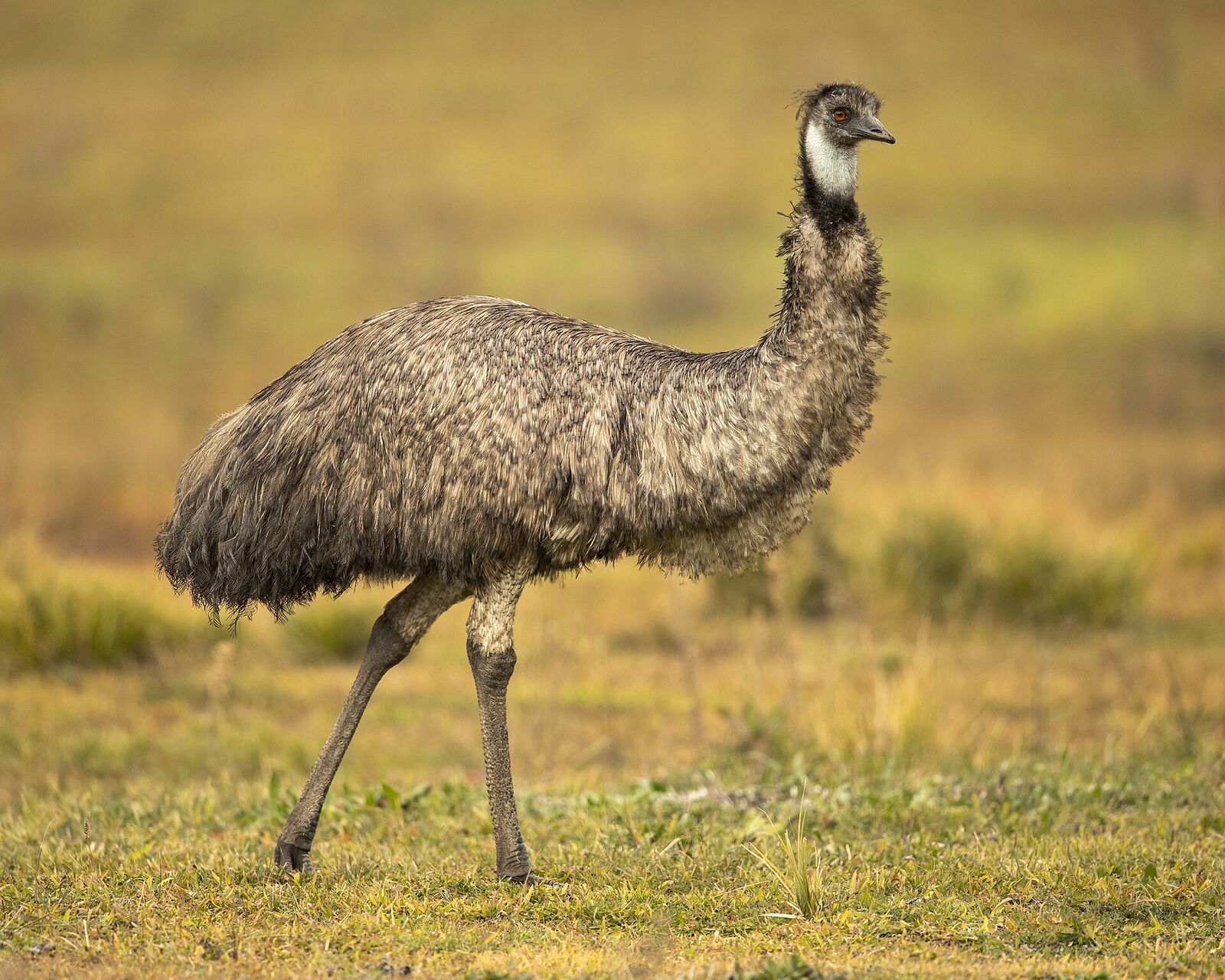
Emus are huge flightless birds from Australia that can sprint 30 mph. Males incubate the eggs alone and guard the chicks for up to about 7 months. They're hardy, but their size and strength demand tall, strong fencing and room to run.
Care guide
Housing
- Pens with room to run, 6 ft chain-link or 2×4 in no-climb fencing, and a sheltered, draft-free area.
- Chicks under about 2 months need draft-free chick runs with supplemental heat when needed.
- Protect them from predators, and clean shelters regularly.
Sources 14
Diet
- Commercial ratite feed built from grains like corn, barley, milo, wheat and oats, with soybean meal for protein plus vitamins and minerals.
- Wild emus eat seeds, grass shoots, fruit and insects. Some fresh greens and produce make good enrichment.
Behavior & enrichment
- Females boom loudly from an inflatable throat pouch, especially in breeding season; a strong boom carries over a mile. Males mostly grunt. Your neighbors will hear it.
- A hiss is a warning.
Sources 13
Health & handling
- Check birds daily: food, water, shelter and behavior. Isolate any sick bird and call a vet.
- Handle from behind using enclosed alleys or runways. Their kicks are powerful.
Sources 14
Show the group care guide for ratites (ostriches, emus, rheas and cassowaries)
Ratites (ostriches, emus, rheas and cassowaries)
Applies to most species in this group. Habitat: Open grassland and forest. Individual species can differ, so compare with the species numbers above and the linked sources.
Housing & setup
- Use species-specific paddock and barrier design. For adult North African ostriches, EAZA recommends visible barriers at least 1.8 m high, with no entanglement or protruding-wire hazards; provide shelter and sand-bathing areas.
- Cassowaries are dangerous and need specialist facilities.
Diet
- Ratite pellets plus grazing, greens and some produce.
Health watch
- Leg problems in fast-growing chicks; impaction from eating foreign objects; powerful kicks.
Understanding the animal
In the wild
In the wild
Researched for this exact species, not its family. Good care copies these conditions.12
| Where it lives | Mainland Australia, especially open woodland, savanna and grassland with access to water. Nomadic movements track changing food and rainfall. |
| Ground it lives on | open grassy or sandy soil, with scattered shrubs and trees |
| Climate | Occupies diverse Australian climates and encounters drought; a species-wide wild temperature or relative-humidity range was not established. |
| Active | Diurnal. |
| Social life | Often solitary, but gathers around resources and forms breeding associations; incubating males remain at the nest. |
| Wild diet | Fruits, seeds, insects and other small animals; diet varies with availability. |
| Behavior to plan for | Travels widely on foot, swims readily and uses powerful defensive kicks. Males incubate eggs and care for chicks. |
What this means for care
- Provide a large unobstructed walking and running area.
- Use strong fencing and handling arrangements that account for kicking.
- Allow separation and quiet shelter for breeding birds.
Native climate (measured)
Native climate (measured)
| Warm-season highs | about 87°F (up to 93°F in the hottest sampled areas) |
| Cool-season lows | about 41°F (down to 38°F in the coldest sampled areas) |
| Average temperature | 56–69°F across sampled records |
| Relative humidity | 54–69% on average (driest month about 49%) |
| Rainfall | about 597 mm a year, spread fairly evenly |
| Winters | Cool to cold winters (lows around 41°F) in much of its native range. Seasonal slowdown may be relevant, but species-specific biology determines whether brumation or hibernation occurs. |
Measured at 137 wild occurrence records sampled against WorldClim 2.1 climate data (1970–2000 averages). Air conditions in the range are ecological context, not enclosure settings: microhabitats such as burrows, leaf litter or basking rocks can be cooler, warmer or more humid.
Profile
Profile
Researched for this exact species. Sources are listed under In the wild above.
History
The emu is endemic to Australia and is the only living member of the genus Dromaius. The Tasmanian, Kangaroo Island, and King Island forms became extinct following European settlement of Australia, while the mainland species remains widespread.
Keeper tips
- Use secure, robust fencing capable of containing a large, powerful running bird.
- Provide reliable access to fresh water even though emus may drink infrequently.
- Allow extensive ground space for walking and running.
- Exercise caution around the legs and feet because powerful kicks can seriously injure predators or other animals.
Behaviors reported
- Travels nomadically over large distances.
- Can sprint at about 30 mph.
- Drinks infrequently but takes in large amounts of water when the opportunity arises.
- Females may mate several times and lay several clutches in one breeding season.
- The male incubates the eggs and later cares for the young.
Unique adaptations
- Three forward-facing toes and no rearward-facing toes, a foot structure associated with running.
- Powerful legs can produce extremely strong kicks.
- Shaggy dark-brown plumage primarily provides insulation from direct sunlight.
- A stride can average about 3 m while running.
Remarkable facts
- The emu is the tallest native bird in Australia and the third-tallest living bird.
- Adults can reach about 6 ft 3 in in height.
- Average body weight is about 36–40 kg.
- The species can reach about 30 mph.
- Eggs hatch after roughly eight weeks.
- Young reach full size at around six months.
From the sources
From the sources
Quoted from the matching sections of reputable sources for this exact species. Specialist databases are used first; Wikipedia (community-edited, CC BY-SA 4.0) only fills gaps. Other sources are short credited quotes.
| Overview | The emu (; Dromaius novaehollandiae) is a species of flightless bird endemic to Australia, where it is the tallest native bird. It is the only extant member of the genus Dromaius and the third-tallest living bird after its African ratite relatives, the common ostrich and Somali ostrich. The emu's native ranges cover most of the Australian mainland. The Tasmanian, Kangaroo Island and King Island subspecies became extinct after the European settlement of Australia in 1788. — Wikipedia (community-edited) |
| Where it lives | Emus, with their nomadic lifestyle, will occupy nearly all available biomes in Australia. — Animal Diversity Web |
| Social life and communication | Emus have the ability to communicate by using an inflatable neck sack, and can create sounds loud enough to be heard 2 km away. — Animal Diversity Web |
| Behavior | Emus are generally solitary birds, but exhibit social behaviors whenever advantageous. — Animal Diversity Web |
| Reproduction | Emus exhibit polyandrous breeding patterns, but not all females engage multiple partners. — Animal Diversity Web |
| Lifespan | When in captivity, under a regular hydration and feeding schedule, emus are able to live up to 20 years. — Animal Diversity Web |
| History and naming | The etymology of the common name "emu" is uncertain, but is thought to have come from an Arabic word for large bird that was later used by Portuguese explorers to describe the related cassowary in Australia and New Guinea. Another theory is that it comes from the word "ema", which is used in Portuguese to denote a large bird akin to an ostrich or crane. — Wikipedia (community-edited) |
Data and studies
The numbers
The numbers
Each bar is what one source reports. Where several sources weigh in, the dashed gold band marks their average.
Lifespan in care
Wild emus live 10–20 years; zoo emus up to 35.
Maximum recorded lifespan
Longest recorded lifespan reported by each database; typical lifespans are usually shorter. The AnAge record comes from an animal in human care.
Typical adult weight
Average adult body mass in each database (FishBase gives the maximum recorded weight).
Incubation
Veterinary & husbandry research
Veterinary & husbandry research
- Gastrointestinal parasites of a population of emus (Dromaius novaehollandiae) in Brazil Gallo SSM et al., Brazilian journal of biology = Revista brasleira de biologia 2020
- Gross morphology of the intra-oral rhamphotheca, oropharynx and proximal oesophagus of the emu (Dromaius novaehollandiae) Crole MR et al., Anatomia, histologia, embryologia 2010
- Recognition and Assessment of Pain-Related Behaviors in Avian Species: An Integrative Review Mikoni NA et al., Journal of avian medicine and surgery 2022
- Characterization of new microsatellite markers derived from sequence databases for the emu (Dromaius novaehollandiae) Yáñez JM et al., Molecular ecology resources 2008
Peer-reviewed papers that mention this species alongside captivity, zoos, veterinary care or aquaculture. Some cover several species or mention it only in passing, so check the abstract. See all 16 on PubMed → 170
Sources for this sheet
- American Emu Association: Emu production guidelines Experienced keeper or breederIndustry association of emu farmers sharing standard care practices.
- San Diego Zoo Wildlife Alliance: Emu Zoo, university or veterinaryMajor zoo and conservation organization.
- AnAge: The Animal Ageing and Longevity Database (Human Ageing Genomic Resources) Peer-reviewed researchCurated, referenced longevity and life-history records for thousands of species; maximum lifespans are often from zoo animals.
- Myhrvold et al. (2015). An amniote life-history database. Ecology 96: 3109 Peer-reviewed researchPeer-reviewed compilation of life-history data for over 21,000 birds, mammals and reptiles.
- 9 CFR 2.1: Animal Welfare Act licensing (USDA) Zoo, university or veterinaryWho needs a USDA license to breed, sell or exhibit animals.
- Merck Veterinary Manual: Management of ratites Zoo, university or veterinaryThe Merck Veterinary Manual: a standard veterinary reference written and reviewed by veterinary specialists.
- EAZA North African Ostrich Best Practice Guidelines (2025) Zoo, university or veterinaryAdded in the 2026 source-checked care-guide review.
- GBIF Backbone Taxonomy (Global Biodiversity Information Facility) Peer-reviewed researchInternational scientific taxonomy used here for classification.
- Wikipedia (species article) Community referenceFree encyclopedia; useful overviews with their own citations. Intro text is quoted under CC BY-SA 4.0.
- PubMed (U.S. National Library of Medicine) Peer-reviewed researchIndex of peer-reviewed veterinary, zoo and husbandry research.
- iNaturalist (captive observations) Community referenceCommunity observation platform run by the California Academy of Sciences and National Geographic; observations marked captive show animals living in homes, zoos and aquariums.