Home / Invertebrates / Emperor and forest scorpions / Emperor scorpion
Some federal rules apply In-depth sheetEmperor scorpion
Pandinus imperator
Invertebrates › Emperor and forest scorpions (Scorpiones) › Scorpionidae (Emperor and forest scorpions)
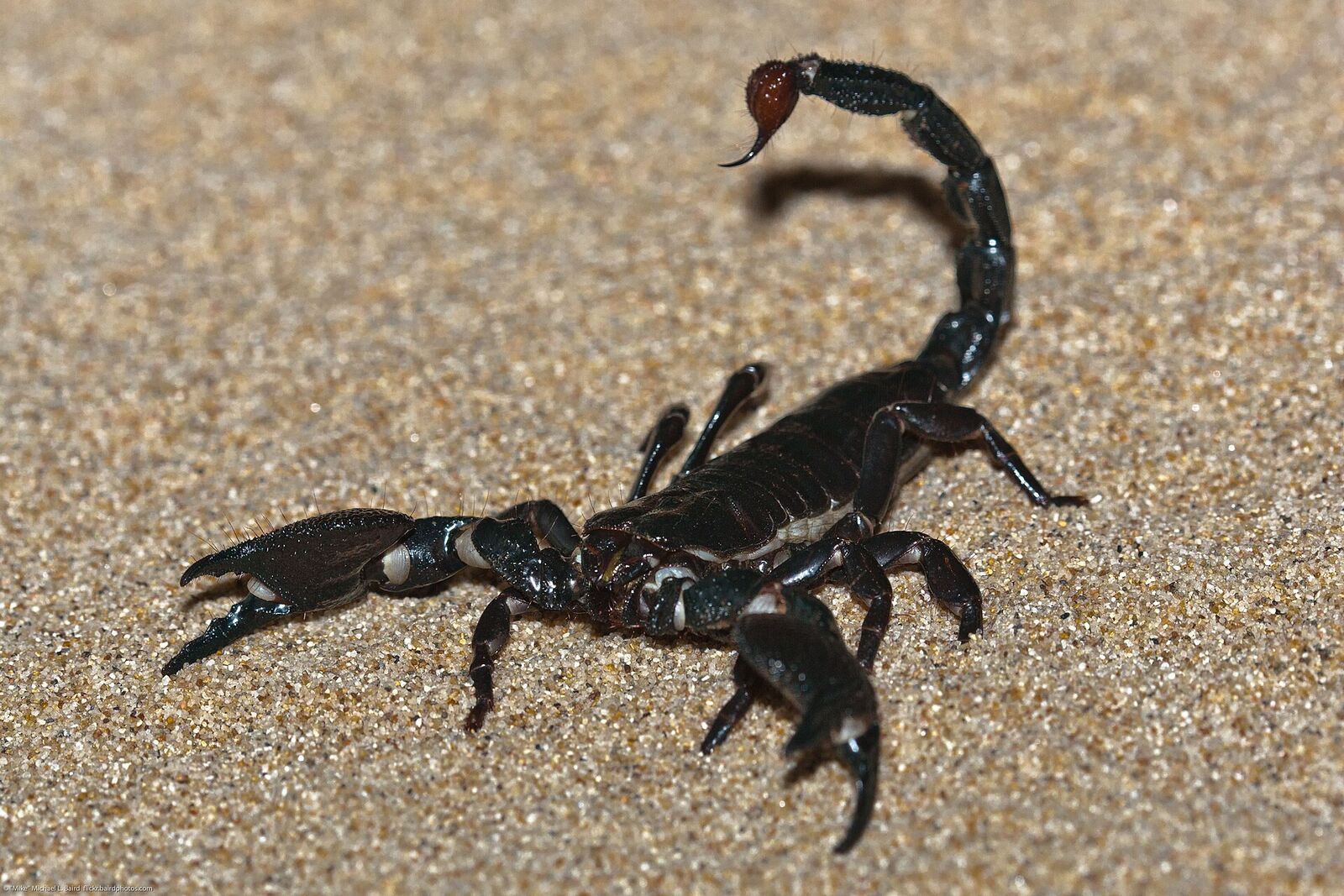
Emperor scorpions are large, timid West African scorpions with mild venom; they mostly use their pincers.
Care guide
Care
- Warm, humid, forest-floor setup with burrowing substrate and leaf litter.
- Can live in colonies of up to 15 in the wild.
Sources 87
Show the group care guide for scorpions
Scorpions
Applies to most species in this group. Habitat: Desert to rainforest. Individual species can differ, so compare with the species numbers above and the linked sources.
Housing & setup
- Desert species: dry sand-soil substrate and rocks. Forest species: humid, deep substrate and leaf litter.
Climate & lighting
Starting point only: A single 40–75% RH range conflates desert and forest requirements. AES suggests about 77°F but separates moisture regimes; select species-specific air and substrate conditions instead. Check the species-specific values for this animal where shown.
| Warm side / daytime | 75–85°F |
| Humidity | 40–75% |
Diet
- Live insects.
Health watch
- Identify the species reliably before acquisition. Some scorpion stings can be life-threatening; never assume a pet-trade scorpion is safe to handle. Even less potent species can cause serious allergic reactions.
Understanding the animal
In the wild
In the wild
Researched for this exact species, not its family. Good care copies these conditions.12
| Where it lives | West African tropical forest, including Ghana, Togo and Nigeria; shelters in burrows, termite mounds and debris near stream banks. |
| Ground it lives on | soil beneath leaf litter and fallen wood; earth burrows and termite mounds |
| Climate | Hot, humid forest conditions; numerical wild temperature and relative-humidity ranges were not established. |
| Active | Nocturnal. |
| Social life | May live in colonies; occasional cannibalism occurs. |
| Wild diet | Termites and other insects and arthropods; occasionally small vertebrates. |
| Behavior to plan for | Excavates shelters and usually retreats when disturbed. Adults subdue prey with powerful pincers; juveniles use their venomous sting more readily. |
What this means for care
- Provide deep moisture-retaining substrate and concealed retreats.
- Offer insect prey rather than routinely feeding vertebrates.
- Communal observations do not guarantee compatibility; separate individuals if aggression occurs.
Native climate (measured)
Native climate (measured)
| Warm-season highs | about 92°F (up to 99°F in the hottest sampled areas) |
| Cool-season lows | about 69°F (down to 61°F in the coldest sampled areas) |
| Average temperature | 77–81°F across sampled records |
| Relative humidity | 70–81% on average (driest month about 67%) |
| Rainfall | about 1406 mm a year |
Measured at 127 wild occurrence records sampled against WorldClim 2.1 climate data (1970–2000 averages). Air conditions in the range are ecological context, not enclosure settings: microhabitats such as burrows, leaf litter or basking rocks can be cooler, warmer or more humid.
Profile
Profile
Researched for this exact species. Sources are listed under In the wild above.
History
The emperor scorpion became a popular species in the pet trade. It is protected under CITES because excessive collection from the wild could affect its survival.
Keeper tips
- Provide burrowing opportunities and ground cover comparable to leaf litter or forest debris.
- Maintain conditions consistent with the hot, humid forests described in the sources.
- Include secure terrestrial hiding areas because the species naturally occupies burrows and covered ground.
- Do not assume the sting is harmless: the source describes it as generally mild but notes that some people may be allergic to scorpion stings.
- Expect adults to rely heavily on their large pincers when handling prey or defending themselves.
Behaviors reported
- Adults commonly use their pincers rather than their sting for defense.
- They crush and dismember prey with their large pincers.
- They tend to live communally.
- They fluoresce greenish-blue under ultraviolet light.
Unique adaptations
- Sensory hairs on the pincers and tail detect vibrations in the air and ground.
- Pectines behind the limbs sense features of the terrain.
- The large pincers are used to overpower prey.
- The exoskeleton is heavily sclerotized.
- The body fluoresces greenish-blue under ultraviolet light.
Remarkable facts
- Emperor scorpions are among the largest scorpions, averaging about 20 cm (7.9 inches) long.
- They are native to West Africa, including forests of Nigeria, Togo, Sierra Leone, Ghana and the Congo region.
- The species is reported to live six to eight years.
- Its venom is described as mild compared with more dangerous scorpions.
- The species is popular in the pet trade and is protected by CITES to limit potentially harmful over-collection.
- Males generally have larger pectines than females.
From the sources
From the sources
Quoted from the matching sections of reputable sources for this exact species. Specialist databases are used first; Wikipedia (community-edited, CC BY-SA 4.0) only fills gaps. Other sources are short credited quotes.
| Overview | The emperor scorpion (Pandinus imperator) is a species of scorpion native to rainforests and savannas in West Africa. It is one of the largest scorpions in the world and lives for six to eight years. Its body is black, but like other scorpions it glows pastel green or blue under ultraviolet light. It is a popular species in the pet trade and is protected by CITES to prevent over-collecting that might affect the species' survival. — Wikipedia (community-edited) |
| Where it lives | Emperor scorpions are typically found in hot and humid forests. — Animal Diversity Web |
| Social life and communication | The eyesight of emperor scorpions is very poor. — Animal Diversity Web |
| Wild diet | Emperor scorpions typically eat insects and other arthropods and occasionally hunt down small vertebrates. — Animal Diversity Web |
| Behavior | Despite their fierce appearance, emperor scorpions are rather timid by nature (which makes them popular as pets). — Animal Diversity Web |
| Reproduction | Emperor scorpions conduct elaborate mating rituals. — Animal Diversity Web |
| Lifespan | Emperor scorpions usually live 5 to 8 years in captivity. — Animal Diversity Web |
| Appearance and size | Emperor scorpions are one of the largest species of scorpions in the world, measuring an average of 20 cm in length. — Animal Diversity Web |
| Conservation | Emperor scorpions are listed in Appendix II by CITES. — Animal Diversity Web |
Data and studies
Researched care notes
Researched care notes
Findings checked against veterinary, zoo, welfare, keeper and peer-reviewed sources. Air, basking-surface and water temperatures are kept separate, and where sources disagree both are shown. “Study” notes report what a paper measured, not a universal rule.
Emperor Scorpion
- Pandinus imperator care in the Cincinnati SOP uses insect prey and removes dead or eaten crickets daily.1
- The same SOP provides coconut-fiber or organic-soil substrate and leaf litter for hiding.1
- Provide a water dish and clean it thoroughly without leaving detergent residue.1
- A female carrying young on her back is separated from other adults and given a low water dish, sufficient hiding clearance and privacy in this protocol.1
The numbers
The numbers
Each bar is what one source reports. Where several sources weigh in, the dashed gold band marks their average.
Lifespan in care
Veterinary & husbandry research
Veterinary & husbandry research
- Pantinin-Derived Peptides against Veterinary Herpesviruses: Activity and Structural Characterization Giugliano R et al., ChemMedChem 2025
- Diagnostic imaging in terrestrial invertebrates: Madagascar hissing cockroach (Gromphadorhina portentosa), desert millipede (Orthoporus sp.), emperor scorpion (Pandinus imperator), Chilean rosehair tarantula (Grammostola spatulata), Mexican fireleg tarantula (Brachypelma boehmei), and Mexican redknee tarantula (Brachypelma smithi) Davis MR et al., Zoo biology 2008
- Expression and production of recombinant scorpine as a potassium channel blocker protein in Escherichia coli Seyfi R et al., Biotechnology and applied biochemistry 2019
- HEMOLYMPH COLLECTION AND ISOFLURANE ANESTHESIA OF THE EMPEROR SCORPION (PANDINUS IMPERATOR) Gaudette C et al., Journal of zoo and wildlife medicine: official publication of the American Association of Zoo Veterinarians 2022
Peer-reviewed papers that mention this species alongside captivity, zoos, veterinary care or aquaculture. Some cover several species or mention it only in passing, so check the abstract. 170
Sources for this sheet
- Animal Diversity Web (University of Michigan): Pandinus imperator Zoo, university or veterinaryUniversity-hosted species account, mostly wild biology.
- Species+ (UNEP-WCMC and the CITES Secretariat) Zoo, university or veterinaryThe official database of species listed under CITES.
- USFWS International Affairs: CITES Zoo, university or veterinaryFederal agency that issues CITES permits.
- Amateur Entomologists' Society: Scorpion care sheet Experienced keeper or breederAmateur Entomologists' Society (UK charity, since 1935): practical invertebrate care sheets written by experienced keepers.
- AES: Scorpion care sheet Zoo, university or veterinaryAdded in the 2026 source-checked care-guide review.
- Clint's Reptiles (YouTube): Emperor Scorpion, The Best Pet Invertebrate? Expert educator & keeperClint Laidlaw, PhD in Biology Education and MS in Evolutionary Ecology; owner of Clint's Reptile Room and a longtime keeper. His "Best Pet?" series reviews each species' care in depth.
- GBIF Backbone Taxonomy (Global Biodiversity Information Facility) Peer-reviewed researchInternational scientific taxonomy used here for classification.
- Wikipedia (species article) Community referenceFree encyclopedia; useful overviews with their own citations. Intro text is quoted under CC BY-SA 4.0.
- PubMed (U.S. National Library of Medicine) Peer-reviewed researchIndex of peer-reviewed veterinary, zoo and husbandry research.
- iNaturalist (captive observations) Community referenceCommunity observation platform run by the California Academy of Sciences and National Geographic; observations marked captive show animals living in homes, zoos and aquariums.