Home / Fishes / Arowanas and elephantfish / Peters's elephantnose fish
No federal permit to keepPeters's elephantnose fish
Gnathonemus petersii
Fishes › Arowanas and elephantfish (Osteoglossiformes) › Mormyridae (Elephantfish)
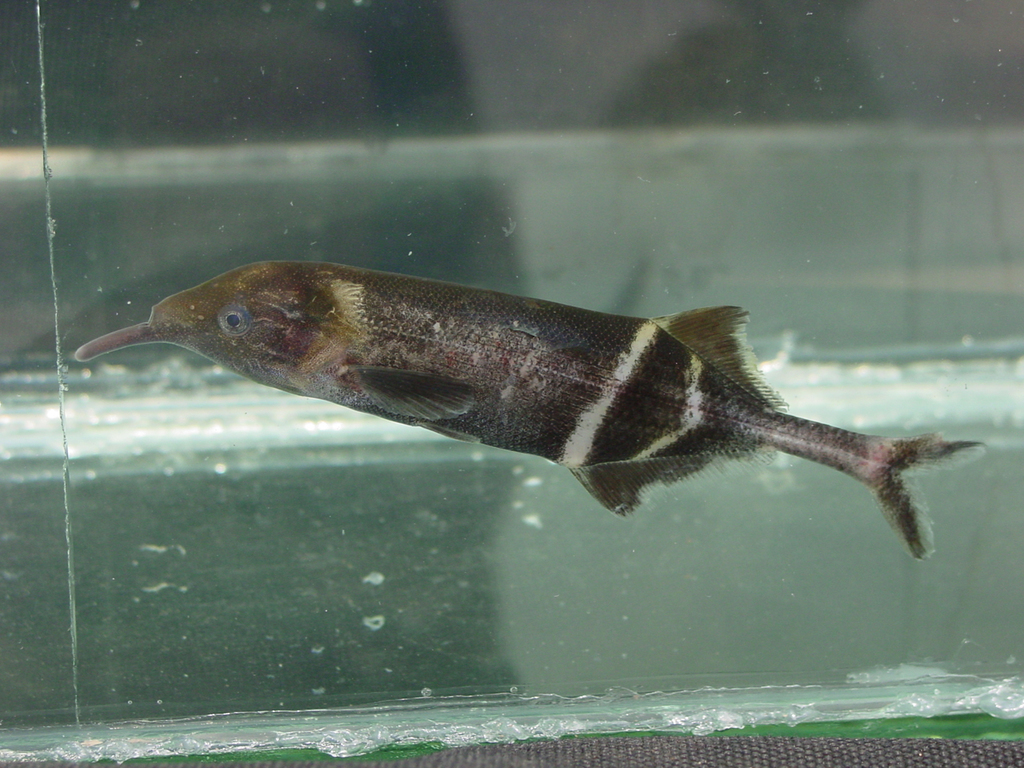
Peters's elephant-nose fish (Gnathonemus petersii) is an African freshwater elephantfish in the genus Gnathonemus.
Care at a glance
Species-specific aquarium care
- Tank: At least 54 in long and 27 in front to back for one adult (adults commonly reach about 13.8 in / 35 cm).
- Water: Freshwater.
- Temperature: 72–82°F (range recorded for this species).
- pH: 6–8.
- Hardness: 5–19 dGH.
- Layout: Lives on or near the bottom: floor space and hiding places matter more than height.
- Diet: A predator: feed meaty foods sized to its mouth (frozen fish, shrimp, worms); it will eat tankmates that fit in its mouth. FishBase classes it as a carnivore.
Calculated from this species' own FishBase record: tank size from its typical adult length and swimming zone, water values from its recorded ranges. The group guide below fills in general care.
Care guide
Species care notes
- Tank: a base of at least 47 × 18 in (roughly 64 US gallons); space needed is rated “large tank”.
- Water: a fairly wide range, from slightly acidic to slightly alkaline, 73–82 °F, pH 6–7.5, 5–15 dGH.
- Behaviour: temperament peaceful; a shoaling fish best kept in a group of six or more.
- Difficulty: Easy (Seriously Fish rating).
Short excerpts from the species profile:
- Setup: “This is a nocturnal fish, so dim lighting is required to make it feel secure.”
- Diet: “Most specimens are quite unfussy and will accept a range of dried, frozen and live foods.”
- Tankmates: “A quiet but territorial species.”
- Breeding: “Not thought to have been achieved in captivity.”
From the Seriously Fish profile for this species, which has the full habitat, maintenance, diet, behaviour and breeding write-up 167
Elephantfish
Applies to most species in this group. Habitat: African elephantfish inhabit rivers and lakes, with Peters’s elephantnose using muddy, shaded, heavily vegetated slow-flowing river areas. Individual species can differ, so compare with the species numbers above and the linked sources.
Housing & setup
- For Gnathonemus petersii, 120 × 45 × 45 cm (48 × 18 × 18 in) is a starting size; a group needs a larger aquarium.
- Provide fine sand for probing with the sensitive lower lip; sharp or coarse substrate can damage its feeding apparatus.
- Use dim lighting, smooth rocks, driftwood and numerous shaded retreats.
- Maintain excellent water quality with biological filtration and water changes; Peters’s elephantnose is sensitive to deteriorating conditions.
- For Mormyrus, the family keeper reference specifies at least 150 cm (60 in) tank length, with further scaling to species and adult size.
Climate & lighting
| Water | 73–82°F |
Diet
- Live or frozen bloodworms, blackworms or white worms.
- Daphnia and other appropriately sized small crustaceans.
- Small prepared foods only where the individual demonstrably accepts them; verify that every fish eats.
Social life
- For G. petersii, use a suitably housed group of at least five to spread aggression; a pair risks severe bullying. Avoid aggressive or fast-feeding companions. Other mormyrids require species-specific grouping.
Health watch
- Emaciation when food is unsuitable or competitors take it.
- Lower-lip injuries from abrasive substrate.
- Water-quality-related illness and adverse reactions to aquarium medications.
Understanding the animal
About this animal
About this animal
Other names in English include elephantnose fish, long-nosed elephant fish, and Ubangi mormyrid, after the Ubangi River. The Latin name petersii is probably for the German naturalist Wilhelm Peters.
Quoted from the Wikipedia article “Peters's elephantnose fish” (CC BY-SA 4.0) 174
In the wild
In the wild
From this species’ own FishBase record (habitat, bottom type, water and breeding data), not its family. Good care copies these conditions.1
| Where it lives | Lives in freshwater, in rivers and streams, lakes. Stays near the bottom. Occurs close to the bottom where it probes for food with the long snout. Territorial and usually aggressive towards members of its own species. This behavior has been shown to involve electric organ discharge (EOD) activity. |
| Water it lives in | Freshwater, 72–82 °F (22–28 °C), pH 6–8, hardness 5–19 dH. |
| Climate | Tropical climate. |
| Wild diet | Hunting macrofauna (predator). |
What this means for care
- Keep water within its wild range, 72–82 °F.
Native climate (measured)
Native climate (measured)
| Warm-season highs | about 88°F (up to 92°F in the hottest sampled areas) |
| Cool-season lows | about 65°F (down to 59°F in the coldest sampled areas) |
| Average temperature | 74–80°F across sampled records |
| Relative humidity | 73–83% on average (driest month about 72%) |
| Rainfall | about 1629 mm a year |
Measured at 109 wild occurrence records sampled against WorldClim 2.1 climate data (1970–2000 averages). Air conditions in the range are ecological context, not enclosure settings: microhabitats such as burrows, leaf litter or basking rocks can be cooler, warmer or more humid.
From the sources
From the sources
Quoted from the matching sections of reputable sources for this exact species. Specialist databases are used first; Wikipedia (community-edited, CC BY-SA 4.0) only fills gaps. Other sources are short credited quotes.
| Overview | Peters's elephant-nose fish (Gnathonemus petersii) is an African freshwater elephantfish in the genus Gnathonemus. Other names in English include elephantnose fish, long-nosed elephant fish, and Ubangi mormyrid, after the Ubangi River. The Latin name petersii is probably for the German naturalist Wilhelm Peters. The fish uses electrolocation to find prey, and has the largest brain-to-body oxygen use ratio of all known vertebrates (around 0.6). — Wikipedia (community-edited) |
| Where it lives | Home ranges Population dynamics Growth parameters Max. ages / sizes Length-weight rel. Length-frequencies Mass conversion Recruitment Abundance Life cycle Reproduction Maturity Maturity/Gills rel. — FishBase |
| Appearance and size | Peters's elephantnose fish is native to the rivers of West and Central Africa, in particular the lower Niger River basin, the Ogun River basin and the upper Chari River. It prefers muddy, slowly moving rivers and pools with cover such as submerged branches. The fish is a dark brown to black in colour, laterally compressed (averaging 23-25), with a rear dorsal fin and anal fin of the same length. — Wikipedia (community-edited) |
| Biology | Occurs close to the bottom where it probes for food with the long snout. Territorial and usually aggressive towards members of its own species. This behavior has been shown to involve electric organ discharge (EOD) activity. — FishBase |
Data and studies
The numbers
The numbers
Each bar is what one source reports. Where several sources weigh in, the dashed gold band marks their average.
Adult length
Maximum recorded length. Measured as standard length (snout to the base of the tail, not counting the tail fin). Fish in home aquariums often stay smaller than wild records.
Water temperature
Range the species tolerates in nature; aim for the middle.
Minimum tank footprint
Seriously Fish recommends a tank base of at least 47 × 18 in (about 64 US gallons).
Veterinary & husbandry research
Veterinary & husbandry research
- Landmark use and development of navigation behaviour in the weakly electric fish Gnathonemus petersii (Mormyridae; Teleostei) Cain P et al., The Journal of experimental biology 2002
- Apomorphine and haloperidol influence electric behaviour of a mormyrid fish Kunze P et al., Zeitschrift fur Naturforschung. C, Journal of biosciences 1988
- Development of the gigantocerebellum of the weakly electric fish Pollimyrus Haugedé-Carré F et al., Journal de physiologie 1979
- Captivity affects behavioral physiology: plasticity in signaling sexual identity Landsman RE et al., Experientia 1991
Peer-reviewed papers that mention this species alongside captivity, zoos, veterinary care or aquaculture. Some cover several species or mention it only in passing, so check the abstract. See all 6 on PubMed → 170
Sources for this sheet
- FishBase (Froese & Pauly, eds.), version 24.07 Peer-reviewed researchThe global scientific database on fishes, maintained by a consortium of research institutions; every value is referenced.
- Seriously Fish species profiles Experienced keeper or breederLong-running aquarium reference written and peer-checked by experienced fishkeepers and ichthyologists; each profile covers habitat, tank size, water, diet, behaviour and breeding.
- Seriously Fish — gnathonemus petersii Experienced keeper or breederAdded in the 2026 source-checked care-guide review.
- Practical Fishkeeping — Definitive guide to elephantnoses Experienced keeper or breederAdded in the 2026 source-checked care-guide review.
- Wikipedia (species article) Community referenceFree encyclopedia; useful overviews with their own citations. Intro text is quoted under CC BY-SA 4.0.
- PubMed (U.S. National Library of Medicine) Peer-reviewed researchIndex of peer-reviewed veterinary, zoo and husbandry research.
- iNaturalist (captive observations) Community referenceCommunity observation platform run by the California Academy of Sciences and National Geographic; observations marked captive show animals living in homes, zoos and aquariums.
