Home / Birds / Ducks, geese and swans / Domestic duck (mallard)
No federal permit to keep In-depth sheetDomestic duck (mallard)
Anas platyrhynchos
Birds › Ducks, geese and swans (Anseriformes) › Anatidae (Ducks, geese and swans)
Domestic ducks are hardy, social waterfowl that live 8–12 years and need swimming water and secure night housing.
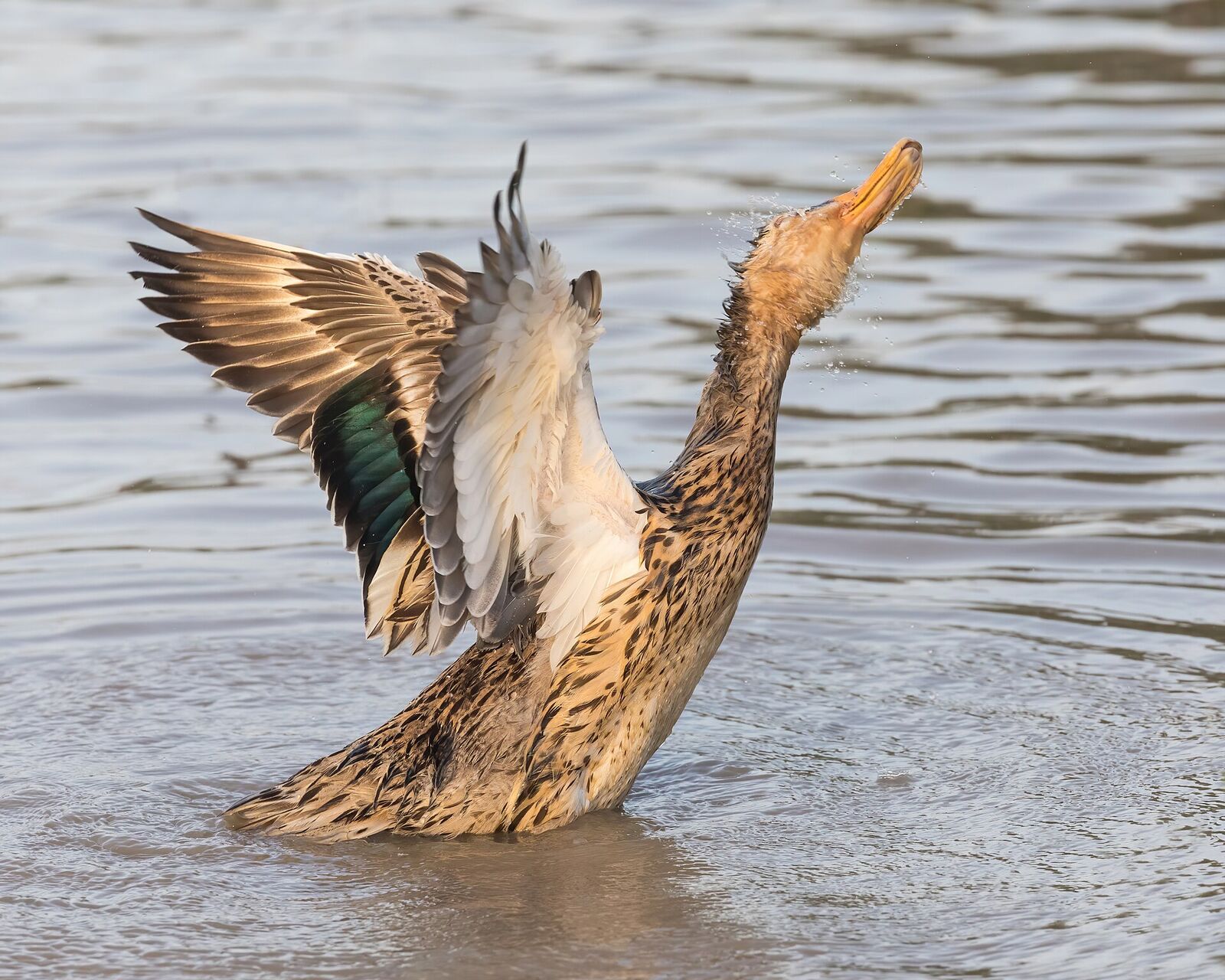
Care at a glance
Species-specific values
Values researched for this exact species. Where they differ from the group guide below, follow these. Air, surface and water temperatures are listed separately, and each source is kept as published rather than averaged.
| Initial brooder environment temperature | about: 86 °F Domestic ducklings; source does not specify a surface measurement. | 328 |
| Brooder weekly temperature reduction | 5 °F per week Domestic ducklings; source schedule reduces toward 55 °F, with heat needs assessed by feathering and conditions. | 328 |
| Diet crude protein | 22 % diet Pekin domestic ducks, starter 0–2 weeks; NRC-derived reference table, not a complete recipe. Adjust to strain, intake and the full amino-acid profile. | 329 |
| Diet crude protein | 16 % diet Pekin domestic ducks, grower 2–7 weeks; NRC-derived reference table, not a complete recipe. Adjust to strain, intake and the full amino-acid profile. | 329 |
| Diet crude protein | 15 % diet Pekin domestic breeding ducks; NRC-derived reference table, not a complete recipe. Adjust to strain, intake and the full amino-acid profile. | 329 |
Care guide
Housing
- Daytime space about 16–22 sq ft (1.5–2 m²) per duck; overnight 5–11 sq ft per duck in a ventilated 3-sided house.
- A pool at least 2 ft deep.
Sources 39
Feed by age
- Starter crumb (18–20% protein) to 3 weeks, grower (15%) to 20 weeks, then layer or breeder pellet (14–18%).
Sources 39
Show the group care guide for ducks, geese and swans
Ducks, geese and swans
Applies to most species in this group. Habitat: Wetlands. Individual species can differ, so compare with the species numbers above and the linked sources.
Housing & setup
- Secure, predator-proof night housing, a pond or deep water for bathing and mating, and grazing space.
- Provide clean head-dipping or bathing water and drain wet areas to preserve dry resting substrate. Duckling water access needs age-appropriate protection against soaking and chilling.
Diet
- Waterfowl pellets plus grass and greens; ducklings need niacin-adequate feed.
Social life
- Use species-specific social housing. Many domestic waterfowl are flock-kept, but adult white-winged ducks require careful pair/group management and should not be treated as unrestricted flock birds.
Health watch
- Angel wing, linked to fast growth and unbalanced, energy-rich diets (limit bread and treats); bumblefoot on hard surfaces.
- Most native North American waterfowl need federal (MBTA) permits; domestic breeds don't.
Understanding the animal
In the wild
In the wild
Researched for this exact species, not its family. Good care copies these conditions.1234
| Where it lives | Wild mallards occupy wetlands across North America and Eurasia, including ponds, marshes, floodplains and estuaries. They feed in shallow water and nest in vegetation on nearby dry land. |
| Ground it lives on | vegetated banks, shoreline soil and dry grassy nesting ground |
| Water it lives in | Freshwater and brackish estuaries; still ponds and marshes or quiet river margins. No single clarity, hardness, pH or wild water-temperature range is established. |
| Climate | Occurs across temperate and subtropical regions. No temperatures in F or humidity values are provided. |
| Active | Cathemeral and seasonally variable; field studies document daytime activity and nocturnal feeding, with commuting flights around dusk and dawn. |
| Social life | Seasonal pairs and flocks; paired males defend breeding territories. |
| Wild diet | Aquatic vegetation and seeds; breeding-season foods include insect larvae, worms, snails and freshwater shrimp; grain is important during migration. |
| Behavior to plan for | Dabbles and tips up to reach underwater food, and also forages ashore. Nesting and feeding require both land and water. |
What this means for care
- Provide bathing and dabbling water with easy entry and exit.
- Retain dry resting ground and covered nesting sites.
- Account for breeding-season aggression when arranging groups.
Native climate (measured)
Native climate (measured)
| Warm-season highs | about 73°F (up to 77°F in the hottest sampled areas) |
| Cool-season lows | about 13°F (down to 11°F in the coldest sampled areas) |
| Average temperature | 40–51°F across sampled records |
| Relative humidity | 74–75% on average (driest month about 62%) |
| Rainfall | about 663 mm a year, spread fairly evenly |
| Winters | Cool to cold winters (lows around 13°F) in much of its native range. Seasonal slowdown may be relevant, but species-specific biology determines whether brumation or hibernation occurs. |
Measured at 132 wild occurrence records sampled against WorldClim 2.1 climate data (1970–2000 averages). Air conditions in the range are ecological context, not enclosure settings: microhabitats such as burrows, leaf litter or basking rocks can be cooler, warmer or more humid.
Profile
Profile
Researched for this exact species. Sources are listed under In the wild above.
History
The mallard is the main ancestor of most breeds of domestic duck. Domestic and feral mallard populations have interbred with wild mallards and closely related indigenous ducks, altering wild gene pools and in some areas threatening native waterfowl through hybridization.
Keeper tips
- Provide access to water that accommodates the species' strong association with wetlands and aquatic habitats.
- Take its flocking behavior into account because mallards naturally congregate in groups.
- Provide opportunities associated with natural foods such as aquatic vegetation and invertebrates.
- For breeding birds, account for the hen's tendency to nest on the ground near water.
- Ducklings are precocial and capable of swimming immediately after hatching.
Behaviors reported
- Congregates in groups or flocks of varying sizes.
- Ducklings can swim as soon as they hatch.
- Pair bonding may begin as early as October and continue through March.
- Males leave hens soon after mating.
- Hens lead newly hatched ducklings to water and do not return to the nest.
Unique adaptations
- Precocial ducklings are capable of swimming immediately after hatching.
- The species is highly adaptable and can thrive in urban environments.
- Its dabbling lifestyle allows it to exploit productive wetlands containing aquatic plants and invertebrates.
Remarkable facts
- Adults are about 20 to 26 inches long with a wingspan of roughly 32 to 39 inches.
- Reported weight is about 1.5 to 3.5 pounds.
- Females commonly lay about 8 to 13 eggs, with another source giving 9 to 13.
- Incubation lasts approximately 26 to 28 days.
- Fledging takes about 50 to 60 days.
- Mallards are the main ancestor of most domestic duck breeds.
From the sources
From the sources
Quoted from the matching sections of reputable sources for this exact species. Specialist databases are used first; Wikipedia (community-edited, CC BY-SA 4.0) only fills gaps. Other sources are short credited quotes.
| Overview | The mallard or wild duck (Anas platyrhynchos) is a dabbling duck that breeds throughout temperate and subtropical North America, Eurasia, and North Africa. It has been introduced to New Zealand, Australia, Peru, Brazil, Uruguay, Argentina, Chile, Colombia, the Falkland Islands, and South Africa. Belonging to the subfamily Anatinae of the waterfowl family Anatidae, mallards live in wetlands, eat water plants and small animals, and are social animals preferring to congregate in groups or flocks of varying sizes. — Wikipedia (community-edited) |
| Where it lives | Most often, they prefer wetlands, where highly productive waters produce large amounts of floating, emergent and submerged vegetation Wetlands also produce a great deal of aquatic invertebrates on which mallards feed. — Animal Diversity Web |
| Wild diet | Mallards consume a wide variety of foods, including vegetation, insects, worms, gastropods and arthropods, although they are not restricted to these. — Animal Diversity Web |
| Behavior | After the breeding season, mallards form flocks and migrate from northern lattitudes to warmer southern areas. — Animal Diversity Web |
| Reproduction | Most mallard hens breed as yearlings, but they may not have much success; studies show that older hens have much lower duckling mortality than yearlings. — Animal Diversity Web |
| Appearance and size | The mallard is undoubtably the most recognized waterfowl in the world. — Animal Diversity Web |
| History and naming | The mallard was one of the many bird species originally described in the 1758 10thedition of Systema Naturae by Carl Linnaeus. He gave it two binomial names: Anas platyrhynchos and Anas boschas. The latter was generally preferred until 1906 when Einar Lönnberg established that A.platyrhynchos had priority, as it appeared on an earlier page in the text. — Wikipedia (community-edited) |
| Conservation | Mallards are the most abundant and widespread of all waterfowl; every year millions are harvested by hunters with little effect on their numbers. — Animal Diversity Web |
Data and studies
Researched care notes
Researched care notes
Findings checked against veterinary, zoo, welfare, keeper and peer-reviewed sources. Air, basking-surface and water temperatures are kept separate, and where sources disagree both are shown. “Study” notes report what a paper measured, not a universal rule.
Domestic Duck
- Provide open water deep enough for adults to wash the head and body, with an exit they can use easily.1
- Provide drinking water separately from bathing water, which rapidly becomes contaminated.1
- Clean and refill small bathing pools or troughs at least daily, and manage drainage to prevent persistent muddy ground.1
- Give young ducklings shallow water facilities; RSPCA advises against access to deep swimming water before sufficient feather waterproofing develops.1
- Feed a ration suited to duck species, age and breed rather than assuming that any poultry feed meets all life-stage requirements.2
- Keep a compatible group; RSPCA recommends at least three birds and cautions against bullying when markedly different body sizes are mixed.2
The numbers
The numbers
Each bar is what one source reports. Where several sources weigh in, the dashed gold band marks their average.
Lifespan
Maximum recorded lifespan
Longest recorded lifespan reported by each database; typical lifespans are usually shorter.
Typical adult weight
Average adult body mass in each database (FishBase gives the maximum recorded weight).
Veterinary & husbandry research
Veterinary & husbandry research
- Health monitoring in birds using bio-loggers and whole blood transcriptomics Jax E et al., Scientific reports 2021
- Comparative pharmacokinetics of three non-steroidal anti-inflammatory drugs in five bird species Baert K et al., Comparative biochemistry and physiology. Toxicology & pharmacology: CBP 2003
- Studies on parasitic prevalence in pet birds from Punjab, Pakistan Sadaf T et al., Brazilian journal of biology = Revista brasleira de biologia 2021
- Approaching birds with drones: first experiments and ethical guidelines Vas E et al., Biology letters 2015
Peer-reviewed papers that mention this species alongside captivity, zoos, veterinary care or aquaculture. Some cover several species or mention it only in passing, so check the abstract. See all 97 on PubMed → 170
Sources for this sheet
- Royal Veterinary College Exotics Service: Duck care Zoo, university or veterinaryVet-school exotics hospital factsheet, reviewed 2021–2024.
- AnAge: The Animal Ageing and Longevity Database (Human Ageing Genomic Resources) Peer-reviewed researchCurated, referenced longevity and life-history records for thousands of species; maximum lifespans are often from zoo animals.
- Myhrvold et al. (2015). An amniote life-history database. Ecology 96: 3109 Peer-reviewed researchPeer-reviewed compilation of life-history data for over 21,000 birds, mammals and reptiles.
- 50 CFR 10.13: List of migratory birds Zoo, university or veterinaryCurrent federal regulation listing birds protected by the Migratory Bird Treaty Act.
- Merck Veterinary Manual: Poultry Zoo, university or veterinaryThe Merck Veterinary Manual: a standard veterinary reference written and reviewed by veterinary specialists.
- EAZA White-winged Duck Best Practice Guidelines (2025) Zoo, university or veterinaryAdded in the 2026 source-checked care-guide review.
- EFSA — Welfare of farmed ducks, geese and quail (2023) Zoo, university or veterinaryAdded in the 2026 source-checked care-guide review.
- University of Kentucky Cooperative Extension — Brooding Poultry Hatchlings Zoo, university or veterinaryAdded in the 2026 source-checked care-guide review.
- MSD Veterinary Manual — Nutritional Requirements of Poultry Zoo, university or veterinaryAdded in the 2026 source-checked care-guide review.
- GBIF Backbone Taxonomy (Global Biodiversity Information Facility) Peer-reviewed researchInternational scientific taxonomy used here for classification.
- Species+ (UNEP-WCMC and the CITES Secretariat) Zoo, university or veterinaryThe official database of species listed under CITES.
- Wikipedia (species article) Community referenceFree encyclopedia; useful overviews with their own citations. Intro text is quoted under CC BY-SA 4.0.
- PubMed (U.S. National Library of Medicine) Peer-reviewed researchIndex of peer-reviewed veterinary, zoo and husbandry research.
- iNaturalist (captive observations) Community referenceCommunity observation platform run by the California Academy of Sciences and National Geographic; observations marked captive show animals living in homes, zoos and aquariums.
