Home / Mammals / Cats, dogs and other carnivores / South American coati
Some federal rules apply In-depth sheetSouth American coati
Nasua nasua
Mammals › Cats, dogs and other carnivores (Carnivora) › Procyonidae (Raccoons, coatis and kinkajous)
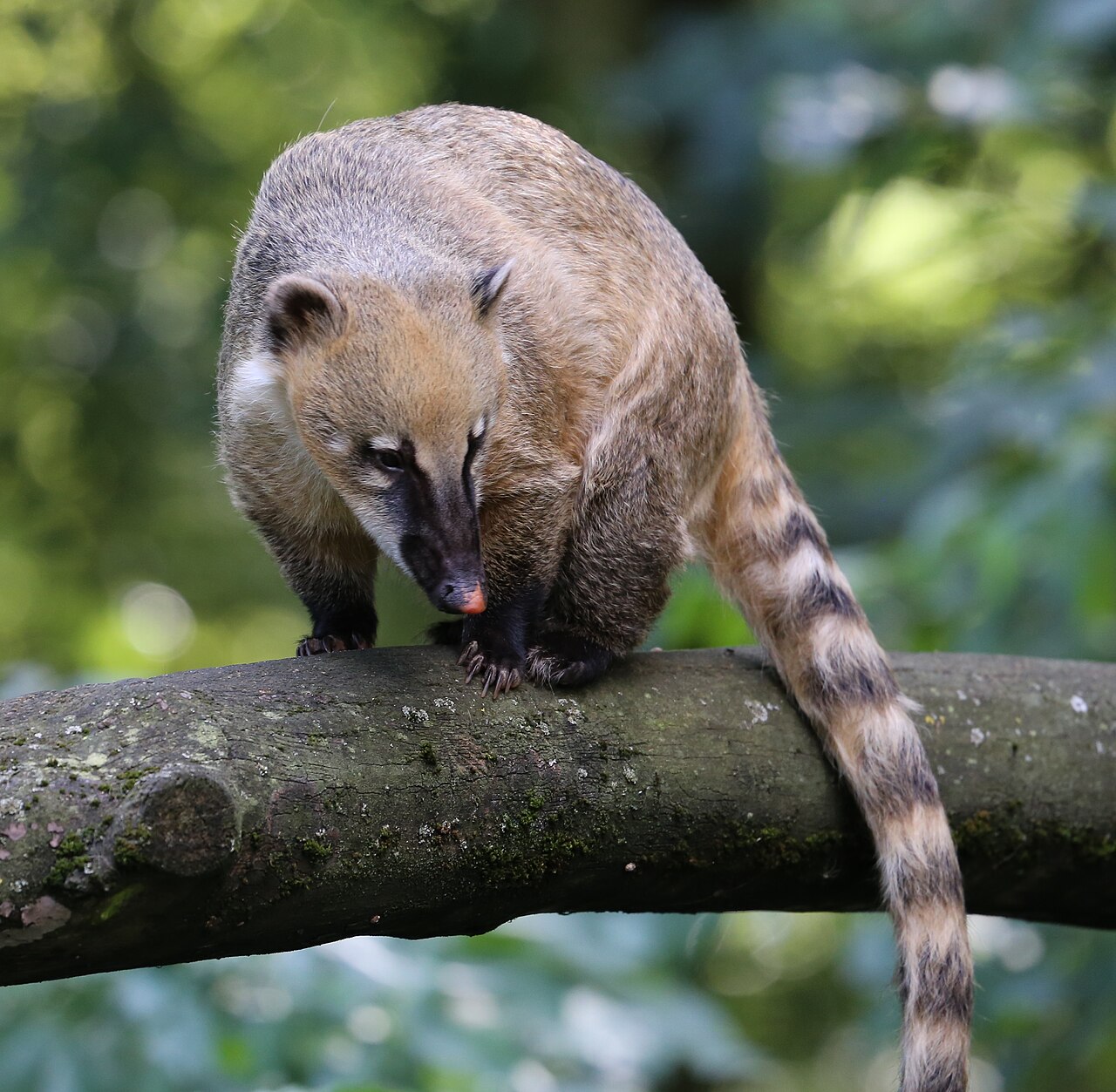
Coatis are active, daytime relatives of the raccoon with long, flexible snouts, strong digging claws and a semi-prehensile tail used for balance. Females and young live in bands, while adult males are usually solitary.
Care guide
Housing
- A large, secure enclosure with plenty of branches and climbing structures, plus digging opportunities.
- They're strong, curious diggers. Floors, walls and locks need to be coati-proof.
Sources 4
Diet
- Omnivores that eat fruit, invertebrates, small rodents and lizards in the wild, foraging on the ground and in trees.
- In care, a balanced omnivore base diet with fruits, vegetables and animal protein mirrors that variety.
Sources 4
Behavior & enrichment
- The snout is their main tool. Hide food in logs, leaf litter and puzzle feeders.
- Very active during the day and need daily exercise and stimulation.
Sources 4
Health & vet care
- Find an exotic-animal vet before bringing one home. Plan spay or neuter with your vet to reduce hormonal behavior.
- Monitor weight monthly.
Sources 2
Show the group care guide for raccoons, coatis and kinkajous
Raccoons, coatis and kinkajous
Applies to most species in this group. Habitat: Forests and suburbs. Individual species can differ, so compare with the species numbers above and the linked sources.
Housing & setup
- Large, climb-proof enclosures with lots of enrichment; very dexterous and destructive.
Diet
- Balanced omnivore diets with fruits, vegetables and protein; kinkajous are mostly fruit-eaters.
Health watch
- Raccoon roundworm (zoonotic) and rabies-vector rules for raccoons.
Understanding the animal
In the wild
In the wild
Researched for this exact species, not its family. Good care copies these conditions.12
| Where it lives | South American forests from Colombia and Venezuela south to Uruguay and northern Argentina, including gallery, cloud, deciduous and dry forests. Often uses edges and secondary growth. |
| Ground it lives on | forest leaf litter, soil and rotting logs; trees for sleeping and nesting |
| Climate | Occurs primarily in tropical and subtropical South America, with the Animal Diversity Web source also listing temperate and tropical habitat regions. Specific temperature, humidity, and seasonal values are not provided. |
| Active | Predominantly diurnal. |
| Social life | Females and young form bands; adult males are mainly solitary outside breeding. |
| Wild diet | Fruit and invertebrates, including beetle larvae, ants, termites, spiders and scorpions; also eggs, lizards, small mammals and carrion. |
| Behavior to plan for | Digs and probes litter with its flexible snout and strong claws. Climbs well, descends trees headfirst and uses trees for sleeping and maternity nests. |
What this means for care
- Provide digging/foraging substrate and secure climbing structures.
- Manage female bands and adult males according to their different social patterns.
- Distribute hidden foods across ground and elevated sites.
Native climate (measured)
Native climate (measured)
| Warm-season highs | about 88°F (up to 90°F in the hottest sampled areas) |
| Cool-season lows | about 48°F (down to 47°F in the coldest sampled areas) |
| Average temperature | 65–74°F across sampled records |
| Relative humidity | 75–77% on average (driest month about 71%) |
| Rainfall | about 1753 mm a year, spread fairly evenly |
Measured at 91 wild occurrence records sampled against WorldClim 2.1 climate data (1970–2000 averages). Air conditions in the range are ecological context, not enclosure settings: microhabitats such as burrows, leaf litter or basking rocks can be cooler, warmer or more humid.
Profile
Profile
Researched for this exact species. Sources are listed under In the wild above.
History
The South American coati has been introduced and naturalized on Mallorca, where it is considered invasive. It has been listed as an Invasive Alien Species of Union concern in the European Union since 2016, restricting import, breeding, transport, commercialization, and intentional release there.
Keeper tips
- Provide substantial climbing opportunities because South American coatis naturally use trees as well as the ground.
- Include ground-level opportunities to probe, dig, and search through material because the flexible snout and strong forelimbs are used in natural foraging.
- Schedule observation and enrichment primarily during daytime hours because the species is diurnal.
- Account for agile headfirst tree descent when designing elevated climbing areas.
- Use varied foraging opportunities that reflect the species' natural use of fruit, invertebrates, and other animal foods.
Behaviors reported
- Moves and forages both on the ground and in trees.
- Searches for fruit high in the forest canopy.
- Uses its elongated flexible snout to investigate leaf litter and overturned debris.
- Digs beneath rotting logs for food.
- Can descend trees headfirst.
Unique adaptations
- The elongated, slightly upturned and highly flexible nose helps search for food beneath leaf litter and debris.
- Strong claws and forelimbs are suited to climbing and digging for food.
- The ankle joints can be reversed, allowing the animal to descend trees headfirst.
- The long tail is used for balance.
Remarkable facts
- Adults generally weigh about 4.4 to 15.9 lb according to the Wikipedia source.
- The species is found from Colombia and the Guianas south to Uruguay and northern Argentina.
- It occurs at elevations up to about 8,200 ft.
- Its coat color is highly variable and the tail rings may be only faintly visible.
- It lacks the largely white snout characteristic of the white-nosed coati.
- It is a member of the raccoon family, Procyonidae.
Stories
- The species became naturalized on Mallorca after introduction and is considered invasive there.
From the sources
From the sources
Quoted from the matching sections of reputable sources for this exact species. Specialist databases are used first; Wikipedia (community-edited, CC BY-SA 4.0) only fills gaps. Other sources are short credited quotes.
| Overview | The South American coati (Nasua nasua), also known as the ring-tailed coati or brown-nosed coati, is a coati species and a member of the raccoon family (Procyonidae), found in the tropical and subtropical parts of South America. An adult generally weighs from 2–7.2 kg and is 85–113 cm long, with half of that being its tail. Its color is highly variable and the rings on the tail may be only somewhat visible, but its most distinguishing characteristic is that it lacks the largely white snout (or "nose") of its northern relative, the white-nosed coati. — Wikipedia (community-edited) |
| Where it lives | Ring-tailed coatis primarily live in forested areas; deciduous, evergreen, cloud forest, riverine gallery forest, xeric, Chaco, cerrado, and dry scrub forest habitats. — Animal Diversity Web |
| Wild diet | Primarily omnivorous, coatis usually seek out fruits and invertebrates. — Animal Diversity Web |
| Reproduction | Typically, one male is accepted into a band of females and juveniles near the beginning of the breeding season. — Animal Diversity Web |
| Lifespan | One captive coati was reported to be still alive after 17 years and 8 months. — Animal Diversity Web |
| Appearance and size | Coati upper parts are dark brown, gray, or dark or brightly rust colored. — Animal Diversity Web |
| History and naming | Viverra nasua was the scientific name proposed by Carl Linnaeus in 1766 for a red coati specimen. It was subordinated to the genus Nasua. — Wikipedia (community-edited) |
| Conservation | They are protected under CITES Appendix III in Uruguay, but are not classified as threatened in the wild (Emmons, 1997; Marwell Zoological Park, 1996). — Animal Diversity Web |
Data and studies
Researched care notes
Researched care notes
Findings checked against veterinary, zoo, welfare, keeper and peer-reviewed sources. Air, basking-surface and water temperatures are kept separate, and where sources disagree both are shown. “Study” notes report what a paper measured, not a universal rule.
Coatis (group)
Researched for this genus; applies to its species unless a species note says otherwise.
- Females and young may form managed groups; adult-male and breeding management require separate accommodation and monitoring.1
- Provide individual sleeping options as well as social space.1
Coatis
Researched for this genus; applies to its species unless a species note says otherwise.
- Containment must address both digging and climbing; a fence that controls only one escape route is incomplete.1
- Offer usable climbing structures and digging opportunities, and inspect ropes or movable furnishings for entanglement hazards.1
- Schedule foraging enrichment during daylight, reflecting the coati's daytime activity rather than applying other procyonids' nocturnal schedule.1
The numbers
The numbers
Each bar is what one source reports. Where several sources weigh in, the dashed gold band marks their average.
Lifespan in care
Average about 14 years; some live into their late teens. Wild coatis live up to about 7.
Maximum recorded lifespan
Longest recorded lifespan reported by each database; typical lifespans are usually shorter. The AnAge record comes from an animal in human care.
Typical adult weight
Average adult body mass in each database (FishBase gives the maximum recorded weight).
Veterinary & husbandry research
Veterinary & husbandry research
- An outbreak of tuberculosis by Mycobacterium bovis in coatis (Nasua nasua) Murakami PS et al., Journal of zoo and wildlife medicine: official publication of the American Association of Zoo Veterinarians 2012
- Normal sonographic anatomy of the abdomen of coatis (Nasua nasua Linnaeus 1766) Ribeiro RG et al., BMC veterinary research 2013
- Congenital glycogen storage disease in a South American coati (Nasua nasua) Chu PD et al., Journal of zoo and wildlife medicine: official publication of the American Association of Zoo Veterinarians 2013
- UPPER DIGESTIVE ENDOSCOPY IN CAPTIVE COATIS (NASUA NASUA, LINNAEUS, 1766) Campos MLC et al., Journal of zoo and wildlife medicine: official publication of the American Association of Zoo Veterinarians 2025
Peer-reviewed papers that mention this species alongside captivity, zoos, veterinary care or aquaculture. Some cover several species or mention it only in passing, so check the abstract. See all 29 on PubMed → 170
Sources for this sheet
- Smithsonian's National Zoo: White-nosed coati Zoo, university or veterinaryZoo with scientific staff and long experience keeping coatis.
- Just Wright Exotics at Beacon Fire Farm: Animal care information Experienced keeper or breederThe farm's general care notes and emergency guidance for adopters.
- AnAge: The Animal Ageing and Longevity Database (Human Ageing Genomic Resources) Peer-reviewed researchCurated, referenced longevity and life-history records for thousands of species; maximum lifespans are often from zoo animals.
- Myhrvold et al. (2015). An amniote life-history database. Ecology 96: 3109 Peer-reviewed researchPeer-reviewed compilation of life-history data for over 21,000 birds, mammals and reptiles.
- Species+ (UNEP-WCMC and the CITES Secretariat) Zoo, university or veterinaryThe official database of species listed under CITES.
- USFWS International Affairs: CITES Zoo, university or veterinaryFederal agency that issues CITES permits.
- 9 CFR 2.1: Animal Welfare Act licensing (USDA) Zoo, university or veterinaryWho needs a USDA license to breed, sell or exhibit animals.
- Animal Diversity Web (University of Michigan): Procyon lotor Zoo, university or veterinaryUniversity-hosted species account, mostly wild biology.
- Animal Diversity Web (University of Michigan): Potos flavus Zoo, university or veterinaryUniversity-hosted species account, mostly wild biology.
- GBIF Backbone Taxonomy (Global Biodiversity Information Facility) Peer-reviewed researchInternational scientific taxonomy used here for classification.
- Wikipedia (species article) Community referenceFree encyclopedia; useful overviews with their own citations. Intro text is quoted under CC BY-SA 4.0.
- PubMed (U.S. National Library of Medicine) Peer-reviewed researchIndex of peer-reviewed veterinary, zoo and husbandry research.
- iNaturalist (captive observations) Community referenceCommunity observation platform run by the California Academy of Sciences and National Geographic; observations marked captive show animals living in homes, zoos and aquariums.