Home / Mammals / Rodents / Long-tailed chinchilla
Federal restrictions apply In-depth sheetLong-tailed chinchilla
Chinchilla lanigera
Mammals › Rodents (Rodentia) › Chinchillidae (Chinchillas and viscachas)
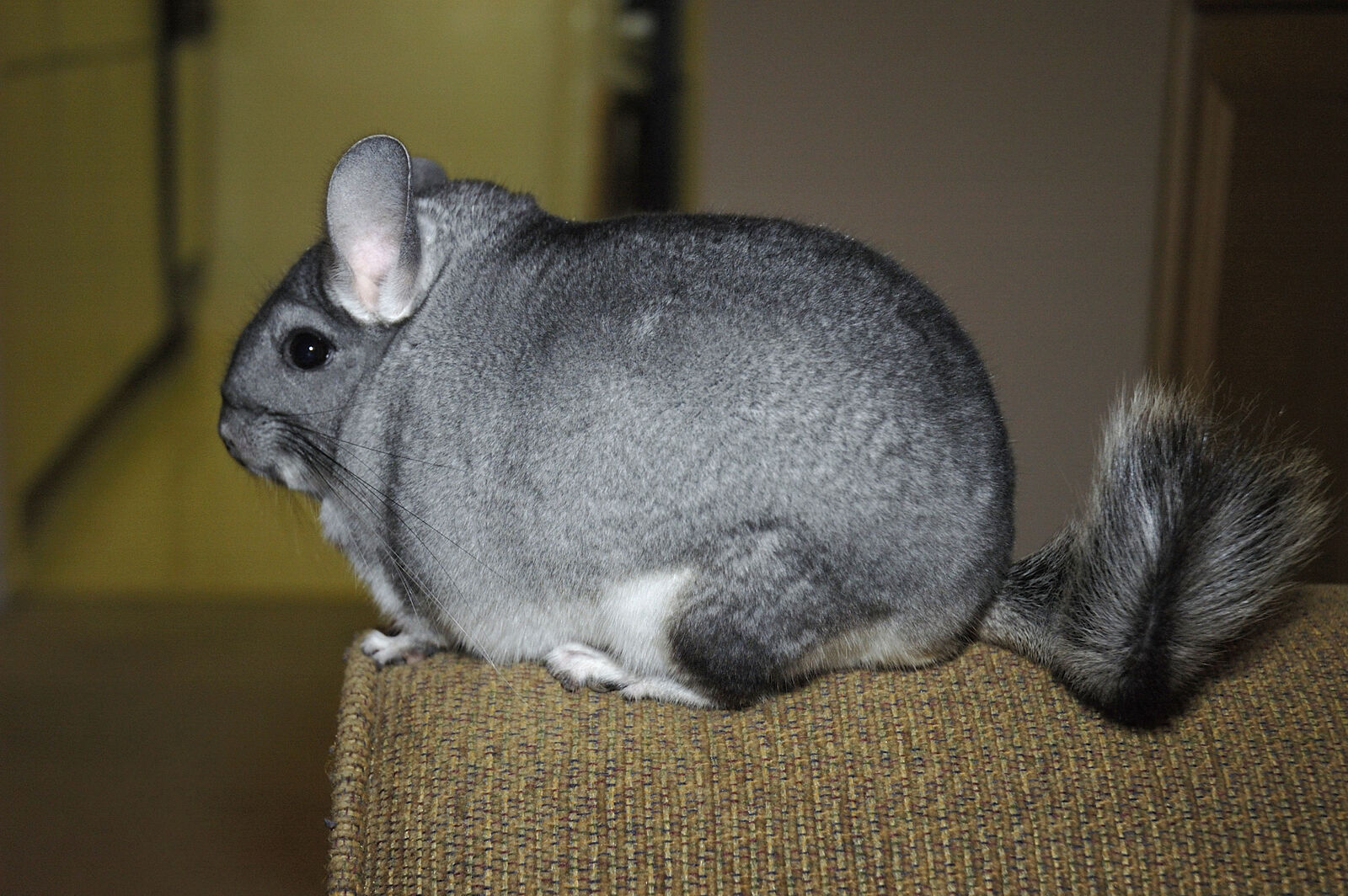
Chinchillas are active, acrobatic rodents from the high Andes with incredibly dense fur. They overheat easily and need dust baths instead of water baths.
Care at a glance
Species-specific values
Values researched for this exact species. Where they differ from the group guide below, follow these. Air, surface and water temperatures are listed separately, and each source is kept as published rather than averaged.
| Lifespan typical captive | 4–15 years Pet-rodent table; not maximum longevity | 291 |
| Adult body mass male | 400–500 g | 291 |
| Adult body mass female | 400–600 g | 291 |
| Diet | Grass hay is the main diet; supplement with species-specific pellets. | 125 |
| Air temperature adapted range | 65–80 °F Source describes adapted range, NOT a recommended upper setpoint; heat risk rises with humidity | 125 |
| Dust bath frequency | 2–3 per week Remove dirty dust after short sessions | 125 |
Warnings
Care guide
Housing
- Tall, multi-level wire cage; UK welfare guidance cited here recommends at least 2 × 2 × 1 m (about 6.5 × 6.5 × 3.3 ft), much larger than typical pet-store cages. Wheels must be at least 15 in (38 cm) across to protect the spine.
Sources 34
Diet
- Mostly hay, plus chinchilla pellets; domesticated chinchillas eat hay, alfalfa and commercial pellets.
Health
- Heatstroke is a real danger in summer; keep them under 77°F (25°C).
Sources 34
Show the group care guide for chinchillas and viscachas
Chinchillas and viscachas
Applies to most species in this group. Habitat: High Andes and pampas. Individual species can differ, so compare with the species numbers above and the linked sources.
Housing & setup
- Tall, multi-level wire cages with solid shelves; cool rooms (below about 75 °F).
- Dust baths several times a week, never water baths.
Diet
- Grass hay, chinchilla pellets and very limited treats.
Health watch
- Pet chinchillas are heat-sensitive; risk also depends on humidity. Fur-slip and dental disease require appropriate handling and diet.
Understanding the animal
In the wild
In the wild
Researched for this exact species, not its family. Good care copies these conditions.123
| Where it lives | Arid, rugged slopes of north-central Chile's transverse mountain ranges, documented at roughly 400–1,650 m. It shelters among rocks and within large Puya bromeliads amid sparse thorn scrub and grasses. |
| Ground it lives on | Rocky or sandy slopes with crevices, sparse shrubs and bromeliad cover. |
| Climate | Semiarid conditions with a prolonged October–April dry season and most rainfall in May–August. A verified numerical wild temperature or relative-humidity range was not found in the species monograph. |
| Active | Primarily nocturnal with crepuscular peaks; active throughout the year. |
| Social life | Lives in colonies, often around 100 animals; individual aggression can still occur. |
| Wild diet | Herbs and grasses from up to 24 plant species, prominently Nassella chilensis and Stipa plumosa; succulents become important in summer. |
| Behavior to plan for | Moves across rocks with rapid jumps and uses sheltered crevices. Dust-bathing maintains its exceptionally dense fur. |
What this means for care
- Provide stable jumping ledges and several enclosed retreats.
- Offer suitable chinchilla dust baths and dry bedding.
- Use fibrous plant-based feeding rather than rich fruit-heavy diets.
- Keep compatible companions with room to separate; colony living does not guarantee compatibility.
Native climate (measured)
Native climate (measured)
| Warm-season highs | about 83°F (up to 91°F in the hottest sampled areas) |
| Cool-season lows | about 33°F (down to 15°F in the coldest sampled areas) |
| Average temperature | 48–64°F across sampled records |
| Relative humidity | 58–72% on average (driest month about 56%) |
| Rainfall | about 670 mm a year |
| Winters | Cool to cold winters (lows around 33°F) in much of its native range. Seasonal slowdown may be relevant, but species-specific biology determines whether brumation or hibernation occurs. |
Measured at 29 wild occurrence records sampled against WorldClim 2.1 climate data (1970–2000 averages). Air conditions in the range are ecological context, not enclosure settings: microhabitats such as burrows, leaf litter or basking rocks can be cooler, warmer or more humid.
Profile
Profile
Researched for this exact species. Sources are listed under In the wild above.
History
Chinchilla lanigera is currently restricted in the wild to the mountains of northern Chile. Domesticated individuals can live substantially longer than the roughly 10-year lifespan reported for wild animals.
Keeper tips
- Provide access to secure hiding or denning spaces because wild chinchillas use rock crevices and holes.
- Keep in mind that the species comes from barren, arid mountain habitat rather than humid forest.
- Account for the animal's extremely dense and soft fur when evaluating its physical condition.
- Females are naturally larger than males, so some sex-related size difference is normal.
Behaviors reported
- Dens in crevices and holes among rocks.
Unique adaptations
- Extremely dense, soft fur, with as many as 60 hairs growing from one follicle.
- Large external ears.
- Large black eyes with vertically split pupils.
- Both forefeet and hindfeet have four digits with stiff bristles surrounding weak claws.
Remarkable facts
- The species is currently found only in the mountains of northern Chile.
- Females may weigh up to about 800 grams, while males weigh about 500 grams.
- Head-and-body length is about 225 to 380 millimeters, with a tail averaging 75 to 150 millimeters.
- Wild lifespan is roughly 10 years, while some domesticated chinchillas have lived for more than 20 years.
- Young are precocial, being fully furred and having their eyes open at birth.
From the sources
From the sources
Quoted from the matching sections of reputable sources for this exact species. Specialist databases are used first; Wikipedia (community-edited, CC BY-SA 4.0) only fills gaps. Other sources are short credited quotes.
| Overview | The long-tailed chinchilla (Chinchilla laniger), also called the Chilean, coastal, common, or lesser chinchilla, is one of two species of rodent from the genus Chinchilla: the other species being C. chinchilla. Both species are endangered in the wild after historically being hunted for their soft hair coats. Domestic breeds of chinchilla are believed to descend from specimens of C. lanigera. Domestic chinchillas come in three types: la plata, costina, and raton. — Wikipedia (community-edited) |
| Where it lives | Chinchilla lanigera is found in the barren, arid areas of mountains at elevations of 3,000-5,000 meters. — Animal Diversity Web |
| Wild diet | Long-tailed chinchillas are primarily folivorous, feeding on many types of vegetation, but primarily on grass and seeds. — Animal Diversity Web |
| Behavior | Female chinchillas are the dominant sex and are very aggresive toward one another and toward males during estrus. — Animal Diversity Web |
| Reproduction | Female chinchillas are mostly monogamous. — Animal Diversity Web |
| Appearance and size | Chinchilla lanigera has a head and body length of 225-380 mm, and a tail averaging 75-150 mm. — Animal Diversity Web |
| Conservation | IUCN lists Chinchilla lanigera as vulnerable. — Animal Diversity Web |
Data and studies
Researched care notes
Researched care notes
Findings checked against veterinary, zoo, welfare, keeper and peer-reviewed sources. Air, basking-surface and water temperatures are kept separate, and where sources disagree both are shown. “Study” notes report what a paper measured, not a universal rule.
Chinchilla (group)
Researched for this genus; applies to its species unless a species note says otherwise.
- Grass hay is the principal food, with suitable chinchilla pellets rather than an energy-dense mixed ration.1
- Caecotrophy is part of normal feeding physiology. Biological fact.1
- RSPCA describes cool, dry, well-ventilated housing and gives 10–18°C as its preferred indoor-air range. A multi-source numerical optimum was not established here. Confidence: LOW.2
- Provide suitable jumping/resting structures, nest boxes, and hiding places.2
- Offer suitable clean chinchilla dust and remove or clean the bath after use to limit soiling.2
The numbers
The numbers
Each bar is what one source reports. Where several sources weigh in, the dashed gold band marks their average.
Lifespan in care
Room temperature
Heat stress begins around 78°F (26°C).
Maximum recorded lifespan
Longest recorded lifespan reported by each database; typical lifespans are usually shorter. The AnAge record comes from an animal in human care.
Typical adult weight
Average adult body mass in each database (FishBase gives the maximum recorded weight).
Veterinary & husbandry research
Veterinary & husbandry research
- Reproductive performance and weaning success in fur-chewing chinchillas (Chinchilla lanigera) Galeano MG et al., Reproductive biology 2014
- Urinalysis in chinchillas (Chinchilla lanigera) Doss GA et al., Journal of the American Veterinary Medical Association 2016
- Update on Diseases in Chinchillas: 2013-2019 Martel A et al., The veterinary clinics of North America. Exotic animal practice 2020
- Survey of Hymenolepis spp. in pet rodents in Italy d'Ovidio D et al., Parasitology research 2015
Peer-reviewed papers that mention this species alongside captivity, zoos, veterinary care or aquaculture. Some cover several species or mention it only in passing, so check the abstract. See all 41 on PubMed → 170
Sources for this sheet
- Royal Veterinary College Exotics Service: Chinchilla care Zoo, university or veterinaryVet-school exotics hospital factsheet, reviewed 2021–2024.
- Animal Diversity Web (University of Michigan): Chinchilla lanigera Zoo, university or veterinaryUniversity-hosted species account, mostly wild biology.
- AnAge: The Animal Ageing and Longevity Database (Human Ageing Genomic Resources) Peer-reviewed researchCurated, referenced longevity and life-history records for thousands of species; maximum lifespans are often from zoo animals.
- Myhrvold et al. (2015). An amniote life-history database. Ecology 96: 3109 Peer-reviewed researchPeer-reviewed compilation of life-history data for over 21,000 birds, mammals and reptiles.
- Species+ (UNEP-WCMC and the CITES Secretariat) Zoo, university or veterinaryThe official database of species listed under CITES.
- USFWS International Affairs: CITES Zoo, university or veterinaryFederal agency that issues CITES permits.
- 9 CFR 2.1: Animal Welfare Act licensing (USDA) Zoo, university or veterinaryWho needs a USDA license to breed, sell or exhibit animals.
- Merck Veterinary Manual: Chinchillas Zoo, university or veterinaryThe Merck Veterinary Manual: a standard veterinary reference written and reviewed by veterinary specialists.
- Clint's Reptiles (YouTube): Chinchilla, The Best Pet Mammal? Expert educator & keeperClint Laidlaw, PhD in Biology Education and MS in Evolutionary Ecology; owner of Clint's Reptile Room and a longtime keeper. His "Best Pet?" series reviews each species' care in depth.
- GBIF Backbone Taxonomy (Global Biodiversity Information Facility) Peer-reviewed researchInternational scientific taxonomy used here for classification.
- Wikipedia (species article) Community referenceFree encyclopedia; useful overviews with their own citations. Intro text is quoted under CC BY-SA 4.0.
- PubMed (U.S. National Library of Medicine) Peer-reviewed researchIndex of peer-reviewed veterinary, zoo and husbandry research.
- iNaturalist (captive observations) Community referenceCommunity observation platform run by the California Academy of Sciences and National Geographic; observations marked captive show animals living in homes, zoos and aquariums.