Home / Mammals / Monkeys, lemurs and apes / White-faced capuchin
Federal restrictions apply In-depth sheetWhite-faced capuchin
Cebus capucinus
Mammals › Monkeys, lemurs and apes (Primates) › Cebidae (Capuchins and squirrel monkeys)
Capuchins are highly intelligent, social primates that can live 45 years or more in captivity. Their needs and legal hurdles are serious.
Warnings
Care guide
Diet
- About 50–80% fruit, 20–30% animal food and 10% other plants.
Sources 77
Behavior
- Problem-solvers that love taking things apart; need vertical space and constant enrichment.
Sources 77
Show the group care guide for capuchins and squirrel monkeys
Capuchins and squirrel monkeys
Applies to most species in this group. Habitat: Capuchins and squirrel monkeys inhabit Central and South American forests, using complex arboreal routes to forage and travel. Individual species can differ, so compare with the species numbers above and the linked sources.
Housing & setup
- For about 10 breeding capuchins, EAZA recommends at least 40 m² indoors and 3 m height; a group of 10–15 needs at least three indoor compartments.
- For 10–15 capuchins, provide at least two outdoor enclosures totaling at least 10 m² per individual and 4.5 m height.
- Provide branching travel routes, ropes, elevated resting positions, visual screens and foraging substrate; squirrel monkeys also need abundant climbing and hiding opportunities.
- Provide separate accommodation for evicted group members and secure transfer compartments.
- Distribute feeding and puzzle opportunities so subordinate animals can obtain their complete ration.
Climate & lighting
| Indoor minimum | 64.4–68°F or warmer |
- UVB: EAZA recommends daylight/UV access for capuchins, with dietary vitamin D3 provision reviewed by the nutritionist; lighting alone should not be assumed adequate.
Diet
- A complete New World primate feed with appropriate vitamin C and D3 provision.
- Vegetables such as bell pepper, carrot and sweet potato.
- Gut-loaded insects for capuchins, delivered through foraging enrichment.
- Small quantities of in-shell nuts for capuchins; restrict sweet fruit and other high-calorie rewards.
Social life
- Maintain stable conspecific social groups with professionally managed introductions. Saimiri sciureus and S. boliviensis differ in social organization; mixed capuchin–squirrel monkey exhibits require expert assessment.
Handling
- Train voluntary crate entry and veterinary cooperation; reserve physical restraint for trained staff.
Health watch
- Obesity and associated diabetes in capuchins.
- Dental disease with sugary diets.
- Bloat in squirrel monkeys.
- Aggression-related injuries.
Understanding the animal
In the wild
In the wild
Researched for this exact species, not its family. Good care copies these conditions.123
| Where it lives | Colombian populations occupy both tropical dry forest fragments in Montes de María and wet forest on Gorgona Island. Gorgona animals chiefly use canopy and subcanopy but also descend to the ground; this account excludes Central American C. imitator. |
| Ground it lives on | Mostly arboreal; also uses the forest floor. |
| Climate | Tropical. The species is common in areas of high humidity, but the source provides no specific temperature or humidity values or seasonal temperature ranges. |
| Active | Diurnal. |
| Social life | Mixed-sex groups; observed groups contained 12–25 animals on Gorgona, while Montes de María groups averaged about 10.5. |
| Wild diet | Gorgona field observations recorded fruit, flowers and invertebrates. |
| Behavior to plan for | Uses several forest strata and moves through canopy and subcanopy while foraging. |
What this means for care
- Provide extensive connected climbing routes plus ground access.
- Plan for compatible social groups rather than solitary housing.
- Distribute fruit, floral and invertebrate-style foraging tasks through multiple heights.
Native climate (measured)
Native climate (measured)
| Warm-season highs | about 88°F (up to 90°F in the hottest sampled areas) |
| Cool-season lows | about 72°F (down to 66°F in the coldest sampled areas) |
| Average temperature | 75–81°F across sampled records |
| Relative humidity | 82–84% on average (driest month about 76%) |
| Rainfall | about 2454 mm a year |
Measured at 90 wild occurrence records sampled against WorldClim 2.1 climate data (1970–2000 averages). Air conditions in the range are ecological context, not enclosure settings: microhabitats such as burrows, leaf litter or basking rocks can be cooler, warmer or more humid.
Profile
Profile
Researched for this exact species. Sources are listed under In the wild above.
History
Its broad distribution and ability to occupy wet, dry, primary, and secondary forests make it one of the more geographically widespread New World monkeys.
Keeper tips
- Provide extensive vertical and elevated climbing opportunities.
- Include structures that allow quadrupedal travel as well as jumping between supports.
- Provide supports that can be grasped with the prehensile tail.
- Design the environment around the species' use of forest middle strata rather than only floor space.
- Consider its natural association with humid tropical forests when designing environmental conditions.
Behaviors reported
- Uses a prehensile tail for grasping.
- Uses the tail to carry food.
- Uses the tail for added postural support.
- Is an excellent climber and leaper.
- Moves primarily quadrupedally.
Unique adaptations
- A prehensile tail provides grasping ability and postural support.
- Strong climbing and leaping ability supports movement through forest habitats.
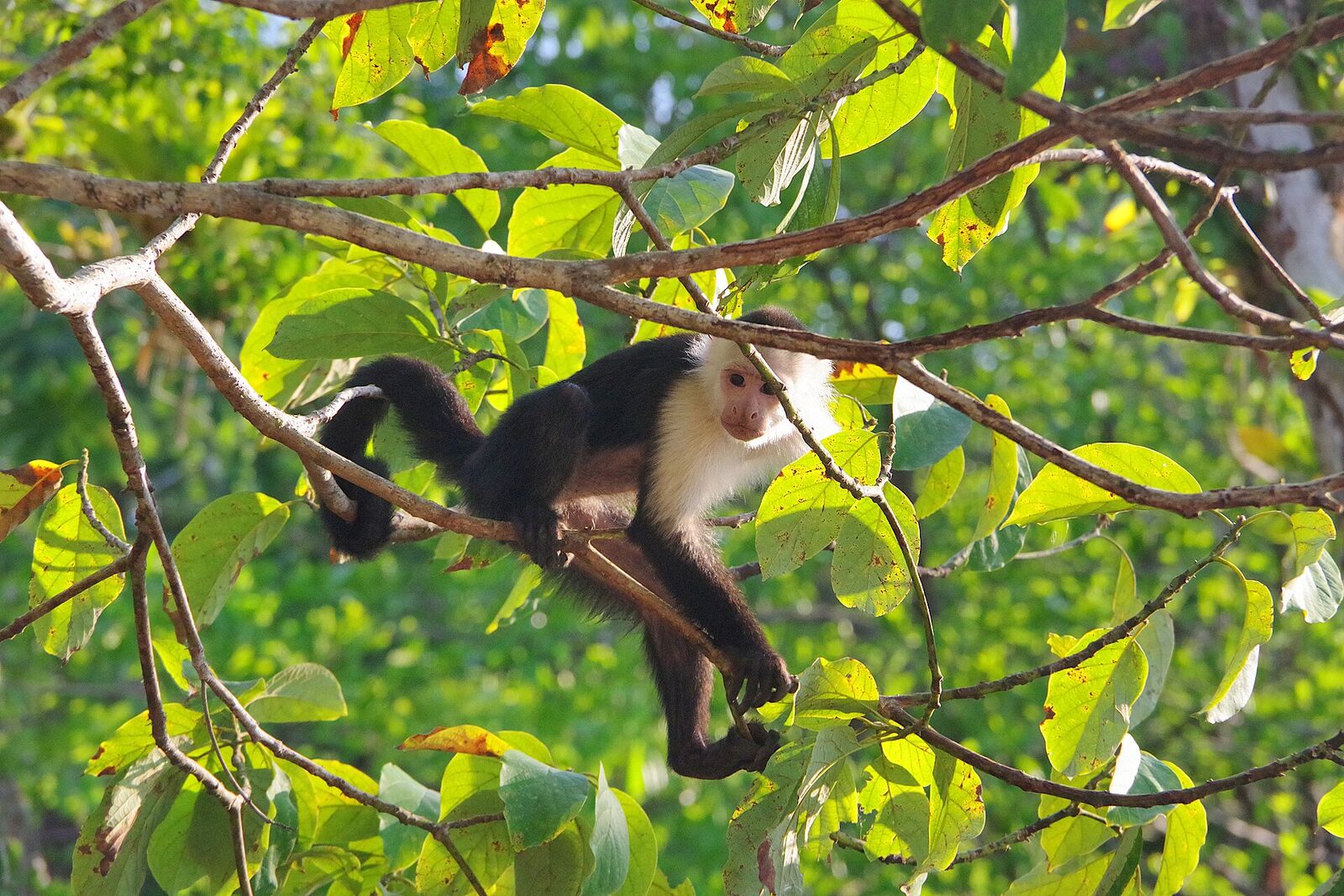
- Distinctive black-and-white coloration includes black dorsum and hindquarters with white upper chest, forearms, and facial fur.
Remarkable facts
- It occurs from sea level to about 2100 m, with an average reported elevation of about 1100 m.
- Males weigh about 3-4 kg and females about 2-3 kg.
- It reaches full adult size by about eight years of age.
- The source describes its sexual size difference as the greatest degree of sexual dimorphism among capuchins.
From the sources
From the sources
Quoted from the matching sections of reputable sources for this exact species. Specialist databases are used first; Wikipedia (community-edited, CC BY-SA 4.0) only fills gaps. Other sources are short credited quotes.
| Overview | The Colombian white-faced capuchin (Cebus capucinus), also known as the Colombian white-headed capuchin or Colombian white-throated capuchin, is a medium-sized New World monkey of the family Cebidae, subfamily Cebinae. It is native to the extreme eastern portion of Panama and the extreme north-western portion of South America in western Colombia and northwestern Ecuador. The Colombian white-faced capuchin was one of the many species originally described by Carl Linnaeus in his landmark 1758 10th edition of Systema Naturae. — Wikipedia (community-edited) |
| Where it lives | White-faced capuchins are highly adaptable and occupy a wide range of habitats. — Animal Diversity Web |
| Social life and communication | White-faced capuchins are highly social and communication is very important. — Animal Diversity Web |
| Wild diet | White-faced capuchins eat a wide variety of plants and animals. — Animal Diversity Web |
| Behavior | White-faced capuchins are highly social and live in multi male - multi female groups of 18 to 20. — Animal Diversity Web |
| Reproduction | White-faced capuchins are polygamous, with males and females having multiple partners. — Animal Diversity Web |
| Lifespan | White-faced capuchin maximum lifespan in captivity is 55 years. — Animal Diversity Web |
| Appearance and size | White-faced capuchins have distinctive markings that distinguish them from other capuchin monkeys. — Animal Diversity Web |
| History and naming | Until the 21st century, the Panamanian white-faced capuchin, Cebus imitator, was considered conspecific with the Colombian white-faced capuchin, as the subspecies C. capucinus imitator. Some primatologists continue to consider the Panamanian and Colombian white-faced capuchins as a single species. — Wikipedia (community-edited) |
| Conservation | C. c. capucinus has been listed as vulnerable from a conservation standpoint by the IUCN, while C. c. curtus has been listed as vulnerable. — Wikipedia (community-edited) |
Data and studies
The numbers
The numbers
Each bar is what one source reports. Where several sources weigh in, the dashed gold band marks their average.
Lifespan in care
Maximum recorded lifespan
Longest recorded lifespan reported by each database; typical lifespans are usually shorter. The AnAge record comes from an animal in human care.
Typical adult weight
Average adult body mass in each database (FishBase gives the maximum recorded weight).
Veterinary & husbandry research
Veterinary & husbandry research
- Divergent personality structures of brown (Sapajus apella) and white-faced capuchins (Cebus capucinus) Robinson LM et al., Journal of comparative psychology (Washington, D.C.: 1983) 2016
- Trichromacy increases fruit intake rates of wild capuchins (Cebus capucinus imitator) Melin AD et al., Proceedings of the National Academy of Sciences of the United States of America 2017
- Object-use in free-ranging white-faced capuchins (Cebus capucinus) in Costa Rica Panger MA et al., American journal of physical anthropology 1998
- ZOO-FISH suggests a complete homology between human and capuchin monkey (Platyrrhini) euchromatin Richard F et al., Genomics 1996
Peer-reviewed papers that mention this species alongside captivity, zoos, veterinary care or aquaculture. Some cover several species or mention it only in passing, so check the abstract. See all 15 on PubMed → 170
Sources for this sheet
- Animal Diversity Web (University of Michigan): Cebus capucinus Zoo, university or veterinaryUniversity-hosted species account, mostly wild biology.
- AnAge: The Animal Ageing and Longevity Database (Human Ageing Genomic Resources) Peer-reviewed researchCurated, referenced longevity and life-history records for thousands of species; maximum lifespans are often from zoo animals.
- Myhrvold et al. (2015). An amniote life-history database. Ecology 96: 3109 Peer-reviewed researchPeer-reviewed compilation of life-history data for over 21,000 birds, mammals and reptiles.
- CDC: Bringing an animal into the United States Zoo, university or veterinaryFederal rules on importing animals that can carry human disease.
- Species+ (UNEP-WCMC and the CITES Secretariat) Zoo, university or veterinaryThe official database of species listed under CITES.
- USFWS International Affairs: CITES Zoo, university or veterinaryFederal agency that issues CITES permits.
- 9 CFR 2.1: Animal Welfare Act licensing (USDA) Zoo, university or veterinaryWho needs a USDA license to breed, sell or exhibit animals.
- Souvignet et al.: EAZA Best Practice Guidelines for Capuchin Monkeys (2019), accessible text mirror Zoo, university or veterinaryAdded in the 2026 source-checked care-guide review.
- Schuler and Abee: Enrichment for Nonhuman Primates—Squirrel Monkeys (Saimiri), NIH (2005) Experienced keeper or breederAdded in the 2026 source-checked care-guide review.
- GBIF Backbone Taxonomy (Global Biodiversity Information Facility) Peer-reviewed researchInternational scientific taxonomy used here for classification.
- Wikipedia (species article) Community referenceFree encyclopedia; useful overviews with their own citations. Intro text is quoted under CC BY-SA 4.0.
- PubMed (U.S. National Library of Medicine) Peer-reviewed researchIndex of peer-reviewed veterinary, zoo and husbandry research.
- iNaturalist (captive observations) Community referenceCommunity observation platform run by the California Academy of Sciences and National Geographic; observations marked captive show animals living in homes, zoos and aquariums.