Home / Birds / Songbirds and perching birds / Domestic canary
No federal permit to keep In-depth sheetDomestic canary
Serinus canaria
Birds › Songbirds and perching birds (Passeriformes) › Fringillidae (Finches and canaries)
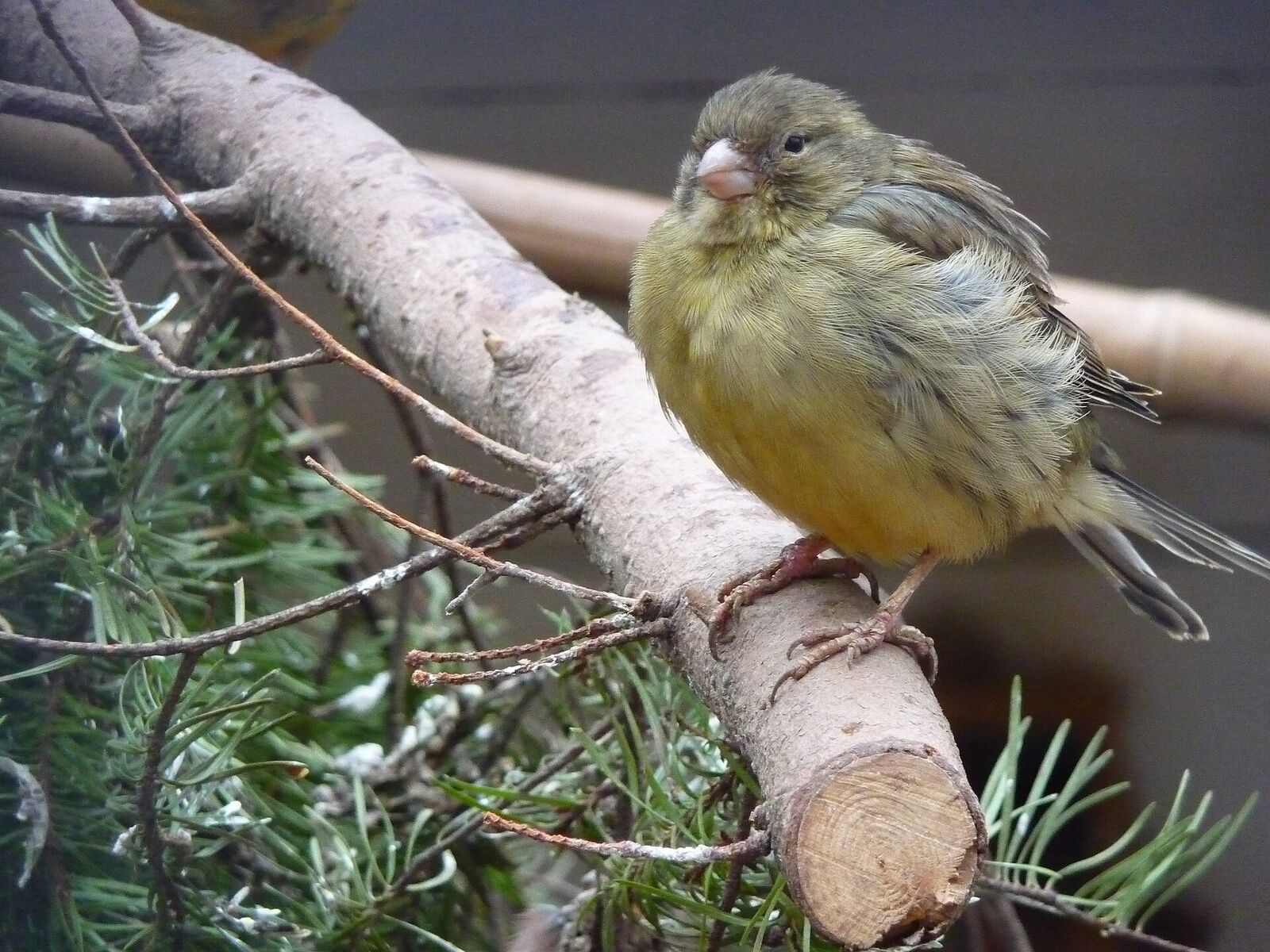
Canaries have been bred since at least the 1400s for song and color. They prefer to be watched and heard rather than handled.
Care at a glance
Species-specific values
Values researched for this exact species. Where they differ from the group guide below, follow these. Air, surface and water temperatures are listed separately, and each source is kept as published rather than averaged.
| Diet | Balanced canary pellets or pellet-based mash, with appropriately planned supplements and fresh foods; seed alone is deficient. | 318 |
| Diet pellet fraction | 75–80 % VCA recommendation; source does not specify weight or offered-food basis. | 325 |
| Diet fresh produce fraction | 20–25 % Approximate VCA recommendation, not a separately additive exact recipe. | 325 |
| Digestive grit | Do not offer insoluble grit or gravel; canaries remove seed hulls. | 325 |
| Diet crude protein | 18–22 % Formulated breeding diets described by MSD; not an adult-maintenance target. | 318 |
| Diet fat | 5–8 % Formulated breeding diets described by MSD; percentage basis not specified. | 318 |
Care guide
Care
- Roomy flight cage or aviary, cleaned regularly with a bird-safe disinfectant.
Sources 32
Show the group care guide for canaries and true finches
Canaries and true finches
Applies to most species in this group. Habitat: Woodland and scrub. Individual species can differ, so compare with the species numbers above and the linked sources.
Housing & setup
- Long flight cages; canaries are traditionally kept singly (males sing best alone) or in aviaries.
- Bath water daily.
Diet
- For pet canaries, use a nutritionally balanced formulated diet or an avian-veterinarian-designed seed ration; greens and egg food alone do not correct every seed-mixture deficiency.
Health watch
- Mites, respiratory infections and feather cysts.
Understanding the animal
In the wild
In the wild
Researched for this exact species, not its family. Good care copies these conditions.1
| Where it lives | Wild Atlantic canaries occur in the Canary Islands, Madeira and Azores; wooded edges, scrub, orchards and gardens provide feeding and nesting sites. Recorded from sea level to approximately 6,560 feet. |
| Ground it lives on | branches and shrubs; also low vegetation and seed-bearing plants |
| Social life | Pairs nest near other pairs with limited territoriality; adults and young form wandering flocks after breeding. |
| Wild diet | Primarily seeds, shoots and buds, with smaller amounts of insects. |
| Behavior to plan for | Builds cup nests on outer tree or shrub branches. Post-breeding flocks move through wooded and open feeding areas. |
What this means for care
- Provide horizontal flight room and varied perching heights.
- Offer greens and seed-bearing vegetation alongside balanced nutrition.
- Monitor domestic birds for compatibility despite wild flocking.
Native climate (measured)
Native climate (measured)
| Warm-season highs | about 77°F (up to 84°F in the hottest sampled areas) |
| Cool-season lows | about 53°F (down to 48°F in the coldest sampled areas) |
| Average temperature | 60–68°F across sampled records |
| Relative humidity | 65–71% on average (driest month about 62%) |
| Rainfall | about 369 mm a year |
Measured at 127 wild occurrence records sampled against WorldClim 2.1 climate data (1970–2000 averages). Air conditions in the range are ecological context, not enclosure settings: microhabitats such as burrows, leaf litter or basking rocks can be cooler, warmer or more humid.
From the sources
From the sources
Quoted from the matching sections of reputable sources for this exact species. Specialist databases are used first; Wikipedia (community-edited, CC BY-SA 4.0) only fills gaps. Other sources are short credited quotes.
| Overview | The Atlantic canary (Serinus canaria), known worldwide simply as the wild canary and also called the island canary, common canary, or canary, is a small passerine bird belonging to the genus Serinus in the true finch family, Fringillidae. It is native to the Canary Islands, the Azores, and Madeira. Wild birds are mostly yellow-green, with brownish streaking on the back. The species is common in captivity and a number of colour varieties have been bred. — Wikipedia (community-edited) |
| Where it lives | It is endemic to the Canary Islands, Azores and Madeira in the region known as Macaronesia in the eastern Atlantic Ocean. In the Canary Islands, it is common on Tenerife, La Gomera, La Palma and El Hierro, but more local on Gran Canaria, and rare on Lanzarote and Fuerteventura, where it has only recently begun breeding. — Wikipedia (community-edited) |
| Wild diet | It typically feeds in flocks, foraging on the ground or amongst low vegetation. It mainly feeds on seeds such as those of weeds, grasses and figs. It also feeds on other plant material and small insects. — Wikipedia (community-edited) |
| Reproduction | It is a gregarious bird which often nests in groups with each pair defending a small territory. The cup-shaped nest is built 1–6 m above the ground in a tree or bush, most commonly at 3–4 m. It is well-hidden amongst leaves, often at the end of a branch or in a fork. — Wikipedia (community-edited) |
| Appearance and size | The Atlantic canary can range from 10 to 12 cm in length, with a wingspan of 21 to 23.7 cm and a weight of 8.4 to 24.3 g, with an average of around 15 g. The male has a largely yellow-green head and underparts with a yellower forehead, face and supercilium. The lower belly and undertail-coverts are whitish and there are some dark streaks on the sides. — Wikipedia (community-edited) |
| History and naming | The Atlantic canary was formally described in 1758 by the Swedish naturalist Carl Linnaeus in the tenth edition of his Systema Naturae. He placed it with the finches in the genus Fringilla and coined the binomial name Fringilla canaria. In 1555 the Swiss naturalist Conrad Gessner had used the Latin name Canaria for the species in his book Historia animalium. — Wikipedia (community-edited) |
Data and studies
Researched care notes
Researched care notes
Findings checked against veterinary, zoo, welfare, keeper and peer-reviewed sources. Air, basking-surface and water temperatures are kept separate, and where sources disagree both are shown. “Study” notes report what a paper measured, not a universal rule.
Canary
- An all-seed diet is nutritionally incomplete; VCA recommends a balanced canary-formulated diet with limited seed and suitable fresh greens.1
- Provide flight space and securely spaced bars; PetMD gives a maximum bar gap of 3/8 inch, approximately 9.5 mm.2
- Male canaries may fight when housed together; monitor any proposed pair or group and retain the ability to separate incompatible birds.2
- Provide varied perch sizes and textures, avoiding abrasive sandpaper or gravel coatings and positioning perches away from food and water below.2
- Provide a clean bathing opportunity and wash food and water dishes daily.2
The numbers
The numbers
Each bar is what one source reports. Where several sources weigh in, the dashed gold band marks their average.
Maximum recorded lifespan
Longest recorded lifespan reported by each database; typical lifespans are usually shorter. The AnAge record comes from an animal in human care.
Typical adult weight
Average adult body mass in each database (FishBase gives the maximum recorded weight).
Incubation
Veterinary & husbandry research
Veterinary & husbandry research
- Domestic canaries (Serinus canaria forma domestica) are susceptible to low pathogenic avian influenza virus infections Marché S et al., Avian pathology: journal of the W.V.P.A 2018
- Sex differences in seasonal brain plasticity and the neuroendocrine regulation of vocal behavior in songbirds Rose EM et al., Hormones and behavior 2022
- Detection and molecular characterization of Cryptosporidium spp. in captive canaries (Serinus canaria) using different diagnostic methods Camargo VDS et al., Revista brasileira de parasitologia veterinaria = Brazilian journal of veterinary parasitology: Orgao Oficial do Colegio Brasileiro de Parasitologia Veterinaria 2018
- Does reproduction protect against oxidative stress? Costantini D et al., The Journal of experimental biology 2014
Peer-reviewed papers that mention this species alongside captivity, zoos, veterinary care or aquaculture. Some cover several species or mention it only in passing, so check the abstract. See all 35 on PubMed → 170
Sources for this sheet
- Royal Veterinary College Exotics Service: Canary care Zoo, university or veterinaryVet-school exotics hospital factsheet, reviewed 2021–2024.
- AnAge: The Animal Ageing and Longevity Database (Human Ageing Genomic Resources) Peer-reviewed researchCurated, referenced longevity and life-history records for thousands of species; maximum lifespans are often from zoo animals.
- Myhrvold et al. (2015). An amniote life-history database. Ecology 96: 3109 Peer-reviewed researchPeer-reviewed compilation of life-history data for over 21,000 birds, mammals and reptiles.
- Merck Veterinary Manual: Management of pet birds Zoo, university or veterinaryThe Merck Veterinary Manual: a standard veterinary reference written and reviewed by veterinary specialists.
- Merck Veterinary Manual: Nutritional diseases of pet birds Zoo, university or veterinaryThe Merck Veterinary Manual: a standard veterinary reference written and reviewed by veterinary specialists.
- MSD Veterinary Manual — Nutrition in Passerines (2025) Zoo, university or veterinaryAdded in the 2026 source-checked care-guide review.
- GBIF Backbone Taxonomy (Global Biodiversity Information Facility) Peer-reviewed researchInternational scientific taxonomy used here for classification.
- Wikipedia (species article) Community referenceFree encyclopedia; useful overviews with their own citations. Intro text is quoted under CC BY-SA 4.0.
- PubMed (U.S. National Library of Medicine) Peer-reviewed researchIndex of peer-reviewed veterinary, zoo and husbandry research.
- iNaturalist (captive observations) Community referenceCommunity observation platform run by the California Academy of Sciences and National Geographic; observations marked captive show animals living in homes, zoos and aquariums.